Breaking News! US Warship Struck by Iranian Missile Forces It to Return to Port, Hindering US Freedom Plan
2026-05-04 18:29:42
On Monday (May 4), spot gold continued to decline during the Asian and European sessions. The optimism of May 1 did not last long, and the price of gold almost gave back most of the recent rebound, currently trading around 4579.
On Monday evening (May 4), the United States will officially launch the "Freedom of Navigation Initiative" aimed at restarting shipping in the Strait of Hormuz. The initiative will deploy guided-missile destroyers, more than 100 combat aircraft, and 15,000 military personnel to establish an "enhanced security zone" south of the strait's regular shipping lanes, guide stranded vessels to change course, and coordinate closely with Omani authorities.
On a practical level, a U.S. warship ignored Iranian warnings today (May 4) and attempted to approach and enter the Strait of Hormuz. Iran fired two missiles at it, forcing the U.S. warship to return to port and leave the area.

As a key waterway for about one-fifth of the world's oil transportation, the Strait of Hormuz has been continuously blocked since the US and Israel launched the war on February 28. About 2,000 ships and 20,000 crew members are stranded. Some ships are facing shortages of drinking water and food. Seafarers have witnessed drones and missiles exploding in the airspace above the waters. Shipping costs and risk premiums have risen sharply.
The U.S. Central Command characterized the plan as a "humanitarian operation." President Trump had previously pledged on social media to ensure freedom of navigation for "neutral and non-conflicting countries." However, the Pentagon did not disclose specific details of the military deployment and did not clarify whether it would provide military escort for ships transiting the Iranian-controlled straits. This uncertainty has kept shipping companies and insurance companies on a cautious stance, with safe-haven funds flowing into traditional safe-haven assets such as gold and the Japanese yen.
The Joint Maritime Information Center also warned that conventional separation navigation channels pose an "extremely high safety risk" due to undetected and unresolved mine hazards, directly threatening the safety of shipping assets.
Iran has declared that it sees itself as the guardian and protector of the Strait of Hormuz, a vital waterway.
According to a report quoting Abdullahhi, a senior official at the Khatnam Anbia Central Headquarters of the Iranian Armed Forces, "We warn any foreign armed forces, especially the aggressive U.S. military, that they will be struck if they intend to approach or enter the Strait of Hormuz."
US President Trump posted on social media on the 3rd that the United States will begin a diversion operation on the morning of the 4th, local time in the Middle East, to "guide" ships trapped in the Strait of Hormuz to leave the strait.
On the same day, the Iranian military command made it clear through the state broadcaster IRIB that all passing vessels must be coordinated by Iran before they can pass. Major General Ali Abdullah, a pilot, solemnly warned: "Any foreign military forces that attempt to approach or enter the Strait of Hormuz—especially the US military, which pursues an aggressive policy—will become our precision strike targets."
At the same time, the Iranian Islamic Parliament announced that it would approve the "Strait of Hormuz Management Law," which asserts that sovereignty over the strait belongs entirely to Iran, implements a passage approval system and a tiered fee system, and requires ships from hostile countries to pay "war reparations" of $1.5 million to $2 million, with payments accepted only in RMB or cryptocurrency.
This move, which violates international law, has been met with unanimous opposition from the United States and Gulf states. The U.S. has explicitly warned shipping companies that paying related fees to Iran would result in sanctions.
Parallel to the military standoff is the continued stalemate in US-Iran peace talks.
Iran had previously submitted a 14-point proposal to the United States through its mediator Pakistan, demanding that the United States lift sanctions against Iran within 30 days, end the port blockade, withdraw its troops from the region, and cease all hostilities (including Israel's military operations in Lebanon). The core objective was to completely end the war rather than extend the ceasefire.
However, Iranian Foreign Ministry spokesman Esmail Bagheei made it clear that "there are no negotiations related to the nuclear issue at the current stage," advocating for prioritizing the resolution of other issues, which is significantly different from the core demands of the United States.
Trump publicly expressed his "dissatisfaction" with the proposal, saying he "cannot imagine it being acceptable," and the two sides have not yet started substantive negotiations.
The economic struggle is equally intense. The US naval blockade, which began on April 13, continues to cut off Iran's oil revenues, which are the lifeblood of its frail economy.
U.S. Treasury Secretary Scott Bessant revealed that Iran has only received less than $1.3 million through toll collection, a negligible amount compared to its pre-war daily oil revenue, and its oil reserves are rapidly approaching saturation, with some oil wells expected to be forced to shut down within the next week.
This situation has led to increased volatility in international oil prices, with Brent crude futures rising nearly 1% to $109.14 per barrel. OECD oil inventories are expected to hit their lowest operating levels in mid-to-late May, and the market is concerned that supply disruptions could trigger an exponential price surge, further impacting global energy trade and the real economy.
Continued inflationary pressures have caused the 2-10 year US Treasury yield to turn upward, and rising global financing costs have continued to increase the cost of holding gold, thus limiting the upward development of gold prices.
The launch of the U.S. "Freedom Project" marks the formal implementation of an attempt to restore shipping across the strait and rebuild confidence in navigation, but this move may also break the fragile ceasefire that was previously barely maintained.
Meanwhile, as of the morning of May 4, no merchant ships had confirmed accepting the US guidance proposal, and Iran's 14-point proposal was in sharp opposition to the US blockade and pressure.
The shipping deadlock in the Strait of Hormuz and the lack of hope for a breakthrough in US-Iran peace talks continue to bring strong uncertainty to the stability of global energy trade and foreign exchange and commodity markets. Currently, proposals aimed at ending the war and restoring pre-war shipping levels remain in the proposal review stage, and the international community's expectation for both sides to resolve the crisis through diplomatic means is becoming increasingly urgent.
Gold prices remain weak. The negative impact of previous central bank interest rate decisions, coupled with the positive impact of the sudden ceasefire on May Day, has failed to give gold a strong performance. It's worth noting that the US dollar index plummeted by nearly 100 points that day, while gold only rebounded by 1.75%.
Currently, the US and Iran are locked in a tense standoff. The US has provided a specific timetable, and the outcome of its implementation will serve as the best indicator of the geopolitical situation. Today, a US warship ignored Iranian warnings and attempted to approach and enter the Strait of Hormuz, prompting Iran to launch two missiles at it. The ship then turned back, which could easily trigger a renewed escalation of the geopolitical conflict.
The main factors currently constraining gold price increases remain rising oil prices due to geopolitical conflicts and global inflation. Central banks around the world need to take more hawkish measures to curb inflation, leading to a shift in the global interest rate center and raising the cost of holding gold.
From a technical perspective, spot gold held its downward channel on May 1st, boosted by the positive news of the US-Iran talks, but has since fallen sharply below the lower channel line. 4500 remains a key support level, and the overall trend for gold remains weak.
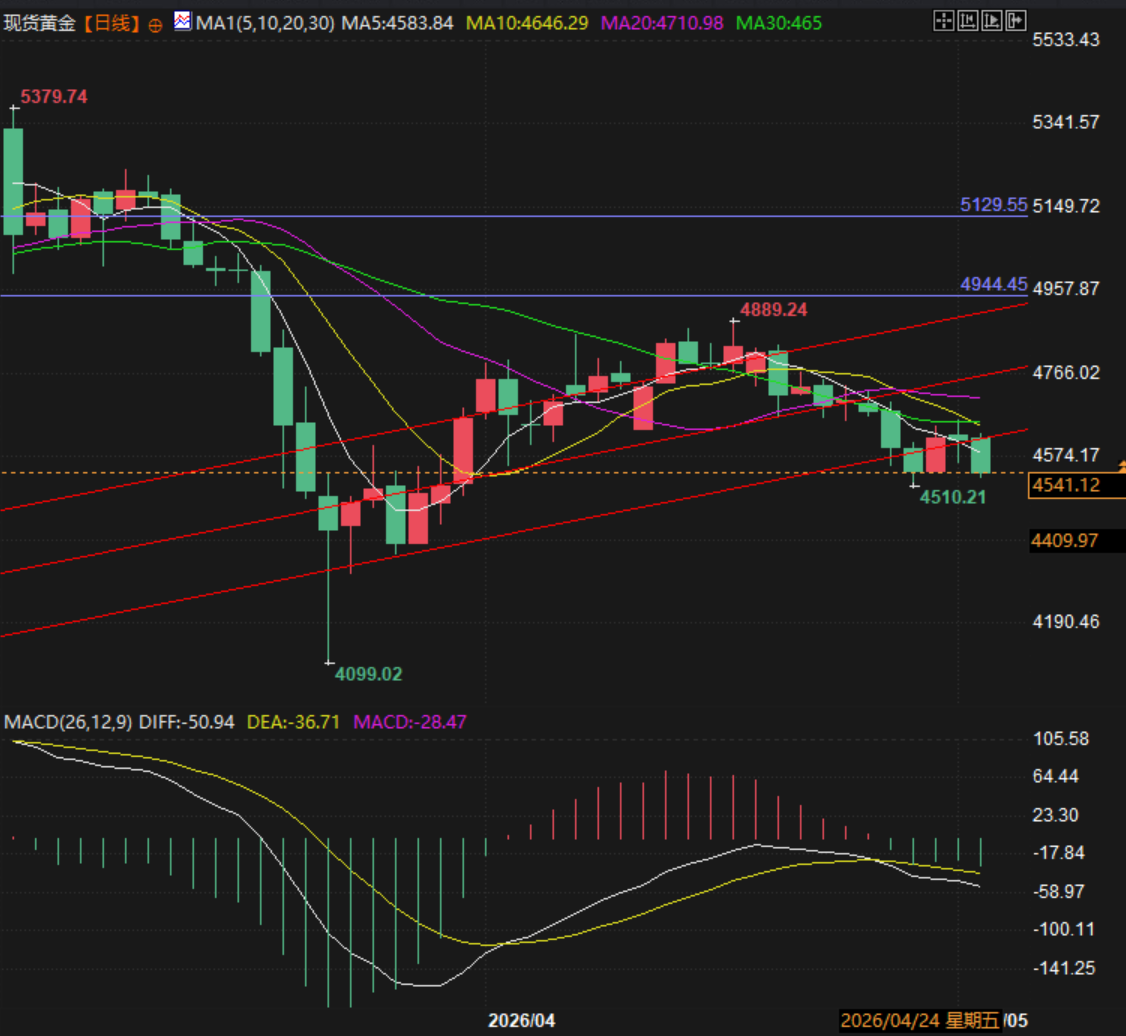
(Spot gold daily chart, source: EasyForex subsidiary)
At 18:27 Beijing time, spot gold was trading at $4,544 per ounce.
On Monday evening (May 4), the United States will officially launch the "Freedom of Navigation Initiative" aimed at restarting shipping in the Strait of Hormuz. The initiative will deploy guided-missile destroyers, more than 100 combat aircraft, and 15,000 military personnel to establish an "enhanced security zone" south of the strait's regular shipping lanes, guide stranded vessels to change course, and coordinate closely with Omani authorities.
On a practical level, a U.S. warship ignored Iranian warnings today (May 4) and attempted to approach and enter the Strait of Hormuz. Iran fired two missiles at it, forcing the U.S. warship to return to port and leave the area.
As a key waterway for about one-fifth of the world's oil transportation, the Strait of Hormuz has been continuously blocked since the US and Israel launched the war on February 28. About 2,000 ships and 20,000 crew members are stranded. Some ships are facing shortages of drinking water and food. Seafarers have witnessed drones and missiles exploding in the airspace above the waters. Shipping costs and risk premiums have risen sharply.
The U.S. Central Command characterized the plan as a "humanitarian operation." President Trump had previously pledged on social media to ensure freedom of navigation for "neutral and non-conflicting countries." However, the Pentagon did not disclose specific details of the military deployment and did not clarify whether it would provide military escort for ships transiting the Iranian-controlled straits. This uncertainty has kept shipping companies and insurance companies on a cautious stance, with safe-haven funds flowing into traditional safe-haven assets such as gold and the Japanese yen.
The Joint Maritime Information Center also warned that conventional separation navigation channels pose an "extremely high safety risk" due to undetected and unresolved mine hazards, directly threatening the safety of shipping assets.
Iran retaliates strongly: drawing red lines for passage, pushing for tolls and asserting sovereignty claims.
Iran has declared that it sees itself as the guardian and protector of the Strait of Hormuz, a vital waterway.
According to a report quoting Abdullahhi, a senior official at the Khatnam Anbia Central Headquarters of the Iranian Armed Forces, "We warn any foreign armed forces, especially the aggressive U.S. military, that they will be struck if they intend to approach or enter the Strait of Hormuz."
US President Trump posted on social media on the 3rd that the United States will begin a diversion operation on the morning of the 4th, local time in the Middle East, to "guide" ships trapped in the Strait of Hormuz to leave the strait.
On the same day, the Iranian military command made it clear through the state broadcaster IRIB that all passing vessels must be coordinated by Iran before they can pass. Major General Ali Abdullah, a pilot, solemnly warned: "Any foreign military forces that attempt to approach or enter the Strait of Hormuz—especially the US military, which pursues an aggressive policy—will become our precision strike targets."
At the same time, the Iranian Islamic Parliament announced that it would approve the "Strait of Hormuz Management Law," which asserts that sovereignty over the strait belongs entirely to Iran, implements a passage approval system and a tiered fee system, and requires ships from hostile countries to pay "war reparations" of $1.5 million to $2 million, with payments accepted only in RMB or cryptocurrency.
This move, which violates international law, has been met with unanimous opposition from the United States and Gulf states. The U.S. has explicitly warned shipping companies that paying related fees to Iran would result in sanctions.
Peace talks have reached a deadlock: significant disagreements remain over the 14-point proposal, and the nuclear issue is temporarily shelved.
Parallel to the military standoff is the continued stalemate in US-Iran peace talks.
Iran had previously submitted a 14-point proposal to the United States through its mediator Pakistan, demanding that the United States lift sanctions against Iran within 30 days, end the port blockade, withdraw its troops from the region, and cease all hostilities (including Israel's military operations in Lebanon). The core objective was to completely end the war rather than extend the ceasefire.
However, Iranian Foreign Ministry spokesman Esmail Bagheei made it clear that "there are no negotiations related to the nuclear issue at the current stage," advocating for prioritizing the resolution of other issues, which is significantly different from the core demands of the United States.
Trump publicly expressed his "dissatisfaction" with the proposal, saying he "cannot imagine it being acceptable," and the two sides have not yet started substantive negotiations.
Economic rivalry intensifies: Blockade squeezes Iranian revenue, oil price volatility raises global concerns.
The economic struggle is equally intense. The US naval blockade, which began on April 13, continues to cut off Iran's oil revenues, which are the lifeblood of its frail economy.
U.S. Treasury Secretary Scott Bessant revealed that Iran has only received less than $1.3 million through toll collection, a negligible amount compared to its pre-war daily oil revenue, and its oil reserves are rapidly approaching saturation, with some oil wells expected to be forced to shut down within the next week.
This situation has led to increased volatility in international oil prices, with Brent crude futures rising nearly 1% to $109.14 per barrel. OECD oil inventories are expected to hit their lowest operating levels in mid-to-late May, and the market is concerned that supply disruptions could trigger an exponential price surge, further impacting global energy trade and the real economy.
Continued inflationary pressures have caused the 2-10 year US Treasury yield to turn upward, and rising global financing costs have continued to increase the cost of holding gold, thus limiting the upward development of gold prices.
Summary and Technical Analysis:
The launch of the U.S. "Freedom Project" marks the formal implementation of an attempt to restore shipping across the strait and rebuild confidence in navigation, but this move may also break the fragile ceasefire that was previously barely maintained.
Meanwhile, as of the morning of May 4, no merchant ships had confirmed accepting the US guidance proposal, and Iran's 14-point proposal was in sharp opposition to the US blockade and pressure.
The shipping deadlock in the Strait of Hormuz and the lack of hope for a breakthrough in US-Iran peace talks continue to bring strong uncertainty to the stability of global energy trade and foreign exchange and commodity markets. Currently, proposals aimed at ending the war and restoring pre-war shipping levels remain in the proposal review stage, and the international community's expectation for both sides to resolve the crisis through diplomatic means is becoming increasingly urgent.
Gold prices remain weak. The negative impact of previous central bank interest rate decisions, coupled with the positive impact of the sudden ceasefire on May Day, has failed to give gold a strong performance. It's worth noting that the US dollar index plummeted by nearly 100 points that day, while gold only rebounded by 1.75%.
Currently, the US and Iran are locked in a tense standoff. The US has provided a specific timetable, and the outcome of its implementation will serve as the best indicator of the geopolitical situation. Today, a US warship ignored Iranian warnings and attempted to approach and enter the Strait of Hormuz, prompting Iran to launch two missiles at it. The ship then turned back, which could easily trigger a renewed escalation of the geopolitical conflict.
The main factors currently constraining gold price increases remain rising oil prices due to geopolitical conflicts and global inflation. Central banks around the world need to take more hawkish measures to curb inflation, leading to a shift in the global interest rate center and raising the cost of holding gold.
From a technical perspective, spot gold held its downward channel on May 1st, boosted by the positive news of the US-Iran talks, but has since fallen sharply below the lower channel line. 4500 remains a key support level, and the overall trend for gold remains weak.
(Spot gold daily chart, source: EasyForex subsidiary)
At 18:27 Beijing time, spot gold was trading at $4,544 per ounce.
- Risk Warning and Disclaimer
- The market involves risk, and trading may not be suitable for all investors. This article is for reference only and does not constitute personal investment advice, nor does it take into account certain users’ specific investment objectives, financial situation, or other needs. Any investment decisions made based on this information are at your own risk.