The strengthening of the yen raises the risk of central bank intervention in the USD/JPY exchange rate.
2026-05-04 18:57:39
On Monday (May 4th) during the European session, the USD/JPY pair experienced a typical rollercoaster ride: In the early Asian session, the pair steadily rose amid fluctuations, reaching a daily high of around 157.20; then, in the afternoon session, it suddenly plunged, dropping rapidly to around 155.70 within minutes, with a daily range exceeding 150 pips, demonstrating extreme volatility. However, after touching the low support level, the pair did not continue its decline, but instead began to recover steadily from the afternoon, gradually regaining most of its losses. Currently, the price has essentially returned to the central level of the morning's consolidation range, exhibiting a wide-range oscillation characteristic of "surge-sharp drop-recovery," indicating intense competition between bulls and bears, with the bulls ultimately regaining the upper hand.

Affected by a combination of factors, including rising market concerns about the Bank of Japan's intervention, thin market liquidity during Japan's Golden Week holiday, and pressure on high US Treasury yields, global forex traders are closely watching the Japanese authorities' policy moves. As a result, the USD/JPY exchange rate has fallen, and the yen has experienced a period of strong appreciation.
Stimulated by the risk of a new round of intervention by the Bank of Japan, the yen suddenly surged against the dollar, breaking its previous weak and volatile pattern. As of press time, the dollar/yen pair had fallen to a low of 155.703 during the session before rebounding slightly and is currently trading around 156.748, showing a short-term consolidation trend.
The USD/JPY pair fell as much as 0.75% intraday, briefly dropping to 155.70. This sharp rise in the yen was not gradual, but rather occurred within a mere nine minutes around midday Singapore time, demonstrating extremely volatile short-term fluctuations. As of now, Japanese officials have not officially confirmed this exchange rate anomaly or whether they have intervened in the market. However, the unusually sharp fluctuations have put global forex traders on high alert, prompting them to adjust their positions to mitigate potential risks.
The risk of intervention has risen again.
Looking back at last week's market activity, rumors circulated that the Bank of Japan had intervened in the market. Authoritative sources revealed that Japanese authorities had bought yen again after two years to curb its continued depreciation. Affected by this news, the global foreign exchange market remained cautious, with traders generally hesitant to make large bets, resulting in a conservative market sentiment.
Currently, Japan is in the midst of its Golden Week holiday, with most financial institutions and trading entities on holiday. This has directly led to a significant decrease in market activity and a marked tightening of liquidity. In a market environment of thin liquidity, exchange rates become much more sensitive to capital flows, making them highly susceptible to large fluctuations. Even small-scale capital inflows and outflows can trigger sharp rises and falls in exchange rates. Especially since the market is already closely watching the Japanese government's intervention, this volatility effect is further amplified, increasing the uncertainty of short-term exchange rate trends.
Interest rate differentials continue to dominate medium- to long-term trends.
From a long-term perspective, while the Bank of Japan's market intervention can create a short-term impact, quickly suppressing the USD/JPY exchange rate and pushing the yen to appreciate temporarily, the intervention itself is insufficient to support a long-term strong yen. The overall trend of USD/JPY remains dominated by the interest rate differential between the US and Japan, and this core logic has not changed.
Specifically, if US Treasury yields continue to remain high and the Bank of Japan maintains its current conservative and accommodative monetary policy stance without clear signals of interest rate hikes or policy shifts, global forex traders will likely continue to buy USD/JPY on dips, driving the exchange rate gradually higher. Conversely, for the yen to experience a sustained appreciation, the market needs to meet one of the following conditions: a clear weakening of the US economy, a significant decline in US Treasury yields, or a clear shift in global market expectations regarding interest rates in both the US and Japan. These factors are key to driving a long-term strengthening of the yen.
The situation in Hormuz adds to risk aversion pressures.
Besides expectations of Bank of Japan intervention and interest rate differentials, global geopolitical tensions have also become a significant variable influencing the USD/JPY exchange rate, with the situation in the Strait of Hormuz attracting considerable market attention. As a vital global oil transportation route, the stability of the Strait of Hormuz directly impacts international oil prices, thereby affecting global inflation expectations and the flow of safe-haven funds.
From the perspective of the impact logic, the tension in the Strait of Hormuz has a two-way effect on the USD/JPY exchange rate: on the one hand, escalating geopolitical risks usually drive safe-haven funds to flow into the US dollar, supporting the dollar's strength and thus putting downward pressure on the yen; on the other hand, rising risk aversion will also boost the demand for the yen as a safe haven, and the market will further bet that the Japanese authorities will increase their intervention to curb further depreciation of the yen, which will indirectly boost the yen's exchange rate. The two forces intertwine and further exacerbate the volatility of the exchange rate.
USD/JPY faces pressure at key support levels.
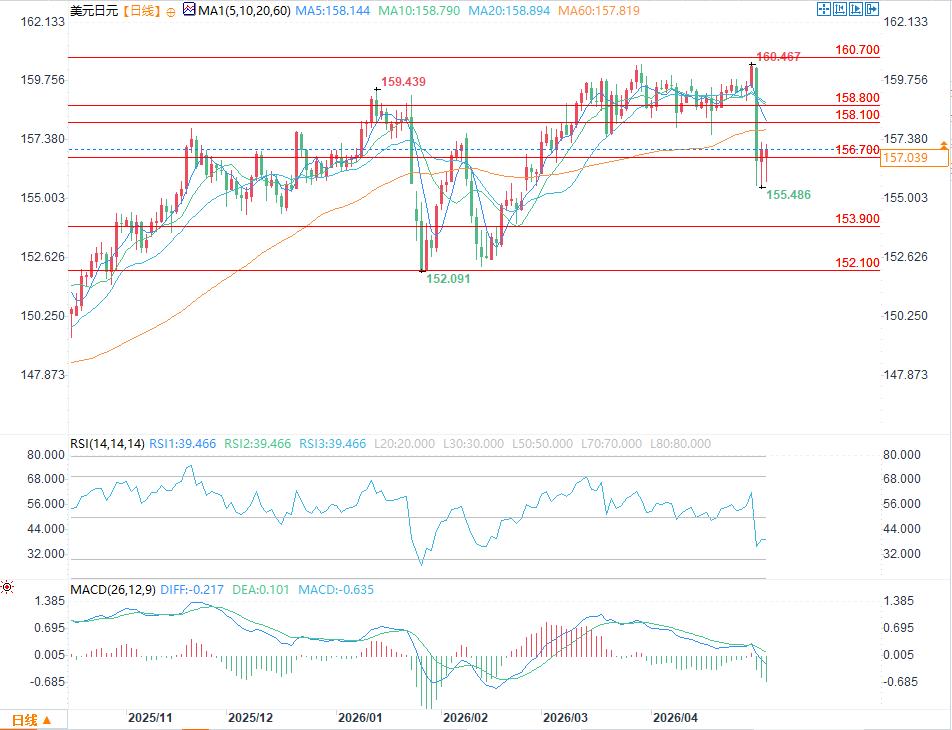
(USD/JPY daily chart source: EasyForex)
From a technical analysis perspective, the USD/JPY exchange rate previously surged to around the 160 level but failed to hold due to strong resistance, subsequently gradually declining and currently fluctuating around 156.75. Short-term technical indicators show that the exchange rate has successfully broken below the 5-day, 10-day, and 20-day moving averages, indicating that the short-term trend of USD/JPY has shifted to a bearish bias, with significant downward pressure in the short term.
From a key level perspective, the current key support level for USD/JPY is around 156.70. Holding this level could alleviate short-term downward pressure and drive a rebound in the exchange rate. A break below this support level would open up further downside potential, potentially leading to support levels at 153.90 and 152.10. On the resistance side, short-term resistance is mainly concentrated around 158.10. A break above this level would face resistance at key levels such as 158.80 and 160.70. However, a successful retest above 158.80 would indicate that market panic regarding the Bank of Japan's intervention is gradually subsiding, and USD/JPY could resume its upward trend.
At 18:43 Beijing time, the USD/JPY exchange rate was 157.058/071, unchanged from the opening price.
Affected by a combination of factors, including rising market concerns about the Bank of Japan's intervention, thin market liquidity during Japan's Golden Week holiday, and pressure on high US Treasury yields, global forex traders are closely watching the Japanese authorities' policy moves. As a result, the USD/JPY exchange rate has fallen, and the yen has experienced a period of strong appreciation.
Stimulated by the risk of a new round of intervention by the Bank of Japan, the yen suddenly surged against the dollar, breaking its previous weak and volatile pattern. As of press time, the dollar/yen pair had fallen to a low of 155.703 during the session before rebounding slightly and is currently trading around 156.748, showing a short-term consolidation trend.
The USD/JPY pair fell as much as 0.75% intraday, briefly dropping to 155.70. This sharp rise in the yen was not gradual, but rather occurred within a mere nine minutes around midday Singapore time, demonstrating extremely volatile short-term fluctuations. As of now, Japanese officials have not officially confirmed this exchange rate anomaly or whether they have intervened in the market. However, the unusually sharp fluctuations have put global forex traders on high alert, prompting them to adjust their positions to mitigate potential risks.
The risk of intervention has risen again.
Looking back at last week's market activity, rumors circulated that the Bank of Japan had intervened in the market. Authoritative sources revealed that Japanese authorities had bought yen again after two years to curb its continued depreciation. Affected by this news, the global foreign exchange market remained cautious, with traders generally hesitant to make large bets, resulting in a conservative market sentiment.
Currently, Japan is in the midst of its Golden Week holiday, with most financial institutions and trading entities on holiday. This has directly led to a significant decrease in market activity and a marked tightening of liquidity. In a market environment of thin liquidity, exchange rates become much more sensitive to capital flows, making them highly susceptible to large fluctuations. Even small-scale capital inflows and outflows can trigger sharp rises and falls in exchange rates. Especially since the market is already closely watching the Japanese government's intervention, this volatility effect is further amplified, increasing the uncertainty of short-term exchange rate trends.
Interest rate differentials continue to dominate medium- to long-term trends.
From a long-term perspective, while the Bank of Japan's market intervention can create a short-term impact, quickly suppressing the USD/JPY exchange rate and pushing the yen to appreciate temporarily, the intervention itself is insufficient to support a long-term strong yen. The overall trend of USD/JPY remains dominated by the interest rate differential between the US and Japan, and this core logic has not changed.
Specifically, if US Treasury yields continue to remain high and the Bank of Japan maintains its current conservative and accommodative monetary policy stance without clear signals of interest rate hikes or policy shifts, global forex traders will likely continue to buy USD/JPY on dips, driving the exchange rate gradually higher. Conversely, for the yen to experience a sustained appreciation, the market needs to meet one of the following conditions: a clear weakening of the US economy, a significant decline in US Treasury yields, or a clear shift in global market expectations regarding interest rates in both the US and Japan. These factors are key to driving a long-term strengthening of the yen.
The situation in Hormuz adds to risk aversion pressures.
Besides expectations of Bank of Japan intervention and interest rate differentials, global geopolitical tensions have also become a significant variable influencing the USD/JPY exchange rate, with the situation in the Strait of Hormuz attracting considerable market attention. As a vital global oil transportation route, the stability of the Strait of Hormuz directly impacts international oil prices, thereby affecting global inflation expectations and the flow of safe-haven funds.
From the perspective of the impact logic, the tension in the Strait of Hormuz has a two-way effect on the USD/JPY exchange rate: on the one hand, escalating geopolitical risks usually drive safe-haven funds to flow into the US dollar, supporting the dollar's strength and thus putting downward pressure on the yen; on the other hand, rising risk aversion will also boost the demand for the yen as a safe haven, and the market will further bet that the Japanese authorities will increase their intervention to curb further depreciation of the yen, which will indirectly boost the yen's exchange rate. The two forces intertwine and further exacerbate the volatility of the exchange rate.
USD/JPY faces pressure at key support levels.
(USD/JPY daily chart source: EasyForex)
From a technical analysis perspective, the USD/JPY exchange rate previously surged to around the 160 level but failed to hold due to strong resistance, subsequently gradually declining and currently fluctuating around 156.75. Short-term technical indicators show that the exchange rate has successfully broken below the 5-day, 10-day, and 20-day moving averages, indicating that the short-term trend of USD/JPY has shifted to a bearish bias, with significant downward pressure in the short term.
From a key level perspective, the current key support level for USD/JPY is around 156.70. Holding this level could alleviate short-term downward pressure and drive a rebound in the exchange rate. A break below this support level would open up further downside potential, potentially leading to support levels at 153.90 and 152.10. On the resistance side, short-term resistance is mainly concentrated around 158.10. A break above this level would face resistance at key levels such as 158.80 and 160.70. However, a successful retest above 158.80 would indicate that market panic regarding the Bank of Japan's intervention is gradually subsiding, and USD/JPY could resume its upward trend.
At 18:43 Beijing time, the USD/JPY exchange rate was 157.058/071, unchanged from the opening price.
- Risk Warning and Disclaimer
- The market involves risk, and trading may not be suitable for all investors. This article is for reference only and does not constitute personal investment advice, nor does it take into account certain users’ specific investment objectives, financial situation, or other needs. Any investment decisions made based on this information are at your own risk.