The yen has suddenly surged; is the historical script of yen intervention repeating itself?
2026-05-06 17:34:04
The yen surged suddenly on Wednesday (May 6), fueling renewed speculation that Japanese authorities may have intervened. It is widely believed that the Japanese government's intervention last week was the catalyst for the sharp rise in this long-weak currency.
Although Japanese officials have not confirmed that they are buying yen, they have been threatening to intervene for months.

Investors remain wary of further intervention.
Investors have been bracing for further Japanese intervention after sources indicated last week that Japanese authorities intervened on Thursday to stem the yen's decline. Data suggests Japan may have spent as much as $35 billion to support the yen.
Japanese Finance Minister Katayama warned on Monday to be wary of speculative activity in the foreign exchange market. This followed a brief surge in the yen earlier in the week, sparking speculation that Japanese authorities might intervene again to support the currency.
"As I have repeatedly emphasized, we will take decisive measures against speculative activities in accordance with the statement signed by Japan and the United States last year," Katayama told reporters after the Asian Development Bank annual meeting in Uzbekistan.
A market source revealed that throughout the holiday period, agents' traders remained on standby, ready to execute intervention orders.
Intervention signals suggest USD/JPY may have peaked.
It's worth noting that historical data shows yen intervention often coincides with significant tops in USD/JPY, and its impact typically lasts for weeks or even months. Following the 2022 peak, USD/JPY fell 16.3%; after the 2024 peak, the decline reached 13.8%. Even the smallest drop in these three interventions (5.1%) exceeds the current retracement of approximately 3.3% from the cycle high.
Given that European and American markets have not yet fully reacted, and the dollar has already come under pressure following the recent news of the "peace agreement," USD/JPY may need some time before it tries to break through the 158 level again.
The Japanese yen led the foreign exchange market gains, with volatility rising significantly.
The Japanese yen was the strongest major currency pair in today's trading session, with USD/JPY, EUR/JPY, and GBP/JPY among the biggest losers. Notably, several major currency pairs have exceeded their average daily trading range—a rarity during Asian trading hours.
This indicates that the market is undergoing aggressive repricing rather than gradual volatility. Several currency pairs have broken through 100% of their 10-day average true range, with volatility significantly amplified, and the risk of further follow-through is rising as European and US traders react.
USD/JPY Technical Analysis: Bearish Structure Forming on Daily Chart
The daily chart shows that USD/JPY is poised to form a bearish outside engulfing pattern, but it has currently found support at the 200-day exponential moving average. Considering that the pair has recovered more than a third of its losses from suspected intervention in the past hour, there may be room for a slight rebound. However, given that authorities are not keen on a strong yen, USD/JPY shorts may seek to re-enter the market once the dust settles.
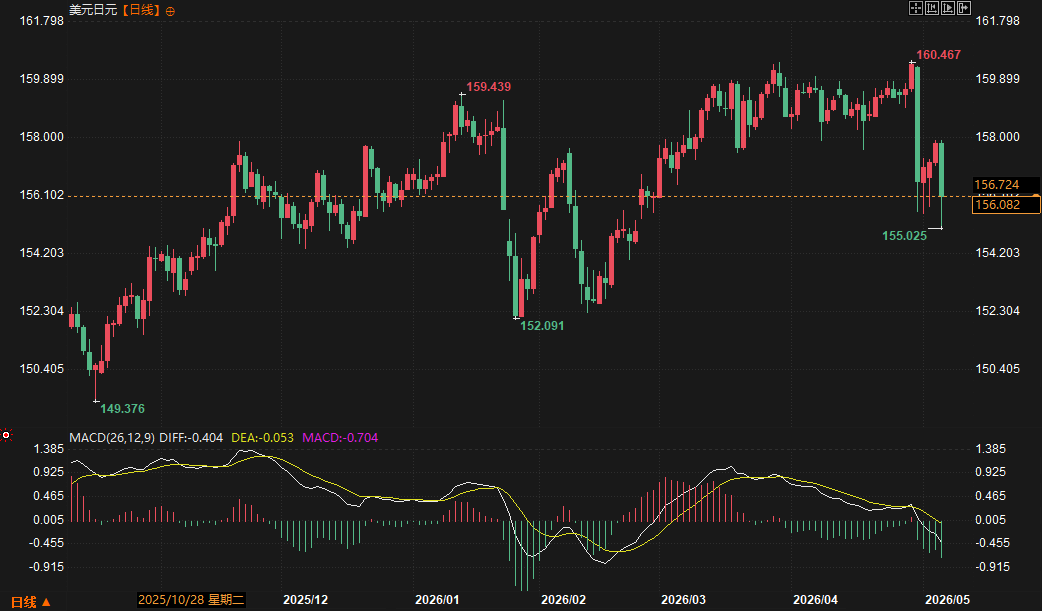
(USD/JPY daily chart, source: EasyForex)
The 156.50 and 157 levels are potential areas where bears might consider shorting on rallies, awaiting a retest of the trend support near the 200-day simple moving average. For reference, a drop of 5.1% from the smallest decline seen in recent interventions could see USD/JPY fall to the monthly S2 pivot point, slightly above the 152 level.
Overall, Japanese authorities appear to have intervened again, successfully pushing the USD/JPY pair down from the key resistance level of 158. Historical experience suggests that such interventions often foreshadow the formation of a medium-term top, but the depth of the pullback will depend on the subsequent strength of the US dollar, the trend of US Treasury yields, and further actions by Japanese authorities.
Volatility has risen significantly, and market reaction after the opening of the European and American trading sessions will be crucial. If the USD/JPY rebound falters and falls again, it could open up further downside potential; conversely, if the market quickly digests the impact of intervention, it may return to a range-bound pattern. Traders should closely monitor subsequent statements from Japanese officials and the potential impact of Friday's US non-farm payroll data on the dollar.
At 17:28 Beijing time, the USD/JPY exchange rate was 156.058/66.
Although Japanese officials have not confirmed that they are buying yen, they have been threatening to intervene for months.
Expectations of intervention continue to rise, and officials issue repeated verbal warnings.
Investors remain wary of further intervention.
Investors have been bracing for further Japanese intervention after sources indicated last week that Japanese authorities intervened on Thursday to stem the yen's decline. Data suggests Japan may have spent as much as $35 billion to support the yen.
Japanese Finance Minister Katayama warned on Monday to be wary of speculative activity in the foreign exchange market. This followed a brief surge in the yen earlier in the week, sparking speculation that Japanese authorities might intervene again to support the currency.
"As I have repeatedly emphasized, we will take decisive measures against speculative activities in accordance with the statement signed by Japan and the United States last year," Katayama told reporters after the Asian Development Bank annual meeting in Uzbekistan.
A market source revealed that throughout the holiday period, agents' traders remained on standby, ready to execute intervention orders.
Historical experience shows that intervention often corresponds to significant tops in USD/JPY.
Intervention signals suggest USD/JPY may have peaked.
It's worth noting that historical data shows yen intervention often coincides with significant tops in USD/JPY, and its impact typically lasts for weeks or even months. Following the 2022 peak, USD/JPY fell 16.3%; after the 2024 peak, the decline reached 13.8%. Even the smallest drop in these three interventions (5.1%) exceeds the current retracement of approximately 3.3% from the cycle high.
Given that European and American markets have not yet fully reacted, and the dollar has already come under pressure following the recent news of the "peace agreement," USD/JPY may need some time before it tries to break through the 158 level again.
The Japanese yen led the foreign exchange market gains, with volatility rising significantly.
The Japanese yen was the strongest major currency pair in today's trading session, with USD/JPY, EUR/JPY, and GBP/JPY among the biggest losers. Notably, several major currency pairs have exceeded their average daily trading range—a rarity during Asian trading hours.
This indicates that the market is undergoing aggressive repricing rather than gradual volatility. Several currency pairs have broken through 100% of their 10-day average true range, with volatility significantly amplified, and the risk of further follow-through is rising as European and US traders react.
USD/JPY Technical Analysis: Bearish Structure Forming on Daily Chart
The daily chart shows that USD/JPY is poised to form a bearish outside engulfing pattern, but it has currently found support at the 200-day exponential moving average. Considering that the pair has recovered more than a third of its losses from suspected intervention in the past hour, there may be room for a slight rebound. However, given that authorities are not keen on a strong yen, USD/JPY shorts may seek to re-enter the market once the dust settles.
(USD/JPY daily chart, source: EasyForex)
The 156.50 and 157 levels are potential areas where bears might consider shorting on rallies, awaiting a retest of the trend support near the 200-day simple moving average. For reference, a drop of 5.1% from the smallest decline seen in recent interventions could see USD/JPY fall to the monthly S2 pivot point, slightly above the 152 level.
Short-term volatility has intensified; the medium-term trend depends on the level of intervention.
Overall, Japanese authorities appear to have intervened again, successfully pushing the USD/JPY pair down from the key resistance level of 158. Historical experience suggests that such interventions often foreshadow the formation of a medium-term top, but the depth of the pullback will depend on the subsequent strength of the US dollar, the trend of US Treasury yields, and further actions by Japanese authorities.
Volatility has risen significantly, and market reaction after the opening of the European and American trading sessions will be crucial. If the USD/JPY rebound falters and falls again, it could open up further downside potential; conversely, if the market quickly digests the impact of intervention, it may return to a range-bound pattern. Traders should closely monitor subsequent statements from Japanese officials and the potential impact of Friday's US non-farm payroll data on the dollar.
At 17:28 Beijing time, the USD/JPY exchange rate was 156.058/66.
- Risk Warning and Disclaimer
- The market involves risk, and trading may not be suitable for all investors. This article is for reference only and does not constitute personal investment advice, nor does it take into account certain users’ specific investment objectives, financial situation, or other needs. Any investment decisions made based on this information are at your own risk.