Slowing wage growth might just lead to interest rate hikes? With the euro breaking 1.17, will the ECB really take action in June?
2026-05-06 18:03:27
On Wednesday (May 6), data released by the European Central Bank showed that wage growth in the eurozone is expected to slow this year, despite the Middle East conflict pushing up energy prices. An indicator tracking union wage agreements showed that wages are projected to rise by 2.6% in 2026, lower than the 3% increase in 2025.
European Central Bank officials emphasized that wage trends are a key indicator of whether inflation can fall back to the 2% target. There are currently no clear signs that the wage agreement will exacerbate inflation.
A cooling labor market and AI are dragging down wages. European Central Bank Executive Board member Cipolane stated that wage tracking indicators continue to point to a slowdown as the labor market cools. He also pointed out that companies adopting AI could further suppress wage growth, with many workers fearing job losses due to new technologies.
The likelihood of a June rate hike has increased. The European Central Bank kept interest rates unchanged last week but hinted at a possible rate hike at its June meeting if inflation continues to rise. Officials are concerned that if energy prices remain high, workers will seek higher wages, further pushing up prices.
The ongoing conflict will alter wage paths. The March baseline forecast assumes an early end to the conflict, with wage growth gradually slowing. However, under a "severe disruption" scenario, wage growth could rise to 3.7% to 4.6% in the fourth quarter of 2026 and reach 5.8% in 2027.
Cipollone stated that the situation in the Middle East no longer aligns with the ECB's baseline scenario. He said, "The current situation is deviating from our March baseline forecast, which increases the likelihood that we may need to adjust policy rates."
Overall, the slowdown in wage growth provides the European Central Bank with room to observe, but if the energy shock continues, the likelihood of a rate hike in June will increase significantly.
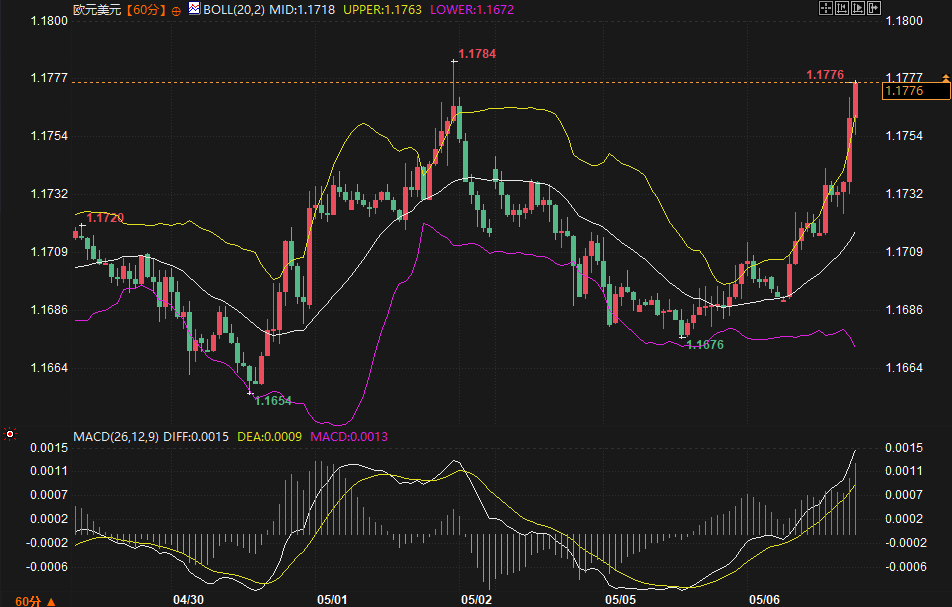
From the 60-minute chart, the euro/dollar exchange rate has recently shown a strong rebound pattern, initially declining before rising, with technical signals resonating with fundamental expectations of interest rate hikes.
The current price is trading above the upper Bollinger Band (1.1763), with the latest quote reaching 1.1776, just a step away from the previous high of 1.1784, indicating strong short-term bullish momentum. The middle Bollinger Band (1.1718) continues to turn upwards, providing strong support for the exchange rate. The short-term upward trend is clear, and if it can hold above the upper band, it will open up further upside potential.
Support and resistance levels
The recent lows of 1.1654 (April 30) and 1.1676 (May 5) form a double bottom support. With the continuous rise in prices, the 1.1700 level has become a strong short-term support level. The first resistance level above is the previous high of 1.1784. If it breaks through, it may challenge the psychological level of 1.1800.
The MACD lines (DIFF: 0.0015, DEA: 0.0009) formed a golden cross above the zero axis and continued to diverge upwards, with the red momentum bars steadily expanding, indicating that the bullish force is still accumulating and there are no obvious top divergence or exhaustion signals yet. The short-term upward trend is expected to continue.
From a fundamental perspective, the rising expectation of a June rate hike by the European Central Bank is the core driver of the euro's rebound. If subsequent policy statements release further hawkish signals, the convergence of technical and fundamental factors will push the euro against the US dollar to continue its upward trend. However, it is necessary to be wary that if the conflict in the Middle East eases and energy prices fall, it may lead to a cooling of rate hike expectations and trigger a short-term correction in the exchange rate.
European Central Bank officials emphasized that wage trends are a key indicator of whether inflation can fall back to the 2% target. There are currently no clear signs that the wage agreement will exacerbate inflation.
Multiple factors are suppressing wages, but the likelihood of an interest rate hike is rising.
A cooling labor market and AI are dragging down wages. European Central Bank Executive Board member Cipolane stated that wage tracking indicators continue to point to a slowdown as the labor market cools. He also pointed out that companies adopting AI could further suppress wage growth, with many workers fearing job losses due to new technologies.
The likelihood of a June rate hike has increased. The European Central Bank kept interest rates unchanged last week but hinted at a possible rate hike at its June meeting if inflation continues to rise. Officials are concerned that if energy prices remain high, workers will seek higher wages, further pushing up prices.
The ongoing conflict will alter wage paths. The March baseline forecast assumes an early end to the conflict, with wage growth gradually slowing. However, under a "severe disruption" scenario, wage growth could rise to 3.7% to 4.6% in the fourth quarter of 2026 and reach 5.8% in 2027.
The situation has deviated from the baseline, and the June meeting has become a key juncture.
Cipollone stated that the situation in the Middle East no longer aligns with the ECB's baseline scenario. He said, "The current situation is deviating from our March baseline forecast, which increases the likelihood that we may need to adjust policy rates."
Overall, the slowdown in wage growth provides the European Central Bank with room to observe, but if the energy shock continues, the likelihood of a rate hike in June will increase significantly.
EUR/USD Technical Analysis
From the 60-minute chart, the euro/dollar exchange rate has recently shown a strong rebound pattern, initially declining before rising, with technical signals resonating with fundamental expectations of interest rate hikes.
The current price is trading above the upper Bollinger Band (1.1763), with the latest quote reaching 1.1776, just a step away from the previous high of 1.1784, indicating strong short-term bullish momentum. The middle Bollinger Band (1.1718) continues to turn upwards, providing strong support for the exchange rate. The short-term upward trend is clear, and if it can hold above the upper band, it will open up further upside potential.
Support and resistance levels
The recent lows of 1.1654 (April 30) and 1.1676 (May 5) form a double bottom support. With the continuous rise in prices, the 1.1700 level has become a strong short-term support level. The first resistance level above is the previous high of 1.1784. If it breaks through, it may challenge the psychological level of 1.1800.
The MACD lines (DIFF: 0.0015, DEA: 0.0009) formed a golden cross above the zero axis and continued to diverge upwards, with the red momentum bars steadily expanding, indicating that the bullish force is still accumulating and there are no obvious top divergence or exhaustion signals yet. The short-term upward trend is expected to continue.
From a fundamental perspective, the rising expectation of a June rate hike by the European Central Bank is the core driver of the euro's rebound. If subsequent policy statements release further hawkish signals, the convergence of technical and fundamental factors will push the euro against the US dollar to continue its upward trend. However, it is necessary to be wary that if the conflict in the Middle East eases and energy prices fall, it may lead to a cooling of rate hike expectations and trigger a short-term correction in the exchange rate.
- Risk Warning and Disclaimer
- The market involves risk, and trading may not be suitable for all investors. This article is for reference only and does not constitute personal investment advice, nor does it take into account certain users’ specific investment objectives, financial situation, or other needs. Any investment decisions made based on this information are at your own risk.