Federal Reserve officials warn that geopolitical conflicts are pushing up inflation, and the possibility of interest rate hikes cannot be ruled out.
2026-05-07 10:58:28
Federal Reserve officials issued a clear warning on Wednesday (May 6) that the ongoing conflict between the United States and Iran is increasing the risk of an inflationary shock. Persistently high oil prices, escalating disruptions to global supply chains, and rising costs of industrial inputs are all contributing to new inflationary pressures. While the market widely expects interest rates to remain unchanged, St. Louis Fed President Musalaim explicitly stated that the risks to monetary policy have shifted to rising inflation, and the possibility of future rate hikes cannot be ruled out.
Goolsby: The longer the conflict lasts, the more serious the supply chain problems will be.
Chicago Federal Reserve President John Goolsby told reporters after attending a Milken Institute conference that at the outset of the conflict, business executives believed that short-term oil price increases were not a concern. However, "if oil prices remain high for several months, they will begin to feel considerable pressure on the supply chain," a situation mirroring the surge in inflation during the COVID-19 pandemic. He pointed out that the distribution of inputs such as industrial chemicals has been disrupted, and persistently high fuel prices are increasingly being passed on to transportation and other costs. Goolsby emphasized, "The longer the conflict lasts, the more severe these problems will become." He also clarified that it has not yet developed into a stagflationary shock, "This is just an inflationary shock. And the longer this situation continues, the more uneasy I become."
Musalaim: Inflation risks are gradually shifting, and the possibility of interest rate hikes cannot be ignored.
St. Louis Federal Reserve President Musaleem, speaking at an event in Alabama, stated, "Inflation is significantly above our target. We face risks on both the employment and inflation fronts. In my view, the risks are gradually tilting towards inflation." He further noted that while there is a "reasonable scenario" for interest rate cuts given slowing demand and rising unemployment, there is also the possibility that the Fed may have to raise borrowing costs at this stage. Musaleem emphasized that inflationary pressures are no longer limited to the impact of tariffs and high oil prices triggered by the Middle East wars; rising prices of industrial inputs such as aluminum, helium, and diesel "will all cause disruptions" and could also dampen hiring.
Market expectations have shifted: a rate cut is virtually impossible, and maintaining the current interest rate level has become the baseline scenario.
Currently, the US inflation rate is about one percentage point higher than the Federal Reserve's 2% target and may rise further. Investors believe that the Fed is unlikely to cut interest rates for at least the next year or even longer. Since last December, the federal funds rate has remained in the range of 3.50% to 3.75%. The statements by Musalaim and Goolsby confirm Fed Chairman Powell's previous remarks—that the Fed's internal focus is gradually shifting to acknowledging the need to address inflation risks through interest rate hikes.
With a highly uncertain outlook, the Federal Reserve is caught between a wait-and-see approach and caution.
In conclusion, the escalating conflict between the US and Iran is forcing the Federal Reserve to reassess its inflation outlook. Dramatic oil price volatility—with global benchmarks falling below $100 after reconciliation rumors and then rebounding rapidly—coupled with gasoline prices surging from around $3 per gallon to over $4.50, and the New York Fed's global supply chain stress index jumping to its highest level since July 2022, all pose a real threat to inflation. Although neither Musalaim nor Goolsby are currently voting members of the interest rate policy committee, their hawkish statements suggest that even without an immediate rate hike, the Fed will maintain interest rates for some time and is prepared to take more aggressive action if necessary. This will undoubtedly make it more complex for incoming Fed Chairman Warsh to implement the rate cuts expected by President Trump.
Given the hawkish signals from Federal Reserve officials and the resurgence of interest rate hikes, the US dollar index is currently at a critical technical juncture. On Wednesday (May 6), the dollar index closed at 98.05, down 0.44% for the day, fluctuating around the 98.00 level. In Asian trading on Thursday, the dollar index is trading in a narrow range at lower levels, currently around 97.95, with key support around 97.60.
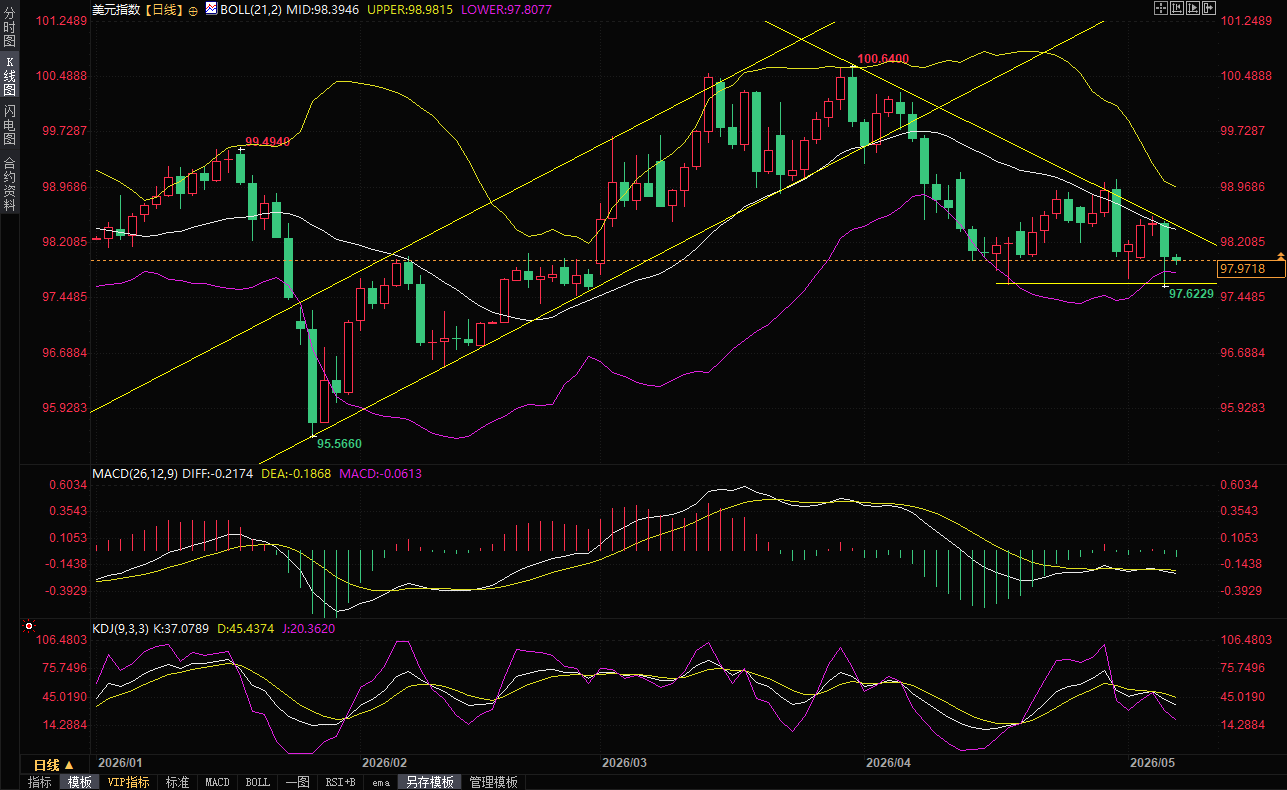
(US Dollar Index Daily Chart, Source: FX678)
Market focus is now entirely on the upcoming US April non-farm payrolls report. This report will be a key catalyst for determining the short-term direction of the US dollar index.
If employment data is strong (new jobs exceeding expectations, wage growth steady): it will confirm the resilience of the US economy, strengthen expectations that the Federal Reserve will maintain tightening or even raise interest rates, and the US dollar index is expected to be boosted, testing the 98.50-98.80 resistance zone.
If employment data is weak, market expectations for the Federal Reserve to shift to a more accommodative stance will intensify, and the dollar index may test the 97.60 support level, or even trigger a larger-scale technical correction.
The US dollar index is currently consolidating at a key level within a downward channel, with 97.60 serving as a crucial support/resistance level. Hawkish policy signals are providing support, but the overall technical bearish trend has not yet reversed. Friday's non-farm payroll data will determine whether the dollar breaks through moving average resistance and begins a rebound, or breaks down and continues its decline. Traders are advised to remain on the sidelines and wait for the data to become clearer before making any moves.
At 10:57 Beijing time, the US dollar index is currently at 97.95.
Pressure is transmitted layer by layer, and officials' stances are becoming more hawkish.
Goolsby: The longer the conflict lasts, the more serious the supply chain problems will be.
Chicago Federal Reserve President John Goolsby told reporters after attending a Milken Institute conference that at the outset of the conflict, business executives believed that short-term oil price increases were not a concern. However, "if oil prices remain high for several months, they will begin to feel considerable pressure on the supply chain," a situation mirroring the surge in inflation during the COVID-19 pandemic. He pointed out that the distribution of inputs such as industrial chemicals has been disrupted, and persistently high fuel prices are increasingly being passed on to transportation and other costs. Goolsby emphasized, "The longer the conflict lasts, the more severe these problems will become." He also clarified that it has not yet developed into a stagflationary shock, "This is just an inflationary shock. And the longer this situation continues, the more uneasy I become."
Musalaim: Inflation risks are gradually shifting, and the possibility of interest rate hikes cannot be ignored.
St. Louis Federal Reserve President Musaleem, speaking at an event in Alabama, stated, "Inflation is significantly above our target. We face risks on both the employment and inflation fronts. In my view, the risks are gradually tilting towards inflation." He further noted that while there is a "reasonable scenario" for interest rate cuts given slowing demand and rising unemployment, there is also the possibility that the Fed may have to raise borrowing costs at this stage. Musaleem emphasized that inflationary pressures are no longer limited to the impact of tariffs and high oil prices triggered by the Middle East wars; rising prices of industrial inputs such as aluminum, helium, and diesel "will all cause disruptions" and could also dampen hiring.
Market expectations have shifted: a rate cut is virtually impossible, and maintaining the current interest rate level has become the baseline scenario.
Currently, the US inflation rate is about one percentage point higher than the Federal Reserve's 2% target and may rise further. Investors believe that the Fed is unlikely to cut interest rates for at least the next year or even longer. Since last December, the federal funds rate has remained in the range of 3.50% to 3.75%. The statements by Musalaim and Goolsby confirm Fed Chairman Powell's previous remarks—that the Fed's internal focus is gradually shifting to acknowledging the need to address inflation risks through interest rate hikes.
With a highly uncertain outlook, the Federal Reserve is caught between a wait-and-see approach and caution.
In conclusion, the escalating conflict between the US and Iran is forcing the Federal Reserve to reassess its inflation outlook. Dramatic oil price volatility—with global benchmarks falling below $100 after reconciliation rumors and then rebounding rapidly—coupled with gasoline prices surging from around $3 per gallon to over $4.50, and the New York Fed's global supply chain stress index jumping to its highest level since July 2022, all pose a real threat to inflation. Although neither Musalaim nor Goolsby are currently voting members of the interest rate policy committee, their hawkish statements suggest that even without an immediate rate hike, the Fed will maintain interest rates for some time and is prepared to take more aggressive action if necessary. This will undoubtedly make it more complex for incoming Fed Chairman Warsh to implement the rate cuts expected by President Trump.
US Dollar Index: Stalled around the 98 level; Non-Farm Payrolls data may be key to breaking the deadlock.
Given the hawkish signals from Federal Reserve officials and the resurgence of interest rate hikes, the US dollar index is currently at a critical technical juncture. On Wednesday (May 6), the dollar index closed at 98.05, down 0.44% for the day, fluctuating around the 98.00 level. In Asian trading on Thursday, the dollar index is trading in a narrow range at lower levels, currently around 97.95, with key support around 97.60.
(US Dollar Index Daily Chart, Source: FX678)
Market focus is now entirely on the upcoming US April non-farm payrolls report. This report will be a key catalyst for determining the short-term direction of the US dollar index.
If employment data is strong (new jobs exceeding expectations, wage growth steady): it will confirm the resilience of the US economy, strengthen expectations that the Federal Reserve will maintain tightening or even raise interest rates, and the US dollar index is expected to be boosted, testing the 98.50-98.80 resistance zone.
If employment data is weak, market expectations for the Federal Reserve to shift to a more accommodative stance will intensify, and the dollar index may test the 97.60 support level, or even trigger a larger-scale technical correction.
The US dollar index is currently consolidating at a key level within a downward channel, with 97.60 serving as a crucial support/resistance level. Hawkish policy signals are providing support, but the overall technical bearish trend has not yet reversed. Friday's non-farm payroll data will determine whether the dollar breaks through moving average resistance and begins a rebound, or breaks down and continues its decline. Traders are advised to remain on the sidelines and wait for the data to become clearer before making any moves.
At 10:57 Beijing time, the US dollar index is currently at 97.95.
- Risk Warning and Disclaimer
- The market involves risk, and trading may not be suitable for all investors. This article is for reference only and does not constitute personal investment advice, nor does it take into account certain users’ specific investment objectives, financial situation, or other needs. Any investment decisions made based on this information are at your own risk.