Copper prices are near record highs, base metals are showing resilience, and the market is betting on a tight supply-demand balance.
2026-05-11 15:04:45
According to APP, copper prices are nearing record closing highs, with other major metals also rising. Despite the apparent stalemate between the US and Iran, traders opted to join the broader rally in risk assets. Five of the six major contracts on the London Metal Exchange (LME) recorded gains, and the exchange's composite price index hit a record high at Friday's close.

Amid the conflicts in the Middle East, various metals, from copper to zinc, have demonstrated strong resilience, primarily due to signs that demand exceeds supply. Although the initial weeks of the conflict saw a sharp market downturn triggered by investor concerns about a severe global economic shock, most base metal prices have since seen steady gains this year. Copper prices have risen by approximately 10% since the end of 2025. Analysts at Citigroup point out that demand for metals from the energy transition and defense sectors, coupled with supply-side headwinds, will enhance copper's price resilience even in the worst-case scenario.
Current copper prices in the LME March contract are near or have reached previous highs, while COMEX copper futures have also risen to around $6.25 per pound, just shy of the record high of $6.58 per pound set in January. The record performance of the LME Composite Index reflects a collective recovery in metals such as aluminum, zinc, and nickel. Supply faces multiple constraints: the Middle East conflict disrupts the transportation of key copper smelting raw materials, coupled with declining production in some major copper-producing countries and the impact of export policies by major Asian nations, further tightening the global supply of refined copper.
Demand remains strong in the long term. The energy transition is driving grid upgrades, AI data center construction, and electrification, while defense spending also contributes to additional metal consumption. Even if short-term geopolitical risks disrupt risk appetite, traders remain optimistic about the structural supply-demand gap. Citigroup analysts recently emphasized that even in extreme scenarios such as a prolonged closure of the Strait of Hormuz, copper prices will have strong support because the fundamental drivers—green transition and strategic needs—remain unchanged.
The following table shows the latest price trends and year-to-date performance of major LME metals (data as of early May 2026):
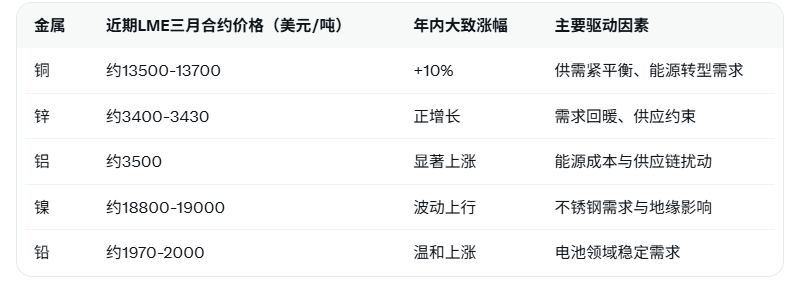
This comparison highlights the synchronicity of the base metals sector, where supply and demand fundamentals dominate despite lingering geopolitical risks.
The Middle East conflict has lasted for about 10 weeks, initially causing sharp fluctuations in metal prices, but the market quickly adapted and shifted its focus to long-term trends. Traders have not completely avoided risk, but rather captured upward opportunities through risk asset allocation. As major global metal consumers, Asian countries' economic activity is closely linked to commodity prices; any further disruption to supply chains could amplify global price volatility. Analysts from institutions such as Citigroup recently stated that supply headwinds and structural demand will jointly support metal prices. Even with short-term macroeconomic uncertainties, the resilience of key metals such as copper has been proven.
Editor's Summary:
The resilience of base metal prices amid a complex geopolitical environment stems from structural imbalances in supply and demand and long-term transformation needs. Future trends will depend on the evolution of the Middle East conflict, the speed of supply chain recovery, and the momentum of global economic growth. Investors need to balance short-term volatility with medium- to long-term investment opportunities.
Amid the conflicts in the Middle East, various metals, from copper to zinc, have demonstrated strong resilience, primarily due to signs that demand exceeds supply. Although the initial weeks of the conflict saw a sharp market downturn triggered by investor concerns about a severe global economic shock, most base metal prices have since seen steady gains this year. Copper prices have risen by approximately 10% since the end of 2025. Analysts at Citigroup point out that demand for metals from the energy transition and defense sectors, coupled with supply-side headwinds, will enhance copper's price resilience even in the worst-case scenario.
Current copper prices in the LME March contract are near or have reached previous highs, while COMEX copper futures have also risen to around $6.25 per pound, just shy of the record high of $6.58 per pound set in January. The record performance of the LME Composite Index reflects a collective recovery in metals such as aluminum, zinc, and nickel. Supply faces multiple constraints: the Middle East conflict disrupts the transportation of key copper smelting raw materials, coupled with declining production in some major copper-producing countries and the impact of export policies by major Asian nations, further tightening the global supply of refined copper.
Demand remains strong in the long term. The energy transition is driving grid upgrades, AI data center construction, and electrification, while defense spending also contributes to additional metal consumption. Even if short-term geopolitical risks disrupt risk appetite, traders remain optimistic about the structural supply-demand gap. Citigroup analysts recently emphasized that even in extreme scenarios such as a prolonged closure of the Strait of Hormuz, copper prices will have strong support because the fundamental drivers—green transition and strategic needs—remain unchanged.
The following table shows the latest price trends and year-to-date performance of major LME metals (data as of early May 2026):
This comparison highlights the synchronicity of the base metals sector, where supply and demand fundamentals dominate despite lingering geopolitical risks.
The Middle East conflict has lasted for about 10 weeks, initially causing sharp fluctuations in metal prices, but the market quickly adapted and shifted its focus to long-term trends. Traders have not completely avoided risk, but rather captured upward opportunities through risk asset allocation. As major global metal consumers, Asian countries' economic activity is closely linked to commodity prices; any further disruption to supply chains could amplify global price volatility. Analysts from institutions such as Citigroup recently stated that supply headwinds and structural demand will jointly support metal prices. Even with short-term macroeconomic uncertainties, the resilience of key metals such as copper has been proven.
Editor's Summary:
The resilience of base metal prices amid a complex geopolitical environment stems from structural imbalances in supply and demand and long-term transformation needs. Future trends will depend on the evolution of the Middle East conflict, the speed of supply chain recovery, and the momentum of global economic growth. Investors need to balance short-term volatility with medium- to long-term investment opportunities.
- Risk Warning and Disclaimer
- The market involves risk, and trading may not be suitable for all investors. This article is for reference only and does not constitute personal investment advice, nor does it take into account certain users’ specific investment objectives, financial situation, or other needs. Any investment decisions made based on this information are at your own risk.