The probability of a Fed rate cut in 2026 has surged; how long can the dollar hold above 98?
2026-05-11 15:58:32
On Monday, May 11, the US dollar index traded around 98 in early European trading, a significant pullback from its April high. With the ongoing tensions in the Middle East pushing up energy prices and stronger-than-expected US April jobs data, market expectations for the Federal Reserve's interest rate cut path have been pushed back further. Several international investment banks' latest reports indicate that the number of rate cuts in 2026 has been significantly lowered or even pushed back to 2027. Traders are closely watching the support levels for the dollar index from inflation stickiness and labor market resilience.
The daily chart for the US dollar index shows that it briefly touched a high above 100.6 in April before entering a downward trend. The Bollinger Bands have a middle band at 98.5041, an upper band at 99.5024, and a lower band at 97.5058. The current price is near the lower band, indicating a narrowing short-term trading range. The MACD indicator shows a DIFF value of -0.2331, a DEA value of -0.1985, and a MACD histogram of -0.0692, continuing to be below the zero line with persistent green bars, indicating weak momentum.
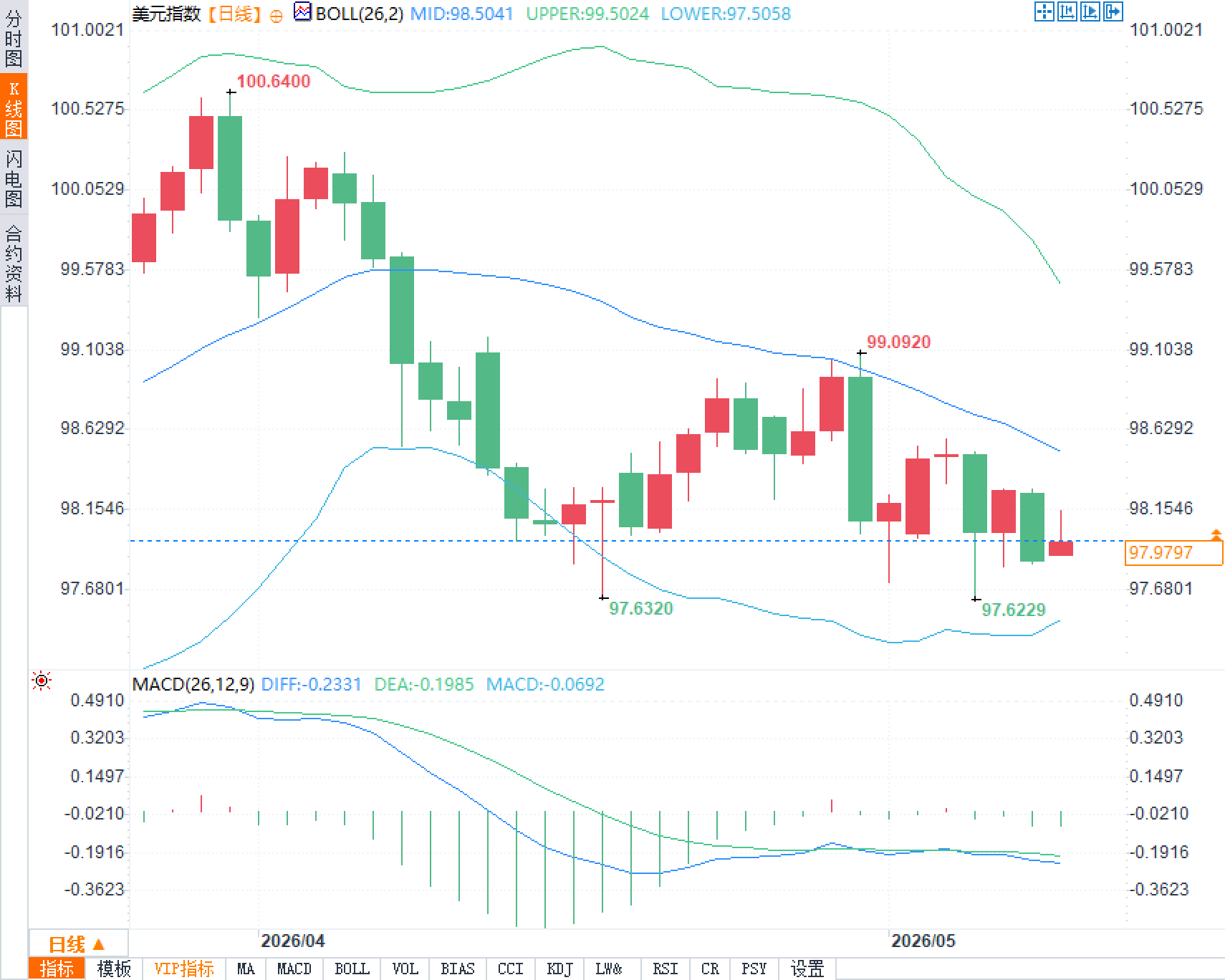
The price briefly rebounded to 99.0920, but then fell back to a low of 97.6229, and has been fluctuating between 97.50 and 98.50 since May. Technically, the 98 level has become a significant psychological support. If it holds, a rebound to test the middle Bollinger Band may occur; conversely, a break below the lower Bollinger Band at 97.5058 could open up further downside potential. Traders should pay attention to the breakout direction after the Bollinger Bands narrow, and whether the MACD shows a divergence signal.
Bank of America Global Research and Goldman Sachs are among the institutions that have recently adjusted their forecasts. In a report dated May 8, Bank of America Global Research completely removed its expectation of a Federal Reserve rate cut in 2026, instead predicting two 25 basis point cuts in July and September 2027. Goldman Sachs, on the other hand, postponed the first rate cut from September 2026 to December, followed by a second cut in March 2027.
Both institutions pointed out that high energy prices have kept core PCE growth at around 3% year-on-year, far above the 2% target. Coupled with the fact that the labor market has not weakened sufficiently, the Federal Reserve is unlikely to launch an easing cycle in 2026. Other investment banks' forecasts are also divergent, with some institutions believing that there may be no rate cuts in 2026, while a few still expect limited easing. However, the overall trend is one of postponement rather than acceleration.
The above adjustments directly reflect the market's strengthened pricing of a "higher and longer" interest rate path.
Non-farm payrolls increased by 115,000 in April, far exceeding market expectations. The unemployment rate remained stable at 4.3%, and wage growth continued, indicating that the labor market's resilience exceeded expectations. The Federal Reserve's April 29 meeting saw a rare 8-4 vote to maintain interest rates at 3.50%-3.75%. On the inflation front, energy cost transmission kept the March PCE year-on-year growth rate high, with the core reading close to 3%.
Incoming Federal Reserve Chairman Warsh is expected by the market to favor lower interest rates, but several investment banks emphasize that current data flows do not support immediate action. Traders have observed that Fed officials have repeatedly stressed data dependence, requiring any rate cut to be accompanied by a combination of signals: a sustained decline in inflation and a significant cooling in the labor market. Currently, the CME FedWatch tool indicates that the probability of maintaining the current interest rate range throughout the year remains dominant.
The Middle East conflict has persisted for ten weeks, significantly raising energy prices and directly increasing US import costs and overall inflation expectations. Rising oil prices not only affect the PCE composition but also transmit to core inflation through the supply chain, prompting the Federal Reserve to remain cautious in its policy. As a reserve currency, the US dollar maintains a relative interest rate advantage in a high-interest-rate environment; although prices have recently fallen, fundamental support has not completely disappeared.
Traders continue to monitor subsequent employment, CPI, and geopolitical developments, as these variables will collectively determine whether the dollar index can break out of its trading range around the 98 level, and the extent of subsequent volatility.
Recent Trends and Technical Characteristics of the US Dollar Index
The daily chart for the US dollar index shows that it briefly touched a high above 100.6 in April before entering a downward trend. The Bollinger Bands have a middle band at 98.5041, an upper band at 99.5024, and a lower band at 97.5058. The current price is near the lower band, indicating a narrowing short-term trading range. The MACD indicator shows a DIFF value of -0.2331, a DEA value of -0.1985, and a MACD histogram of -0.0692, continuing to be below the zero line with persistent green bars, indicating weak momentum.
The price briefly rebounded to 99.0920, but then fell back to a low of 97.6229, and has been fluctuating between 97.50 and 98.50 since May. Technically, the 98 level has become a significant psychological support. If it holds, a rebound to test the middle Bollinger Band may occur; conversely, a break below the lower Bollinger Band at 97.5058 could open up further downside potential. Traders should pay attention to the breakout direction after the Bollinger Bands narrow, and whether the MACD shows a divergence signal.
Major investment banks have lowered their expectations for a Federal Reserve rate cut in 2026.
Bank of America Global Research and Goldman Sachs are among the institutions that have recently adjusted their forecasts. In a report dated May 8, Bank of America Global Research completely removed its expectation of a Federal Reserve rate cut in 2026, instead predicting two 25 basis point cuts in July and September 2027. Goldman Sachs, on the other hand, postponed the first rate cut from September 2026 to December, followed by a second cut in March 2027.
Both institutions pointed out that high energy prices have kept core PCE growth at around 3% year-on-year, far above the 2% target. Coupled with the fact that the labor market has not weakened sufficiently, the Federal Reserve is unlikely to launch an easing cycle in 2026. Other investment banks' forecasts are also divergent, with some institutions believing that there may be no rate cuts in 2026, while a few still expect limited easing. However, the overall trend is one of postponement rather than acceleration.
| mechanism | The first interest rate cut was originally expected. | New Expectations for First Interest Rate Cut | Total number of interest rate cuts in 2026 |
|---|---|---|---|
| Bank of America Global Research | September 2026 | July 2027 | 0 times |
| Goldman Sachs | September 2026 | December 2026 | 1 time |
Monetary Policy Outlook Amid Strong Employment and Inflationary Pressures
Non-farm payrolls increased by 115,000 in April, far exceeding market expectations. The unemployment rate remained stable at 4.3%, and wage growth continued, indicating that the labor market's resilience exceeded expectations. The Federal Reserve's April 29 meeting saw a rare 8-4 vote to maintain interest rates at 3.50%-3.75%. On the inflation front, energy cost transmission kept the March PCE year-on-year growth rate high, with the core reading close to 3%.
Incoming Federal Reserve Chairman Warsh is expected by the market to favor lower interest rates, but several investment banks emphasize that current data flows do not support immediate action. Traders have observed that Fed officials have repeatedly stressed data dependence, requiring any rate cut to be accompanied by a combination of signals: a sustained decline in inflation and a significant cooling in the labor market. Currently, the CME FedWatch tool indicates that the probability of maintaining the current interest rate range throughout the year remains dominant.
The impact of rising energy prices and geopolitical factors on the US dollar index
The Middle East conflict has persisted for ten weeks, significantly raising energy prices and directly increasing US import costs and overall inflation expectations. Rising oil prices not only affect the PCE composition but also transmit to core inflation through the supply chain, prompting the Federal Reserve to remain cautious in its policy. As a reserve currency, the US dollar maintains a relative interest rate advantage in a high-interest-rate environment; although prices have recently fallen, fundamental support has not completely disappeared.
Traders continue to monitor subsequent employment, CPI, and geopolitical developments, as these variables will collectively determine whether the dollar index can break out of its trading range around the 98 level, and the extent of subsequent volatility.
Frequently Asked Questions
Question 1: Why are major investment banks postponing their expectations for a Fed rate cut in 2026?
A: The core reason is that high energy prices have led to sticky inflation, with core PCE expected to remain close to 3% year-on-year for the whole year, far above the 2% target. Meanwhile, April's non-farm payrolls were stronger than expected, and the unemployment rate remained stable at 4.3%, indicating that the labor market has not weakened sufficiently. Investment banks believe that a combination of signals—a easing of the oil price crisis, a significant decline in monthly inflation data, and further cooling of the employment situation—is needed before interest rate cuts can be initiated, thus postponing the first action to the end of 2026 or 2027.
Question 2: What potential impact will Warsh's upcoming appointment as Federal Reserve Chairman have on policy direction?
A: The analysis indicates that Warsh favors a lower interest rate path, but current data clearly does not support immediate action. Investment banks emphasize that policy will remain highly data-dependent, and easing is only possible if inflation continues to approach the target and the labor market shows a significant cooling. Therefore, the logic supporting the high interest rate environment for the US dollar index is likely to continue in the short term.
- Risk Warning and Disclaimer
- The market involves risk, and trading may not be suitable for all investors. This article is for reference only and does not constitute personal investment advice, nor does it take into account certain users’ specific investment objectives, financial situation, or other needs. Any investment decisions made based on this information are at your own risk.