Gold Trading Alert: Gold Prices Plunge Back to 4750; US-Iran Conflict Hangs by a Thread + CPI Expectations Arrive; Gold Could Head Straight to 5000 by Year-End?
2026-05-12 07:08:33
On Tuesday morning in Asian trading, spot gold continued its overnight rebound, rising as much as 0.43% to $4754.87 per ounce, demonstrating strong resilience and support from bargain hunters. Amidst continued volatility in global markets, gold prices are at a critical juncture where geopolitical risks and macroeconomic data intertwine, leading to complex and volatile investor sentiment.

Spot gold rebounded from its lows on Monday, ultimately closing up 0.4% at $4,734.63 per ounce, after hitting a low of $4,648.14 during the session. US gold futures were also largely unchanged around $4,728.70. Market participants generally believe that this volatile upward trend is mainly due to investors' continued focus on the US-Iran situation.
US President Donald Trump stated on Monday that a ceasefire agreement with Iran is "hanging by a thread." He swiftly rejected Iran's response to the US peace proposal, deeming its conditions "completely unacceptable." The 10-week-long conflict has resulted in thousands of casualties and severely disrupted global energy supplies, particularly bringing shipping in the Strait of Hormuz to a near standstill. The strait, which once handled about one-fifth of the world's crude oil and liquefied natural gas transport, now sees shipping volumes plummeting, with several oil tankers even disabling their trackers to avoid the risks.
As a result, international oil prices rebounded sharply, with Brent crude rising nearly 3% to around $104 and US crude approaching the $100 mark. The surge in oil prices directly pushed up global inflation expectations, further reinforcing market sentiment that interest rates will remain high for an extended period. While a high-interest-rate environment typically puts pressure on gold, safe-haven demand stemming from geopolitical conflicts and potential long-term inflation risks have provided significant support for gold prices. Analysts at ING Group pointed out that the stalled peace negotiations have increased short-term uncertainty, but they maintain their optimistic forecast that gold prices will rise to $5,000 per ounce by the end of the year.
This week, the market will face the test of key US inflation data. The Consumer Price Index (CPI) will be released on Tuesday, and the Producer Price Index (PPI) on Wednesday. Analysts expect the overall CPI to rise 0.6% month-on-month in April, with a year-on-year increase of 3.7%; the core CPI is expected to rise 2.7% year-on-year. The PPI data also faces upward pressure, and the transmission effect of oil prices warrants close observation.
U.S. Treasury yields rose on Monday, with the 10-year yield climbing to 4.404% and the two-year yield also rising significantly, reflecting market concerns about oil prices driving inflation back up. Stronger-than-expected April non-farm payroll data further reduced the likelihood of a near-term rate cut by the Federal Reserve. Institutions such as Goldman Sachs have postponed their rate cut expectations to the end of 2026. The Fed is currently in a dilemma: it needs to assess the transmission of the oil price shock to inflation while also observing whether the labor market softens further.
According to Jim Wyckoff, a market analyst at the U.S. Gold Exchange, there is currently clear buying interest on dips, as investors adjust their positions in anticipation of this week's inflation data. This position adjustment itself provides a short-term buffer for gold prices.
Besides the US-Iran situation and US data, other important events on the international stage are influencing market sentiment. President Trump will pay a two-day visit to China this week, meeting with Chinese President Xi Jinping to discuss issues such as Iran, artificial intelligence, and nuclear weapons. This diplomatic development is closely watched because China could play a significant role in resolving the Iranian issue.
On the other hand, Indian Prime Minister Modi called on the public to suspend gold purchases for the next year to protect foreign exchange reserves. As the world's second-largest gold consumer, India's statement directly led to a sharp drop in the stock prices of local jewelry retailers. However, from a global perspective, the divergence in physical gold demand has not completely suppressed gold's safe-haven appeal.
It is worth noting that spot silver performed even stronger on Monday, rising by more than 6%, showing a coordinated rebound across the precious metals sector.
The gold market is currently in a typical phase of "risk and opportunity coexisting." The protracted conflict between the US and Iran and the uncertainty surrounding the Strait of Hormuz provide a solid safe-haven floor for gold prices; while the direction of US inflation data and the Federal Reserve's policy path will determine whether gold prices can further expand their upside potential.
If this week's CPI and PPI data are higher than expected, coupled with the failure of geopolitical conflicts to ease quickly, gold prices are expected to continue to challenge higher levels. Conversely, if a substantial ceasefire signal emerges, gold prices may face some downward pressure. However, from a longer-term perspective, the $5,000 target set by institutions such as ING remains a relevant reference point—the backdrop of increasing global uncertainty and persistently high inflation risks still provides neutral to bullish support for gold.
Overall, gold, as a traditional safe-haven and inflation hedge, has once again demonstrated its unique value in the current complex international environment. Investors need to closely monitor this week's US inflation data and the progress of Trump's trip to Beijing, adjusting their strategies flexibly. Regardless of short-term fluctuations, gold's importance in global asset allocation is becoming increasingly prominent as geopolitical risks evolve. In the near future, gold prices are likely to maintain a volatile but upward trend within a high range, warranting continued attention.
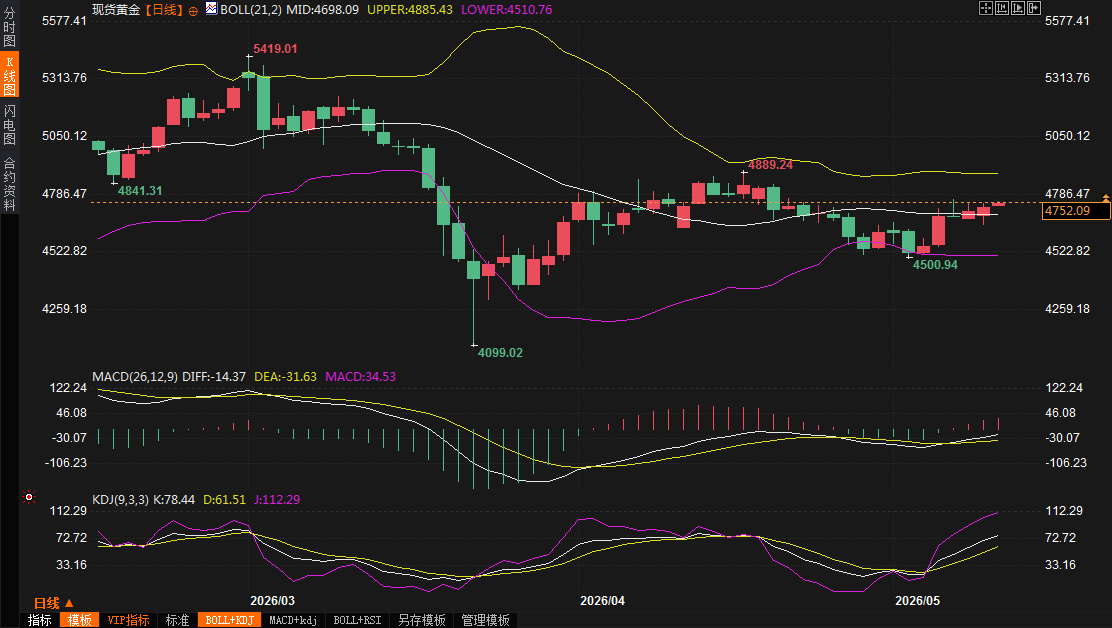
(Spot gold daily chart, source: FX678)
At 07:06 Beijing time, spot gold was trading at $4751.83 per ounce.
Geopolitical uncertainty looms, providing safe-haven support for gold prices.
Spot gold rebounded from its lows on Monday, ultimately closing up 0.4% at $4,734.63 per ounce, after hitting a low of $4,648.14 during the session. US gold futures were also largely unchanged around $4,728.70. Market participants generally believe that this volatile upward trend is mainly due to investors' continued focus on the US-Iran situation.
US President Donald Trump stated on Monday that a ceasefire agreement with Iran is "hanging by a thread." He swiftly rejected Iran's response to the US peace proposal, deeming its conditions "completely unacceptable." The 10-week-long conflict has resulted in thousands of casualties and severely disrupted global energy supplies, particularly bringing shipping in the Strait of Hormuz to a near standstill. The strait, which once handled about one-fifth of the world's crude oil and liquefied natural gas transport, now sees shipping volumes plummeting, with several oil tankers even disabling their trackers to avoid the risks.
As a result, international oil prices rebounded sharply, with Brent crude rising nearly 3% to around $104 and US crude approaching the $100 mark. The surge in oil prices directly pushed up global inflation expectations, further reinforcing market sentiment that interest rates will remain high for an extended period. While a high-interest-rate environment typically puts pressure on gold, safe-haven demand stemming from geopolitical conflicts and potential long-term inflation risks have provided significant support for gold prices. Analysts at ING Group pointed out that the stalled peace negotiations have increased short-term uncertainty, but they maintain their optimistic forecast that gold prices will rise to $5,000 per ounce by the end of the year.
Inflation data is about to be released, and the Federal Reserve's policy will be the focus.
This week, the market will face the test of key US inflation data. The Consumer Price Index (CPI) will be released on Tuesday, and the Producer Price Index (PPI) on Wednesday. Analysts expect the overall CPI to rise 0.6% month-on-month in April, with a year-on-year increase of 3.7%; the core CPI is expected to rise 2.7% year-on-year. The PPI data also faces upward pressure, and the transmission effect of oil prices warrants close observation.
U.S. Treasury yields rose on Monday, with the 10-year yield climbing to 4.404% and the two-year yield also rising significantly, reflecting market concerns about oil prices driving inflation back up. Stronger-than-expected April non-farm payroll data further reduced the likelihood of a near-term rate cut by the Federal Reserve. Institutions such as Goldman Sachs have postponed their rate cut expectations to the end of 2026. The Fed is currently in a dilemma: it needs to assess the transmission of the oil price shock to inflation while also observing whether the labor market softens further.
According to Jim Wyckoff, a market analyst at the U.S. Gold Exchange, there is currently clear buying interest on dips, as investors adjust their positions in anticipation of this week's inflation data. This position adjustment itself provides a short-term buffer for gold prices.
Multiple events have led to a divergence in global gold demand.
Besides the US-Iran situation and US data, other important events on the international stage are influencing market sentiment. President Trump will pay a two-day visit to China this week, meeting with Chinese President Xi Jinping to discuss issues such as Iran, artificial intelligence, and nuclear weapons. This diplomatic development is closely watched because China could play a significant role in resolving the Iranian issue.
On the other hand, Indian Prime Minister Modi called on the public to suspend gold purchases for the next year to protect foreign exchange reserves. As the world's second-largest gold consumer, India's statement directly led to a sharp drop in the stock prices of local jewelry retailers. However, from a global perspective, the divergence in physical gold demand has not completely suppressed gold's safe-haven appeal.
It is worth noting that spot silver performed even stronger on Monday, rising by more than 6%, showing a coordinated rebound across the precious metals sector.
Overall Outlook: Short-term fluctuations expected, but upside potential remains in the medium to long term.
The gold market is currently in a typical phase of "risk and opportunity coexisting." The protracted conflict between the US and Iran and the uncertainty surrounding the Strait of Hormuz provide a solid safe-haven floor for gold prices; while the direction of US inflation data and the Federal Reserve's policy path will determine whether gold prices can further expand their upside potential.
If this week's CPI and PPI data are higher than expected, coupled with the failure of geopolitical conflicts to ease quickly, gold prices are expected to continue to challenge higher levels. Conversely, if a substantial ceasefire signal emerges, gold prices may face some downward pressure. However, from a longer-term perspective, the $5,000 target set by institutions such as ING remains a relevant reference point—the backdrop of increasing global uncertainty and persistently high inflation risks still provides neutral to bullish support for gold.
Overall, gold, as a traditional safe-haven and inflation hedge, has once again demonstrated its unique value in the current complex international environment. Investors need to closely monitor this week's US inflation data and the progress of Trump's trip to Beijing, adjusting their strategies flexibly. Regardless of short-term fluctuations, gold's importance in global asset allocation is becoming increasingly prominent as geopolitical risks evolve. In the near future, gold prices are likely to maintain a volatile but upward trend within a high range, warranting continued attention.
(Spot gold daily chart, source: FX678)
At 07:06 Beijing time, spot gold was trading at $4751.83 per ounce.
- Risk Warning and Disclaimer
- The market involves risk, and trading may not be suitable for all investors. This article is for reference only and does not constitute personal investment advice, nor does it take into account certain users’ specific investment objectives, financial situation, or other needs. Any investment decisions made based on this information are at your own risk.