Gold prices continued their slight decline as the market awaited the US-China summit and PPI data.
2026-05-13 19:28:54
On Wednesday (May 13), during the European session, international gold prices continued their slight decline. The latest US inflation data exceeded expectations, reinforcing market expectations that the Federal Reserve would maintain a hawkish monetary policy. This pushed up the US dollar index and US Treasury yields, directly exerting significant downward pressure on gold, a non-interest-bearing asset. Market data shows that spot gold prices hovered around $4700 per ounce, a significant pullback from the three-week high of $4774. However, US gold futures prices showed relative resilience, with limited downside.
Inflation data cools expectations of interest rate cuts; market speculates on the possibility of a rate hike at the end of the year.
U.S. Consumer Price Index (CPI) data released on Tuesday signaled strong inflation, with overall U.S. inflation in April posting its largest monthly increase in three years, significantly exceeding market expectations. Core inflation also continued to strengthen, showing no signs of decline. This better-than-expected inflation report completely reversed market expectations for the Federal Reserve's accommodative monetary policy, significantly cooling expectations for interest rate cuts this year. Current market pricing indicates that the probability of the Fed starting to raise interest rates by the end of 2026 has risen to 30% to 40%, essentially solidifying expectations of a delayed monetary policy easing cycle.
Following the release of inflation data, US Treasury yields rose across the board, with the 30-year Treasury yield briefly breaking the 5% mark, reaching a new high for the period. The rising yields, coupled with expectations of tighter monetary policy, strongly supported the stabilization and recovery of the US dollar exchange rate, with the dollar index holding steady at a one-week high. Since gold does not generate interest income, its attractiveness has significantly declined in a high-yield, strong-dollar market environment, clearly indicating short-term pressure. The market focus has now shifted to the upcoming release of the US April Producer Price Index (PPI), with economists predicting a 4.9% year-on-year increase in US wholesale inflation for April. If the PPI data again exceeds expectations, it will further solidify the prevailing market view of "high interest rates remaining for a long time," continuing to put downward pressure on gold prices.
Multiple geopolitical and policy factors intertwined, providing a floor for gold prices.
Although short-term negative factors dominate gold price movements, various geopolitical uncertainties provide a safety net for gold's safe-haven demand, limiting the downside potential of gold prices. Currently, the geopolitical situation surrounding Iran remains tense, shipping risks in the Strait of Hormuz persist, and the uncertainty of Middle East geopolitical conflicts continues to escalate, providing sustained support for gold's traditional safe-haven attributes.
In addition, US President Trump will visit Beijing this Thursday and Friday for a high-level summit between the two leaders, covering key topics such as the situation in Iran, US-China trade relations, and overall bilateral relations. The market is closely watching the outcome of this summit. If geopolitical risks ease, safe-haven demand for gold will likely decline, further limiting the upside potential of gold prices.
Besides the international geopolitical situation, India's new gold import policy has also impacted the regional gold market. To curb overseas gold imports and stabilize the country's foreign exchange reserves, India has officially raised import tariffs on gold and silver to 15%. In the short term, this policy will suppress India's gold import demand and weaken the momentum of physical gold consumption, but at the same time, it will reduce the outflow of domestic gold supply, which is expected to support a stabilization and strengthening of domestic gold prices in India.
In other market sectors, geopolitical risks in the Middle East have pushed up international oil prices, and the continued rise in crude oil prices has further exacerbated global inflation anxieties, indirectly reinforcing the Federal Reserve's hawkish policy stance. This has a dual impact on gold prices: on the one hand, rising inflation benefits gold's anti-inflationary properties, providing safe-haven support; on the other hand, it forces the Federal Reserve to maintain a tight monetary policy, which in turn suppresses gold price increases. At the same time, structural demand from global central banks continuing to purchase gold, market funds reducing their holdings of fiat currency, and allocating gold to diversify risk has become a core long-term positive factor supporting gold prices, helping gold hold key support levels and avoid a deep correction.
Analyst Opinions
Kyle Rhoda, senior financial market analyst at Capital.com, said: "The strong U.S. inflation data has essentially weakened or even eliminated all market expectations for a Fed rate cut. The market is now even pricing in a high probability that the Fed will start a rate hike cycle by the end of the year, and this expectation has directly put significant downward pressure on gold prices."
UBS analyst Giovanni Stanovo holds a relatively neutral view: "Yesterday's better-than-expected inflation data will prompt the Federal Reserve to keep interest rates unchanged for a longer period, but the Fed will still maintain an overall accommodative stance. This policy pattern will likely keep gold in a range-bound trading pattern in the short term, with little chance of a one-sided rise or fall. Overall, US economic data will continue to dominate gold price movements, and if US economic growth slows down in the future, it will provide support for gold prices to rise."
Anan Rashid Securities commodities and foreign exchange research analyst Wedika Navkar points out that, considering India's tariff increase policy and the overall global market environment, Indian domestic gold prices will gradually align with international gold prices in the future. Although rising US Treasury yields and uncertainty surrounding Federal Reserve policy have put short-term upward pressure on gold prices, the medium- to long-term outlook for gold remains positive, and the structural upward trend has not been broken.
Technical Analysis and Outlook
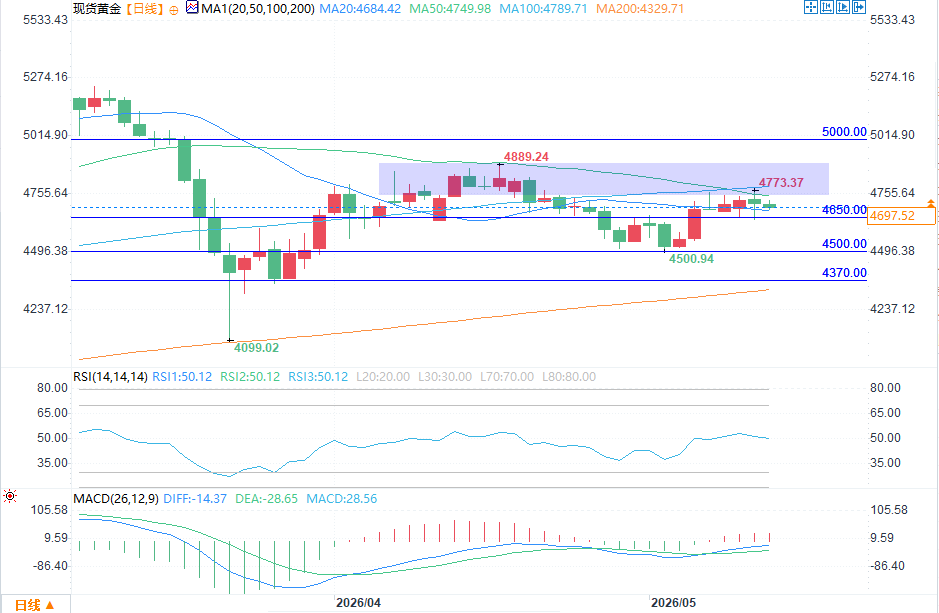
(Spot gold daily chart source: FX678)
From a technical perspective, the current rebound in gold prices has encountered resistance near the 50-day simple moving average (SMA) and the downward trend line. The core resistance range is concentrated between $4,750 and $4,890 per ounce. Currently, gold prices are in a short-term consolidation and correction phase, with bulls and bears locked in a battle.
On the downside risk front, if gold prices fail to break through the resistance of the 50-day moving average, they will likely fall back to test the support level near $4,650/oz. If this support is breached, gold prices will further decline to $4,500/oz, with the ultimate retracement target being the 50% Fibonacci retracement level near $4,370/oz.
The bullish trigger conditions are clear and explicit. If gold prices break strongly through the resistance zone of $4,750 to $4,890 per ounce and hold above it, it will open up upward space and is expected to challenge the $5,000 per ounce mark. At the same time, it will completely repair the short-term weak technical structure and reverse the oscillating and corrective pattern.
Overall, gold has shown strong resilience in the $4,600-$4,700/ounce range, supported by geopolitical safe-haven demand and the structural benefits of continued global central bank gold purchases, with solid bottom support. However, a strong US dollar and persistently high real yields continue to limit the short-term upside potential of gold prices. Short-term market volatility will be mainly driven by US PPI inflation data, the latest news from the US-China summit, and the trend of the US dollar index. In the medium to long term, core positive factors such as central bank gold purchases and global asset diversification remain stable. Several major financial institutions predict that international gold prices may reach the high range of $5,000-$6,300/ounce by the end of 2026.
At 19:26 Beijing time, spot gold was trading at $4,697.10 per ounce, down 0.38%.
Inflation data cools expectations of interest rate cuts; market speculates on the possibility of a rate hike at the end of the year.
U.S. Consumer Price Index (CPI) data released on Tuesday signaled strong inflation, with overall U.S. inflation in April posting its largest monthly increase in three years, significantly exceeding market expectations. Core inflation also continued to strengthen, showing no signs of decline. This better-than-expected inflation report completely reversed market expectations for the Federal Reserve's accommodative monetary policy, significantly cooling expectations for interest rate cuts this year. Current market pricing indicates that the probability of the Fed starting to raise interest rates by the end of 2026 has risen to 30% to 40%, essentially solidifying expectations of a delayed monetary policy easing cycle.
Following the release of inflation data, US Treasury yields rose across the board, with the 30-year Treasury yield briefly breaking the 5% mark, reaching a new high for the period. The rising yields, coupled with expectations of tighter monetary policy, strongly supported the stabilization and recovery of the US dollar exchange rate, with the dollar index holding steady at a one-week high. Since gold does not generate interest income, its attractiveness has significantly declined in a high-yield, strong-dollar market environment, clearly indicating short-term pressure. The market focus has now shifted to the upcoming release of the US April Producer Price Index (PPI), with economists predicting a 4.9% year-on-year increase in US wholesale inflation for April. If the PPI data again exceeds expectations, it will further solidify the prevailing market view of "high interest rates remaining for a long time," continuing to put downward pressure on gold prices.
Multiple geopolitical and policy factors intertwined, providing a floor for gold prices.
Although short-term negative factors dominate gold price movements, various geopolitical uncertainties provide a safety net for gold's safe-haven demand, limiting the downside potential of gold prices. Currently, the geopolitical situation surrounding Iran remains tense, shipping risks in the Strait of Hormuz persist, and the uncertainty of Middle East geopolitical conflicts continues to escalate, providing sustained support for gold's traditional safe-haven attributes.
In addition, US President Trump will visit Beijing this Thursday and Friday for a high-level summit between the two leaders, covering key topics such as the situation in Iran, US-China trade relations, and overall bilateral relations. The market is closely watching the outcome of this summit. If geopolitical risks ease, safe-haven demand for gold will likely decline, further limiting the upside potential of gold prices.
Besides the international geopolitical situation, India's new gold import policy has also impacted the regional gold market. To curb overseas gold imports and stabilize the country's foreign exchange reserves, India has officially raised import tariffs on gold and silver to 15%. In the short term, this policy will suppress India's gold import demand and weaken the momentum of physical gold consumption, but at the same time, it will reduce the outflow of domestic gold supply, which is expected to support a stabilization and strengthening of domestic gold prices in India.
In other market sectors, geopolitical risks in the Middle East have pushed up international oil prices, and the continued rise in crude oil prices has further exacerbated global inflation anxieties, indirectly reinforcing the Federal Reserve's hawkish policy stance. This has a dual impact on gold prices: on the one hand, rising inflation benefits gold's anti-inflationary properties, providing safe-haven support; on the other hand, it forces the Federal Reserve to maintain a tight monetary policy, which in turn suppresses gold price increases. At the same time, structural demand from global central banks continuing to purchase gold, market funds reducing their holdings of fiat currency, and allocating gold to diversify risk has become a core long-term positive factor supporting gold prices, helping gold hold key support levels and avoid a deep correction.
Analyst Opinions
Kyle Rhoda, senior financial market analyst at Capital.com, said: "The strong U.S. inflation data has essentially weakened or even eliminated all market expectations for a Fed rate cut. The market is now even pricing in a high probability that the Fed will start a rate hike cycle by the end of the year, and this expectation has directly put significant downward pressure on gold prices."
UBS analyst Giovanni Stanovo holds a relatively neutral view: "Yesterday's better-than-expected inflation data will prompt the Federal Reserve to keep interest rates unchanged for a longer period, but the Fed will still maintain an overall accommodative stance. This policy pattern will likely keep gold in a range-bound trading pattern in the short term, with little chance of a one-sided rise or fall. Overall, US economic data will continue to dominate gold price movements, and if US economic growth slows down in the future, it will provide support for gold prices to rise."
Anan Rashid Securities commodities and foreign exchange research analyst Wedika Navkar points out that, considering India's tariff increase policy and the overall global market environment, Indian domestic gold prices will gradually align with international gold prices in the future. Although rising US Treasury yields and uncertainty surrounding Federal Reserve policy have put short-term upward pressure on gold prices, the medium- to long-term outlook for gold remains positive, and the structural upward trend has not been broken.
Technical Analysis and Outlook
(Spot gold daily chart source: FX678)
From a technical perspective, the current rebound in gold prices has encountered resistance near the 50-day simple moving average (SMA) and the downward trend line. The core resistance range is concentrated between $4,750 and $4,890 per ounce. Currently, gold prices are in a short-term consolidation and correction phase, with bulls and bears locked in a battle.
On the downside risk front, if gold prices fail to break through the resistance of the 50-day moving average, they will likely fall back to test the support level near $4,650/oz. If this support is breached, gold prices will further decline to $4,500/oz, with the ultimate retracement target being the 50% Fibonacci retracement level near $4,370/oz.
The bullish trigger conditions are clear and explicit. If gold prices break strongly through the resistance zone of $4,750 to $4,890 per ounce and hold above it, it will open up upward space and is expected to challenge the $5,000 per ounce mark. At the same time, it will completely repair the short-term weak technical structure and reverse the oscillating and corrective pattern.
Overall, gold has shown strong resilience in the $4,600-$4,700/ounce range, supported by geopolitical safe-haven demand and the structural benefits of continued global central bank gold purchases, with solid bottom support. However, a strong US dollar and persistently high real yields continue to limit the short-term upside potential of gold prices. Short-term market volatility will be mainly driven by US PPI inflation data, the latest news from the US-China summit, and the trend of the US dollar index. In the medium to long term, core positive factors such as central bank gold purchases and global asset diversification remain stable. Several major financial institutions predict that international gold prices may reach the high range of $5,000-$6,300/ounce by the end of 2026.
At 19:26 Beijing time, spot gold was trading at $4,697.10 per ounce, down 0.38%.
- Risk Warning and Disclaimer
- The market involves risk, and trading may not be suitable for all investors. This article is for reference only and does not constitute personal investment advice, nor does it take into account certain users’ specific investment objectives, financial situation, or other needs. Any investment decisions made based on this information are at your own risk.