Global oil supply suffers its worst disruption in history; International Energy Agency: 14 million barrels of crude oil disappear daily, sky-high oil prices on the way.
2026-05-14 10:00:49
The International Energy Agency (IEA) said on Wednesday (May 13) that global oil supply will be unable to meet total demand in 2026 due to the war in Iran severely disrupting Middle Eastern oil production and depleting inventories at an unprecedented rate, completely overturning the agency's previous forecast of a supply surplus.
The IEA points out that the war between the United States and Israel and Iran, the damage to oil infrastructure, and the de facto blockade of the Strait of Hormuz have triggered the worst oil supply crisis in history, causing oil prices to soar.

In its monthly report, the IEA noted that due to continued restrictions on tanker passage through the Strait of Hormuz, the cumulative supply loss for oil-producing countries in the Middle East Gulf has exceeded 1 billion barrels, with more than 14 million barrels of crude oil currently unable to be produced per day, constituting an "unprecedented supply shock."
The report states that global oil inventories are being depleted at a record pace as importing countries face unprecedented disruptions to Middle Eastern supplies. Global oil inventories fell by 246 million barrels in March and April, which could further exacerbate price volatility ahead of the peak summer demand season.
The IEA’s forecast shows that oil supply will be 1.78 million barrels per day lower than total demand in 2026, completely wiping out the 410,000 barrels per day surplus predicted in last month’s report and the nearly 4 million barrels per day surplus in December’s report.
The agency stated that even assuming the conflict ends in early June, the market will still face a severe supply shortage until the end of the third quarter of 2026, with a deficit of up to 6 million barrels per day in the second quarter. The baseline scenario predicts that cross-strait shipping will gradually recover from the third quarter, potentially leading to a "slight surplus" in the market in the fourth quarter, allowing depleted inventories to begin rebuilding.
Due to the impact of the war, the IEA projects a decrease of approximately 3.9 million barrels per day (bpd) in global crude oil supply by 2026, a significant downward revision from its previous forecast of a 1.5 million bpd decline. Simultaneously, the war is also putting pressure on oil consumption: due to soaring oil prices leading to shrinking demand and slower economic growth, the IEA has lowered its demand decline forecast for this year from 80,000 bpd to 420,000 bpd. Currently, the petrochemical and aviation industries are most affected, but rising oil prices, a weak economic environment, and fuel-saving measures will have an increasingly significant impact on fuel use.
OPEC's report released Wednesday also highlighted the production decline, showing that due to ongoing disruptions in the Strait of Hormuz, OPEC+'s average daily output in April was only 33.19 million barrels, a further decrease from March and well below the level needed to balance the market. OPEC also lowered its 2026 oil demand forecast, but unlike the IEA, it still expects demand to grow this year. Due to the war, the IEA announced a postponement of its first supply and demand forecast for 2027 and its annual oil report for 2026.
The IEA report paints a grim picture of the global oil market: the de facto blockade of the Strait of Hormuz has resulted in a loss of over 14 million barrels of crude oil per day, with cumulative losses exceeding 1 billion barrels, and global inventories are being depleted at a record rate. Even if the conflict ends in early June, the shortage will persist into the third quarter. While the supply side is suffering a severe blow, high oil prices are also beginning to negatively impact demand. This most severe oil supply crisis in history will continue to support high oil prices and exacerbate uncertainty surrounding the global economic and inflationary outlook.
Morgan Asset Management believes that U.S. consumers and businesses view the current surge in energy prices as a "temporary phenomenon," which helps avoid a broader economic slowdown; while Europe, heavily reliant on energy imports, faces the dual risks of weak growth and rising inflation.
Morgan Stanley has warned that the oil market is facing a "race against time"—if the Strait of Hormuz remains closed until June, the buffer against rising oil prices will fail. Analyst Martijn Rats emphasized that the window of opportunity for developments is crucial; any delay could cause oil prices to surge rapidly.
Looking at the daily chart for US crude oil, the current price is trading around $100.94, remaining within a strong upward channel that began in February 2026. Influenced by the Iran war and the blockade of the Strait of Hormuz, oil prices surged from around $60 at the end of February and are currently consolidating in a high-level range.
In terms of the moving average system, a textbook bullish pattern is presented. Specifically, the four moving averages—MA20 (97.81), MA50 (96.58), MA100 (79.54), and MA200 (70.28)—are arranged from bottom to top, with the short-term moving average at the top and the long-term moving average at the bottom. This is a typical bullish trend signal, indicating that the medium- to long-term upward trend in oil prices remains strong. The current price is approximately $100.94, higher than all major moving averages, especially more than $3 above the MA20, showing that bullish forces still dominate. It is worth noting that the MA20 and MA50 are highly converging in the $97-98 area, forming a strong support zone below; while the MA100 and MA200 are located at 79.54 and 70.28 respectively, which are far from the current price, meaning that even if a pullback occurs, the threshold for a medium-term trend reversal is quite high.
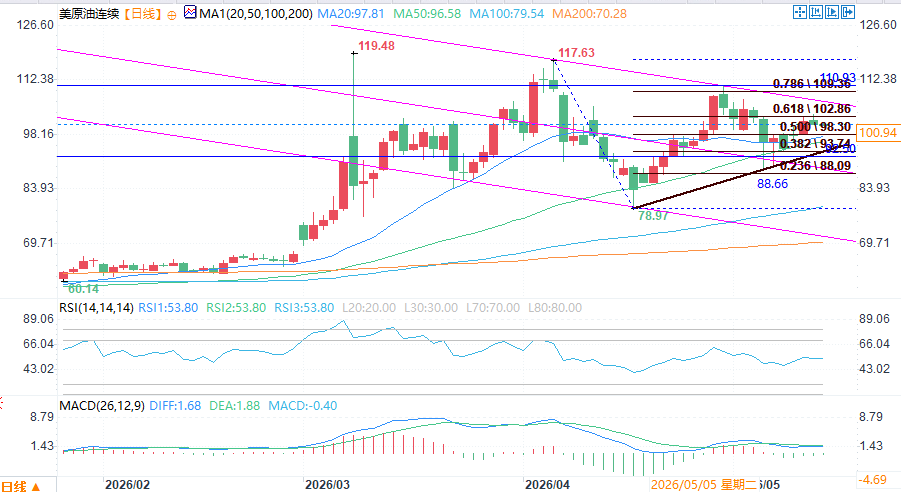
(US crude oil futures daily chart, source: FX678)
At 10:00 AM Beijing time on May 14, US crude oil futures were trading at $101.09 per barrel.
The IEA points out that the war between the United States and Israel and Iran, the damage to oil infrastructure, and the de facto blockade of the Strait of Hormuz have triggered the worst oil supply crisis in history, causing oil prices to soar.
Supply losses exceed 1 billion barrels, and inventories are being depleted at a record rate.
In its monthly report, the IEA noted that due to continued restrictions on tanker passage through the Strait of Hormuz, the cumulative supply loss for oil-producing countries in the Middle East Gulf has exceeded 1 billion barrels, with more than 14 million barrels of crude oil currently unable to be produced per day, constituting an "unprecedented supply shock."
The report states that global oil inventories are being depleted at a record pace as importing countries face unprecedented disruptions to Middle Eastern supplies. Global oil inventories fell by 246 million barrels in March and April, which could further exacerbate price volatility ahead of the peak summer demand season.
Outlook – Shortages to continue into the third quarter, with a slight surplus possible in the fourth quarter.
The IEA’s forecast shows that oil supply will be 1.78 million barrels per day lower than total demand in 2026, completely wiping out the 410,000 barrels per day surplus predicted in last month’s report and the nearly 4 million barrels per day surplus in December’s report.
The agency stated that even assuming the conflict ends in early June, the market will still face a severe supply shortage until the end of the third quarter of 2026, with a deficit of up to 6 million barrels per day in the second quarter. The baseline scenario predicts that cross-strait shipping will gradually recover from the third quarter, potentially leading to a "slight surplus" in the market in the fourth quarter, allowing depleted inventories to begin rebuilding.
A double whammy of supply and demand – supply decreased by 3.9 million barrels per day, while demand also came under pressure.
Due to the impact of the war, the IEA projects a decrease of approximately 3.9 million barrels per day (bpd) in global crude oil supply by 2026, a significant downward revision from its previous forecast of a 1.5 million bpd decline. Simultaneously, the war is also putting pressure on oil consumption: due to soaring oil prices leading to shrinking demand and slower economic growth, the IEA has lowered its demand decline forecast for this year from 80,000 bpd to 420,000 bpd. Currently, the petrochemical and aviation industries are most affected, but rising oil prices, a weak economic environment, and fuel-saving measures will have an increasingly significant impact on fuel use.
OPEC report confirms production decline, IEA report's schedule delayed due to war.
OPEC's report released Wednesday also highlighted the production decline, showing that due to ongoing disruptions in the Strait of Hormuz, OPEC+'s average daily output in April was only 33.19 million barrels, a further decrease from March and well below the level needed to balance the market. OPEC also lowered its 2026 oil demand forecast, but unlike the IEA, it still expects demand to grow this year. Due to the war, the IEA announced a postponement of its first supply and demand forecast for 2027 and its annual oil report for 2026.
The worst supply shock in history continues to pose a risk of high oil prices.
The IEA report paints a grim picture of the global oil market: the de facto blockade of the Strait of Hormuz has resulted in a loss of over 14 million barrels of crude oil per day, with cumulative losses exceeding 1 billion barrels, and global inventories are being depleted at a record rate. Even if the conflict ends in early June, the shortage will persist into the third quarter. While the supply side is suffering a severe blow, high oil prices are also beginning to negatively impact demand. This most severe oil supply crisis in history will continue to support high oil prices and exacerbate uncertainty surrounding the global economic and inflationary outlook.
The buffer mechanism is being exhausted, and an explosive surge in oil prices is imminent.
Morgan Asset Management believes that U.S. consumers and businesses view the current surge in energy prices as a "temporary phenomenon," which helps avoid a broader economic slowdown; while Europe, heavily reliant on energy imports, faces the dual risks of weak growth and rising inflation.
Morgan Stanley has warned that the oil market is facing a "race against time"—if the Strait of Hormuz remains closed until June, the buffer against rising oil prices will fail. Analyst Martijn Rats emphasized that the window of opportunity for developments is crucial; any delay could cause oil prices to surge rapidly.
Looking at the daily chart for US crude oil, the current price is trading around $100.94, remaining within a strong upward channel that began in February 2026. Influenced by the Iran war and the blockade of the Strait of Hormuz, oil prices surged from around $60 at the end of February and are currently consolidating in a high-level range.
In terms of the moving average system, a textbook bullish pattern is presented. Specifically, the four moving averages—MA20 (97.81), MA50 (96.58), MA100 (79.54), and MA200 (70.28)—are arranged from bottom to top, with the short-term moving average at the top and the long-term moving average at the bottom. This is a typical bullish trend signal, indicating that the medium- to long-term upward trend in oil prices remains strong. The current price is approximately $100.94, higher than all major moving averages, especially more than $3 above the MA20, showing that bullish forces still dominate. It is worth noting that the MA20 and MA50 are highly converging in the $97-98 area, forming a strong support zone below; while the MA100 and MA200 are located at 79.54 and 70.28 respectively, which are far from the current price, meaning that even if a pullback occurs, the threshold for a medium-term trend reversal is quite high.
(US crude oil futures daily chart, source: FX678)
At 10:00 AM Beijing time on May 14, US crude oil futures were trading at $101.09 per barrel.
- Risk Warning and Disclaimer
- The market involves risk, and trading may not be suitable for all investors. This article is for reference only and does not constitute personal investment advice, nor does it take into account certain users’ specific investment objectives, financial situation, or other needs. Any investment decisions made based on this information are at your own risk.