A chart: Baltic Dry Index rises to a more than five-month high.
2026-05-14 22:40:01
Latest data shows that the Baltic Dry Index (BDI) reached 3195 points on May 14, 2026, a new high since December 4, 2023, up 0.19% month-on-month, marking the fourth consecutive day of increase (including zero growth). Looking at the short-term charts, the recent 11 BDI data points show: 9 positive increases, 2 negative increases, and 0 zero increases. Specifically, the Panamax Freight Index (BPI) was 2503 points, up 2.00% from the previous value; the Capesize Freight Index (BCI) was 5316 points, down 0.45%; and the Supramax Freight Index (BSI) was 1558 points, up 0.32%. For detailed 720-day and 10-year trend charts of the Baltic Dry Index and its three main sub-indices, please refer to the specially designed charts.
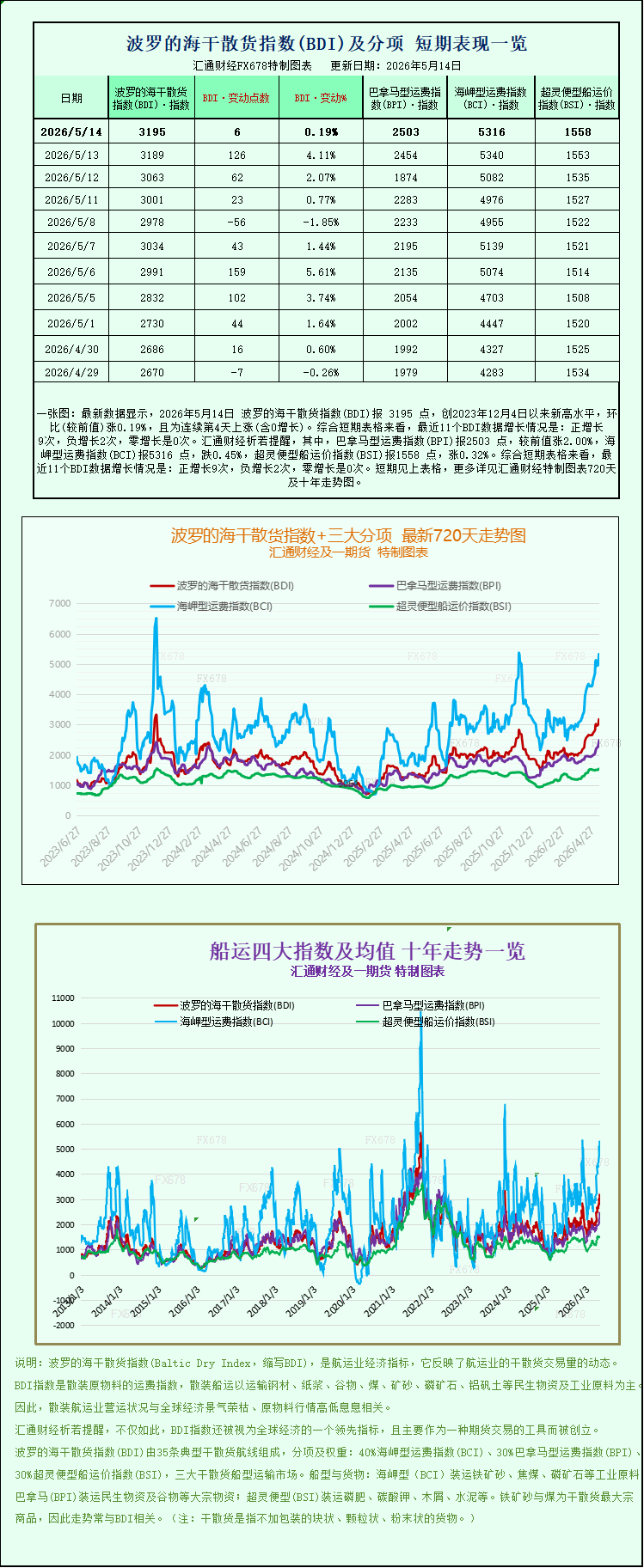
The Baltic Dry Index, which tracks global dry bulk shipping rates, rose slightly on Thursday, climbing to its highest level in more than five months. The main driver of this rise was significant gains in the Panamax and Supramax sectors, whose strong performance effectively offset a slight decline in the Capesize sector, ultimately pushing the overall index into positive territory. This reflects the current structural divergence in the dry bulk shipping market.
As a core indicator for measuring the health of the global dry bulk shipping market, the Baltic Dry Index, which covers freight rates for the three major types of vessels—Capesize, Panamax, and Supramax—rose 6 points, or 0.2%, to close at 3195 points. This figure is the highest since December 5th of last year, indicating that the dry bulk shipping market is showing signs of recovery and market activity has improved compared to before.
Looking specifically at the performance of various shipping sub-sectors, the Capesize shipping sector was the only one to decline on the day. The Capesize shipping index fell 24 points, a decrease of 0.5%, closing at 5316 points. Simultaneously, the operating income of this type of vessel also declined. As a core operating indicator for Capesize vessels, those capable of carrying 150,000 tons of cargo (mainly iron ore, coal, and other bulk commodities) saw their average daily revenue decrease by $224 from the previous trading day, ultimately falling to $44,706. This decline is closely related to short-term fluctuations in the global iron ore market. It is understood that Dalian iron ore futures closed flat on Thursday, ending a two-day losing streak. Traders are currently closely weighing the contradiction between weak demand for Chinese steel products and the expected increase in iron ore production next week. This market uncertainty directly affects the freight rates for Capesize vessels.
In stark contrast to the sluggish performance of the Capesize shipping sector, the Panamax sector shone, becoming a key driver of the overall index's rise. The Panamax index rose 49 points, or 2%, to close at 2503 points, significantly outperforming the overall index. Correspondingly, the operating revenue of Panamax vessels also increased substantially. These vessels, which typically carry 60,000 to 70,000 tons of cargo such as coal or grain, saw their average daily revenue increase by $445, ultimately reaching $22,528. This demonstrates the continued recovery in global demand for bulk cargo transportation such as coal and grain, providing strong support for Panamax freight rates.
Within the smaller shipping sector, the Supramax index also performed well, becoming another important support for the overall index's upward movement. Although specific gains and revenue data for this sector were not further disclosed, as a crucial component of the dry bulk shipping market, Supramax vessels primarily handle small and medium-sized bulk cargo transportation. Their freight rate increases fully reflect the recovery in global demand for small and medium-sized bulk cargo transportation. Together with the Panamax sector, this offset the decline in the Capesize sector, propelling the Baltic Dry Index to achieve a breakthrough and stabilize at its highest level in over five months.
The Baltic Dry Index, which tracks global dry bulk shipping rates, rose slightly on Thursday, climbing to its highest level in more than five months. The main driver of this rise was significant gains in the Panamax and Supramax sectors, whose strong performance effectively offset a slight decline in the Capesize sector, ultimately pushing the overall index into positive territory. This reflects the current structural divergence in the dry bulk shipping market.
As a core indicator for measuring the health of the global dry bulk shipping market, the Baltic Dry Index, which covers freight rates for the three major types of vessels—Capesize, Panamax, and Supramax—rose 6 points, or 0.2%, to close at 3195 points. This figure is the highest since December 5th of last year, indicating that the dry bulk shipping market is showing signs of recovery and market activity has improved compared to before.
Looking specifically at the performance of various shipping sub-sectors, the Capesize shipping sector was the only one to decline on the day. The Capesize shipping index fell 24 points, a decrease of 0.5%, closing at 5316 points. Simultaneously, the operating income of this type of vessel also declined. As a core operating indicator for Capesize vessels, those capable of carrying 150,000 tons of cargo (mainly iron ore, coal, and other bulk commodities) saw their average daily revenue decrease by $224 from the previous trading day, ultimately falling to $44,706. This decline is closely related to short-term fluctuations in the global iron ore market. It is understood that Dalian iron ore futures closed flat on Thursday, ending a two-day losing streak. Traders are currently closely weighing the contradiction between weak demand for Chinese steel products and the expected increase in iron ore production next week. This market uncertainty directly affects the freight rates for Capesize vessels.
In stark contrast to the sluggish performance of the Capesize shipping sector, the Panamax sector shone, becoming a key driver of the overall index's rise. The Panamax index rose 49 points, or 2%, to close at 2503 points, significantly outperforming the overall index. Correspondingly, the operating revenue of Panamax vessels also increased substantially. These vessels, which typically carry 60,000 to 70,000 tons of cargo such as coal or grain, saw their average daily revenue increase by $445, ultimately reaching $22,528. This demonstrates the continued recovery in global demand for bulk cargo transportation such as coal and grain, providing strong support for Panamax freight rates.
Within the smaller shipping sector, the Supramax index also performed well, becoming another important support for the overall index's upward movement. Although specific gains and revenue data for this sector were not further disclosed, as a crucial component of the dry bulk shipping market, Supramax vessels primarily handle small and medium-sized bulk cargo transportation. Their freight rate increases fully reflect the recovery in global demand for small and medium-sized bulk cargo transportation. Together with the Panamax sector, this offset the decline in the Capesize sector, propelling the Baltic Dry Index to achieve a breakthrough and stabilize at its highest level in over five months.
- Risk Warning and Disclaimer
- The market involves risk, and trading may not be suitable for all investors. This article is for reference only and does not constitute personal investment advice, nor does it take into account certain users’ specific investment objectives, financial situation, or other needs. Any investment decisions made based on this information are at your own risk.