Gold prices fluctuated, pressured by both geopolitical factors and expectations surrounding the Federal Reserve.
2026-05-15 01:56:13
On Thursday (May 14), during the US trading session, international gold prices continued their weakness. Spot gold was quoted at $4,681.56 per ounce, down $7.15 from the previous trading day, a decrease of 0.15%. It briefly touched an intraday high of $4,718.50 before retreating, opening at $4,692.35. US gold futures for June delivery also declined, falling 0.2% to $4,695.80. Overall, gold prices were pressured below the $4,700 mark, and the bulls failed to hold this key psychological level.
A stronger dollar puts pressure on precious metals.
The US dollar index rose 0.2% on the day, making dollar-denominated gold relatively more expensive for investors holding other currencies, thus posing a direct obstacle to further gold price increases. The US dollar index (DXY) remained around 98.54, near a one-week high.
Meanwhile, the yield on the 10-year US Treasury note remained around 4.4%, further diminishing gold's appeal. Tradu.com senior market analyst Nikos Zaboras noted, "Gold currently lacks a clear direction as markets weigh the ongoing geopolitical uncertainty, the economic impact of the Middle East conflict, and hopes that a meeting between Trump and Xi Jinping will ease tensions."
FXStreet analyst Vishal Chaturvedi added that buyers' lack of willingness to push gold prices higher stems from the market's widespread expectation that the Federal Reserve will maintain high interest rates for an extended period, an expectation that continues to dampen market sentiment.
It's worth noting that the recent pullback in gold prices from their intraday high of $4,718.50 was likely triggered by significant movements in the oil market. WTI crude oil rebounded slightly to $101.53, a 0.50% increase, while Brent crude also rose to $105.60. This rise in oil prices somewhat alleviated extreme market concerns about supply disruptions in the Strait of Hormuz, leading to a contraction in gold's safe-haven premium.
Meanwhile, Bart Melek, global head of commodities strategy at TD Securities, had previously warned that gold prices risked a significant pullback should the situation in the Middle East ease. However, rising oil prices are a double-edged sword – while compressing safe-haven demand, they also further reinforce inflation expectations, pushing up government bond yields and thus exerting additional downward pressure on gold, which does not generate returns. Combined with the backdrop of a continuously strengthening US dollar, the interplay of multiple forces may be the fundamental reason for the ultimate pressure on gold prices, but the market is still uncertain.
Situation in the Strait of Hormuz
The Strait of Hormuz remains the most closely watched geopolitical risk point in the energy and metals markets. With the ongoing conflict involving Iran lasting over two months, the risk of supply disruptions to this vital global energy route remains highly sensitive. Iranian state media reported that approximately 30 ships recently transited the Strait of Hormuz, and reports of attacks on ships in the vicinity have also surfaced. This news initially put downward pressure on oil prices during trading.
The International Energy Agency has warned that current supply disruptions are "depleting global oil inventories at an unprecedented rate." Melek stated, "If the Middle East conflict remains unresolved, there is a risk of a sharp drop in gold prices." He also warned that energy product inventories and supplies could tighten to the point of causing a sharp price increase, which could further drive up overall inflation.
This logic creates a dual effect on gold: on the one hand, safe-haven demand supports gold prices; on the other hand, rising oil prices push up inflation expectations, which in turn raises government bond yields, thus constraining gold prices.
China-US summit
US President Donald Trump arrived in Beijing for a two-day summit with Chinese President Donald Trump. During the talks, the two sides exchanged in-depth views on major issues including economic and trade cooperation, the Taiwan issue, and the situation in Iran. According to a post-meeting statement released by the White House, the two sides agreed to expand market access for US companies in China and welcomed China's increased investment in the US. Both leaders agreed that the unimpeded passage through the Strait of Hormuz must be guaranteed and unanimously opposed Iran's development of nuclear weapons.
The meeting reached some consensus but also acknowledged existing differences. The Chinese side clearly stated during the talks that positive progress had been made in the China-US trade consultations, but the Taiwan issue, as the most important and sensitive core issue in China-US relations, still presents significant differences in position between the two sides. Improper handling could pose a serious challenge to the stability of bilateral relations. It is noteworthy that the US-released summary of the talks did not mention the Taiwan issue.
The market's interpretation of the meeting between the Chinese and US leaders was divided, which was also an important factor contributing to the volatile and unclear direction of international gold prices that day.
hawkish stance of the Federal Reserve
According to the CME Group's FedWatch tool, the market has largely priced in the possibility of a U.S. interest rate cut this year, driven by a sharp rise in U.S. producer and consumer prices in April—primarily due to persistently high energy costs. Traders currently expect the Federal Reserve to likely raise rates before the end of the year.
Boston Federal Reserve President Susan Collins stated clearly on Wednesday that the U.S. central bank may need to raise interest rates further to curb inflationary pressures, and expects the Fed to maintain a tight monetary policy stance for some time to come. She also noted that job growth over the past year has been generally balanced, and the unemployment rate is "relatively low."
Retail sales data also confirmed the economy's resilience: retail sales rose 0.5% month-on-month in April, while the March increase was revised to 1.6%. In the week ending May 9, initial jobless claims rose by 12,000 to 211,000, indicating that the labor market is generally solid but no longer in a state of contraction.
Although gold has historically been regarded as a tool to hedge against inflation, higher interest rates often put pressure on this non-yielding metal, and the current tug-of-war between the two is the core contradiction that has led to the gold price falling into a range-bound oscillation.
India restricts gold imports
New variables have also emerged on the demand side. The Indian government announced that, under its pre-authorization scheme, the cap on gold imports has been set at 100 kilograms per shipment, with certain exemptions granted to Indian exporters. This move aims to control the scale of imports and may have some impact on the global gold demand structure. The market will continue to monitor the implementation of this policy and its actual impact on physical demand.
Technical Analysis: Clear Bull-Bear Lines
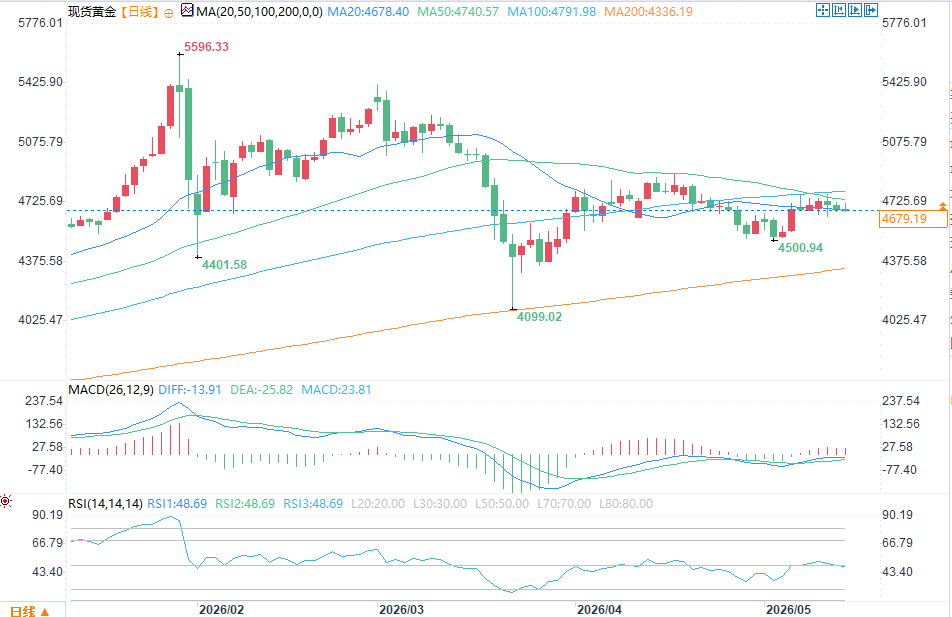
(Spot gold daily chart source: FX678)
From a technical perspective, XAU/USD is currently still between the 21-day moving average and the 50-day moving average. Momentum indicators suggest that the market is in a neutral state overall, with price movements exhibiting a range-bound pattern.
The bulls' near-term target is to push gold prices above the resistance zone of $4,711 to $4,723. If the rise continues, the next target price is $4,774. The bears, on the other hand, hope that gold prices will fall below $4,686, with a further downside target of $4,561.
The first resistance level is at $4,711, followed by $4,723; the first support level is at $4,697, followed by $4,686.
At 01:50 Beijing time, spot gold was trading at $4,679.97 per ounce, down 0.19%.
A stronger dollar puts pressure on precious metals.
The US dollar index rose 0.2% on the day, making dollar-denominated gold relatively more expensive for investors holding other currencies, thus posing a direct obstacle to further gold price increases. The US dollar index (DXY) remained around 98.54, near a one-week high.
Meanwhile, the yield on the 10-year US Treasury note remained around 4.4%, further diminishing gold's appeal. Tradu.com senior market analyst Nikos Zaboras noted, "Gold currently lacks a clear direction as markets weigh the ongoing geopolitical uncertainty, the economic impact of the Middle East conflict, and hopes that a meeting between Trump and Xi Jinping will ease tensions."
FXStreet analyst Vishal Chaturvedi added that buyers' lack of willingness to push gold prices higher stems from the market's widespread expectation that the Federal Reserve will maintain high interest rates for an extended period, an expectation that continues to dampen market sentiment.
It's worth noting that the recent pullback in gold prices from their intraday high of $4,718.50 was likely triggered by significant movements in the oil market. WTI crude oil rebounded slightly to $101.53, a 0.50% increase, while Brent crude also rose to $105.60. This rise in oil prices somewhat alleviated extreme market concerns about supply disruptions in the Strait of Hormuz, leading to a contraction in gold's safe-haven premium.
Meanwhile, Bart Melek, global head of commodities strategy at TD Securities, had previously warned that gold prices risked a significant pullback should the situation in the Middle East ease. However, rising oil prices are a double-edged sword – while compressing safe-haven demand, they also further reinforce inflation expectations, pushing up government bond yields and thus exerting additional downward pressure on gold, which does not generate returns. Combined with the backdrop of a continuously strengthening US dollar, the interplay of multiple forces may be the fundamental reason for the ultimate pressure on gold prices, but the market is still uncertain.
Situation in the Strait of Hormuz
The Strait of Hormuz remains the most closely watched geopolitical risk point in the energy and metals markets. With the ongoing conflict involving Iran lasting over two months, the risk of supply disruptions to this vital global energy route remains highly sensitive. Iranian state media reported that approximately 30 ships recently transited the Strait of Hormuz, and reports of attacks on ships in the vicinity have also surfaced. This news initially put downward pressure on oil prices during trading.
The International Energy Agency has warned that current supply disruptions are "depleting global oil inventories at an unprecedented rate." Melek stated, "If the Middle East conflict remains unresolved, there is a risk of a sharp drop in gold prices." He also warned that energy product inventories and supplies could tighten to the point of causing a sharp price increase, which could further drive up overall inflation.
This logic creates a dual effect on gold: on the one hand, safe-haven demand supports gold prices; on the other hand, rising oil prices push up inflation expectations, which in turn raises government bond yields, thus constraining gold prices.
China-US summit
US President Donald Trump arrived in Beijing for a two-day summit with Chinese President Donald Trump. During the talks, the two sides exchanged in-depth views on major issues including economic and trade cooperation, the Taiwan issue, and the situation in Iran. According to a post-meeting statement released by the White House, the two sides agreed to expand market access for US companies in China and welcomed China's increased investment in the US. Both leaders agreed that the unimpeded passage through the Strait of Hormuz must be guaranteed and unanimously opposed Iran's development of nuclear weapons.
The meeting reached some consensus but also acknowledged existing differences. The Chinese side clearly stated during the talks that positive progress had been made in the China-US trade consultations, but the Taiwan issue, as the most important and sensitive core issue in China-US relations, still presents significant differences in position between the two sides. Improper handling could pose a serious challenge to the stability of bilateral relations. It is noteworthy that the US-released summary of the talks did not mention the Taiwan issue.
The market's interpretation of the meeting between the Chinese and US leaders was divided, which was also an important factor contributing to the volatile and unclear direction of international gold prices that day.
hawkish stance of the Federal Reserve
According to the CME Group's FedWatch tool, the market has largely priced in the possibility of a U.S. interest rate cut this year, driven by a sharp rise in U.S. producer and consumer prices in April—primarily due to persistently high energy costs. Traders currently expect the Federal Reserve to likely raise rates before the end of the year.
Boston Federal Reserve President Susan Collins stated clearly on Wednesday that the U.S. central bank may need to raise interest rates further to curb inflationary pressures, and expects the Fed to maintain a tight monetary policy stance for some time to come. She also noted that job growth over the past year has been generally balanced, and the unemployment rate is "relatively low."
Retail sales data also confirmed the economy's resilience: retail sales rose 0.5% month-on-month in April, while the March increase was revised to 1.6%. In the week ending May 9, initial jobless claims rose by 12,000 to 211,000, indicating that the labor market is generally solid but no longer in a state of contraction.
Although gold has historically been regarded as a tool to hedge against inflation, higher interest rates often put pressure on this non-yielding metal, and the current tug-of-war between the two is the core contradiction that has led to the gold price falling into a range-bound oscillation.
India restricts gold imports
New variables have also emerged on the demand side. The Indian government announced that, under its pre-authorization scheme, the cap on gold imports has been set at 100 kilograms per shipment, with certain exemptions granted to Indian exporters. This move aims to control the scale of imports and may have some impact on the global gold demand structure. The market will continue to monitor the implementation of this policy and its actual impact on physical demand.
Technical Analysis: Clear Bull-Bear Lines
(Spot gold daily chart source: FX678)
From a technical perspective, XAU/USD is currently still between the 21-day moving average and the 50-day moving average. Momentum indicators suggest that the market is in a neutral state overall, with price movements exhibiting a range-bound pattern.
The bulls' near-term target is to push gold prices above the resistance zone of $4,711 to $4,723. If the rise continues, the next target price is $4,774. The bears, on the other hand, hope that gold prices will fall below $4,686, with a further downside target of $4,561.
The first resistance level is at $4,711, followed by $4,723; the first support level is at $4,697, followed by $4,686.
At 01:50 Beijing time, spot gold was trading at $4,679.97 per ounce, down 0.19%.
- Risk Warning and Disclaimer
- The market involves risk, and trading may not be suitable for all investors. This article is for reference only and does not constitute personal investment advice, nor does it take into account certain users’ specific investment objectives, financial situation, or other needs. Any investment decisions made based on this information are at your own risk.