USD/JPY poised for its sixth consecutive gain, confirmed by a hawkish Fed, geopolitical risk aversion, and a bullish trend.
2026-05-18 11:14:00
On Monday (May 18) during the Asian session, the US dollar continued its upward trend against the Japanese yen, trading around 158.90, and is on track for its sixth consecutive trading day of gains.
Market expectations that the Federal Reserve will take a more aggressive stance to curb inflation have driven the dollar higher against other currencies. Meanwhile, Japan's producer price index (PPI) rose more than expected, fueling market expectations that the Bank of Japan (BoJ) will raise its historically low interest rates.

Several Federal Reserve officials have recently emphasized that controlling inflation is the top priority, even hinting that further interest rate hikes may be necessary if price pressures persist. Financial markets have quickly raised their expectations for a Fed rate hike—according to the CME FedWatch tool, the market now sees the probability of a December rate hike as having jumped from just 14% a week ago to nearly 48%.
The US dollar also benefits from its status as a safe-haven asset. The US and Iran have yet to reach an agreement on ending the weeks-long conflict and reopening the crucial Strait of Hormuz.
US President Trump publicly warned Iran that it must make progress or face new consequences. With the Strait of Hormuz effectively closed, global oil prices continue to rise, placing a heavy economic burden on countries heavily reliant on energy imports.
Amid global pressures, Japan is facing its own economic challenges. Stronger-than-expected producer inflation data has fueled market expectations that the Bank of Japan will need to adjust its historically low interest rates. Bank of Japan Policy Board member Kazuyuki Masu called for a swift increase in policy rates, warning that the current war is creating persistent inflationary risks that Japan must address.
ING analyst Min Joo Kang expects the Japanese economy to maintain a similar growth level to the previous quarter, with first-quarter GDP growing by 0.3% quarter-on-quarter. She believes the energy shock triggered by the war will have a limited impact on trade and growth, but a more significant impact on inflation. ING forecasts that Japan's inflation rate will be 1.8% year-on-year in April, with subsidies suppressing overall price pressures.
The US dollar rose against the Japanese yen for the sixth consecutive day, driven primarily by rising expectations of a hawkish stance from the Federal Reserve and safe-haven demand stemming from geopolitical conflicts.
In Japan, despite rising domestic inflationary pressures and calls from central bank officials for an earlier interest rate hike, the impact on economic growth has been relatively limited, and the yen continues to be under pressure amid widening interest rate differentials.
In the short term, the USD/JPY exchange rate will depend on the further evolution of expectations regarding the Federal Reserve's interest rate hikes, and whether the Bank of Japan will truly take steps towards policy normalization amid persistently higher-than-expected inflation. Until then, the yen's weakness is unlikely to be fundamentally reversed.
The current USD/JPY daily chart shows a bullish moving average structure: MA20 (158.23) > MA100 (157.43) > MA200 (154.53), with MA50 (158.76) at the top. Notably, the MA20 has crossed above the MA100, and the short-term moving average is crossing above the long-term moving average, a typical signal of a strengthening medium-term trend.
From a price perspective, the latest price of approximately 158.90 has firmly established itself above all major moving averages, indicating that the bulls hold absolute dominance. The 20-day moving average (MA20) at 158.23 serves as short-term dynamic support, and the current price is significantly above this level, providing a technical foundation for continued upward movement. The 200-day moving average (MA200) at 154.53, a long-term bull-bear dividing line, has been far below, confirming the validity of the medium- to long-term upward trend.
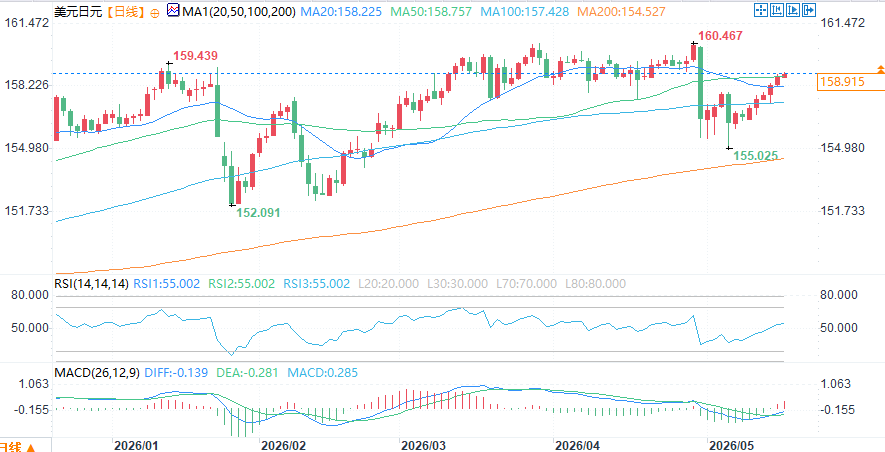
(USD/JPY daily chart, source: FX678)
At 11:12 Beijing time on May 18, the USD/JPY exchange rate was 158.92/93.
Market expectations that the Federal Reserve will take a more aggressive stance to curb inflation have driven the dollar higher against other currencies. Meanwhile, Japan's producer price index (PPI) rose more than expected, fueling market expectations that the Bank of Japan (BoJ) will raise its historically low interest rates.
The Federal Reserve has turned hawkish, and the probability of a rate hike has surged.
Several Federal Reserve officials have recently emphasized that controlling inflation is the top priority, even hinting that further interest rate hikes may be necessary if price pressures persist. Financial markets have quickly raised their expectations for a Fed rate hike—according to the CME FedWatch tool, the market now sees the probability of a December rate hike as having jumped from just 14% a week ago to nearly 48%.
Geopolitical safe-haven demand supports the US dollar
The US dollar also benefits from its status as a safe-haven asset. The US and Iran have yet to reach an agreement on ending the weeks-long conflict and reopening the crucial Strait of Hormuz.
US President Trump publicly warned Iran that it must make progress or face new consequences. With the Strait of Hormuz effectively closed, global oil prices continue to rise, placing a heavy economic burden on countries heavily reliant on energy imports.
Japan's economy faces dual pressures.
Amid global pressures, Japan is facing its own economic challenges. Stronger-than-expected producer inflation data has fueled market expectations that the Bank of Japan will need to adjust its historically low interest rates. Bank of Japan Policy Board member Kazuyuki Masu called for a swift increase in policy rates, warning that the current war is creating persistent inflationary risks that Japan must address.
Institutional Outlook: Limited Impact on Growth, More Prominent Inflation Effect
ING analyst Min Joo Kang expects the Japanese economy to maintain a similar growth level to the previous quarter, with first-quarter GDP growing by 0.3% quarter-on-quarter. She believes the energy shock triggered by the war will have a limited impact on trade and growth, but a more significant impact on inflation. ING forecasts that Japan's inflation rate will be 1.8% year-on-year in April, with subsidies suppressing overall price pressures.
The US dollar rose against the Japanese yen for the sixth consecutive day, driven primarily by rising expectations of a hawkish stance from the Federal Reserve and safe-haven demand stemming from geopolitical conflicts.
In Japan, despite rising domestic inflationary pressures and calls from central bank officials for an earlier interest rate hike, the impact on economic growth has been relatively limited, and the yen continues to be under pressure amid widening interest rate differentials.
In the short term, the USD/JPY exchange rate will depend on the further evolution of expectations regarding the Federal Reserve's interest rate hikes, and whether the Bank of Japan will truly take steps towards policy normalization amid persistently higher-than-expected inflation. Until then, the yen's weakness is unlikely to be fundamentally reversed.
Moving average system: Bullish alignment gradually taking shape
The current USD/JPY daily chart shows a bullish moving average structure: MA20 (158.23) > MA100 (157.43) > MA200 (154.53), with MA50 (158.76) at the top. Notably, the MA20 has crossed above the MA100, and the short-term moving average is crossing above the long-term moving average, a typical signal of a strengthening medium-term trend.
From a price perspective, the latest price of approximately 158.90 has firmly established itself above all major moving averages, indicating that the bulls hold absolute dominance. The 20-day moving average (MA20) at 158.23 serves as short-term dynamic support, and the current price is significantly above this level, providing a technical foundation for continued upward movement. The 200-day moving average (MA200) at 154.53, a long-term bull-bear dividing line, has been far below, confirming the validity of the medium- to long-term upward trend.
(USD/JPY daily chart, source: FX678)
At 11:12 Beijing time on May 18, the USD/JPY exchange rate was 158.92/93.
- Risk Warning and Disclaimer
- The market involves risk, and trading may not be suitable for all investors. This article is for reference only and does not constitute personal investment advice, nor does it take into account certain users’ specific investment objectives, financial situation, or other needs. Any investment decisions made based on this information are at your own risk.