Soaring US Treasury yields and a strong dollar dampened safe-haven demand, leading to a sharp correction in gold and silver prices and weakening market sentiment.
2026-05-18 15:57:48
During Monday's Asian and European trading sessions, Christopher Huang, a foreign exchange strategist at OCBC Bank, stated that the recent sharp correction in gold and silver prices was primarily due to the rapid rise in US Treasury yields and the US dollar index, which suppressed safe-haven demand for precious metals. In the latter half of last week, gold prices fell by nearly 2.5%, approaching the $4,500 area, while silver experienced an even more dramatic decline, plunging by approximately 9% at one point, falling below $76 at its lowest point.

The simultaneous strengthening of US Treasury yields and the US dollar has become the core source of pressure for the recent correction in precious metals. Market analysts believe that the continued rise in international oil prices, which has rekindled concerns about global inflation, is a key reason for the recent shift in market logic. As shipping risks in the Strait of Hormuz remain, tensions in the international energy market continue to escalate. Rising oil prices have driven the market to re-induce expectations of "long-term high interest rates," further increasing US Treasury yields.
Meanwhile, the continued rise of the US dollar index, driven by safe-haven demand and interest rate advantages, has also weakened the appeal of precious metals. For gold and silver, as non-interest-bearing assets, investors typically prefer to allocate to higher-yielding dollar assets when market interest rates rise, leading to capital outflows from precious metals. The high-interest-rate environment is diminishing the investment appeal of gold and silver.
OCBC Bank points out that silver's recent decline has been significantly greater than gold's, primarily because silver's previous price surge included strong "high-beta risk trading" characteristics. Previously, rising market demand for industrial metals, new energy industries, and artificial intelligence-related investments fueled a rapid increase in silver prices. However, as market risk appetite cools, silver's volatility is typically significantly higher than gold's, thus facing greater selling pressure in this correction.
Meanwhile, recent downward revisions in institutional expectations for silver investment demand have further weakened market sentiment. Silver's previous significant speculative gains have led to a more pronounced correction in this round. Looking at the gold market, the market is currently reassessing its safe-haven logic.
While the ongoing tensions in the Middle East theoretically support safe-haven demand for gold, rising oil prices have fueled inflation expectations, leading to increased market concerns that the Federal Reserve may maintain high interest rates or even raise them further. Therefore, the precious metals market has gradually shifted from "geopolitical safe-haven trading" to "high-interest-rate suppression trading."
OCBC Bank believes that if US Treasury yields fail to decline significantly in the future, or if international oil prices and geopolitical risks continue to drive the market to re-induce hawkish interest rate expectations, then gold and silver still face further downside risks in the short term. However, if shipping in the Strait of Hormuz gradually returns to normal, or if there are signs of easing tensions in the Middle East, market risk sentiment may improve, providing some support for precious metals. Changes in the situation in the Strait of Hormuz have become one of the core variables currently attracting market attention.
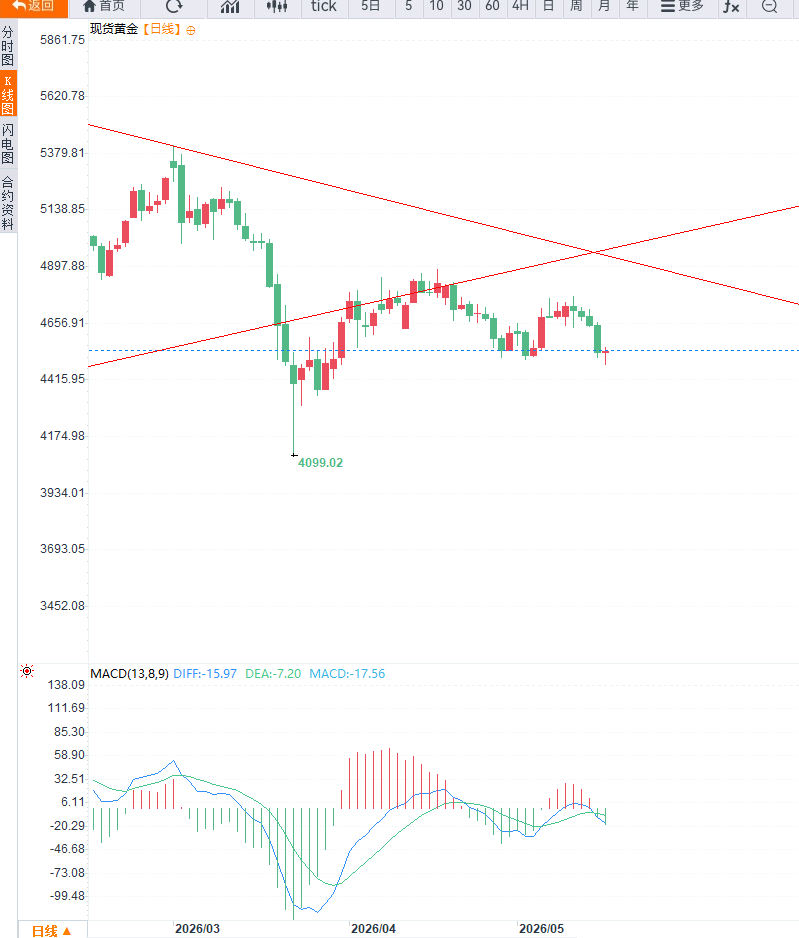
From a technical perspective, gold has clearly broken below short-term moving average support on the daily chart. The previous strong upward structure has begun to shift towards a high-level correction. OCBC points out that gold is currently trading around $4540, and the daily RSI indicator has clearly declined, indicating that the previous strong upward momentum is weakening. The first key support level for gold is around $4452, which corresponds to the 23.6% Fibonacci retracement level of the 2026 high and low. More important medium- to long-term support lies around the 200-day moving average area near $4340. On the upside, the area around $4670 is the first resistance zone, which corresponds to both the 21-day moving average and the 38.2% Fibonacci retracement level. The $4730 and $4850 areas correspond to the 50-day moving average and the 50% Fibonacci retracement level, respectively.
Observing the 4-hour chart, gold has formed a clear descending channel structure in the short term. The MACD indicator continues to run below the zero line, while the RSI indicator is close to the weak zone, indicating that bearish sentiment still dominates the market. However, since gold is currently approaching a short-term technical support area, a technical rebound is possible in the short term. But if the US dollar and US Treasury yields continue to remain strong, the upside potential for gold may be limited.
Editor's Summary:
The gold and silver markets are currently under triple pressure from high interest rate expectations, a strengthening US dollar, and concerns about energy-driven inflation. While geopolitical risks persist, market focus has shifted to the future policy path of the Federal Reserve and changes in US Treasury yields. Meanwhile, silver's previously accumulated high risk appetite has led to a significantly larger correction than gold. In the short term, the precious metals market is likely to maintain high volatility, with the US dollar, US Treasury yields, and developments in the Strait of Hormuz continuing to dominate market direction.
The simultaneous strengthening of US Treasury yields and the US dollar has become the core source of pressure for the recent correction in precious metals. Market analysts believe that the continued rise in international oil prices, which has rekindled concerns about global inflation, is a key reason for the recent shift in market logic. As shipping risks in the Strait of Hormuz remain, tensions in the international energy market continue to escalate. Rising oil prices have driven the market to re-induce expectations of "long-term high interest rates," further increasing US Treasury yields.
Meanwhile, the continued rise of the US dollar index, driven by safe-haven demand and interest rate advantages, has also weakened the appeal of precious metals. For gold and silver, as non-interest-bearing assets, investors typically prefer to allocate to higher-yielding dollar assets when market interest rates rise, leading to capital outflows from precious metals. The high-interest-rate environment is diminishing the investment appeal of gold and silver.
OCBC Bank points out that silver's recent decline has been significantly greater than gold's, primarily because silver's previous price surge included strong "high-beta risk trading" characteristics. Previously, rising market demand for industrial metals, new energy industries, and artificial intelligence-related investments fueled a rapid increase in silver prices. However, as market risk appetite cools, silver's volatility is typically significantly higher than gold's, thus facing greater selling pressure in this correction.
Meanwhile, recent downward revisions in institutional expectations for silver investment demand have further weakened market sentiment. Silver's previous significant speculative gains have led to a more pronounced correction in this round. Looking at the gold market, the market is currently reassessing its safe-haven logic.
While the ongoing tensions in the Middle East theoretically support safe-haven demand for gold, rising oil prices have fueled inflation expectations, leading to increased market concerns that the Federal Reserve may maintain high interest rates or even raise them further. Therefore, the precious metals market has gradually shifted from "geopolitical safe-haven trading" to "high-interest-rate suppression trading."
OCBC Bank believes that if US Treasury yields fail to decline significantly in the future, or if international oil prices and geopolitical risks continue to drive the market to re-induce hawkish interest rate expectations, then gold and silver still face further downside risks in the short term. However, if shipping in the Strait of Hormuz gradually returns to normal, or if there are signs of easing tensions in the Middle East, market risk sentiment may improve, providing some support for precious metals. Changes in the situation in the Strait of Hormuz have become one of the core variables currently attracting market attention.
From a technical perspective, gold has clearly broken below short-term moving average support on the daily chart. The previous strong upward structure has begun to shift towards a high-level correction. OCBC points out that gold is currently trading around $4540, and the daily RSI indicator has clearly declined, indicating that the previous strong upward momentum is weakening. The first key support level for gold is around $4452, which corresponds to the 23.6% Fibonacci retracement level of the 2026 high and low. More important medium- to long-term support lies around the 200-day moving average area near $4340. On the upside, the area around $4670 is the first resistance zone, which corresponds to both the 21-day moving average and the 38.2% Fibonacci retracement level. The $4730 and $4850 areas correspond to the 50-day moving average and the 50% Fibonacci retracement level, respectively.
Observing the 4-hour chart, gold has formed a clear descending channel structure in the short term. The MACD indicator continues to run below the zero line, while the RSI indicator is close to the weak zone, indicating that bearish sentiment still dominates the market. However, since gold is currently approaching a short-term technical support area, a technical rebound is possible in the short term. But if the US dollar and US Treasury yields continue to remain strong, the upside potential for gold may be limited.
Editor's Summary:
The gold and silver markets are currently under triple pressure from high interest rate expectations, a strengthening US dollar, and concerns about energy-driven inflation. While geopolitical risks persist, market focus has shifted to the future policy path of the Federal Reserve and changes in US Treasury yields. Meanwhile, silver's previously accumulated high risk appetite has led to a significantly larger correction than gold. In the short term, the precious metals market is likely to maintain high volatility, with the US dollar, US Treasury yields, and developments in the Strait of Hormuz continuing to dominate market direction.
- Risk Warning and Disclaimer
- The market involves risk, and trading may not be suitable for all investors. This article is for reference only and does not constitute personal investment advice, nor does it take into account certain users’ specific investment objectives, financial situation, or other needs. Any investment decisions made based on this information are at your own risk.