Oil prices remained high, and the strong dollar pushed the dollar near its all-time high against the Indian rupee.
2026-05-19 15:05:01
The US dollar remained strong against the Indian rupee in Asian trading on Tuesday, trading around 96.35, close to its previous record high of 96.62. The persistently high international oil prices, coupled with a generally strong US dollar, are putting significant pressure on India's energy-dependent economy, leading to the rupee's weakness for the tenth consecutive trading day.

International oil prices have recently been driven by supply risks in the Middle East. Due to restrictions on energy transport through the Strait of Hormuz, market concerns about a global tightness in crude oil supply have intensified significantly. The Strait of Hormuz handles approximately 20% of global seaborne crude oil transport , and any disruption to this transport would quickly push up international oil prices.
WTI crude oil prices are currently holding above $102, having touched $104.74 on Monday, a near two-week high. While recent comments from US President Trump suggest potential positive progress in US-Iran negotiations, limiting further price increases in the short term, overall supply concerns remain.
Trump stated that planned military action against Iran has been postponed due to "positive progress" in negotiations, adding that the likelihood of an agreement is high. Meanwhile, the Iranian Foreign Ministry also stated that the current focus is on ending the regional conflict and confirmed that related negotiations are still ongoing. Despite the temporary easing of geopolitical risks, high oil prices continue to exert significant pressure on the Indian economy. India is highly dependent on crude oil imports, so rising oil prices often widen the trade deficit, push up inflation, and weaken the local currency.
In response to rising energy costs, the Indian government has recently raised gasoline and diesel prices consecutively. Data shows that gasoline prices have increased by approximately 0.87 rupees per liter, and diesel prices by approximately 0.91 rupees per liter. This follows a previous increase of approximately 3 rupees per liter in the preceding days. These consecutive price hikes indicate that high oil prices are gradually being transmitted to domestic inflation in India .
However, the Indian stock market has recently received some support from overseas capital inflows. Foreign institutional investors (FIIs) continued to increase their holdings in the Indian stock market over the past three trading days, with a cumulative net purchase of approximately 4.33 billion rupees. On Monday alone, the inflow of overseas funds reached approximately 2.81 billion rupees. The market believes that although rising energy costs are putting pressure on the profitability of Indian companies, the relatively stable outlook for India's economic growth continues to attract some international capital inflows.
Regarding the US dollar, expectations of high US interest rates continue to support the strength of the dollar index. Recent US inflation data has exceeded market expectations, and Federal Reserve officials have continued to release hawkish signals, pushing US Treasury yields to remain high. Currently, the 10-year US Treasury yield is hovering around 4.60%, close to its year-to-date high of 4.63%. Meanwhile, market expectations for a Fed rate cut this year have cooled significantly. According to the CME FedWatch tool, the market expects a 53% probability that the Fed will maintain the current interest rate level by the end of the year , with other market participants even betting on at least one more rate hike this year.
Driven by the yield advantage of the US dollar, global funds continue to flow into dollar assets, which further strengthens the upward momentum of the US dollar against the Indian rupee.
From a technical perspective, the USD/INR pair continues its clear upward trend on the daily chart. The exchange rate is currently well above the 20-day exponential moving average (EMA) around 95.07, indicating that the short-to-medium-term bullish structure remains solid. The 20-day moving average continues to diverge upwards, also showing that the overall market uptrend is continuing. The Relative Strength Index (RSI) has risen above 70, entering overbought territory. While this suggests a rapid short-term rise and a potential for technical correction, the overall momentum remains strong.
Current technical indicators show that the 20-day EMA around 95.07 forms a significant dynamic support zone. If the exchange rate retraces, this area is expected to attract renewed buying. A break below this moving average could lead to a further decline to test the previously broken area around 94.50. On the upside, with the USD/INR pair currently near historical highs, the market is focused on the 97.00 level. If oil prices remain high and the dollar remains strong, the probability of USD/INR further testing 97.00 is increasing .
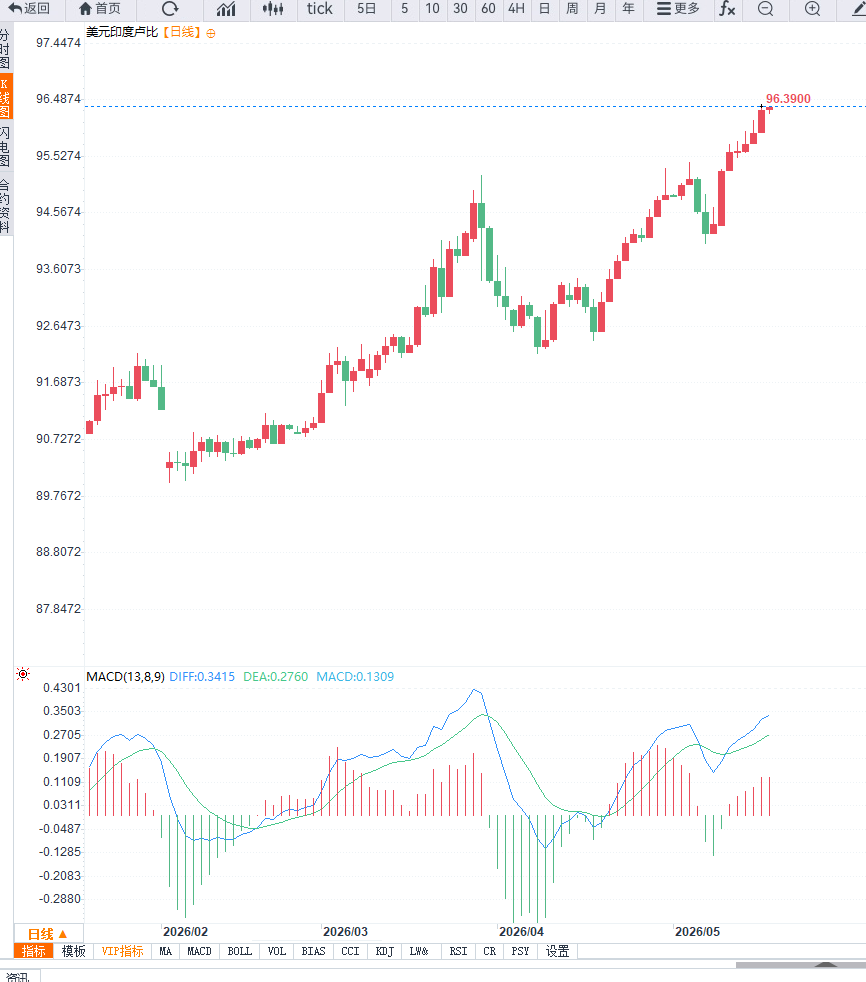
Overall, the current exchange rate of the USD/INR is mainly driven by international oil prices, the situation in the Middle East, expectations regarding Federal Reserve policy, and changes in dollar yields. In the short term, as long as international oil prices remain high, the Indian rupee may continue to face downward pressure.
Editor's Summary : The Indian rupee is currently facing the typical dual pressures of high oil prices and a strong US dollar. As one of the world's major energy-importing economies, India is extremely sensitive to changes in international crude oil prices, while supply risks in the Strait of Hormuz further amplify market concerns. At the same time, the Federal Reserve's high-interest-rate policy strengthens the attractiveness of the US dollar, continuously driving capital flows into dollar assets. In the short term, if international oil prices continue to remain above $100, the USD/IRR exchange rate may further challenge the 97.00 level. However, if the situation in the Middle East eases, oil prices fall, or the Reserve Bank of India takes measures to stabilize the exchange rate, the pressure on the rupee to depreciate may be alleviated.
International oil prices have recently been driven by supply risks in the Middle East. Due to restrictions on energy transport through the Strait of Hormuz, market concerns about a global tightness in crude oil supply have intensified significantly. The Strait of Hormuz handles approximately 20% of global seaborne crude oil transport , and any disruption to this transport would quickly push up international oil prices.
WTI crude oil prices are currently holding above $102, having touched $104.74 on Monday, a near two-week high. While recent comments from US President Trump suggest potential positive progress in US-Iran negotiations, limiting further price increases in the short term, overall supply concerns remain.
Trump stated that planned military action against Iran has been postponed due to "positive progress" in negotiations, adding that the likelihood of an agreement is high. Meanwhile, the Iranian Foreign Ministry also stated that the current focus is on ending the regional conflict and confirmed that related negotiations are still ongoing. Despite the temporary easing of geopolitical risks, high oil prices continue to exert significant pressure on the Indian economy. India is highly dependent on crude oil imports, so rising oil prices often widen the trade deficit, push up inflation, and weaken the local currency.
In response to rising energy costs, the Indian government has recently raised gasoline and diesel prices consecutively. Data shows that gasoline prices have increased by approximately 0.87 rupees per liter, and diesel prices by approximately 0.91 rupees per liter. This follows a previous increase of approximately 3 rupees per liter in the preceding days. These consecutive price hikes indicate that high oil prices are gradually being transmitted to domestic inflation in India .
However, the Indian stock market has recently received some support from overseas capital inflows. Foreign institutional investors (FIIs) continued to increase their holdings in the Indian stock market over the past three trading days, with a cumulative net purchase of approximately 4.33 billion rupees. On Monday alone, the inflow of overseas funds reached approximately 2.81 billion rupees. The market believes that although rising energy costs are putting pressure on the profitability of Indian companies, the relatively stable outlook for India's economic growth continues to attract some international capital inflows.
Regarding the US dollar, expectations of high US interest rates continue to support the strength of the dollar index. Recent US inflation data has exceeded market expectations, and Federal Reserve officials have continued to release hawkish signals, pushing US Treasury yields to remain high. Currently, the 10-year US Treasury yield is hovering around 4.60%, close to its year-to-date high of 4.63%. Meanwhile, market expectations for a Fed rate cut this year have cooled significantly. According to the CME FedWatch tool, the market expects a 53% probability that the Fed will maintain the current interest rate level by the end of the year , with other market participants even betting on at least one more rate hike this year.
Driven by the yield advantage of the US dollar, global funds continue to flow into dollar assets, which further strengthens the upward momentum of the US dollar against the Indian rupee.
From a technical perspective, the USD/INR pair continues its clear upward trend on the daily chart. The exchange rate is currently well above the 20-day exponential moving average (EMA) around 95.07, indicating that the short-to-medium-term bullish structure remains solid. The 20-day moving average continues to diverge upwards, also showing that the overall market uptrend is continuing. The Relative Strength Index (RSI) has risen above 70, entering overbought territory. While this suggests a rapid short-term rise and a potential for technical correction, the overall momentum remains strong.
Current technical indicators show that the 20-day EMA around 95.07 forms a significant dynamic support zone. If the exchange rate retraces, this area is expected to attract renewed buying. A break below this moving average could lead to a further decline to test the previously broken area around 94.50. On the upside, with the USD/INR pair currently near historical highs, the market is focused on the 97.00 level. If oil prices remain high and the dollar remains strong, the probability of USD/INR further testing 97.00 is increasing .
Overall, the current exchange rate of the USD/INR is mainly driven by international oil prices, the situation in the Middle East, expectations regarding Federal Reserve policy, and changes in dollar yields. In the short term, as long as international oil prices remain high, the Indian rupee may continue to face downward pressure.
Editor's Summary : The Indian rupee is currently facing the typical dual pressures of high oil prices and a strong US dollar. As one of the world's major energy-importing economies, India is extremely sensitive to changes in international crude oil prices, while supply risks in the Strait of Hormuz further amplify market concerns. At the same time, the Federal Reserve's high-interest-rate policy strengthens the attractiveness of the US dollar, continuously driving capital flows into dollar assets. In the short term, if international oil prices continue to remain above $100, the USD/IRR exchange rate may further challenge the 97.00 level. However, if the situation in the Middle East eases, oil prices fall, or the Reserve Bank of India takes measures to stabilize the exchange rate, the pressure on the rupee to depreciate may be alleviated.
- Risk Warning and Disclaimer
- The market involves risk, and trading may not be suitable for all investors. This article is for reference only and does not constitute personal investment advice, nor does it take into account certain users’ specific investment objectives, financial situation, or other needs. Any investment decisions made based on this information are at your own risk.