Societe Generale: Gold prices fell below the 50-day moving average two months ago, exacerbating downside risks.
2026-05-21 00:44:18
Gold prices recently fell below the $4,500 per ounce mark, creating renewed downward pressure. Societe Generale commodities analysts point out that several key technical levels currently form strong support levels; if these levels are breached, gold prices could fall by another 10%.

In their latest research report, analysts stated that gold prices have been under continuous downward pressure since falling below the 50-day moving average (50-DMA) two months ago. "After gold prices fell below the 50-day moving average in March of this year, a correction began, and subsequent rebounds have consistently failed to regain a foothold above this moving average, which is sufficient to confirm that the downward trend remains strong."
Key support and resistance: $4,350 becomes a "life-or-death line," with clear resistance to any rebound.
Societe Generale explicitly pointed out that the $4,350 range, formed by the intersection of the 200-day moving average (200-DMA) and the multi-year upward trend line, is currently the most crucial support level for gold. "The 200-day long-term moving average, combined with the multi-year upward trend line, forms important support around $4,350. Whether gold prices can hold this level and rebound is critical."
Analysts further warned that gold has fallen below the important $4,500 level. Only by holding the 200-day moving average at $4,353 can the deep correction be halted; otherwise, the price is likely to fall to $4,100. If a short-term rebound occurs, the previous high of $4,685 to $4,775 will become a strong resistance level.
Asset allocation adjustment: Societe Generale cancels gold overweight for the first time, reducing its holding ratio.
Back on March 23, Societe Generale released its second-quarter multi-asset portfolio allocation strategy report, announcing its first reduction in gold holdings since 2022, no longer overweighting gold assets. The bank adjusted its investment strategy, lowering the proportion of gold holdings from 10% in the first quarter to 7%, adopting a balanced allocation approach.
It is worth noting that although it reduced its holdings, Societe Generale remains optimistic about the long-term outlook for gold and maintains its year-end target price of $6,000.
Overall Strategy: Increase investment in commodities, adjust equity and fixed income allocations.
In terms of overall asset allocation, Societe Generale focused on optimizing its portfolio structure, reducing its equity holdings by 5% and increasing its allocation to commodities. The most significant adjustment was increasing its global commodity holdings from 0% in the first quarter to 8%, reflecting its strong belief in the investment potential of the energy sector.
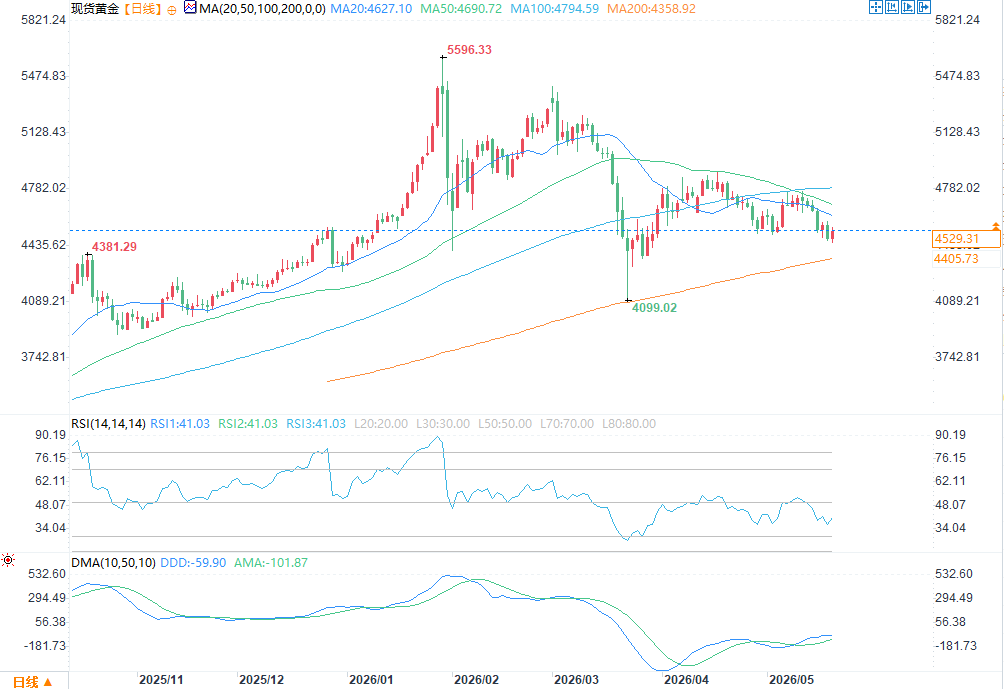
(Spot gold daily chart source: FX678)
The bank stated, "This asset allocation focuses more on long-term macroeconomic strategic logic, increasing the allocation to commodities while broadening the scope of equity investments, no longer limited to the US technology sector. Commodities are a core category in the geopolitical self-reliance strategy. Even if the situation in the Middle East stabilizes, international oil prices are unlikely to fall back to the previously predicted range of $55."
Commodity Forecast: Oil prices are expected to rise in the medium to long term, while copper prices will be supported by essential demand.
According to Societe Generale's latest forecast, Brent crude oil prices will fall to $77 per barrel in the second quarter of 2026 and drop to $68 in the fourth quarter, but will return to an upward trend in the medium to long term, mainly supported by the peak of US crude oil production and the Organization of the Petroleum Exporting Countries (OPEC) regaining market share; while copper prices are supported by the long-term rigid demand from the global electrification transformation and data center construction.
The core reason for portfolio rebalancing: Gold price volatility has surged, rendering its safe-haven appeal ineffective.
Societe Generale admitted that increased volatility in gold prices was the core reason for this portfolio rebalancing, and predicted that gold would become one of the most volatile asset classes in the next 12 months. "The current situation in the Middle East has triggered risk aversion in the market, but gold has failed to effectively hedge against portfolio losses caused by the decline in the stock market. At the same time, gold's short-term volatility has surged significantly, far exceeding other mainstream investment classes."
Analysts added that, in terms of asset correlation, gold now moves in the same direction as most mainstream assets. For portfolios that strictly control volatility, the high volatility of gold prices, coupled with its correlation with the market, has created a significant investment obstacle.
Equities and Fixed Income Allocation: Reduce holdings of US stocks, increase holdings of European stocks, and maintain stable fixed income.
In terms of equity allocation, Societe Generale reduced its holdings of US stocks, global emerging market stocks, and mainland China stocks, while increasing its holdings of European equity assets excluding the UK. The bank stated that market skepticism regarding the sustainability of the artificial intelligence sector's rally is growing, therefore it is bearish on the overall trend of US stocks and prefers an equal-weighted allocation strategy using the S&P 500 to avoid the risk of concentrated investment in a single sector and to explore diversified market growth opportunities. Meanwhile, the steady recovery of the European economic cycle remains a key area for its overweight allocation.
We maintain a stable allocation to fixed-income assets: 25% in government bonds, 5% in corporate bonds, and 5% in cash to ensure asset liquidity.
In their latest research report, analysts stated that gold prices have been under continuous downward pressure since falling below the 50-day moving average (50-DMA) two months ago. "After gold prices fell below the 50-day moving average in March of this year, a correction began, and subsequent rebounds have consistently failed to regain a foothold above this moving average, which is sufficient to confirm that the downward trend remains strong."
Key support and resistance: $4,350 becomes a "life-or-death line," with clear resistance to any rebound.
Societe Generale explicitly pointed out that the $4,350 range, formed by the intersection of the 200-day moving average (200-DMA) and the multi-year upward trend line, is currently the most crucial support level for gold. "The 200-day long-term moving average, combined with the multi-year upward trend line, forms important support around $4,350. Whether gold prices can hold this level and rebound is critical."
Analysts further warned that gold has fallen below the important $4,500 level. Only by holding the 200-day moving average at $4,353 can the deep correction be halted; otherwise, the price is likely to fall to $4,100. If a short-term rebound occurs, the previous high of $4,685 to $4,775 will become a strong resistance level.
Asset allocation adjustment: Societe Generale cancels gold overweight for the first time, reducing its holding ratio.
Back on March 23, Societe Generale released its second-quarter multi-asset portfolio allocation strategy report, announcing its first reduction in gold holdings since 2022, no longer overweighting gold assets. The bank adjusted its investment strategy, lowering the proportion of gold holdings from 10% in the first quarter to 7%, adopting a balanced allocation approach.
It is worth noting that although it reduced its holdings, Societe Generale remains optimistic about the long-term outlook for gold and maintains its year-end target price of $6,000.
Overall Strategy: Increase investment in commodities, adjust equity and fixed income allocations.
In terms of overall asset allocation, Societe Generale focused on optimizing its portfolio structure, reducing its equity holdings by 5% and increasing its allocation to commodities. The most significant adjustment was increasing its global commodity holdings from 0% in the first quarter to 8%, reflecting its strong belief in the investment potential of the energy sector.
(Spot gold daily chart source: FX678)
The bank stated, "This asset allocation focuses more on long-term macroeconomic strategic logic, increasing the allocation to commodities while broadening the scope of equity investments, no longer limited to the US technology sector. Commodities are a core category in the geopolitical self-reliance strategy. Even if the situation in the Middle East stabilizes, international oil prices are unlikely to fall back to the previously predicted range of $55."
Commodity Forecast: Oil prices are expected to rise in the medium to long term, while copper prices will be supported by essential demand.
According to Societe Generale's latest forecast, Brent crude oil prices will fall to $77 per barrel in the second quarter of 2026 and drop to $68 in the fourth quarter, but will return to an upward trend in the medium to long term, mainly supported by the peak of US crude oil production and the Organization of the Petroleum Exporting Countries (OPEC) regaining market share; while copper prices are supported by the long-term rigid demand from the global electrification transformation and data center construction.
The core reason for portfolio rebalancing: Gold price volatility has surged, rendering its safe-haven appeal ineffective.
Societe Generale admitted that increased volatility in gold prices was the core reason for this portfolio rebalancing, and predicted that gold would become one of the most volatile asset classes in the next 12 months. "The current situation in the Middle East has triggered risk aversion in the market, but gold has failed to effectively hedge against portfolio losses caused by the decline in the stock market. At the same time, gold's short-term volatility has surged significantly, far exceeding other mainstream investment classes."
Analysts added that, in terms of asset correlation, gold now moves in the same direction as most mainstream assets. For portfolios that strictly control volatility, the high volatility of gold prices, coupled with its correlation with the market, has created a significant investment obstacle.
Equities and Fixed Income Allocation: Reduce holdings of US stocks, increase holdings of European stocks, and maintain stable fixed income.
In terms of equity allocation, Societe Generale reduced its holdings of US stocks, global emerging market stocks, and mainland China stocks, while increasing its holdings of European equity assets excluding the UK. The bank stated that market skepticism regarding the sustainability of the artificial intelligence sector's rally is growing, therefore it is bearish on the overall trend of US stocks and prefers an equal-weighted allocation strategy using the S&P 500 to avoid the risk of concentrated investment in a single sector and to explore diversified market growth opportunities. Meanwhile, the steady recovery of the European economic cycle remains a key area for its overweight allocation.
We maintain a stable allocation to fixed-income assets: 25% in government bonds, 5% in corporate bonds, and 5% in cash to ensure asset liquidity.
- Risk Warning and Disclaimer
- The market involves risk, and trading may not be suitable for all investors. This article is for reference only and does not constitute personal investment advice, nor does it take into account certain users’ specific investment objectives, financial situation, or other needs. Any investment decisions made based on this information are at your own risk.