Gold Trading Alert: Oil and Dollar Join Forces to Stabilize Gold Prices After a Dramatic Retreat – Is the Deep Correction Over?
2026-05-22 07:52:01
On Thursday (May 21), spot gold initially plunged 1% during the session before stabilizing and ultimately closing almost flat at $4,543 per ounce. Meanwhile, US gold futures edged down 0.04%, closing at $4,542.50. This movement was the result of a confluence of three forces: sharp fluctuations in the oil market, a pullback in the US dollar index, and a downward turn in US Treasury yields. Investors are now asking: after experiencing a deep correction of over 14% since the outbreak of the war, has gold found its bottom?
Gold's successful rebound from its intraday lows on Thursday was primarily driven by a dramatic turnaround in the oil market. Early in the day, oil prices surged by more than 4% following news that Iran's Supreme Leader Mojtaba Khamenei had ordered a halt to the export of enriched uranium. This strong statement dampened market hopes for a swift resolution to the conflict, triggering a wave of risk aversion.
However, as the trading session progressed, the situation reversed. Uncertainty surrounding the prospects of US-Iran negotiations began to drag down oil prices, with Brent crude futures ultimately closing down 2.3% at $102.58 per barrel and US crude futures down 1.9% at $96.35, both hitting their lowest closing prices in nearly two weeks. For gold, the decline in oil prices had a dual effect. On the one hand, the drop in oil prices eased some inflation anxieties, cooling market bets on aggressive interest rate hikes by the Federal Reserve; on the other hand, lower oil prices also weakened short-term demand for gold as an inflation hedge. However, on Thursday, this latter effect was offset by the simultaneous weakening of the dollar and yields.
Peter Grant, Vice President and Senior Precious Metals Strategist at Zaner Metals, offered a succinct commentary: Falling oil prices coupled with a pullback in the dollar from a six-week high should be beneficial for gold in the short term, and gold prices have indeed strengthened. However, he also cautioned that the market may remain cautious initially, given the lingering fears caused by the previous breakdown of agreements.
If the drop in oil prices was the trigger for gold's stabilization, then the simultaneous rise and fall of the US dollar index and US Treasury yields provided solid bottom support for gold prices.
The dollar index fluctuated wildly on Thursday. In early trading, the dollar surged to a six-week high after a Reuters report that Iran's Supreme Leader had ordered that enriched uranium must remain in Iran. However, subsequent unconfirmed reports that Washington and Tehran had reached a final draft agreement to end the war caused the dollar to quickly give back its gains, ultimately settling near flat at 99.13. A weaker dollar means that dollar-denominated gold becomes cheaper for investors holding other currencies, providing direct demand support for gold prices.
Meanwhile, U.S. Treasury yields finally found some respite after a fierce sell-off. The benchmark 10-year Treasury yield fell 0.8 basis points to 4.575%, a significant drop from Tuesday's high of 4.687%, the highest level since January 2025. The 30-year Treasury yield fell even more sharply, dropping about 2 basis points to 5.096%, retreating from Tuesday's 5.197%, the highest level since July 2007, before the global financial crisis. The decline in yields directly reduced the opportunity cost of holding gold, a non-interest-bearing asset, enhancing its attractiveness to investors.
It's worth noting that this round of yield correction was largely driven by progress in US-Iran negotiations. After US President Trump stated that talks to end the war with Iran were entering their final stages, the sentiment in the bond market began to subtly shift. Weil Hartman, US interest rate strategist at BMO Capital Markets, aptly pointed out that market sentiment is gradually moving away from the theme of interest rate cuts currently being strongly promoted by Trump.
To understand the current macroeconomic environment for gold, it is essential to delve into the negotiation landscape of the Middle East. The complexity of this situation currently far exceeds what is apparent on the surface.
On the positive side, US Secretary of State Marco Rubio signaled to the media on Thursday that "some positive signs" had emerged in the negotiations. Pakistan, as one of the main mediators, also kept hope alive with the possibility that its Army Chief of Staff, Munir, might travel to Tehran for further mediation. Three sources told Reuters that all parties are working to streamline communication and accelerate progress.
However, the differences between the US and Iran remain a deep and unfathomable chasm. First and foremost is the issue of uranium stockpiles. Trump has made it clear that the US will eventually reclaim Iran's highly enriched uranium reserves, stating firmly, "We will get it. We don't need it, and we don't want it. We may destroy it after we get it, but we will not let them have it." Meanwhile, Iran's Supreme Leader Khamenei has ordered a ban on the export of uranium, making the two sides' positions virtually irreconcilable.
Secondly, there is the dispute over control of the Strait of Hormuz. Iran announced the establishment of a new "Persian Gulf Straits Authority" to oversee this strategic waterway that carries one-fifth of the world's oil and gas shipments. The United States firmly opposes any form of toll collection, with Trump emphasizing that it is an international waterway and must remain open and free. Rubio went even further, stating that if Iran implements a toll collection system, a diplomatic solution will be impossible.
More worryingly, Trump's patience is rapidly wearing thin. He has made it clear that he is prepared to resume strikes against Iran if he does not receive the "right response" from the Iranian leadership. Meanwhile, the Iranian Revolutionary Guard has warned of a wider-ranging retaliation should another attack be launched. This tit-for-tat tension means that any slight movement could trigger a sharp market reaction.
When analyzing the future gold market, the Federal Reserve's monetary policy direction is a crucial variable that cannot be ignored. According to the CME Group's FedWatch tool, traders currently expect a 58% probability of at least one Fed rate hike by the end of 2026, a significant increase from 48% the previous day. Specifically for December, the market's implied probability of a rate hike has reached approximately 60%.
The rising expectation of an interest rate hike stems from the continued inflationary impact of war. As the conflict in the Middle East continues, the risk of prolonged energy supply disruptions is gradually transmitting to core consumer prices and inflation expectations in the United States. Although oil prices have recently declined, Brent crude remains firmly above $100, far exceeding pre-war levels. This high energy price environment is eroding consumer purchasing power. Walmart's CFO has explicitly stated that consumers are under pressure from high oil prices, and retail price inflation is expected to rise slightly in the second quarter and the second half of the year.
However, it's not all bad news for gold bulls. Molly Brooks, U.S. interest rate strategist at TD Securities, believes that interest rates will remain high for the remainder of the year, and the yield curve will largely remain at its current level. This means that once the market has fully priced in rate hike expectations, their marginal negative impact on gold may gradually weaken. Meanwhile, the U.S. labor market remains resilient, with initial jobless claims declining last week. This gives the Federal Reserve room to focus on combating inflation, but also means the economy has not fallen into recession, and the safe-haven demand for gold will not see a full-blown surge in the near future.
Globally, the ripple effects of war are becoming apparent in multiple economies. In May, Eurozone economic activity contracted by the largest margin in over two and a half years, hit by a double whammy of war-driven high living costs severely impacting demand for services and accelerated layoffs by businesses. British businesses are experiencing their broadest contraction in over a year. Japanese manufacturing growth slowed slightly, while service sector growth stalled for the first time in over a year.
These weak purchasing managers' index (PMI) figures exacerbated market concerns about a deterioration in global economic growth. However, this divergence had a complex impact on the US dollar and gold. Noah Buffam, Director of Capital Markets Strategy at CIBC, pointed out that nearly three months after the oil shock, a time when global economic growth typically begins to show signs of deterioration, has led to caution regarding currencies affected by global economic growth. The stronger US growth outlook, in turn, further reinforced the case for the Federal Reserve to tighten policy, thus pushing up the dollar's exchange rate.
This means that although gold received support from a weaker dollar on Thursday, the relative strength of the dollar may still limit the upside potential for gold prices in the medium term. For gold to embark on a sustained upward trend, it needs a simultaneous decline in both the dollar and real yields, which often requires the Federal Reserve to shift to a rate-cutting cycle—a scenario that seems far off in the current inflationary environment.
It's worth noting that the performance of the US stock market is also sending important signals to the gold market. On Thursday, the three major Wall Street stock indexes closed slightly higher after volatile trading, with the Dow Jones Industrial Average even hitting a record closing high. However, what's more intriguing is the shift in market focus. Jason Pride, Head of Investment Strategy and Research at Glenmede, pointed out incisively that current valuations are high, partly due to strong corporate earnings, but with the earnings season largely over, the market won't suddenly receive any more positive earnings reports. This means that market attention has returned to the Iran issue.
The strategist further stated that in the short term, market movements will depend on rumors or actual agreements announced regarding Iran. This highly sensitive situation is actually relatively favorable for gold. Marc Dizard, Chief Investment Officer of Huntington Wealth Management, expressed a similar view, believing that the fragile ceasefire agreement is still in place and the possibility of de-escalation remains, which is a positive sign. However, apart from Iran and the core circle within the United States, no one knows how much actual progress has been made.
This information asymmetry and high degree of uncertainty are precisely the classic scenarios in which gold fulfills its safe-haven function. Whenever the market reacts sharply to a piece of geopolitical news, gold becomes one of the safe havens for funds.
In summary, the current gold market is at a crossroads where multiple forces are at play. Short-term support factors are clearly visible: the pullback in oil prices from their highs has eased fears of extreme inflation; the US dollar index encountered resistance at a six-week high; US Treasury yields have undergone a technical correction after a sharp rise; and geopolitical negotiations could see unexpected twists at any time. These factors combined have helped gold prices find temporary equilibrium around the $4540 level.
However, the suppressive factors cannot be ignored: the probability of the Federal Reserve raising interest rates is rising, the relative strength of the US dollar has not been shaken, the global economic slowdown has instead strengthened the comparative advantage of the United States, and gold has fallen by more than 14% since the outbreak of the war, and is still in a downward channel in terms of technical pattern.
For gold investors, the next few days to weeks will be crucial. Whether the US-Iran negotiations will achieve a substantial breakthrough or break down again, whether a compromise can be found for the passage fee dispute in the Strait of Hormuz, and where Trump's patience ends—the answers to these questions will directly determine the next direction of oil prices, which will then be transmitted to the gold market through three channels: inflation expectations, monetary policy path, and risk aversion.
As Peter Grant noted, the market may remain cautious initially. Gold will likely continue its volatile pattern until the fog completely clears, with any news from the negotiating table potentially triggering sharp price fluctuations. However, for patient long-term investors, current price levels may be approaching an attractive allocation range. After all, deep-seated geopolitical conflicts cannot be resolved overnight, and gold's value as the ultimate safe-haven asset will never be forgotten by the market in such turbulent times.
The White House stated that the swearing-in ceremony for the new Federal Reserve Chairman, Warsh, will be held at 11:00 AM on May 22 (11:00 PM Beijing time), and investors should pay attention to it.
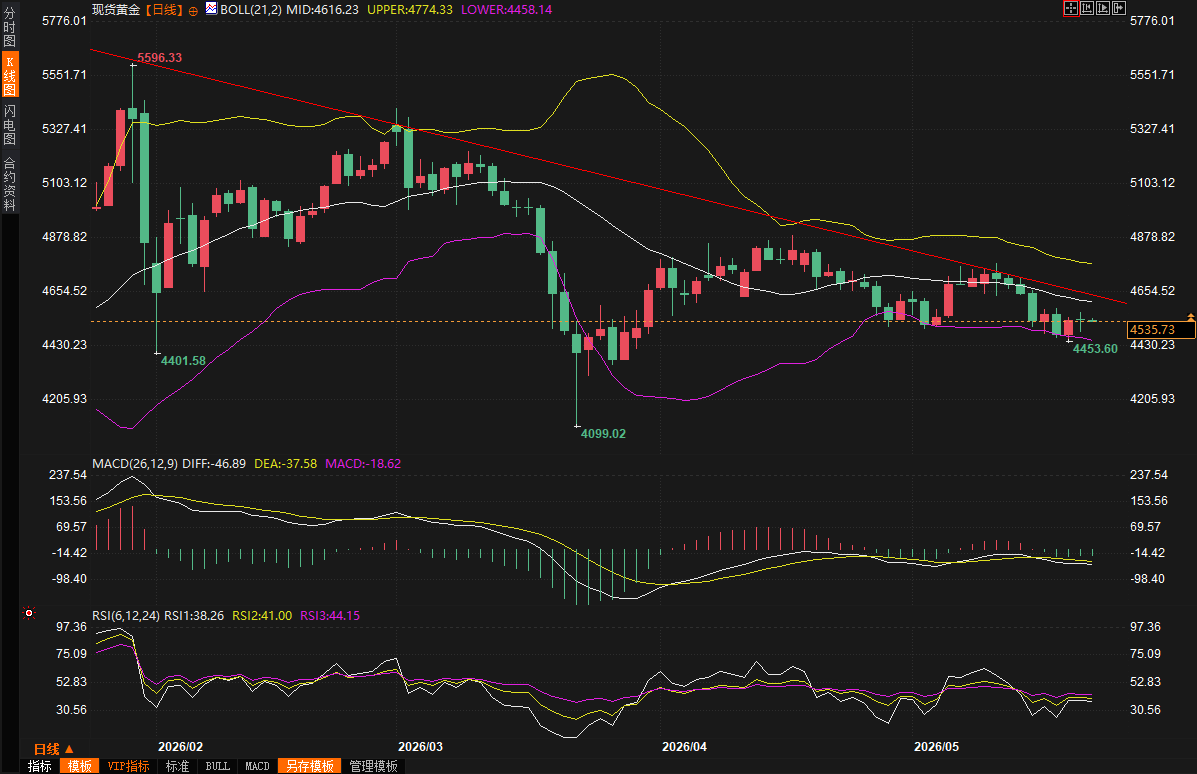
(Spot gold daily chart, source: FX678)
At 07:50 Beijing time, spot gold was trading at $4,535.81 per ounce.
Oil prices on a rollercoaster: from soaring to plummeting, with gold being an "unexpected catalyst."
Gold's successful rebound from its intraday lows on Thursday was primarily driven by a dramatic turnaround in the oil market. Early in the day, oil prices surged by more than 4% following news that Iran's Supreme Leader Mojtaba Khamenei had ordered a halt to the export of enriched uranium. This strong statement dampened market hopes for a swift resolution to the conflict, triggering a wave of risk aversion.
However, as the trading session progressed, the situation reversed. Uncertainty surrounding the prospects of US-Iran negotiations began to drag down oil prices, with Brent crude futures ultimately closing down 2.3% at $102.58 per barrel and US crude futures down 1.9% at $96.35, both hitting their lowest closing prices in nearly two weeks. For gold, the decline in oil prices had a dual effect. On the one hand, the drop in oil prices eased some inflation anxieties, cooling market bets on aggressive interest rate hikes by the Federal Reserve; on the other hand, lower oil prices also weakened short-term demand for gold as an inflation hedge. However, on Thursday, this latter effect was offset by the simultaneous weakening of the dollar and yields.
Peter Grant, Vice President and Senior Precious Metals Strategist at Zaner Metals, offered a succinct commentary: Falling oil prices coupled with a pullback in the dollar from a six-week high should be beneficial for gold in the short term, and gold prices have indeed strengthened. However, he also cautioned that the market may remain cautious initially, given the lingering fears caused by the previous breakdown of agreements.
The "divine assistance" from the US dollar and US Treasury yields: dual support appears simultaneously.
If the drop in oil prices was the trigger for gold's stabilization, then the simultaneous rise and fall of the US dollar index and US Treasury yields provided solid bottom support for gold prices.
The dollar index fluctuated wildly on Thursday. In early trading, the dollar surged to a six-week high after a Reuters report that Iran's Supreme Leader had ordered that enriched uranium must remain in Iran. However, subsequent unconfirmed reports that Washington and Tehran had reached a final draft agreement to end the war caused the dollar to quickly give back its gains, ultimately settling near flat at 99.13. A weaker dollar means that dollar-denominated gold becomes cheaper for investors holding other currencies, providing direct demand support for gold prices.
Meanwhile, U.S. Treasury yields finally found some respite after a fierce sell-off. The benchmark 10-year Treasury yield fell 0.8 basis points to 4.575%, a significant drop from Tuesday's high of 4.687%, the highest level since January 2025. The 30-year Treasury yield fell even more sharply, dropping about 2 basis points to 5.096%, retreating from Tuesday's 5.197%, the highest level since July 2007, before the global financial crisis. The decline in yields directly reduced the opportunity cost of holding gold, a non-interest-bearing asset, enhancing its attractiveness to investors.
It's worth noting that this round of yield correction was largely driven by progress in US-Iran negotiations. After US President Trump stated that talks to end the war with Iran were entering their final stages, the sentiment in the bond market began to subtly shift. Weil Hartman, US interest rate strategist at BMO Capital Markets, aptly pointed out that market sentiment is gradually moving away from the theme of interest rate cuts currently being strongly promoted by Trump.
Geopolitical Fog: Positive Signs at the Negotiating Table and Inviolable Red Lines
To understand the current macroeconomic environment for gold, it is essential to delve into the negotiation landscape of the Middle East. The complexity of this situation currently far exceeds what is apparent on the surface.
On the positive side, US Secretary of State Marco Rubio signaled to the media on Thursday that "some positive signs" had emerged in the negotiations. Pakistan, as one of the main mediators, also kept hope alive with the possibility that its Army Chief of Staff, Munir, might travel to Tehran for further mediation. Three sources told Reuters that all parties are working to streamline communication and accelerate progress.
However, the differences between the US and Iran remain a deep and unfathomable chasm. First and foremost is the issue of uranium stockpiles. Trump has made it clear that the US will eventually reclaim Iran's highly enriched uranium reserves, stating firmly, "We will get it. We don't need it, and we don't want it. We may destroy it after we get it, but we will not let them have it." Meanwhile, Iran's Supreme Leader Khamenei has ordered a ban on the export of uranium, making the two sides' positions virtually irreconcilable.
Secondly, there is the dispute over control of the Strait of Hormuz. Iran announced the establishment of a new "Persian Gulf Straits Authority" to oversee this strategic waterway that carries one-fifth of the world's oil and gas shipments. The United States firmly opposes any form of toll collection, with Trump emphasizing that it is an international waterway and must remain open and free. Rubio went even further, stating that if Iran implements a toll collection system, a diplomatic solution will be impossible.
More worryingly, Trump's patience is rapidly wearing thin. He has made it clear that he is prepared to resume strikes against Iran if he does not receive the "right response" from the Iranian leadership. Meanwhile, the Iranian Revolutionary Guard has warned of a wider-ranging retaliation should another attack be launched. This tit-for-tat tension means that any slight movement could trigger a sharp market reaction.
Interest rate hike expectations are quietly rising: a Damocles' sword hanging over gold.
When analyzing the future gold market, the Federal Reserve's monetary policy direction is a crucial variable that cannot be ignored. According to the CME Group's FedWatch tool, traders currently expect a 58% probability of at least one Fed rate hike by the end of 2026, a significant increase from 48% the previous day. Specifically for December, the market's implied probability of a rate hike has reached approximately 60%.
The rising expectation of an interest rate hike stems from the continued inflationary impact of war. As the conflict in the Middle East continues, the risk of prolonged energy supply disruptions is gradually transmitting to core consumer prices and inflation expectations in the United States. Although oil prices have recently declined, Brent crude remains firmly above $100, far exceeding pre-war levels. This high energy price environment is eroding consumer purchasing power. Walmart's CFO has explicitly stated that consumers are under pressure from high oil prices, and retail price inflation is expected to rise slightly in the second quarter and the second half of the year.
However, it's not all bad news for gold bulls. Molly Brooks, U.S. interest rate strategist at TD Securities, believes that interest rates will remain high for the remainder of the year, and the yield curve will largely remain at its current level. This means that once the market has fully priced in rate hike expectations, their marginal negative impact on gold may gradually weaken. Meanwhile, the U.S. labor market remains resilient, with initial jobless claims declining last week. This gives the Federal Reserve room to focus on combating inflation, but also means the economy has not fallen into recession, and the safe-haven demand for gold will not see a full-blown surge in the near future.
The shadow of macroeconomic uncertainty: Global growth slowdown and the US's "relative advantage"
Globally, the ripple effects of war are becoming apparent in multiple economies. In May, Eurozone economic activity contracted by the largest margin in over two and a half years, hit by a double whammy of war-driven high living costs severely impacting demand for services and accelerated layoffs by businesses. British businesses are experiencing their broadest contraction in over a year. Japanese manufacturing growth slowed slightly, while service sector growth stalled for the first time in over a year.
These weak purchasing managers' index (PMI) figures exacerbated market concerns about a deterioration in global economic growth. However, this divergence had a complex impact on the US dollar and gold. Noah Buffam, Director of Capital Markets Strategy at CIBC, pointed out that nearly three months after the oil shock, a time when global economic growth typically begins to show signs of deterioration, has led to caution regarding currencies affected by global economic growth. The stronger US growth outlook, in turn, further reinforced the case for the Federal Reserve to tighten policy, thus pushing up the dollar's exchange rate.
This means that although gold received support from a weaker dollar on Thursday, the relative strength of the dollar may still limit the upside potential for gold prices in the medium term. For gold to embark on a sustained upward trend, it needs a simultaneous decline in both the dollar and real yields, which often requires the Federal Reserve to shift to a rate-cutting cycle—a scenario that seems far off in the current inflationary environment.
The "canary in the coal mine" signal in the stock market: Geopolitics replaces financial reports as the focus.
It's worth noting that the performance of the US stock market is also sending important signals to the gold market. On Thursday, the three major Wall Street stock indexes closed slightly higher after volatile trading, with the Dow Jones Industrial Average even hitting a record closing high. However, what's more intriguing is the shift in market focus. Jason Pride, Head of Investment Strategy and Research at Glenmede, pointed out incisively that current valuations are high, partly due to strong corporate earnings, but with the earnings season largely over, the market won't suddenly receive any more positive earnings reports. This means that market attention has returned to the Iran issue.
The strategist further stated that in the short term, market movements will depend on rumors or actual agreements announced regarding Iran. This highly sensitive situation is actually relatively favorable for gold. Marc Dizard, Chief Investment Officer of Huntington Wealth Management, expressed a similar view, believing that the fragile ceasefire agreement is still in place and the possibility of de-escalation remains, which is a positive sign. However, apart from Iran and the core circle within the United States, no one knows how much actual progress has been made.
This information asymmetry and high degree of uncertainty are precisely the classic scenarios in which gold fulfills its safe-haven function. Whenever the market reacts sharply to a piece of geopolitical news, gold becomes one of the safe havens for funds.
Conclusion: Gold stands at a crossroads, awaiting the dissipation of the Middle East fog.
In summary, the current gold market is at a crossroads where multiple forces are at play. Short-term support factors are clearly visible: the pullback in oil prices from their highs has eased fears of extreme inflation; the US dollar index encountered resistance at a six-week high; US Treasury yields have undergone a technical correction after a sharp rise; and geopolitical negotiations could see unexpected twists at any time. These factors combined have helped gold prices find temporary equilibrium around the $4540 level.
However, the suppressive factors cannot be ignored: the probability of the Federal Reserve raising interest rates is rising, the relative strength of the US dollar has not been shaken, the global economic slowdown has instead strengthened the comparative advantage of the United States, and gold has fallen by more than 14% since the outbreak of the war, and is still in a downward channel in terms of technical pattern.
For gold investors, the next few days to weeks will be crucial. Whether the US-Iran negotiations will achieve a substantial breakthrough or break down again, whether a compromise can be found for the passage fee dispute in the Strait of Hormuz, and where Trump's patience ends—the answers to these questions will directly determine the next direction of oil prices, which will then be transmitted to the gold market through three channels: inflation expectations, monetary policy path, and risk aversion.
As Peter Grant noted, the market may remain cautious initially. Gold will likely continue its volatile pattern until the fog completely clears, with any news from the negotiating table potentially triggering sharp price fluctuations. However, for patient long-term investors, current price levels may be approaching an attractive allocation range. After all, deep-seated geopolitical conflicts cannot be resolved overnight, and gold's value as the ultimate safe-haven asset will never be forgotten by the market in such turbulent times.
The White House stated that the swearing-in ceremony for the new Federal Reserve Chairman, Warsh, will be held at 11:00 AM on May 22 (11:00 PM Beijing time), and investors should pay attention to it.
(Spot gold daily chart, source: FX678)
At 07:50 Beijing time, spot gold was trading at $4,535.81 per ounce.
- Risk Warning and Disclaimer
- The market involves risk, and trading may not be suitable for all investors. This article is for reference only and does not constitute personal investment advice, nor does it take into account certain users’ specific investment objectives, financial situation, or other needs. Any investment decisions made based on this information are at your own risk.