Institutions: Gold's monetary attributes are making a strong comeback; $8,900 expected by the end of 2030.
2026-05-22 09:41:51
Looking at the gold price trend this year, the market has experienced a sharp rise at the beginning of the year, a period of violent fluctuations in the middle, and is now in a range-bound consolidation phase.
Incrementum AG released its 20th-anniversary industry report, noting that gold price movements align with its asset positioning, and that the value of gold as a monetary asset continues to stand out amidst changes in the global economic landscape. Supported by multiple factors such as geopolitical divergence, the progress of de-dollarization, and high debt levels, the foundation for a long-term bull market in gold is solid, with prices steadily rising. Short-term fluctuations will not alter the medium- to long-term upward trend, and the market's potential for further gains remains considerable.
This 20th-anniversary report, titled "Returning to the Fundamentals of Money: A Future of True Monetary Purpose," was co-authored by Ronald-Peter Stöferle and Mark Valek. The authors argue that gold's recent record high is not an abnormal market phenomenon driven by speculative capital, but rather an inevitable trend driven by multiple macroeconomic factors, reflecting gold's return to the monetary system. Geopolitical tensions, accelerated global de-dollarization, recurring inflationary volatility, and declining market confidence in fiat currencies have all contributed to the revaluation of gold.
The report argues that the current fiat currency system is showing signs of weakness, and gold is once again becoming a stabilizing anchor for global finance. In 2025, gold's annual increase reached 64.4%, marking its best annual performance since 1979. In January 2026, the price of gold climbed to $5,595 per ounce, setting a new historical record. Comparing this to the industry's development twenty years ago, when the report was only twenty pages long and the price of gold remained at $670 per ounce, the report has now grown to over four hundred pages, with the cumulative increase in the price of gold exceeding six times, demonstrating a leapfrog increase in the influence of the gold market.
Analysts believe that the multi-year bull market for gold is far from over. The report states that the decade-long bull market for gold predicted in 2020 has fully materialized, with gold prices, denominated in US dollars, rising by a cumulative 165% since then. The current market is experiencing a surge in ordinary investors, representing the most active and longest-lasting period of the entire bull market, with solid fundamentals providing strong support for further price increases.
Based on market changes, institutions have raised their long-term price forecasts, and the 2020 target of $4,800 per ounce by 2030 has already been achieved ahead of schedule. The author states that, considering a high-inflation scenario, gold prices are expected to reach $8,900 per ounce by the end of 2030, and if the monetization of gold accelerates further, prices could see even greater potential.
The existing global order dominated by the United States is gradually shifting, reshaping the monetary landscape, and increasingly emphasizing gold's neutral reserve asset status. Central banks around the world have been consistently increasing their gold reserves, with purchases reaching 863 tons in 2025. In the three years prior, annual purchases exceeded 1,000 tons, indicating strong official demand.
Discussions about revaluing the US gold reserves are growing, with the US still holding gold reserves valued at $42.22 per ounce, a stark contrast to the current market price of nearly $4,600. The author argues that a revaluation of gold reserves is no longer a far-fetched conjecture but is gradually becoming a reality.
From an asset allocation perspective, the overall allocation ratio of gold is still relatively low , with private gold assets accounting for only 2.7% of global financial assets. There is ample room for institutional allocation, and the market has not seen excessive speculation.
In the future, the main drivers of gold consumption will gradually shift from central banks to various investment entities. Global debt is projected to reach a new high of $348 trillion by the end of 2025, with US debt exceeding $39 trillion this year. This high level of debt is becoming a core driving force supporting the long-term strength of gold prices.
The risk-free nature of traditional government bonds is weakening, with real returns after adjusting for inflation consistently negative. Investors are increasingly shifting away from traditional assets and seeking safe havens like gold. Multiple negative factors impacting credit assets further amplify the attractiveness of gold as a portfolio allocation.
Institutions warn that while the medium- to long-term upward trend in gold is clear, the process will not be smooth sailing, and price fluctuations will be the norm. Analysts indicate that gold prices will enter a consolidation phase in the short term, followed by a steady upward trend in the medium term, and will ultimately regain its core position in the monetary system. Gold prices are likely to fluctuate between $4,500 and $4,950 per ounce in early summer this year.
Gold prices have experienced a significant decline this year, and coupled with factors such as rising US Treasury yields and tightening market liquidity, short-term prices still face downward pressure. Industry experts believe that every short-term pullback is a healthy adjustment and a good opportunity for investors to buy on dips.
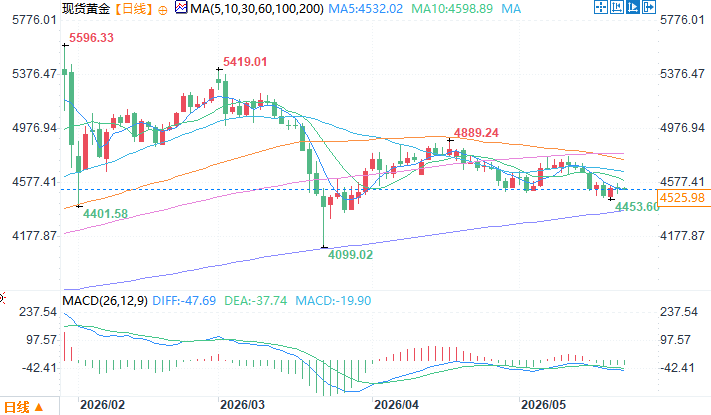
Spot gold daily chart source: EasyForex
At 9:41 AM Beijing time on May 22, spot gold was trading at $4523.98 per ounce.
Incrementum AG released its 20th-anniversary industry report, noting that gold price movements align with its asset positioning, and that the value of gold as a monetary asset continues to stand out amidst changes in the global economic landscape. Supported by multiple factors such as geopolitical divergence, the progress of de-dollarization, and high debt levels, the foundation for a long-term bull market in gold is solid, with prices steadily rising. Short-term fluctuations will not alter the medium- to long-term upward trend, and the market's potential for further gains remains considerable.
Market landscape changes, gold's monetary value is being highlighted again.
This 20th-anniversary report, titled "Returning to the Fundamentals of Money: A Future of True Monetary Purpose," was co-authored by Ronald-Peter Stöferle and Mark Valek. The authors argue that gold's recent record high is not an abnormal market phenomenon driven by speculative capital, but rather an inevitable trend driven by multiple macroeconomic factors, reflecting gold's return to the monetary system. Geopolitical tensions, accelerated global de-dollarization, recurring inflationary volatility, and declining market confidence in fiat currencies have all contributed to the revaluation of gold.
The report argues that the current fiat currency system is showing signs of weakness, and gold is once again becoming a stabilizing anchor for global finance. In 2025, gold's annual increase reached 64.4%, marking its best annual performance since 1979. In January 2026, the price of gold climbed to $5,595 per ounce, setting a new historical record. Comparing this to the industry's development twenty years ago, when the report was only twenty pages long and the price of gold remained at $670 per ounce, the report has now grown to over four hundred pages, with the cumulative increase in the price of gold exceeding six times, demonstrating a leapfrog increase in the influence of the gold market.
Long-term bull market continues, long-term price targets raised again.
Analysts believe that the multi-year bull market for gold is far from over. The report states that the decade-long bull market for gold predicted in 2020 has fully materialized, with gold prices, denominated in US dollars, rising by a cumulative 165% since then. The current market is experiencing a surge in ordinary investors, representing the most active and longest-lasting period of the entire bull market, with solid fundamentals providing strong support for further price increases.
Based on market changes, institutions have raised their long-term price forecasts, and the 2020 target of $4,800 per ounce by 2030 has already been achieved ahead of schedule. The author states that, considering a high-inflation scenario, gold prices are expected to reach $8,900 per ounce by the end of 2030, and if the monetization of gold accelerates further, prices could see even greater potential.
Multiple positive factors from the monetary system reform continue to support gold prices.
The existing global order dominated by the United States is gradually shifting, reshaping the monetary landscape, and increasingly emphasizing gold's neutral reserve asset status. Central banks around the world have been consistently increasing their gold reserves, with purchases reaching 863 tons in 2025. In the three years prior, annual purchases exceeded 1,000 tons, indicating strong official demand.
Discussions about revaluing the US gold reserves are growing, with the US still holding gold reserves valued at $42.22 per ounce, a stark contrast to the current market price of nearly $4,600. The author argues that a revaluation of gold reserves is no longer a far-fetched conjecture but is gradually becoming a reality.
From an asset allocation perspective, the overall allocation ratio of gold is still relatively low , with private gold assets accounting for only 2.7% of global financial assets. There is ample room for institutional allocation, and the market has not seen excessive speculation.
Shifting demand structure and debt risk drive demand for asset preservation
In the future, the main drivers of gold consumption will gradually shift from central banks to various investment entities. Global debt is projected to reach a new high of $348 trillion by the end of 2025, with US debt exceeding $39 trillion this year. This high level of debt is becoming a core driving force supporting the long-term strength of gold prices.
The risk-free nature of traditional government bonds is weakening, with real returns after adjusting for inflation consistently negative. Investors are increasingly shifting away from traditional assets and seeking safe havens like gold. Multiple negative factors impacting credit assets further amplify the attractiveness of gold as a portfolio allocation.
Market volatility inevitably leads to pullbacks, presenting opportunities for strategic positioning.
Institutions warn that while the medium- to long-term upward trend in gold is clear, the process will not be smooth sailing, and price fluctuations will be the norm. Analysts indicate that gold prices will enter a consolidation phase in the short term, followed by a steady upward trend in the medium term, and will ultimately regain its core position in the monetary system. Gold prices are likely to fluctuate between $4,500 and $4,950 per ounce in early summer this year.
Gold prices have experienced a significant decline this year, and coupled with factors such as rising US Treasury yields and tightening market liquidity, short-term prices still face downward pressure. Industry experts believe that every short-term pullback is a healthy adjustment and a good opportunity for investors to buy on dips.
Spot gold daily chart source: EasyForex
At 9:41 AM Beijing time on May 22, spot gold was trading at $4523.98 per ounce.
- Risk Warning and Disclaimer
- The market involves risk, and trading may not be suitable for all investors. This article is for reference only and does not constitute personal investment advice, nor does it take into account certain users’ specific investment objectives, financial situation, or other needs. Any investment decisions made based on this information are at your own risk.