The euro is caught in a range against the dollar, with hawkish expectations from the Federal Reserve limiting its upside potential.
2026-05-22 16:14:35
The euro/dollar pair continued its narrow trading range during Friday's European session, consolidating around 1.1610. Although the euro briefly fell to 1.1575, it quickly rebounded, indicating a strong divergence between bulls and bears around 1.16. The euro's overall movement is currently influenced by three factors: hawkish expectations from the Federal Reserve, a slowing Eurozone economy, and a strong dollar. Earlier in the New York session, the euro briefly dipped to around 1.1575, but the bears failed to mount sustained selling pressure, and the pair subsequently returned above 1.16.

The short-term decline failed to extend, indicating that the bearish momentum in the euro is gradually weakening . Market analysts point out that the euro is currently still in a phase of correction, but market confidence in further sharp declines is waning. Especially given the marginal improvement in some Eurozone economic data, the euro has found some technical support in the short term.
Germany's latest GDP data confirmed first-quarter economic growth of 0.3%, while consumer confidence also exceeded market expectations. However, despite the improvement in German data, the market remains cautious about the overall economic outlook for the Eurozone. The risk of a Eurozone economic slowdown and stagflation remains a key factor weighing on the euro . Previously released Eurozone PMI data showed a significant slowdown in demand in the service sector, while energy and input costs continued to rise.
Market concerns are growing that the combination of high energy prices and weak economic growth could put the European Central Bank (ECB) in a policy dilemma. On the one hand, the ECB needs to control inflation; but on the other hand, maintaining high interest rates could further drag down economic activity. Meanwhile, the US dollar remains strong overall. Market expectations for the Federal Reserve to maintain high interest rates or even raise them further continue to rise. Due to the situation in the Middle East keeping energy prices high, the market is worried that US inflation may rebound in the future.
Market expectations for a significantly reduced probability of a Federal Reserve rate cut this year continue to support the US dollar index, which remains near 99. Furthermore, the overall stability of the US job market further strengthens market preference for dollar assets. Against this backdrop, the euro's overall upside potential is significantly limited. Meanwhile, the situation in the Middle East remains a crucial risk factor influencing global markets.
The Strait of Hormuz handles approximately 20% of global seaborne crude oil transport; therefore, any changes in geopolitical risks could impact international energy prices and global inflation expectations. If international oil prices rebound, it could further strengthen market expectations that the Federal Reserve will maintain high interest rates, thus continuing to support the US dollar.
From a short-term perspective, the market has entered a clear consolidation phase. The euro/dollar exchange rate is expected to fluctuate between 1.1595 and 1.1640 in the short term. Market analysts point out that if the exchange rate can effectively break through the key resistance area of 1.1655, it would mean that the correction that began in mid-May may have ended.
1.1655 has become the current short-term dividing line between bullish and bearish sentiment for the Euro . Conversely, if the Euro breaks below 1.1540 again, the medium-term bearish structure may be further strengthened, potentially opening up downside potential to the 1.1410 area. Looking at the daily chart, EUR/USD is still in a high-level correction phase. The exchange rate has repeatedly attempted to regain a foothold above 1.1650 without success, indicating that selling pressure remains heavy. The daily MACD indicator has formed a death cross at a high level, and the green momentum bars are gradually expanding, indicating that the medium-term upward momentum has weakened. However, the MACD is currently still running near the zero line, suggesting that the overall trend has not yet fully turned bearish. It is worth noting that a short-term support level has recently formed around 1.1575, while the 1.1640 to 1.1655 area constitutes a significant resistance zone.
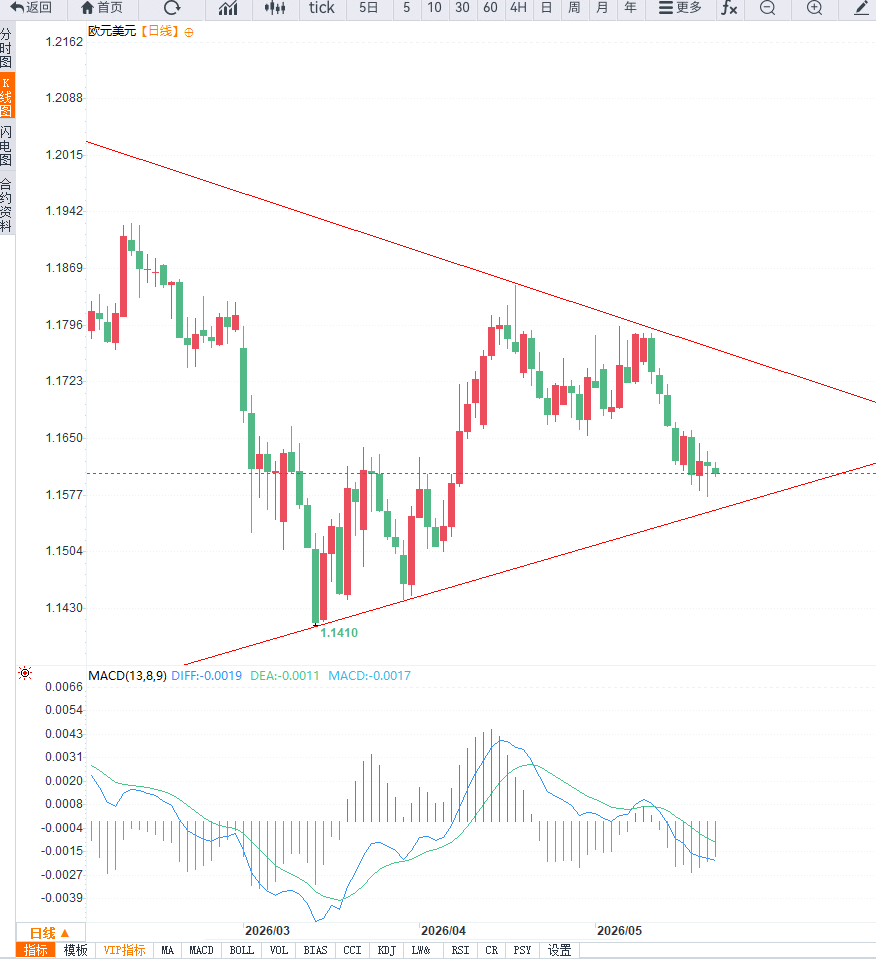
Overall, the euro/dollar exchange rate has entered a critical technical selection phase, and the direction of the subsequent breakout will determine the trend in the next stage.
Editor's Summary : The core logic behind the current EUR/USD exchange rate movement revolves around a strong US dollar and concerns about Eurozone growth. Although the euro's short-term decline has slowed, hawkish expectations from the Federal Reserve and the risk of stagflation in the Eurozone continue to limit the euro's upside potential. From a technical perspective, EUR/USD has entered a typical consolidation phase. Going forward, the market will focus on US inflation data, the Fed's policy direction, European economic data, and developments in the Middle East. A break above 1.1655 could end the euro's current correction; however, a break below 1.1540 would significantly increase the medium-term downside risk.
The short-term decline failed to extend, indicating that the bearish momentum in the euro is gradually weakening . Market analysts point out that the euro is currently still in a phase of correction, but market confidence in further sharp declines is waning. Especially given the marginal improvement in some Eurozone economic data, the euro has found some technical support in the short term.
Germany's latest GDP data confirmed first-quarter economic growth of 0.3%, while consumer confidence also exceeded market expectations. However, despite the improvement in German data, the market remains cautious about the overall economic outlook for the Eurozone. The risk of a Eurozone economic slowdown and stagflation remains a key factor weighing on the euro . Previously released Eurozone PMI data showed a significant slowdown in demand in the service sector, while energy and input costs continued to rise.
Market concerns are growing that the combination of high energy prices and weak economic growth could put the European Central Bank (ECB) in a policy dilemma. On the one hand, the ECB needs to control inflation; but on the other hand, maintaining high interest rates could further drag down economic activity. Meanwhile, the US dollar remains strong overall. Market expectations for the Federal Reserve to maintain high interest rates or even raise them further continue to rise. Due to the situation in the Middle East keeping energy prices high, the market is worried that US inflation may rebound in the future.
Market expectations for a significantly reduced probability of a Federal Reserve rate cut this year continue to support the US dollar index, which remains near 99. Furthermore, the overall stability of the US job market further strengthens market preference for dollar assets. Against this backdrop, the euro's overall upside potential is significantly limited. Meanwhile, the situation in the Middle East remains a crucial risk factor influencing global markets.
The Strait of Hormuz handles approximately 20% of global seaborne crude oil transport; therefore, any changes in geopolitical risks could impact international energy prices and global inflation expectations. If international oil prices rebound, it could further strengthen market expectations that the Federal Reserve will maintain high interest rates, thus continuing to support the US dollar.
From a short-term perspective, the market has entered a clear consolidation phase. The euro/dollar exchange rate is expected to fluctuate between 1.1595 and 1.1640 in the short term. Market analysts point out that if the exchange rate can effectively break through the key resistance area of 1.1655, it would mean that the correction that began in mid-May may have ended.
1.1655 has become the current short-term dividing line between bullish and bearish sentiment for the Euro . Conversely, if the Euro breaks below 1.1540 again, the medium-term bearish structure may be further strengthened, potentially opening up downside potential to the 1.1410 area. Looking at the daily chart, EUR/USD is still in a high-level correction phase. The exchange rate has repeatedly attempted to regain a foothold above 1.1650 without success, indicating that selling pressure remains heavy. The daily MACD indicator has formed a death cross at a high level, and the green momentum bars are gradually expanding, indicating that the medium-term upward momentum has weakened. However, the MACD is currently still running near the zero line, suggesting that the overall trend has not yet fully turned bearish. It is worth noting that a short-term support level has recently formed around 1.1575, while the 1.1640 to 1.1655 area constitutes a significant resistance zone.
Overall, the euro/dollar exchange rate has entered a critical technical selection phase, and the direction of the subsequent breakout will determine the trend in the next stage.
Editor's Summary : The core logic behind the current EUR/USD exchange rate movement revolves around a strong US dollar and concerns about Eurozone growth. Although the euro's short-term decline has slowed, hawkish expectations from the Federal Reserve and the risk of stagflation in the Eurozone continue to limit the euro's upside potential. From a technical perspective, EUR/USD has entered a typical consolidation phase. Going forward, the market will focus on US inflation data, the Fed's policy direction, European economic data, and developments in the Middle East. A break above 1.1655 could end the euro's current correction; however, a break below 1.1540 would significantly increase the medium-term downside risk.
- Risk Warning and Disclaimer
- The market involves risk, and trading may not be suitable for all investors. This article is for reference only and does not constitute personal investment advice, nor does it take into account certain users’ specific investment objectives, financial situation, or other needs. Any investment decisions made based on this information are at your own risk.