After the pullback from the high of 4773: Is gold's drop a "false break" or a "real collapse"? The key lies in this signal.
2026-05-22 17:59:26
On Friday, May 22, spot gold was trading at approximately $4,525 per ounce, continuing its weak and volatile trend. Prices have fallen by about 3.81% over the past month. The core of this correction is not simply a cooling of risk aversion, but rather the combined effect of oil prices, interest rate expectations, the US dollar index, and technical factors squeezing the pricing space for gold.
Brent crude oil rose to around $105 per barrel on May 22, with high oil prices reigniting market sensitivity to imported inflation. Typically, inflation risk strengthens gold's role as a store of value, but when inflationary pressures simultaneously push up real interest rate expectations, gold's weakness as a non-interest-bearing asset is amplified. The current decline in gold prices reflects this contradictory pricing.
The turbulence in the crude oil market stems from repeated negotiations in the Gulf region and uncertainties surrounding key energy routes. The market is not simply trading on reduced supply, but rather reassessing the transmission of energy costs to global production, transportation, and end-consumer demand. If oil prices remain above $100/barrel for an extended period, inflation expectations will become more viscous, and the yield curve will be less likely to shift downwards rapidly. For gold, this means that safe-haven buying and interest rate suppression coexist, making prices more likely to experience wide-ranging fluctuations at high levels rather than a smooth, one-sided upward trend.
The US dollar index is currently around 99.30, near its recent high, and has strengthened slightly over the past month. A stronger dollar directly increases the cost of holding gold for non-dollar funds and suppresses marginal demand for dollar-denominated gold. Meanwhile, the 10-year US Treasury yield is around 4.56%, up about 0.24 percentage points from a month ago, indicating that the bond market is still repricing for inflation stickiness and the path of policy rates.
For traders, gold at this stage is not simply a safe-haven asset in the traditional sense, but rather a rebalancing between "inflation protection needs" and "real interest rate pressures." When rising oil prices fuel inflation concerns, gold receives some support; however, if the same factor leads the market to increase expectations that the Federal Reserve will maintain restrictive policies for a longer period, gold's valuation will come under pressure. These two forces are moving in opposite directions, making the market more prone to repeated fluctuations.
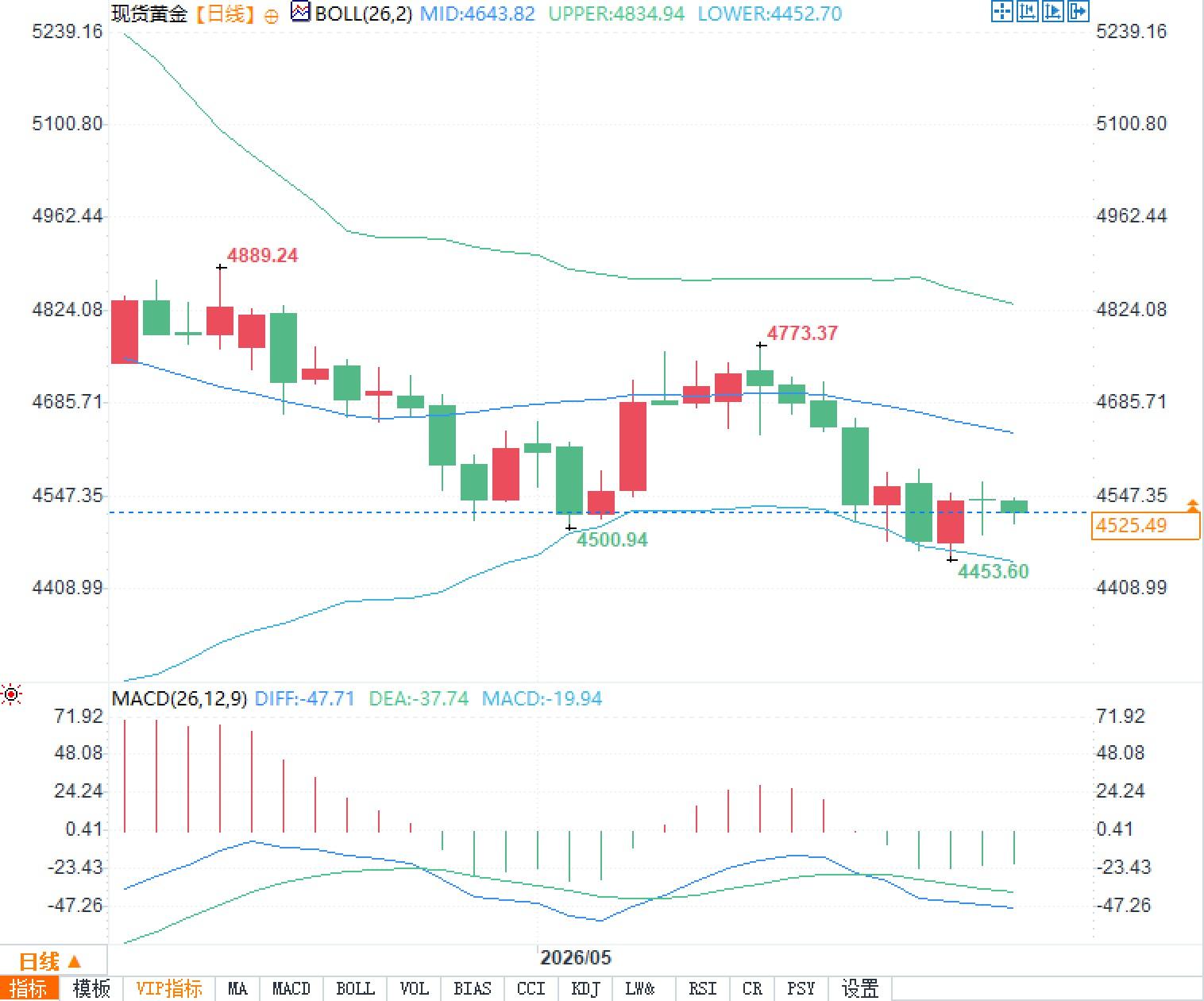
From the daily chart, spot gold is currently trading between the middle and lower Bollinger Bands. The middle band is around $4643.82, the upper band is around $4834.94, and the lower band is around $4452.70. The latest price is around $4525, not far from the lower band, indicating that the price has entered a slightly weaker zone in the short term, but has not yet broken through the lower band decisively.
The recent high in the chart is $4773.37, while previous lows are around $4500.94 and $4453.60. The $4520 to $4540 area is currently a battleground between bulls and bears. Structurally, gold prices have shifted from the previous rebound channel to a weak consolidation. In the MACD indicator, the DIFF is approximately -47.71 and the DEA is approximately -37.74, with the histogram still in negative territory, indicating insufficient momentum recovery. The technical analysis does not support an overly optimistic interpretation. Unless the price rebounds above the middle Bollinger Band, the rebound is more likely to be seen as a correction rather than a renewed trend.
The repricing of the Federal Reserve's path in the interest rate market is one of the most critical factors currently suppressing gold prices. The latest public tools show that the market is still tracking the probability of interest rate changes at future meetings, with federal funds futures continuing to be used to measure the distribution of expectations for rate hikes, cuts, or no change. If energy prices continue to fluctuate at high levels, the rate of decline in inflation data may slow, making it difficult for policy expectations to quickly shift towards easing.
However, the medium-term support for gold has not completely disappeared. If high oil prices further damage consumption and corporate profits, the market will reassess growth risks; once growth concerns outweigh interest rate pressures, safe-haven demand may still flow back into gold. In other words, the current risk for gold is not a lack of fundamental support, but rather that the supporting factors have not yet formed a unified direction. The higher the oil price, the stronger the inflationary pressure and the stronger the interest rate suppression; gold must wait for a new dominant clue among macroeconomic variables.
Question 1: Why didn't the rise in oil prices directly drive up the price of gold?
A: While rising oil prices exacerbate inflation concerns, they also increase market expectations that interest rates will remain high or even tighten further. Gold offers no coupon income, and when US Treasury yields and the dollar strengthen in tandem, the opportunity cost of holding gold increases, and the support from inflation for gold is offset by interest rate pressures.
Question 2: What is the key observation range for gold at present?
A: From the daily chart, the $4450-$4500 area is a key support zone, while the $4640-$4670 area is a short-to-medium-term resistance zone. If the price remains below the Bollinger Middle Band for an extended period, it indicates that the market remains cautious, and the sustainability of any rebound will require further support from macroeconomic variables.
Question 3: What data should we pay more attention to for gold going forward?
A: The key factors are crude oil prices, the US dollar index, the 10-year US Treasury yield, and expectations regarding Federal Reserve policy. If oil prices fall from their highs and yields decline, the pressure on gold may ease; however, if oil prices continue to push up inflation expectations and drive yields upward, gold may still maintain a weak and volatile pattern at high levels.
Oil price shocks are changing the logic of gold pricing.
Brent crude oil rose to around $105 per barrel on May 22, with high oil prices reigniting market sensitivity to imported inflation. Typically, inflation risk strengthens gold's role as a store of value, but when inflationary pressures simultaneously push up real interest rate expectations, gold's weakness as a non-interest-bearing asset is amplified. The current decline in gold prices reflects this contradictory pricing.
The turbulence in the crude oil market stems from repeated negotiations in the Gulf region and uncertainties surrounding key energy routes. The market is not simply trading on reduced supply, but rather reassessing the transmission of energy costs to global production, transportation, and end-consumer demand. If oil prices remain above $100/barrel for an extended period, inflation expectations will become more viscous, and the yield curve will be less likely to shift downwards rapidly. For gold, this means that safe-haven buying and interest rate suppression coexist, making prices more likely to experience wide-ranging fluctuations at high levels rather than a smooth, one-sided upward trend.
The US dollar and US Treasury yields are putting short-term pressure on the currency.
The US dollar index is currently around 99.30, near its recent high, and has strengthened slightly over the past month. A stronger dollar directly increases the cost of holding gold for non-dollar funds and suppresses marginal demand for dollar-denominated gold. Meanwhile, the 10-year US Treasury yield is around 4.56%, up about 0.24 percentage points from a month ago, indicating that the bond market is still repricing for inflation stickiness and the path of policy rates.
For traders, gold at this stage is not simply a safe-haven asset in the traditional sense, but rather a rebalancing between "inflation protection needs" and "real interest rate pressures." When rising oil prices fuel inflation concerns, gold receives some support; however, if the same factor leads the market to increase expectations that the Federal Reserve will maintain restrictive policies for a longer period, gold's valuation will come under pressure. These two forces are moving in opposite directions, making the market more prone to repeated fluctuations.
Technical structure shows enhanced interval constraints
From the daily chart, spot gold is currently trading between the middle and lower Bollinger Bands. The middle band is around $4643.82, the upper band is around $4834.94, and the lower band is around $4452.70. The latest price is around $4525, not far from the lower band, indicating that the price has entered a slightly weaker zone in the short term, but has not yet broken through the lower band decisively.
The recent high in the chart is $4773.37, while previous lows are around $4500.94 and $4453.60. The $4520 to $4540 area is currently a battleground between bulls and bears. Structurally, gold prices have shifted from the previous rebound channel to a weak consolidation. In the MACD indicator, the DIFF is approximately -47.71 and the DEA is approximately -37.74, with the histogram still in negative territory, indicating insufficient momentum recovery. The technical analysis does not support an overly optimistic interpretation. Unless the price rebounds above the middle Bollinger Band, the rebound is more likely to be seen as a correction rather than a renewed trend.
The core contradiction among macroeconomic variables remains policy expectations.
The repricing of the Federal Reserve's path in the interest rate market is one of the most critical factors currently suppressing gold prices. The latest public tools show that the market is still tracking the probability of interest rate changes at future meetings, with federal funds futures continuing to be used to measure the distribution of expectations for rate hikes, cuts, or no change. If energy prices continue to fluctuate at high levels, the rate of decline in inflation data may slow, making it difficult for policy expectations to quickly shift towards easing.
However, the medium-term support for gold has not completely disappeared. If high oil prices further damage consumption and corporate profits, the market will reassess growth risks; once growth concerns outweigh interest rate pressures, safe-haven demand may still flow back into gold. In other words, the current risk for gold is not a lack of fundamental support, but rather that the supporting factors have not yet formed a unified direction. The higher the oil price, the stronger the inflationary pressure and the stronger the interest rate suppression; gold must wait for a new dominant clue among macroeconomic variables.
Frequently Asked Questions
Question 1: Why didn't the rise in oil prices directly drive up the price of gold?
A: While rising oil prices exacerbate inflation concerns, they also increase market expectations that interest rates will remain high or even tighten further. Gold offers no coupon income, and when US Treasury yields and the dollar strengthen in tandem, the opportunity cost of holding gold increases, and the support from inflation for gold is offset by interest rate pressures.
Question 2: What is the key observation range for gold at present?
A: From the daily chart, the $4450-$4500 area is a key support zone, while the $4640-$4670 area is a short-to-medium-term resistance zone. If the price remains below the Bollinger Middle Band for an extended period, it indicates that the market remains cautious, and the sustainability of any rebound will require further support from macroeconomic variables.
Question 3: What data should we pay more attention to for gold going forward?
A: The key factors are crude oil prices, the US dollar index, the 10-year US Treasury yield, and expectations regarding Federal Reserve policy. If oil prices fall from their highs and yields decline, the pressure on gold may ease; however, if oil prices continue to push up inflation expectations and drive yields upward, gold may still maintain a weak and volatile pattern at high levels.
- Risk Warning and Disclaimer
- The market involves risk, and trading may not be suitable for all investors. This article is for reference only and does not constitute personal investment advice, nor does it take into account certain users’ specific investment objectives, financial situation, or other needs. Any investment decisions made based on this information are at your own risk.