The US-Iran negotiations present both "optimistic signs" and a "substantive stalemate," causing the US dollar to open lower against the Japanese yen before rebounding.
2026-05-25 16:27:18
The dollar opened lower against the yen on Monday (May 25) and attracted bargain hunters, currently trading near the 159.00 level at 158.98. Developments over the weekend regarding the US-Iran situation have fueled hopes for an agreement to end the nearly three-month conflict, boosting investor confidence and weakening the dollar's reserve currency status.
However, the United States and Iran remain deeply divided on key issues such as the Strait of Hormuz blockade and Tehran's nuclear program. The nuclear issue is undoubtedly the biggest obstacle to negotiations. The US has consistently adhered to the core principle of "actions for deregulation," demanding that Iran first make substantial concessions, explicitly commit to never seeking nuclear weapons, and negotiate on suspending uranium enrichment activities and transferring its stockpile of highly enriched uranium. The US's bottom line is to ultimately acquire and destroy Iran's highly enriched uranium stockpile. However, Iran has taken a hard line, clearly stating that this round of memorandums of understanding does not involve the nuclear issue at all, and related negotiations will be postponed until all fighting on all fronts ends and the US has substantially fulfilled its commitments. Iran's Supreme Leader Khamenei has explicitly instructed that the highly enriched uranium stockpile must not be shipped out of the country, considering it a "critical strategic asset" for national security.
Meanwhile, there are fundamental differences in the statements made by the two sides regarding control of the Strait of Hormuz. Trump previously claimed that an agreement would promote the "opening of the Strait of Hormuz," but Iran emphasized that even if an agreement is reached, the strait will remain under Iranian control, and merely restoring the number of ships that could navigate it before the war would not mean a return to the completely free passage state before the war. Iran has established the "Persian Gulf Straits Authority," requiring passing ships to coordinate with Iran, and is exploring the establishment of a permanent toll collection mechanism. US Secretary of State Rubio explicitly warned that if Iran insists on a toll system, a diplomatic agreement will be "impossible to reach."
US President Trump said on Sunday that he had told US representatives not to rush into any agreement with Iran. He posted on social media that the blockade against Iran would remain in place until an agreement was reached, certified, and signed, emphasizing that "both sides must be patient and do things right." Trump later added that the US-Iran agreement was "not even fully negotiated yet," declaring, "I'm not going to make a bad deal." White House officials subsequently stated that the US and Iran were "still several days away" from signing an agreement, which still required approval from Iran's Supreme Leader Khamenei. This has perpetuated geopolitical risks, dampened market enthusiasm, and also means that any news of an "imminent agreement" could be proven false at any time.
Traders have almost fully priced in at least a 25 basis point rate hike by the Federal Reserve in early 2027, which should help limit further declines in the dollar. The key driver of this shift in expectations is Waller's sudden "hawkish turn," after previously advocating for rate cuts, explicitly stating that "the possibility of future rate hikes cannot be ruled out." Barclays, Huatai Securities, and other institutions believe that as long as US Treasury yields remain high (10-year yields hovering between 4.5% and 4.7%), the interest rate differential of dollar assets will continue to attract capital inflows, providing a floor for the dollar.
Meanwhile, investor concerns about the economic risks of continued energy supply disruptions weakened the yen and pushed the dollar/yen exchange rate higher. Japan imports about 95% of its oil from the Middle East, and crude oil imports in April plummeted 67.2% year-on-year, while import prices surged 37.9% to a record high. Although core inflation was only 1.4% in April, analysts believe this was mainly due to the "painkiller" effect of government subsidies. Once these subsidies are phased out and import costs are passed on later, a rebound in inflation is almost certain. However, the dollar/yen exchange rate is once again approaching the 160 level, and market vigilance regarding Japanese intervention is rising. Japan had already intervened with approximately $34.5 billion on April 30, and the Finance Minister reiterated the country's readiness to act. As long as the 160 level remains close, short sellers must be constantly wary of the risk of Japanese intervention, which to some extent limits aggressive betting on the yen.
Meanwhile, liquidity is likely to remain low due to holidays in several major markets in the US and Europe. US stock markets are closed for Memorial Day, London markets are closed for the Spring Bank Holiday, and major European markets such as Germany and France are also closed. This means a significant reduction in the amount of capital involved in trading, resulting in a substantial decrease in market liquidity. In a illiquid environment, even small flows of funds can trigger large price fluctuations—both upward and downward—which can be amplified. Traders typically choose to reduce positions and avoid establishing large positions during holidays to mitigate the unpredictable risks associated with insufficient liquidity. This also warrants caution before the USD/JPY pair appreciates further.
However, the fundamental backdrop, coupled with bargain hunting during the session, suggests that the path of least resistance for spot prices remains upward. From a fundamental perspective, the uncertainty surrounding US-Iran negotiations continues to dampen market risk appetite, while expectations of a Fed rate hike provide support for the dollar. In Japan, the risk of energy supply disruptions to the Japanese economy is accumulating, making it difficult for the yen to find support. Looking at market behavior, the USD/JPY pair opened lower on Monday but quickly attracted bargain hunting, resulting in an intraday rebound, indicating strong buying interest at lower levels. As long as geopolitical risks and the energy crisis do not experience dramatic reversals, pullbacks in the USD/JPY pair can be seen as buying opportunities. Although holiday liquidity may cause short-term volatility, the overall direction still points to further upward movement. The 160 level is the next key test, and whether Japanese authorities intervene will be the biggest variable affecting short-term trends.
In summary, the USD/JPY pair is currently supported by multiple factors: uncertainty surrounding US-Iran negotiations is dampening market risk appetite, expectations of a Fed rate hike are supporting the dollar, while the risk of energy supply disruptions to the Japanese economy continues to weigh on the yen. Although intervention speculation and holiday liquidity may limit short-term volatility, the overall fundamental environment still points to further upside for USD/JPY.
From the daily chart, the USD/JPY pair is currently trading around 159.00, in a consolidation phase at high levels after a continuous rise, with multiple technical indicators showing bullish signals.
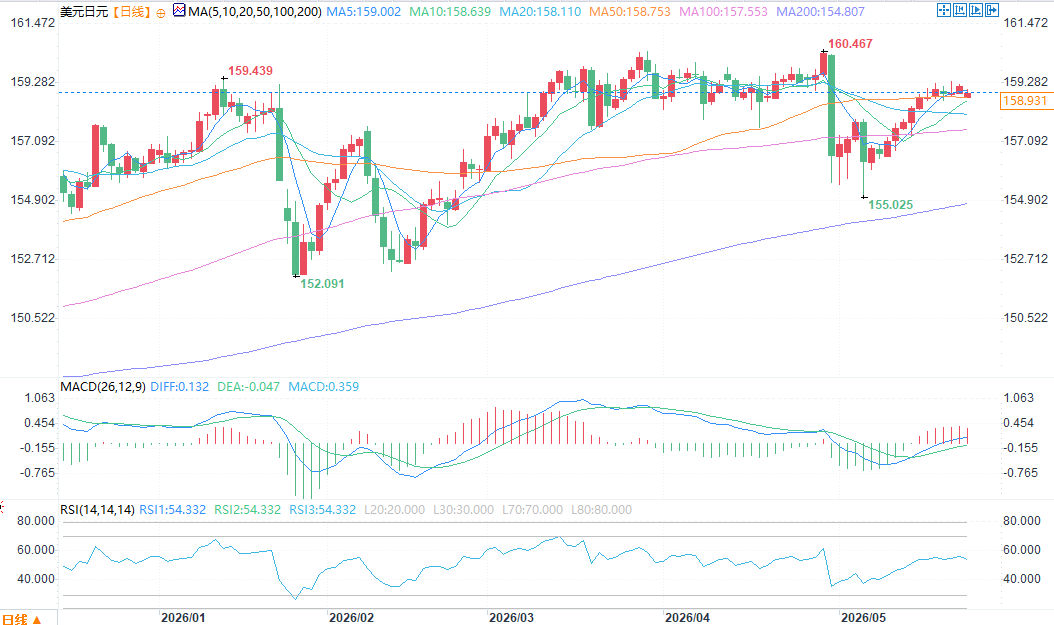
(USD/JPY daily chart, source: FX678)
Regarding the moving average system, the short-term moving averages MA5 (159.01), MA10 (158.64), MA20 (158.11), and MA50 (158.75) are all near or below the current price, forming short-term support; while MA100 (157.55) and MA200 (154.81) are well below the current price, showing a bullish alignment. This alignment of "price above all major moving averages" indicates that USD/JPY remains in a clear upward trend. It is worth noting that the price has been steadily trading above the MA50 since breaking through it in early May, showing that the upward structure remains intact.
At 16:16 Beijing time on May 25, the USD/JPY exchange rate was 158.94/95.
US-Iran negotiations: Optimistic signs coexist with a real stalemate
However, the United States and Iran remain deeply divided on key issues such as the Strait of Hormuz blockade and Tehran's nuclear program. The nuclear issue is undoubtedly the biggest obstacle to negotiations. The US has consistently adhered to the core principle of "actions for deregulation," demanding that Iran first make substantial concessions, explicitly commit to never seeking nuclear weapons, and negotiate on suspending uranium enrichment activities and transferring its stockpile of highly enriched uranium. The US's bottom line is to ultimately acquire and destroy Iran's highly enriched uranium stockpile. However, Iran has taken a hard line, clearly stating that this round of memorandums of understanding does not involve the nuclear issue at all, and related negotiations will be postponed until all fighting on all fronts ends and the US has substantially fulfilled its commitments. Iran's Supreme Leader Khamenei has explicitly instructed that the highly enriched uranium stockpile must not be shipped out of the country, considering it a "critical strategic asset" for national security.
Meanwhile, there are fundamental differences in the statements made by the two sides regarding control of the Strait of Hormuz. Trump previously claimed that an agreement would promote the "opening of the Strait of Hormuz," but Iran emphasized that even if an agreement is reached, the strait will remain under Iranian control, and merely restoring the number of ships that could navigate it before the war would not mean a return to the completely free passage state before the war. Iran has established the "Persian Gulf Straits Authority," requiring passing ships to coordinate with Iran, and is exploring the establishment of a permanent toll collection mechanism. US Secretary of State Rubio explicitly warned that if Iran insists on a toll system, a diplomatic agreement will be "impossible to reach."
US President Trump said on Sunday that he had told US representatives not to rush into any agreement with Iran. He posted on social media that the blockade against Iran would remain in place until an agreement was reached, certified, and signed, emphasizing that "both sides must be patient and do things right." Trump later added that the US-Iran agreement was "not even fully negotiated yet," declaring, "I'm not going to make a bad deal." White House officials subsequently stated that the US and Iran were "still several days away" from signing an agreement, which still required approval from Iran's Supreme Leader Khamenei. This has perpetuated geopolitical risks, dampened market enthusiasm, and also means that any news of an "imminent agreement" could be proven false at any time.
Fundamental Background: Interest Rate Hike Expectations and Energy Risks Jointly Support USD/JPY
Traders have almost fully priced in at least a 25 basis point rate hike by the Federal Reserve in early 2027, which should help limit further declines in the dollar. The key driver of this shift in expectations is Waller's sudden "hawkish turn," after previously advocating for rate cuts, explicitly stating that "the possibility of future rate hikes cannot be ruled out." Barclays, Huatai Securities, and other institutions believe that as long as US Treasury yields remain high (10-year yields hovering between 4.5% and 4.7%), the interest rate differential of dollar assets will continue to attract capital inflows, providing a floor for the dollar.
Meanwhile, investor concerns about the economic risks of continued energy supply disruptions weakened the yen and pushed the dollar/yen exchange rate higher. Japan imports about 95% of its oil from the Middle East, and crude oil imports in April plummeted 67.2% year-on-year, while import prices surged 37.9% to a record high. Although core inflation was only 1.4% in April, analysts believe this was mainly due to the "painkiller" effect of government subsidies. Once these subsidies are phased out and import costs are passed on later, a rebound in inflation is almost certain. However, the dollar/yen exchange rate is once again approaching the 160 level, and market vigilance regarding Japanese intervention is rising. Japan had already intervened with approximately $34.5 billion on April 30, and the Finance Minister reiterated the country's readiness to act. As long as the 160 level remains close, short sellers must be constantly wary of the risk of Japanese intervention, which to some extent limits aggressive betting on the yen.
Holiday factors: Liquidity is low, caution is advised.
Meanwhile, liquidity is likely to remain low due to holidays in several major markets in the US and Europe. US stock markets are closed for Memorial Day, London markets are closed for the Spring Bank Holiday, and major European markets such as Germany and France are also closed. This means a significant reduction in the amount of capital involved in trading, resulting in a substantial decrease in market liquidity. In a illiquid environment, even small flows of funds can trigger large price fluctuations—both upward and downward—which can be amplified. Traders typically choose to reduce positions and avoid establishing large positions during holidays to mitigate the unpredictable risks associated with insufficient liquidity. This also warrants caution before the USD/JPY pair appreciates further.
However, the fundamental backdrop, coupled with bargain hunting during the session, suggests that the path of least resistance for spot prices remains upward. From a fundamental perspective, the uncertainty surrounding US-Iran negotiations continues to dampen market risk appetite, while expectations of a Fed rate hike provide support for the dollar. In Japan, the risk of energy supply disruptions to the Japanese economy is accumulating, making it difficult for the yen to find support. Looking at market behavior, the USD/JPY pair opened lower on Monday but quickly attracted bargain hunting, resulting in an intraday rebound, indicating strong buying interest at lower levels. As long as geopolitical risks and the energy crisis do not experience dramatic reversals, pullbacks in the USD/JPY pair can be seen as buying opportunities. Although holiday liquidity may cause short-term volatility, the overall direction still points to further upward movement. The 160 level is the next key test, and whether Japanese authorities intervene will be the biggest variable affecting short-term trends.
The yen remained under pressure, but the upward trend of the USD/JPY exchange rate remained unchanged.
In summary, the USD/JPY pair is currently supported by multiple factors: uncertainty surrounding US-Iran negotiations is dampening market risk appetite, expectations of a Fed rate hike are supporting the dollar, while the risk of energy supply disruptions to the Japanese economy continues to weigh on the yen. Although intervention speculation and holiday liquidity may limit short-term volatility, the overall fundamental environment still points to further upside for USD/JPY.
USD/JPY Daily Technical Analysis
From the daily chart, the USD/JPY pair is currently trading around 159.00, in a consolidation phase at high levels after a continuous rise, with multiple technical indicators showing bullish signals.
(USD/JPY daily chart, source: FX678)
Regarding the moving average system, the short-term moving averages MA5 (159.01), MA10 (158.64), MA20 (158.11), and MA50 (158.75) are all near or below the current price, forming short-term support; while MA100 (157.55) and MA200 (154.81) are well below the current price, showing a bullish alignment. This alignment of "price above all major moving averages" indicates that USD/JPY remains in a clear upward trend. It is worth noting that the price has been steadily trading above the MA50 since breaking through it in early May, showing that the upward structure remains intact.
At 16:16 Beijing time on May 25, the USD/JPY exchange rate was 158.94/95.
- Risk Warning and Disclaimer
- The market involves risk, and trading may not be suitable for all investors. This article is for reference only and does not constitute personal investment advice, nor does it take into account certain users’ specific investment objectives, financial situation, or other needs. Any investment decisions made based on this information are at your own risk.