The Australian dollar rebounded slightly against the US dollar as expectations of a US-Iran ceasefire boosted market risk appetite and the dollar weakened.
2026-05-25 16:17:17
The Australian dollar maintained its rebound against the US dollar during Monday's European trading session, trading around 0.7170. As expectations of a near-agreement between the US and Iran continued to rise, global market risk appetite improved significantly, and demand for the US dollar as a safe haven cooled, thus supporting risk currencies such as the Australian dollar. Current market expectations are that the US and Iran may be close to reaching an agreement on extending the 60-day ceasefire. According to market sources, the agreement may include the reopening of the Strait of Hormuz, the restoration of free international shipping, and the US potentially lifting its blockade of Iranian ports.

The market believes that if normal shipping resumes in the Strait of Hormuz, global energy supply risks will significantly decrease, and market risk sentiment will further improve. As a result, demand for the US dollar as a safe haven has weakened significantly, pushing the US dollar index down overall. The Australian dollar, as a typical risk currency, benefits from the return of market funds to higher-risk assets.
Meanwhile, improved international risk appetite has further supported the Australian dollar. Commodity currencies like the Australian dollar typically perform relatively strongly during periods of improved global market sentiment. However, the Australian dollar's further upside potential remains limited by weak domestic economic data.
Latest data shows that Australia's unemployment rate unexpectedly rose to 4.5% in April, up from 4.3% in March and reaching its highest level in about four and a half years. This figure was significantly weaker than market expectations, exacerbating concerns about a slowdown in the Australian economy. The cooling job market means that the pressure on the Reserve Bank of Australia (RBA) to raise interest rates further has decreased significantly. Following the data release, financial markets quickly adjusted their expectations for the RBA's future policy path.
According to Westpac's interest rate pricing model, the market expects the probability of a rate hike at the Reserve Bank of Australia's (RBA) next meeting to have fallen to about 3%, far lower than the 13% before the data release. Previously, the market had believed that sticky inflation and a tight labor market in Australia might keep the RBA maintaining a hawkish stance. However, with the significant rise in unemployment, the market has begun to reassess Australia's economic growth prospects.
Meanwhile, the high inflation environment in the United States continues to support the dollar. Recent US inflation data remains stubbornly persistent, and the Federal Reserve's policy expectations have shifted back towards a hawkish stance. According to the CME Group's FedWatch tool, the market currently expects a nearly 41% probability of a 25 basis point rate hike by the Fed before the end of the year. The Fed's continued high interest rate expectations mean that the dollar as a whole still retains a certain yield advantage.
Therefore, although the US dollar has recently retreated due to decreased safe-haven demand, it has not yet fully entered a weak cycle. This also means that the upside potential of the Australian dollar against the US dollar may be somewhat limited. Furthermore, changes in international commodity prices will continue to influence the Australian dollar's exchange rate. As a resource-exporting economy, Australia's economy is highly correlated with global commodity demand.
If a US-Iran agreement is ultimately reached and drives a significant drop in international oil prices, global inflationary pressures may decrease. However, this could also affect the performance of some commodity markets, thereby indirectly influencing the Australian dollar's exchange rate.
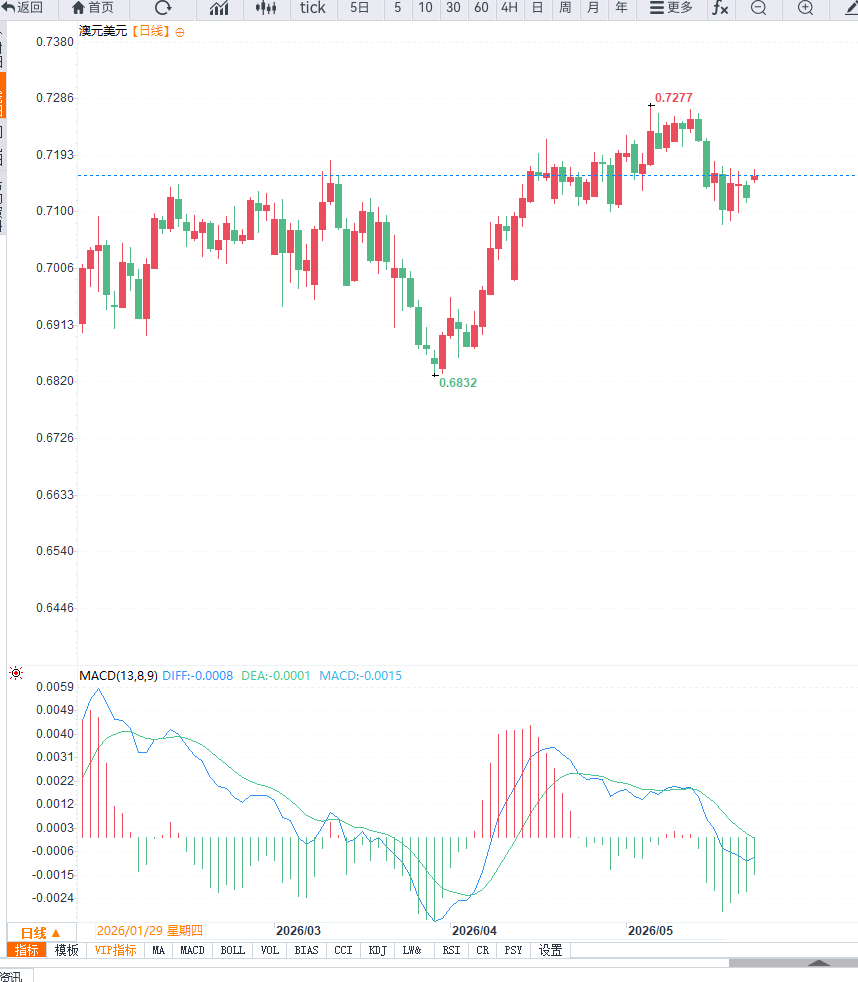
From a technical perspective, the Australian dollar against the US dollar maintains an overall upward-biased structure on the daily chart. The exchange rate rebounded after finding support around 0.7100 and has now regained its footing above the short-term moving average system. Key resistance on the daily chart lies in the 0.7200-0.7225 area; a break above this area could lead to a further test of the 0.7280 level.
On the downside, 0.7140 has formed a key short-term support area, with further support around 0.7100. If the US dollar index continues to decline while market risk appetite improves further, the Australian dollar against the US dollar still has room to rise. Looking at the daily indicators, the MACD remains above the zero line, indicating that the medium-term market structure remains bullish. The RSI indicator is running around 55, reflecting a slightly bullish overall market momentum.
However, if US economic data continues to be strong and the Federal Reserve reaffirms its hawkish stance, the US dollar may regain support. Furthermore, if Australian economic data continues to deteriorate, it could limit further upside potential for the Australian dollar.
Overall, the current Australian dollar's exchange rate against the US dollar is mainly influenced by three factors: improved global risk sentiment, a decline in the US dollar index, and changes in expectations regarding the Reserve Bank of Australia's policy. Short-term market sentiment leans towards a bullish Australian dollar, but future movements will still depend on Federal Reserve policy, the situation in the Middle East, and changes in Australian economic data.
Editor's Summary : The Australian dollar is currently in a tug-of-war between improved global risk appetite and pressure from a slowing Australian economy. A near-agreement between the US and Iran has eased market risk aversion, providing upward momentum for risk currencies like the Australian dollar. However, significantly deteriorating Australian employment data has greatly reduced market expectations for further interest rate hikes by the Reserve Bank of Australia (RBA), limiting the Australian dollar's medium- to long-term upside potential. Going forward, the market will need to focus on the final progress of the US-Iran agreement, changes in Federal Reserve policy, the RBA's interest rate path, and global commodity market trends, as these factors will continue to dominate the future direction of the Australian dollar against the US dollar.
The market believes that if normal shipping resumes in the Strait of Hormuz, global energy supply risks will significantly decrease, and market risk sentiment will further improve. As a result, demand for the US dollar as a safe haven has weakened significantly, pushing the US dollar index down overall. The Australian dollar, as a typical risk currency, benefits from the return of market funds to higher-risk assets.
Meanwhile, improved international risk appetite has further supported the Australian dollar. Commodity currencies like the Australian dollar typically perform relatively strongly during periods of improved global market sentiment. However, the Australian dollar's further upside potential remains limited by weak domestic economic data.
Latest data shows that Australia's unemployment rate unexpectedly rose to 4.5% in April, up from 4.3% in March and reaching its highest level in about four and a half years. This figure was significantly weaker than market expectations, exacerbating concerns about a slowdown in the Australian economy. The cooling job market means that the pressure on the Reserve Bank of Australia (RBA) to raise interest rates further has decreased significantly. Following the data release, financial markets quickly adjusted their expectations for the RBA's future policy path.
According to Westpac's interest rate pricing model, the market expects the probability of a rate hike at the Reserve Bank of Australia's (RBA) next meeting to have fallen to about 3%, far lower than the 13% before the data release. Previously, the market had believed that sticky inflation and a tight labor market in Australia might keep the RBA maintaining a hawkish stance. However, with the significant rise in unemployment, the market has begun to reassess Australia's economic growth prospects.
Meanwhile, the high inflation environment in the United States continues to support the dollar. Recent US inflation data remains stubbornly persistent, and the Federal Reserve's policy expectations have shifted back towards a hawkish stance. According to the CME Group's FedWatch tool, the market currently expects a nearly 41% probability of a 25 basis point rate hike by the Fed before the end of the year. The Fed's continued high interest rate expectations mean that the dollar as a whole still retains a certain yield advantage.
Therefore, although the US dollar has recently retreated due to decreased safe-haven demand, it has not yet fully entered a weak cycle. This also means that the upside potential of the Australian dollar against the US dollar may be somewhat limited. Furthermore, changes in international commodity prices will continue to influence the Australian dollar's exchange rate. As a resource-exporting economy, Australia's economy is highly correlated with global commodity demand.
If a US-Iran agreement is ultimately reached and drives a significant drop in international oil prices, global inflationary pressures may decrease. However, this could also affect the performance of some commodity markets, thereby indirectly influencing the Australian dollar's exchange rate.
From a technical perspective, the Australian dollar against the US dollar maintains an overall upward-biased structure on the daily chart. The exchange rate rebounded after finding support around 0.7100 and has now regained its footing above the short-term moving average system. Key resistance on the daily chart lies in the 0.7200-0.7225 area; a break above this area could lead to a further test of the 0.7280 level.
On the downside, 0.7140 has formed a key short-term support area, with further support around 0.7100. If the US dollar index continues to decline while market risk appetite improves further, the Australian dollar against the US dollar still has room to rise. Looking at the daily indicators, the MACD remains above the zero line, indicating that the medium-term market structure remains bullish. The RSI indicator is running around 55, reflecting a slightly bullish overall market momentum.
However, if US economic data continues to be strong and the Federal Reserve reaffirms its hawkish stance, the US dollar may regain support. Furthermore, if Australian economic data continues to deteriorate, it could limit further upside potential for the Australian dollar.
Overall, the current Australian dollar's exchange rate against the US dollar is mainly influenced by three factors: improved global risk sentiment, a decline in the US dollar index, and changes in expectations regarding the Reserve Bank of Australia's policy. Short-term market sentiment leans towards a bullish Australian dollar, but future movements will still depend on Federal Reserve policy, the situation in the Middle East, and changes in Australian economic data.
Editor's Summary : The Australian dollar is currently in a tug-of-war between improved global risk appetite and pressure from a slowing Australian economy. A near-agreement between the US and Iran has eased market risk aversion, providing upward momentum for risk currencies like the Australian dollar. However, significantly deteriorating Australian employment data has greatly reduced market expectations for further interest rate hikes by the Reserve Bank of Australia (RBA), limiting the Australian dollar's medium- to long-term upside potential. Going forward, the market will need to focus on the final progress of the US-Iran agreement, changes in Federal Reserve policy, the RBA's interest rate path, and global commodity market trends, as these factors will continue to dominate the future direction of the Australian dollar against the US dollar.
- Risk Warning and Disclaimer
- The market involves risk, and trading may not be suitable for all investors. This article is for reference only and does not constitute personal investment advice, nor does it take into account certain users’ specific investment objectives, financial situation, or other needs. Any investment decisions made based on this information are at your own risk.