A 5% yield has become a "golden guillotine," and a brief rebound is unlikely to change the predicament of gold.
2026-05-25 19:22:31
On Monday (May 25), spot gold saw a significant rebound in Asian trading. Prices gradually recovered from last week's closing low, reaching a high of around $4579, a single-day increase of over $60, or 1.4%. Due to the Memorial Day holiday in the United States, US stock markets were closed, and the tightening of liquidity led to a temporary exit of short sellers. The key low of $4502 attracted bargain hunters, and the geopolitical situation in the Middle East provided a safe-haven support. These multiple factors combined to fuel this strong rebound in Asian trading.

However, the core logic driving last week's sharp drop in gold prices—the valuation suppression of non-interest-bearing assets in a high-interest-rate environment—did not show any substantial easing within a single trading day. This rebound is ultimately just a technical correction after an oversold condition and should not be regarded as a signal of a reversal of the bullish trend.
Multiple negative factors are fermenting together
Last week, spot gold generally trended downwards, ultimately closing at $4,502 per ounce, marking two consecutive weeks of declines and completely breaking the upward trend that began at the start of the year. This pullback was supported by two independent resistance lines.
The first key factor is interest rates. On May 13th, the winning bid rate for the 30-year US Treasury bond was set at 5.046%, marking the first time it had surpassed the 5% threshold since 2007. It subsequently climbed to a high of 5.13%, a new high in nearly ten months. The soaring yields on long-term US Treasury bonds significantly increased the opportunity cost of holding gold, leading to a massive outflow of funds from gold and an inflow into interest-bearing assets such as bonds, putting downward pressure on gold prices.
The second main theme is the sudden shift in monetary policy expectations. Previously, the market had long harbored hopes for interest rate cuts, but Federal Reserve Governor Waller publicly advocated last Friday to abandon the dovish bias and open up the option of rate hikes. CME data showed that the probability of at least one rate hike this year jumped from 48% to 58%, completely shattering the narrative of rate cuts. Marex analyst Edward Mex pointed out that the simultaneous rise in real interest rates in many countries around the world, coupled with a strong US dollar, is the underlying core logic suppressing gold prices. These two main themes reinforce each other, jointly constituting the fundamental root cause of this round of sharp gold price declines.
Why has geopolitical risk aversion completely failed?
Geopolitics has always been gold's most solid safe-haven asset, but in the past two weeks, a striking trading paradox has emerged: the situation in the Middle East continues to escalate, but instead of boosting gold prices, the more tense the situation becomes, the more pronounced the downward pressure on gold prices becomes.
StoneX senior analyst Rhona O'Connell offered a precise explanation: the supply chain disruption risks stemming from the Middle East conflict have further fueled global inflation anxiety, while persistently high inflation is conversely forcing the Federal Reserve to maintain a hawkish policy, forming a complete negative feedback loop. In short, geopolitical risks have become an amplifier of inflation expectations within the current macroeconomic framework. Temporary safe-haven buying is completely insufficient to offset the systemic selling pressure under a high-interest-rate environment, rendering gold's traditional safe-haven attributes utterly ineffective in this round of market activity.
Key support and future market direction
(Spot gold daily chart source: FX678)
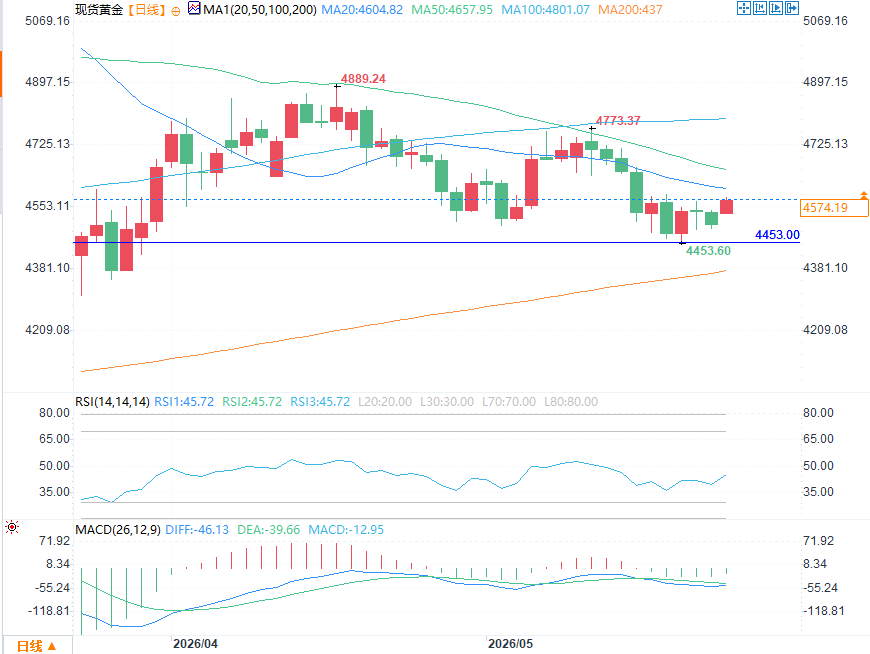
From a technical perspective, $4453 is the current key support level. A break below this level would trigger a new round of deep decline. The $4600 and $4700 levels above form two key resistance levels. Whether the $4600 level can be held is the key signal for determining the strength of this rebound.
On the macro level, the core PCE inflation data released on May 28th is the most important catalyst recently. As the core anchor for the Federal Reserve's monetary policy, if the data again exceeds expectations, expectations of interest rate hikes will further intensify, putting more pressure on gold prices; if a turning point appears, the tightening pattern of high inflation and high interest rates may ease, and gold may usher in a sustained recovery. In addition, the policy tone set at the June interest rate meeting, the trend of long-term US Treasury yields, and developments in the Middle East situation are also key signals that traders cannot ignore.
Until inflation shows a clear downward turning point and the Federal Reserve releases any easing signals, all rebounds can only be defined as oversold corrections, and rallies will instead present excellent opportunities for short-term selling. Only when the two core negative factors—interest rates and policy expectations—ease simultaneously can gold truly escape its current predicament of passive pressure.
At 19:21 Beijing time, spot gold was trading at $4,593.98 per ounce, up 1.49%.
However, the core logic driving last week's sharp drop in gold prices—the valuation suppression of non-interest-bearing assets in a high-interest-rate environment—did not show any substantial easing within a single trading day. This rebound is ultimately just a technical correction after an oversold condition and should not be regarded as a signal of a reversal of the bullish trend.
Multiple negative factors are fermenting together
Last week, spot gold generally trended downwards, ultimately closing at $4,502 per ounce, marking two consecutive weeks of declines and completely breaking the upward trend that began at the start of the year. This pullback was supported by two independent resistance lines.
The first key factor is interest rates. On May 13th, the winning bid rate for the 30-year US Treasury bond was set at 5.046%, marking the first time it had surpassed the 5% threshold since 2007. It subsequently climbed to a high of 5.13%, a new high in nearly ten months. The soaring yields on long-term US Treasury bonds significantly increased the opportunity cost of holding gold, leading to a massive outflow of funds from gold and an inflow into interest-bearing assets such as bonds, putting downward pressure on gold prices.
The second main theme is the sudden shift in monetary policy expectations. Previously, the market had long harbored hopes for interest rate cuts, but Federal Reserve Governor Waller publicly advocated last Friday to abandon the dovish bias and open up the option of rate hikes. CME data showed that the probability of at least one rate hike this year jumped from 48% to 58%, completely shattering the narrative of rate cuts. Marex analyst Edward Mex pointed out that the simultaneous rise in real interest rates in many countries around the world, coupled with a strong US dollar, is the underlying core logic suppressing gold prices. These two main themes reinforce each other, jointly constituting the fundamental root cause of this round of sharp gold price declines.
Why has geopolitical risk aversion completely failed?
Geopolitics has always been gold's most solid safe-haven asset, but in the past two weeks, a striking trading paradox has emerged: the situation in the Middle East continues to escalate, but instead of boosting gold prices, the more tense the situation becomes, the more pronounced the downward pressure on gold prices becomes.
StoneX senior analyst Rhona O'Connell offered a precise explanation: the supply chain disruption risks stemming from the Middle East conflict have further fueled global inflation anxiety, while persistently high inflation is conversely forcing the Federal Reserve to maintain a hawkish policy, forming a complete negative feedback loop. In short, geopolitical risks have become an amplifier of inflation expectations within the current macroeconomic framework. Temporary safe-haven buying is completely insufficient to offset the systemic selling pressure under a high-interest-rate environment, rendering gold's traditional safe-haven attributes utterly ineffective in this round of market activity.
Key support and future market direction
(Spot gold daily chart source: FX678)
From a technical perspective, $4453 is the current key support level. A break below this level would trigger a new round of deep decline. The $4600 and $4700 levels above form two key resistance levels. Whether the $4600 level can be held is the key signal for determining the strength of this rebound.
On the macro level, the core PCE inflation data released on May 28th is the most important catalyst recently. As the core anchor for the Federal Reserve's monetary policy, if the data again exceeds expectations, expectations of interest rate hikes will further intensify, putting more pressure on gold prices; if a turning point appears, the tightening pattern of high inflation and high interest rates may ease, and gold may usher in a sustained recovery. In addition, the policy tone set at the June interest rate meeting, the trend of long-term US Treasury yields, and developments in the Middle East situation are also key signals that traders cannot ignore.
Until inflation shows a clear downward turning point and the Federal Reserve releases any easing signals, all rebounds can only be defined as oversold corrections, and rallies will instead present excellent opportunities for short-term selling. Only when the two core negative factors—interest rates and policy expectations—ease simultaneously can gold truly escape its current predicament of passive pressure.
At 19:21 Beijing time, spot gold was trading at $4,593.98 per ounce, up 1.49%.
- Risk Warning and Disclaimer
- The market involves risk, and trading may not be suitable for all investors. This article is for reference only and does not constitute personal investment advice, nor does it take into account certain users’ specific investment objectives, financial situation, or other needs. Any investment decisions made based on this information are at your own risk.