Repeated US-Iran negotiations disrupt the oil market; high oil prices may become the norm for many years to come.
2026-05-26 10:50:10
International oil prices started the week with fluctuations. Influenced by news that the US and Iran were about to reach an agreement, Brent crude oil prices once fell below $100 per barrel, but subsequent statements from the US have added new uncertainties to the situation.
Despite traders' continued bets on a swift end to the crisis and their persistent shorting of crude oil, multiple risks are accumulating: the closure of the Strait of Hormuz has created a massive supply gap, global crude oil inventories continue to decline, and the industry's long-term underinvestment is exacerbating the already tense supply-demand situation. Industry experts predict that even if the shipping lanes reopen, the crude oil market will struggle to return to low prices, and high oil prices are likely to persist for years to come.
Over the weekend, US President Trump stated that US-Iran negotiations were progressing smoothly, boosting oil prices at the start of the week, with Brent crude falling below $100 per barrel for the first time in several days. However, Trump later stated that there was no need for a hasty agreement and that the US blockade of the Strait of Hormuz would continue, causing prices to fluctuate again.
Since Iran blocked the Strait of Hormuz in response to the US military strikes, the market has maintained an optimistic view that the crisis will be resolved in the short term. Even with a sharp drop of about 14 million barrels per day in global crude oil supply, traders still believe that the shipping disruption will only last for a few days or weeks.
The standoff has now lasted three months, yet this optimism has not subsided. Market data shows that traders have increased their short positions in crude oil for seven consecutive weeks. Analyst John Kemp stated that as of May 19, short positions in Brent crude oil had increased from 40 million barrels at the end of March to 100 million barrels. Meanwhile, the blocked shipping routes remain almost completely at a standstill, and the negative impact continues to spread outwards.
International Energy Agency Executive Director Fatih Birol warned earlier this month that with the arrival of the summer travel season and a steady recovery in market demand, coupled with disruptions to Middle Eastern crude oil exports and rapid depletion of global inventories, the international crude oil market may face a severe supply crisis in July and August this year . Current weakening inventory data confirms that this assessment is not merely a theoretical deduction.
The most pressing problem is the disruption of Middle Eastern crude oil supply, but a deeper issue lies in the continuous shrinking of global investment in the upstream crude oil sector over the past few years.
In their latest quarterly report, resource analysts Leigh Goehring and Adam Rozencwajg analyzed that global oil and gas investment has been sluggish for nearly a decade since the US shale oil boom of 2010. Apart from US shale oil producing regions, global crude oil production growth has essentially stagnated, and even the growth rate of domestic US production capacity is slowing. Now, coupled with shipping lane blockades, the global crude oil market is facing an unprecedented supply shortage.
Two analysts pointed out that insufficient long-term capital investment has led the oil and gas industry into a period of structural supply tightness again, and the recent shutdown of the Strait of Hormuz has created a historic bottleneck in physical circulation. At least 15 million barrels of crude oil supply have been forced to stop daily, making this supply disruption larger than any previous oil crisis. However, the peak price of Brent crude oil was only $4 higher than the 2008 high, indicating that the market severely underestimated the actual impact of the crisis, viewing it merely as a short-term disturbance.
Experts believe that if the blockade continues and the market recognizes the true supply-demand gap, Brent crude oil prices will likely stabilize in the $120-$150 per barrel range for the next few years. Even if the US and Iran reach an agreement and shipping routes reopen, restarting production capacity at the tens of millions of barrels per day will require a long period, and the global energy system will still face pressure from supply shortages. Once the market's inherent optimistic expectations are broken, oil prices will experience a sharp jump and remain high.
In summary, the fluctuating US-Iran negotiations can only lead to short-term market volatility and cannot change the deep-seated supply-demand imbalance in the crude oil market. Weeks of short-selling and optimistic market predictions contradict the continuously deteriorating physical market. The slow pace of global crude oil circulation means that market risks often only fully manifest themselves after imbalances have intensified.
With the combined effects of industry investment gaps and large-scale supply disruptions, international oil prices will remain at high levels for an extended period, regardless of how negotiations unfold.
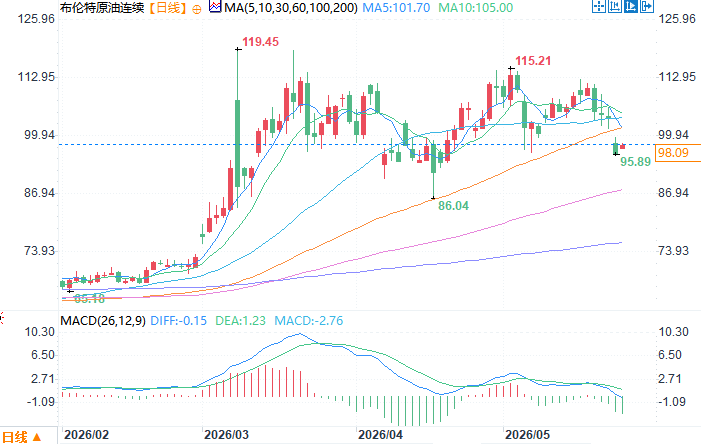
Brent crude oil daily chart source: EasyForex
At 10:49 AM Beijing time on May 26, Brent crude oil futures were trading at $97.86 per barrel.
Despite traders' continued bets on a swift end to the crisis and their persistent shorting of crude oil, multiple risks are accumulating: the closure of the Strait of Hormuz has created a massive supply gap, global crude oil inventories continue to decline, and the industry's long-term underinvestment is exacerbating the already tense supply-demand situation. Industry experts predict that even if the shipping lanes reopen, the crude oil market will struggle to return to low prices, and high oil prices are likely to persist for years to come.
The oil market is experiencing sharp short-term fluctuations due to constantly changing negotiation news.
Over the weekend, US President Trump stated that US-Iran negotiations were progressing smoothly, boosting oil prices at the start of the week, with Brent crude falling below $100 per barrel for the first time in several days. However, Trump later stated that there was no need for a hasty agreement and that the US blockade of the Strait of Hormuz would continue, causing prices to fluctuate again.
Since Iran blocked the Strait of Hormuz in response to the US military strikes, the market has maintained an optimistic view that the crisis will be resolved in the short term. Even with a sharp drop of about 14 million barrels per day in global crude oil supply, traders still believe that the shipping disruption will only last for a few days or weeks.
The standoff has now lasted three months, yet this optimism has not subsided. Market data shows that traders have increased their short positions in crude oil for seven consecutive weeks. Analyst John Kemp stated that as of May 19, short positions in Brent crude oil had increased from 40 million barrels at the end of March to 100 million barrels. Meanwhile, the blocked shipping routes remain almost completely at a standstill, and the negative impact continues to spread outwards.
The supply-demand gap continues to widen, and the oil market is gradually entering a risky phase.
International Energy Agency Executive Director Fatih Birol warned earlier this month that with the arrival of the summer travel season and a steady recovery in market demand, coupled with disruptions to Middle Eastern crude oil exports and rapid depletion of global inventories, the international crude oil market may face a severe supply crisis in July and August this year . Current weakening inventory data confirms that this assessment is not merely a theoretical deduction.
The most pressing problem is the disruption of Middle Eastern crude oil supply, but a deeper issue lies in the continuous shrinking of global investment in the upstream crude oil sector over the past few years.
In their latest quarterly report, resource analysts Leigh Goehring and Adam Rozencwajg analyzed that global oil and gas investment has been sluggish for nearly a decade since the US shale oil boom of 2010. Apart from US shale oil producing regions, global crude oil production growth has essentially stagnated, and even the growth rate of domestic US production capacity is slowing. Now, coupled with shipping lane blockades, the global crude oil market is facing an unprecedented supply shortage.
The industry's structural weaknesses are becoming increasingly apparent, making it difficult to reverse the high oil price situation.
Two analysts pointed out that insufficient long-term capital investment has led the oil and gas industry into a period of structural supply tightness again, and the recent shutdown of the Strait of Hormuz has created a historic bottleneck in physical circulation. At least 15 million barrels of crude oil supply have been forced to stop daily, making this supply disruption larger than any previous oil crisis. However, the peak price of Brent crude oil was only $4 higher than the 2008 high, indicating that the market severely underestimated the actual impact of the crisis, viewing it merely as a short-term disturbance.
Experts believe that if the blockade continues and the market recognizes the true supply-demand gap, Brent crude oil prices will likely stabilize in the $120-$150 per barrel range for the next few years. Even if the US and Iran reach an agreement and shipping routes reopen, restarting production capacity at the tens of millions of barrels per day will require a long period, and the global energy system will still face pressure from supply shortages. Once the market's inherent optimistic expectations are broken, oil prices will experience a sharp jump and remain high.
Summarize
In summary, the fluctuating US-Iran negotiations can only lead to short-term market volatility and cannot change the deep-seated supply-demand imbalance in the crude oil market. Weeks of short-selling and optimistic market predictions contradict the continuously deteriorating physical market. The slow pace of global crude oil circulation means that market risks often only fully manifest themselves after imbalances have intensified.
With the combined effects of industry investment gaps and large-scale supply disruptions, international oil prices will remain at high levels for an extended period, regardless of how negotiations unfold.
Brent crude oil daily chart source: EasyForex
At 10:49 AM Beijing time on May 26, Brent crude oil futures were trading at $97.86 per barrel.
- Risk Warning and Disclaimer
- The market involves risk, and trading may not be suitable for all investors. This article is for reference only and does not constitute personal investment advice, nor does it take into account certain users’ specific investment objectives, financial situation, or other needs. Any investment decisions made based on this information are at your own risk.