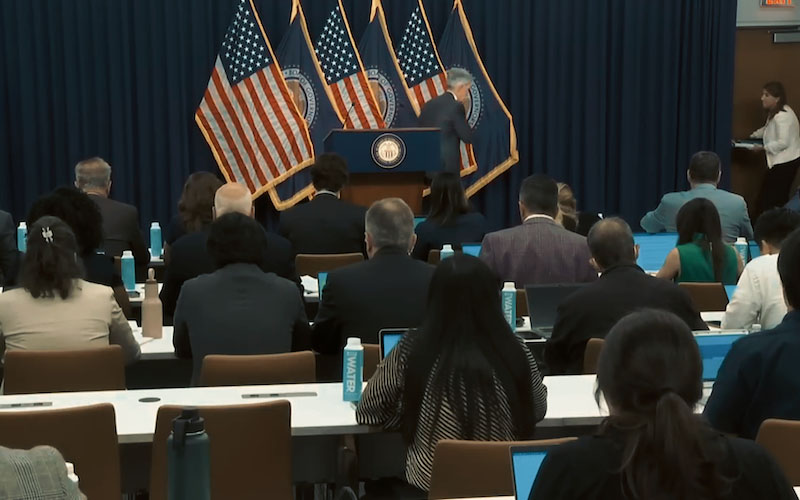
The Reserve Bank of New Zealand is keeping interest rates steady but there are differing opinions, with a higher probability of a rate hike in July.
2026-05-27 13:10:10
The Reserve Bank of New Zealand unanimously approved keeping the official cash rate unchanged at 2.25% in April. Although the rate was also kept unchanged at this meeting, the policy signal it sent was far more hawkish than the market had previously expected.
Prior to the meeting, the market was betting on only a 17% probability of an interest rate hike.
The Monetary Policy Committee vote was divided, with three members supporting an immediate rate hike. Ultimately, Committee Chair Anna Breman exercised her decisive vote to keep the rate unchanged, a result that greatly surprised the market.
More noteworthy is that all committee members unanimously agreed that a rate hike is highly likely to be initiated at a subsequent meeting.

The core of the committee's vote disagreement lies in the differing assessments among the parties regarding whether the sluggish domestic economy can curb inflation in the medium term.
Those advocating for maintaining the current interest rate believe that weakening market confidence and consumer spending, a sluggish housing market, high unemployment, and businesses reducing hiring and investment plans are multiple signs of weakness that will gradually alleviate inflationary pressures. Those supporting an immediate rate hike, however, are more concerned that short-term inflation will be transmitted through wage and commodity pricing, pushing up medium-term inflation; once residents and businesses develop high inflation expectations, the situation will be even more difficult to reverse.
The Reserve Bank of New Zealand also acknowledged that the domestic economy is showing recession-like characteristics across the board, with weak market confidence, consumption, and the housing market. Corporate profit margins are being squeezed, hiring and investment intentions are declining, and high unemployment and increased slack in the labor market could theoretically suppress medium-term inflation. Under these economic conditions, the central bank still predicts that the official cash rate will be raised earlier than initially expected in February, and the increase will be larger. This also indicates that policymakers believe the risk of a second wave of inflation, and subsequently, its solidification, has become apparent.
Recently, several central banks that have implemented inflation targeting have shifted to a tightening stance. The Reserve Bank of New Zealand has also made its choice to curb runaway inflation expectations, even if it may drag down the domestic economy.
The central bank's updated interest rate path further confirms the policy shift towards tightening. The market had previously predicted four interest rate hikes by March next year; however, the revised forecast indicates that the central bank believes that to control inflation, the pace and magnitude of rate hikes may be faster. According to the latest path, rate hikes are highly likely to begin in the middle of this year and continue in stages until mid-2027.
The long-term interest rate center has also shifted upwards, with the official cash rate eventually stabilizing around 3.25%. This means the central bank has raised its estimate of the nominal neutral interest rate, a level that represents a monetary policy that neither stimulates nor inhibits economic activity. Policymakers have concluded that if interest rates remain at the previously projected neutral level, inflation cannot sustainably fall back to the target range.
Interest rate swap market traders have raised their expectations, increasing the probability of the Reserve Bank of New Zealand raising interest rates in July from 70% to 85%. Market pricing indicates two rate hikes before the November election, a third in December, and a fourth in March next year.
The market's anticipated pace of interest rate hikes was slightly faster than the path announced by the central bank, but this was enough to demonstrate that the market had fully grasped the central bank's firm stance against inflation.
The New Zealand dollar surged against the US dollar following the divergent resolution, testing the downtrend line and horizontal resistance level near 0.5880. Various oscillators rose in tandem, indicating initial bullish momentum and a potential upward breakout.
If the exchange rate stabilizes and closes above this resistance level, buying pressure will likely increase, with subsequent tests of the 0.5920 and 0.5969 resistance levels. If the exchange rate remains below 0.5880, the primary support level is 0.5850, with the intraday low approximately 20 basis points below that level.
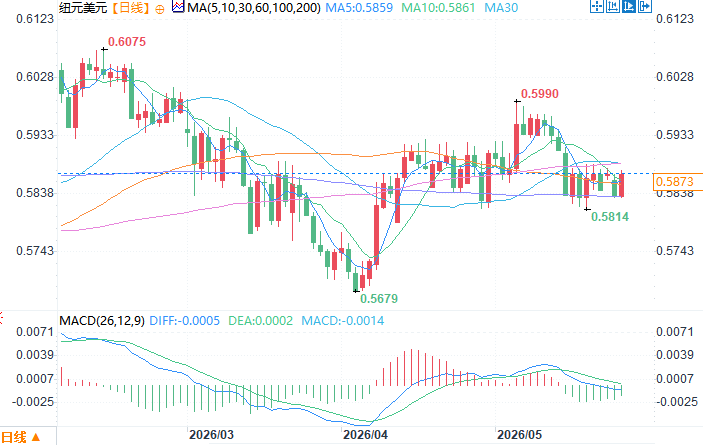
NZD/USD daily chart source: EasyForex
At 13:09 Beijing time on May 27, the New Zealand dollar was trading at 0.5877/78 against the US dollar.
Prior to the meeting, the market was betting on only a 17% probability of an interest rate hike.
The Monetary Policy Committee vote was divided, with three members supporting an immediate rate hike. Ultimately, Committee Chair Anna Breman exercised her decisive vote to keep the rate unchanged, a result that greatly surprised the market.
More noteworthy is that all committee members unanimously agreed that a rate hike is highly likely to be initiated at a subsequent meeting.
A tug-of-war exists between economic weakness and inflation risks.
The core of the committee's vote disagreement lies in the differing assessments among the parties regarding whether the sluggish domestic economy can curb inflation in the medium term.
Those advocating for maintaining the current interest rate believe that weakening market confidence and consumer spending, a sluggish housing market, high unemployment, and businesses reducing hiring and investment plans are multiple signs of weakness that will gradually alleviate inflationary pressures. Those supporting an immediate rate hike, however, are more concerned that short-term inflation will be transmitted through wage and commodity pricing, pushing up medium-term inflation; once residents and businesses develop high inflation expectations, the situation will be even more difficult to reverse.
The Reserve Bank of New Zealand also acknowledged that the domestic economy is showing recession-like characteristics across the board, with weak market confidence, consumption, and the housing market. Corporate profit margins are being squeezed, hiring and investment intentions are declining, and high unemployment and increased slack in the labor market could theoretically suppress medium-term inflation. Under these economic conditions, the central bank still predicts that the official cash rate will be raised earlier than initially expected in February, and the increase will be larger. This also indicates that policymakers believe the risk of a second wave of inflation, and subsequently, its solidification, has become apparent.
Recently, several central banks that have implemented inflation targeting have shifted to a tightening stance. The Reserve Bank of New Zealand has also made its choice to curb runaway inflation expectations, even if it may drag down the domestic economy.
Neutral interest rate forecast revised upward
The central bank's updated interest rate path further confirms the policy shift towards tightening. The market had previously predicted four interest rate hikes by March next year; however, the revised forecast indicates that the central bank believes that to control inflation, the pace and magnitude of rate hikes may be faster. According to the latest path, rate hikes are highly likely to begin in the middle of this year and continue in stages until mid-2027.
The long-term interest rate center has also shifted upwards, with the official cash rate eventually stabilizing around 3.25%. This means the central bank has raised its estimate of the nominal neutral interest rate, a level that represents a monetary policy that neither stimulates nor inhibits economic activity. Policymakers have concluded that if interest rates remain at the previously projected neutral level, inflation cannot sustainably fall back to the target range.
The market quickly interprets policy signals.
Interest rate swap market traders have raised their expectations, increasing the probability of the Reserve Bank of New Zealand raising interest rates in July from 70% to 85%. Market pricing indicates two rate hikes before the November election, a third in December, and a fourth in March next year.
The market's anticipated pace of interest rate hikes was slightly faster than the path announced by the central bank, but this was enough to demonstrate that the market had fully grasped the central bank's firm stance against inflation.
The New Zealand dollar is facing a breakout against the US dollar.
The New Zealand dollar surged against the US dollar following the divergent resolution, testing the downtrend line and horizontal resistance level near 0.5880. Various oscillators rose in tandem, indicating initial bullish momentum and a potential upward breakout.
If the exchange rate stabilizes and closes above this resistance level, buying pressure will likely increase, with subsequent tests of the 0.5920 and 0.5969 resistance levels. If the exchange rate remains below 0.5880, the primary support level is 0.5850, with the intraday low approximately 20 basis points below that level.
NZD/USD daily chart source: EasyForex
At 13:09 Beijing time on May 27, the New Zealand dollar was trading at 0.5877/78 against the US dollar.
- Risk Warning and Disclaimer
- The market involves risk, and trading may not be suitable for all investors. This article is for reference only and does not constitute personal investment advice, nor does it take into account certain users’ specific investment objectives, financial situation, or other needs. Any investment decisions made based on this information are at your own risk.