After rising 2% in May, where is the next target for the USD/CAD pair?
2026-05-28 09:15:12
On Thursday (May 28) during Asian trading hours, the US dollar rose slightly against the Canadian dollar, currently trading at 1.3846. Since May, the US dollar has generally shown a continuous upward trend against the Canadian dollar, with an overall increase of around 2%.
The main factors supporting this rise are the interest rate differential between the US and Canada, and the Bank of Canada's neutral policy stance amid relatively manageable inflation. As long as the policy divergence between the two central banks remains unreversed, buying pressure on the USD/CAD exchange rate is expected to persist in the medium term.

Recent trading sessions have not been entirely favorable for the Canadian dollar. Since the beginning of May, the US dollar has appreciated by 2% against the Canadian dollar, reflecting a market preference for buying the US dollar.
This trend indicates that although the Canadian dollar had previously shown some resilience, buying power in the US dollar is regaining the upper hand recently. The current exchange rate is approaching a key technical level; whether it can break through will directly impact short-term trading sentiment.
Currently, buying pressure on the US dollar against the Canadian dollar is mainly supported by the interest rate differential between the two countries. Meanwhile, the Bank of Canada's maintenance of a neutral outlook amid relatively manageable inflation also provides a favorable environment for a stronger US dollar.
This situation has not yet created conditions sufficient to support sustained demand for the Canadian dollar, meaning that buying pressure on the US dollar against the Canadian dollar is likely to persist in the medium term. In other words, unless there is a substantial shift in the Bank of Canada's policy stance, the attractiveness of the US dollar relative to the Canadian dollar is unlikely to diminish.
One of the main factors supporting the US dollar in recent weeks has been the interest rate differential between the US and other regions, such as Canada. Currently, the US benchmark interest rate remains around 3.75%, significantly higher than the Bank of Canada's 2.25%.
This difference allows the US bond market to continue offering more attractive yields. For 10-year Treasury bonds, US yields remain around 4.5%, while Canadian yields are only around 3.4%. This gap reflects the different monetary policy stances of the two central banks and remains a significant factor supporting demand for the US dollar.
This situation is significant because higher interest rates in the United States make its bond market more attractive compared to other regions. This is likely to continue driving capital inflows into dollar-denominated fixed-income instruments, thereby strengthening demand for the US dollar against currencies such as the Canadian dollar.
Over time, this effect may limit the Canadian dollar's ability to sustain a rebound. Unless there are clear signs that this interest rate differential may narrow, the Canadian dollar is likely to continue to lose its appeal.
In the United States, monetary policy remains neutral, but the CME Group's probability table shows that the market expects a greater than 40% probability that interest rates will rise to 4.00% in March 2027. This suggests that the Federal Reserve may eventually shift to a more hawkish stance, thereby widening the interest rate differential with Canada again.
This expectation itself is influencing exchange rates—even though the rate hike has not yet materialized, market expectations for a shift in Federal Reserve policy have already been priced in to some extent. This is one of the key reasons for the recent strong buying interest in the USD/CAD pair.
The Bank of Canada's outlook is similar to that of the Federal Reserve, expecting interest rates to remain stable in the coming months. However, unlike the Fed, the Bank of Canada has not yet given a clear signal of a possible interest rate hike.
The latest inflation data shows that the CPI in April was 2.8%, higher than the previous value of 2.4%, but lower than the market expectation of 3.1%. This increase was mainly driven by rising gasoline prices, a factor that the Bank of Canada had already anticipated. Therefore, it appears that there is no sufficiently strong catalyst in the short term to prompt the Bank of Canada to raise interest rates.
This contrasts sharply with the United States, where recent inflation data has exceeded expectations, potentially prompting the Federal Reserve to adopt a more hawkish stance. Overall, this divergence between the two central banks remains a major concern for the demand for the Canadian dollar.
As long as there is no confirmation that the Bank of Canada may become more hawkish, the interest rate differential is likely to continue to favor the USD/CAD exchange rate. Therefore, if this gap persists, buying pressure on USD/CAD is likely to continue in the coming weeks.
According to the daily chart, the USD/CAD pair has maintained a relatively clear downward trend since early March 2025, forming a long-term downtrend line that has lasted for several months. However, the recent rebound in the exchange rate has begun to challenge this long-term structure again.
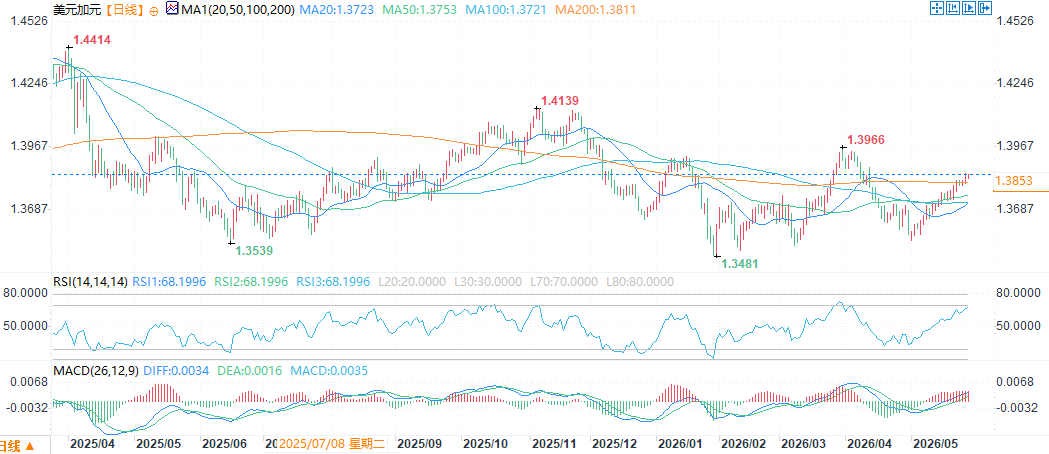
(USD/CAD daily chart, source: EasyForex)
If buying pressure can be sustained, this rebound could begin to invalidate the downtrend structure and open the door to a more significant buying inclination in the coming trading days. Technically, we are currently at a critical juncture in the battle between bulls and bears.
From the RSI indicator, the index has continued to operate above the 50 neutral level, indicating that the average upward momentum over the past 14 trading days still dominates. As long as this trend remains unchanged, the buying bias in the short term is likely to continue.
The robust performance of the RSI is one of the key pieces of evidence for the technical strength, especially since the RSI did not show any obvious bearish divergence signal when the exchange rate approached the key resistance level, which increased the credibility of the breakout.
A similar situation is observed in the MACD indicator, with its histogram remaining above the zero line. This indicates that the average strength of the short-term moving averages still shows an upward bias and may continue to influence the USD/CAD price movement in the coming trading days.
The continued positive performance of the MACD and the RSI have created a technical resonance, further strengthening the momentum of the current rebound. Historically, this pattern of two indicators simultaneously showing a bullish trend often indicates that the trend has a certain degree of sustainability.
In summary, the USD/CAD pair is currently at a critical juncture, where technical and fundamental factors converge. Fundamentally, the interest rate differential between the US and Canada, along with the divergence in central bank policies, continues to support the US dollar, further reinforced by market expectations of a Fed rate hike in 2027. In the short term, traders should focus on the upcoming US PCE data and subsequent statements from the Bank of Canada, as these factors will be key catalysts for the exchange rate's direction.
At 9:15 AM Beijing time on May 28, the USD/CAD exchange rate was 1.3848/49.
The main factors supporting this rise are the interest rate differential between the US and Canada, and the Bank of Canada's neutral policy stance amid relatively manageable inflation. As long as the policy divergence between the two central banks remains unreversed, buying pressure on the USD/CAD exchange rate is expected to persist in the medium term.
Recent Trend: USD/CAD has risen 2% this month.
Recent trading sessions have not been entirely favorable for the Canadian dollar. Since the beginning of May, the US dollar has appreciated by 2% against the Canadian dollar, reflecting a market preference for buying the US dollar.
This trend indicates that although the Canadian dollar had previously shown some resilience, buying power in the US dollar is regaining the upper hand recently. The current exchange rate is approaching a key technical level; whether it can break through will directly impact short-term trading sentiment.
Buying support: Interest rate differentials and the Bank of Canada's neutral stance
Currently, buying pressure on the US dollar against the Canadian dollar is mainly supported by the interest rate differential between the two countries. Meanwhile, the Bank of Canada's maintenance of a neutral outlook amid relatively manageable inflation also provides a favorable environment for a stronger US dollar.
This situation has not yet created conditions sufficient to support sustained demand for the Canadian dollar, meaning that buying pressure on the US dollar against the Canadian dollar is likely to persist in the medium term. In other words, unless there is a substantial shift in the Bank of Canada's policy stance, the attractiveness of the US dollar relative to the Canadian dollar is unlikely to diminish.
Central Bank Update: Interest Rate Spreads Dominate Foreign Exchange Market Trends
One of the main factors supporting the US dollar in recent weeks has been the interest rate differential between the US and other regions, such as Canada. Currently, the US benchmark interest rate remains around 3.75%, significantly higher than the Bank of Canada's 2.25%.
This difference allows the US bond market to continue offering more attractive yields. For 10-year Treasury bonds, US yields remain around 4.5%, while Canadian yields are only around 3.4%. This gap reflects the different monetary policy stances of the two central banks and remains a significant factor supporting demand for the US dollar.
Interest rate differential effect: Capital continues to flow into dollar assets
This situation is significant because higher interest rates in the United States make its bond market more attractive compared to other regions. This is likely to continue driving capital inflows into dollar-denominated fixed-income instruments, thereby strengthening demand for the US dollar against currencies such as the Canadian dollar.
Over time, this effect may limit the Canadian dollar's ability to sustain a rebound. Unless there are clear signs that this interest rate differential may narrow, the Canadian dollar is likely to continue to lose its appeal.
Federal Reserve interest rate hike expectation: Over 40% probability in March 2027
In the United States, monetary policy remains neutral, but the CME Group's probability table shows that the market expects a greater than 40% probability that interest rates will rise to 4.00% in March 2027. This suggests that the Federal Reserve may eventually shift to a more hawkish stance, thereby widening the interest rate differential with Canada again.
This expectation itself is influencing exchange rates—even though the rate hike has not yet materialized, market expectations for a shift in Federal Reserve policy have already been priced in to some extent. This is one of the key reasons for the recent strong buying interest in the USD/CAD pair.
Bank of Canada: Inflation is under control, no signals yet for interest rate hikes
The Bank of Canada's outlook is similar to that of the Federal Reserve, expecting interest rates to remain stable in the coming months. However, unlike the Fed, the Bank of Canada has not yet given a clear signal of a possible interest rate hike.
The latest inflation data shows that the CPI in April was 2.8%, higher than the previous value of 2.4%, but lower than the market expectation of 3.1%. This increase was mainly driven by rising gasoline prices, a factor that the Bank of Canada had already anticipated. Therefore, it appears that there is no sufficiently strong catalyst in the short term to prompt the Bank of Canada to raise interest rates.
Policy divergence between the two countries continues to suppress demand for the Canadian dollar.
This contrasts sharply with the United States, where recent inflation data has exceeded expectations, potentially prompting the Federal Reserve to adopt a more hawkish stance. Overall, this divergence between the two central banks remains a major concern for the demand for the Canadian dollar.
As long as there is no confirmation that the Bank of Canada may become more hawkish, the interest rate differential is likely to continue to favor the USD/CAD exchange rate. Therefore, if this gap persists, buying pressure on USD/CAD is likely to continue in the coming weeks.
Technical Analysis: Long-term downtrend line enters risk zone
According to the daily chart, the USD/CAD pair has maintained a relatively clear downward trend since early March 2025, forming a long-term downtrend line that has lasted for several months. However, the recent rebound in the exchange rate has begun to challenge this long-term structure again.
(USD/CAD daily chart, source: EasyForex)
If buying pressure can be sustained, this rebound could begin to invalidate the downtrend structure and open the door to a more significant buying inclination in the coming trading days. Technically, we are currently at a critical juncture in the battle between bulls and bears.
From the RSI indicator, the index has continued to operate above the 50 neutral level, indicating that the average upward momentum over the past 14 trading days still dominates. As long as this trend remains unchanged, the buying bias in the short term is likely to continue.
The robust performance of the RSI is one of the key pieces of evidence for the technical strength, especially since the RSI did not show any obvious bearish divergence signal when the exchange rate approached the key resistance level, which increased the credibility of the breakout.
A similar situation is observed in the MACD indicator, with its histogram remaining above the zero line. This indicates that the average strength of the short-term moving averages still shows an upward bias and may continue to influence the USD/CAD price movement in the coming trading days.
The continued positive performance of the MACD and the RSI have created a technical resonance, further strengthening the momentum of the current rebound. Historically, this pattern of two indicators simultaneously showing a bullish trend often indicates that the trend has a certain degree of sustainability.
In summary, the USD/CAD pair is currently at a critical juncture, where technical and fundamental factors converge. Fundamentally, the interest rate differential between the US and Canada, along with the divergence in central bank policies, continues to support the US dollar, further reinforced by market expectations of a Fed rate hike in 2027. In the short term, traders should focus on the upcoming US PCE data and subsequent statements from the Bank of Canada, as these factors will be key catalysts for the exchange rate's direction.
At 9:15 AM Beijing time on May 28, the USD/CAD exchange rate was 1.3848/49.
- Risk Warning and Disclaimer
- The market involves risk, and trading may not be suitable for all investors. This article is for reference only and does not constitute personal investment advice, nor does it take into account certain users’ specific investment objectives, financial situation, or other needs. Any investment decisions made based on this information are at your own risk.