Escalating tensions in the Middle East impact Japan's energy outlook; USD/JPY hits four-week high.
2026-05-28 13:50:02
The US dollar rose against the Japanese yen (USD/JPY) for the third consecutive trading day on Thursday in Asian trading, reaching around 159.60, a near four-week high. As the military conflict between the US and Iran escalates further, market concerns about the Japanese economy and energy supply prospects have intensified significantly, putting continued pressure on the yen, while the US dollar remained strong driven by safe-haven demand and expectations of high interest rates.

One of the most pressing concerns in the market right now is the potential impact of disruptions to shipping through the Strait of Hormuz on the Japanese economy. As a major global energy importer, Japan is highly dependent on Middle Eastern crude oil supplies, and the Strait of Hormuz handles approximately 20% of global seaborne crude oil transport. With Iran restricting the passage of some vessels and the US imposing a maritime blockade on Iranian ports, the market is worried that Japan's energy import costs may rise further.
Data shows that commercial traffic in the Strait of Hormuz has declined significantly since the escalation of the Middle East conflict. Given Japan's high dependence on energy imports, rising international oil prices typically cause a rapid increase in production costs for Japanese companies and exacerbate domestic inflationary pressures.
Meanwhile, the US military launched another military strike against Iran on Wednesday. According to market research, the US military attacked Iranian military targets deemed a threat to commercial shipping in the Strait of Hormuz, shooting down several Iranian drones. The market believes that the conflict between the US and Iran is unlikely to ease quickly in the short term.
US President Trump subsequently stated that he was not satisfied with the negotiation terms with Iran and emphasized that he would not rush to reach an agreement. This further weakened market expectations for a diplomatic solution and increased risk aversion in global markets. However, contrary to traditional market logic, the yen has not strengthened due to safe-haven demand. Analysts point out that the main reason is that the market is more concerned about the direct impact of the Middle East situation on the Japanese economy and energy supply chain.
As one of the world's major energy importers, Japan typically faces more severe imported inflationary pressures when international oil prices rise rapidly. Meanwhile, Japan's domestic economic growth is already relatively weak, so high energy prices could further drag down corporate profits and consumer activity. Against this backdrop, the US dollar index (DXY) continues to strengthen, rising above 99.50. With rising international oil prices, the market is again betting that the Federal Reserve may maintain high interest rates for a longer period, with the possibility of rate hikes even as late as 2026.
The market expects the US April PCE price index to rise to 3.8% year-on-year, up from the previous 3.5%; core PCE is expected to rise to 3.3%. As PCE is one of the Federal Reserve's most closely watched inflation indicators, the market is paying close attention to its impact on the future path of interest rates. If PCE data continues to exceed market expectations, US Treasury yields may rise further, thereby further enhancing the attractiveness of dollar assets and driving the USD/JPY exchange rate to remain strong.
In addition, the market is also watching the preliminary US GDP data to assess the overall performance of the US economy in a high-interest-rate environment. If the US economy continues to demonstrate resilience, it will further strengthen bullish sentiment towards the US dollar.
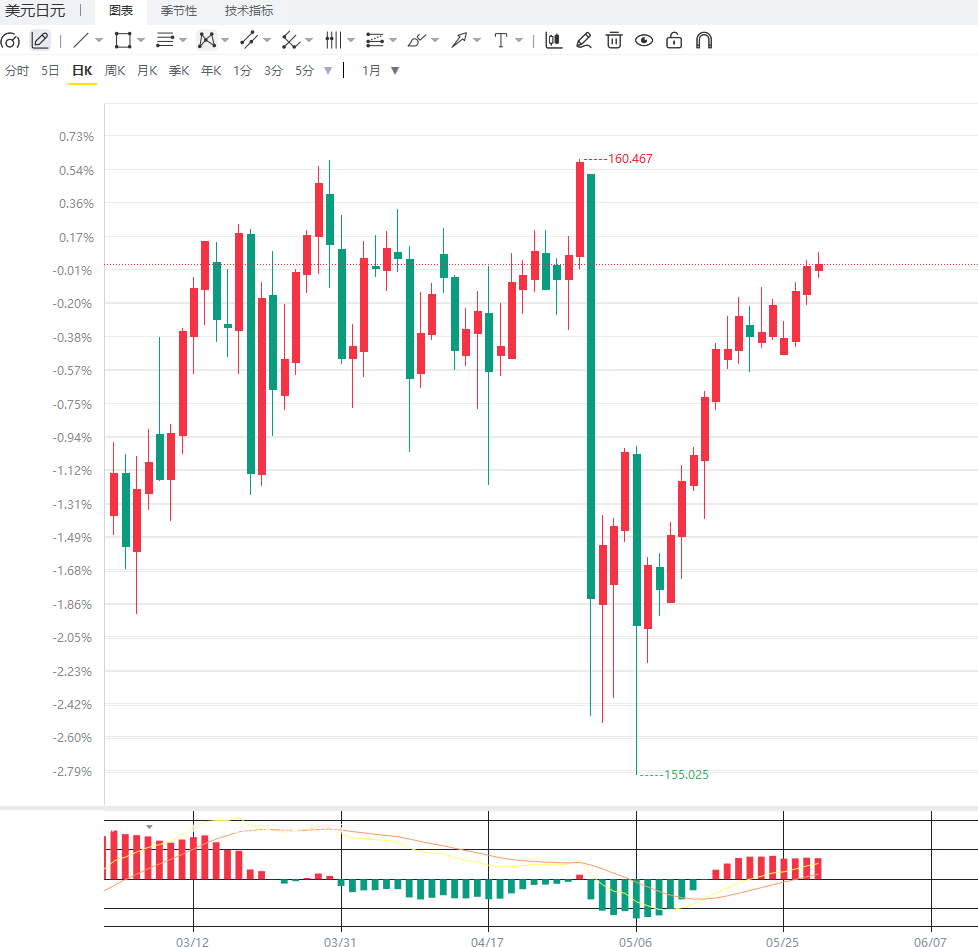
From a daily chart perspective, USD/JPY has successfully broken through the previous key resistance area and maintained an upward trend for several consecutive trading days. The MACD indicator has formed a golden cross again, indicating that the medium- to long-term bullish momentum is strengthening. The moving average system is gradually turning bullish, and the overall technical structure has significantly improved. The first major resistance level is currently at the psychological level of 160.00. Since this area is also a sensitive zone previously closely monitored by the Japanese government for intervention, the market remains cautious about further gains. If the price continues to rise after breaking through 160, it may further test the 160.80 and 161.50 areas. On the downside, the first support levels to watch are 158.80 and 157.90. A break below these levels could slow the short-term bullish momentum.
Previously, Japan's Ministry of Finance had intervened on several occasions when the USD/JPY exchange rate rose rapidly to prevent excessive yen depreciation from impacting the domestic economy and financial markets. Therefore, despite the overall strength of the US dollar, some traders remain cautious about further pushing up the USD/JPY. Furthermore, the Bank of Japan's policy path is also worth noting. Although Japanese inflation has rebounded somewhat, the overall economic recovery remains weak, and the Bank of Japan remains relatively cautious in normalizing monetary policy, which also limits the yen's upside potential.
Overall, USD/JPY is currently in a phase driven by both a strong US dollar and concerns about Japanese energy. US PCE data, changes in the Middle East situation, and the Japanese government's stance will be key factors determining the exchange rate's next move.
Editor's Summary : The core logic behind the current rise in USD/JPY stems primarily from the escalating tensions in the Middle East, which have increased energy risks, and the market's renewed expectation of a high-interest-rate policy from the Federal Reserve. Given Japan's high dependence on energy imports, the negative impact of rising international oil prices on the Japanese economy is significantly stronger than on the US, thus weakening the yen's performance. Technically, USD/JPY is approaching the key psychological level of 160, and the overall trend remains bullish. However, due to the possibility of further intervention in the foreign exchange market by the Japanese government, the market remains cautious about further gains. Going forward, investors should focus on US PCE data, changes in US Treasury yields, developments in the Middle East, and the Japanese government's attitude towards exchange rate fluctuations. If the Federal Reserve maintains a hawkish stance and the Japanese economy continues to perform weakly, USD/JPY still has room for further upward movement.
One of the most pressing concerns in the market right now is the potential impact of disruptions to shipping through the Strait of Hormuz on the Japanese economy. As a major global energy importer, Japan is highly dependent on Middle Eastern crude oil supplies, and the Strait of Hormuz handles approximately 20% of global seaborne crude oil transport. With Iran restricting the passage of some vessels and the US imposing a maritime blockade on Iranian ports, the market is worried that Japan's energy import costs may rise further.
Data shows that commercial traffic in the Strait of Hormuz has declined significantly since the escalation of the Middle East conflict. Given Japan's high dependence on energy imports, rising international oil prices typically cause a rapid increase in production costs for Japanese companies and exacerbate domestic inflationary pressures.
Meanwhile, the US military launched another military strike against Iran on Wednesday. According to market research, the US military attacked Iranian military targets deemed a threat to commercial shipping in the Strait of Hormuz, shooting down several Iranian drones. The market believes that the conflict between the US and Iran is unlikely to ease quickly in the short term.
US President Trump subsequently stated that he was not satisfied with the negotiation terms with Iran and emphasized that he would not rush to reach an agreement. This further weakened market expectations for a diplomatic solution and increased risk aversion in global markets. However, contrary to traditional market logic, the yen has not strengthened due to safe-haven demand. Analysts point out that the main reason is that the market is more concerned about the direct impact of the Middle East situation on the Japanese economy and energy supply chain.
As one of the world's major energy importers, Japan typically faces more severe imported inflationary pressures when international oil prices rise rapidly. Meanwhile, Japan's domestic economic growth is already relatively weak, so high energy prices could further drag down corporate profits and consumer activity. Against this backdrop, the US dollar index (DXY) continues to strengthen, rising above 99.50. With rising international oil prices, the market is again betting that the Federal Reserve may maintain high interest rates for a longer period, with the possibility of rate hikes even as late as 2026.
The market expects the US April PCE price index to rise to 3.8% year-on-year, up from the previous 3.5%; core PCE is expected to rise to 3.3%. As PCE is one of the Federal Reserve's most closely watched inflation indicators, the market is paying close attention to its impact on the future path of interest rates. If PCE data continues to exceed market expectations, US Treasury yields may rise further, thereby further enhancing the attractiveness of dollar assets and driving the USD/JPY exchange rate to remain strong.
In addition, the market is also watching the preliminary US GDP data to assess the overall performance of the US economy in a high-interest-rate environment. If the US economy continues to demonstrate resilience, it will further strengthen bullish sentiment towards the US dollar.
From a daily chart perspective, USD/JPY has successfully broken through the previous key resistance area and maintained an upward trend for several consecutive trading days. The MACD indicator has formed a golden cross again, indicating that the medium- to long-term bullish momentum is strengthening. The moving average system is gradually turning bullish, and the overall technical structure has significantly improved. The first major resistance level is currently at the psychological level of 160.00. Since this area is also a sensitive zone previously closely monitored by the Japanese government for intervention, the market remains cautious about further gains. If the price continues to rise after breaking through 160, it may further test the 160.80 and 161.50 areas. On the downside, the first support levels to watch are 158.80 and 157.90. A break below these levels could slow the short-term bullish momentum.
Previously, Japan's Ministry of Finance had intervened on several occasions when the USD/JPY exchange rate rose rapidly to prevent excessive yen depreciation from impacting the domestic economy and financial markets. Therefore, despite the overall strength of the US dollar, some traders remain cautious about further pushing up the USD/JPY. Furthermore, the Bank of Japan's policy path is also worth noting. Although Japanese inflation has rebounded somewhat, the overall economic recovery remains weak, and the Bank of Japan remains relatively cautious in normalizing monetary policy, which also limits the yen's upside potential.
Overall, USD/JPY is currently in a phase driven by both a strong US dollar and concerns about Japanese energy. US PCE data, changes in the Middle East situation, and the Japanese government's stance will be key factors determining the exchange rate's next move.
Editor's Summary : The core logic behind the current rise in USD/JPY stems primarily from the escalating tensions in the Middle East, which have increased energy risks, and the market's renewed expectation of a high-interest-rate policy from the Federal Reserve. Given Japan's high dependence on energy imports, the negative impact of rising international oil prices on the Japanese economy is significantly stronger than on the US, thus weakening the yen's performance. Technically, USD/JPY is approaching the key psychological level of 160, and the overall trend remains bullish. However, due to the possibility of further intervention in the foreign exchange market by the Japanese government, the market remains cautious about further gains. Going forward, investors should focus on US PCE data, changes in US Treasury yields, developments in the Middle East, and the Japanese government's attitude towards exchange rate fluctuations. If the Federal Reserve maintains a hawkish stance and the Japanese economy continues to perform weakly, USD/JPY still has room for further upward movement.
- Risk Warning and Disclaimer
- The market involves risk, and trading may not be suitable for all investors. This article is for reference only and does not constitute personal investment advice, nor does it take into account certain users’ specific investment objectives, financial situation, or other needs. Any investment decisions made based on this information are at your own risk.