The dollar rose for the fourth straight day against the yen, hitting a four-week high, and remained range-bound ahead of key US data releases.
2026-05-28 13:18:57
The recent geopolitical tensions in the Middle East have completely altered the short-term trading pattern of the USD/JPY exchange rate.
Affected by the disruption of shipping in the Strait of Hormuz and the renewed escalation of tensions between the US and Iran, the safe-haven appeal of the yen has weakened significantly and it has continued to decline. Coupled with the overall strengthening of the US dollar and rising expectations of a Fed rate hike, the USD/JPY pair had previously risen for three consecutive days, hitting a four-week high in Asian trading on Thursday (May 28).
However, the expectation of potential intervention in the foreign exchange market by the Bank of Japan, as well as the upcoming release of key US economic data, have created significant resistance to further appreciation of the exchange rate, resulting in an intensified battle between bulls and bears in the market.
The US dollar continued its strong performance against the Japanese yen during Thursday's Asian trading session, extending its gains from the previous three trading days. The yen reached a high of 159.649, a new high in nearly four weeks.
The core driver of the current weakness in the yen stems from the negative external economic impact of the Middle East conflict. As a country heavily reliant on imported energy, Japan's energy supply chain is directly disrupted by the disruption of shipping through the Strait of Hormuz. Growing concerns about a Japanese economic downturn have significantly weakened the yen's support. Simultaneously, the across-the-board strengthening of the US dollar has further propelled the USD/JPY exchange rate, becoming the primary driver of this appreciation.

The current Middle East geopolitical crisis continues to disrupt global markets. Since the outbreak of the conflict, Iran has imposed shipping restrictions, coupled with the US military's blockade of Iranian ports. This has led to a sharp decline in the volume of traffic through the Strait of Hormuz, a core global energy shipping route, directly resulting in a tightening of the global energy supply pattern.
For resource-poor Japan, which is highly dependent on energy imports, supply chain disruptions will significantly increase pressure on the domestic economy, and market pessimism continues to weigh on the yen's exchange rate. On Wednesday night Beijing time, the US launched another military strike against Iran, further escalating regional conflict and boosting geopolitical uncertainty, which continues to weigh on yen assets.
A U.S. official stated that the military operation precisely targeted Iranian military facilities that posed a direct threat to U.S. forces and commercial shipping in the Strait of Hormuz. The official added that the U.S. military successfully intercepted and shot down several threatening Iranian drones during the operation. U.S. President Trump stated that he was not satisfied with the current terms of the U.S.-Iran negotiations and would not hastily sign a ceasefire agreement, completely dispelling market expectations for a short-term diplomatic reconciliation and an end to the March geopolitical conflict.
Escalating geopolitical risks coupled with inflationary concerns have further solidified the US dollar's dominance as the global reserve currency. Markets widely anticipate that, influenced by persistent inflationary disturbances, the Federal Reserve may initiate an interest rate hike cycle this year. This expectation of monetary policy tightening continues to support the dollar's strength, providing medium- to long-term upward momentum for the USD/JPY exchange rate.
At the same time, market sentiment turned cautious, limiting the unilateral upward movement of the exchange rate. The market widely anticipates that Japanese regulators may intervene in the exchange rate again to stabilize the yen, an expectation that has deterred yen bears from taking any aggressive action.
Global trading funds have largely opted to temporarily withdraw and observe the market, primarily due to the release of several key US macroeconomic data releases at 8:30 PM Beijing time on Thursday, including the preliminary US PCE and GDP reports. As core indicators for the Federal Reserve's monetary policy adjustments, these data will directly impact market expectations for interest rate hikes and determine the subsequent trajectory of the US dollar.
Before the data is released, market trading is cautious, and the short-term gains of the USD/JPY exchange rate may be limited, with the overall trend remaining one of high-level fluctuations.
In summary, escalating geopolitical conflicts in the Middle East, the energy supply crisis, and divergent monetary policy expectations between the US and Japan have collectively fueled the rise in the USD/JPY exchange rate, pushing it to a new high. However, potential intervention in the Japanese foreign exchange market and uncertainties surrounding key economic data have limited the upside potential of the exchange rate.
The market is expected to fluctuate at high levels in the short term, and its future trend will depend heavily on the latest developments in US inflation, economic data, and the situation in the Middle East.
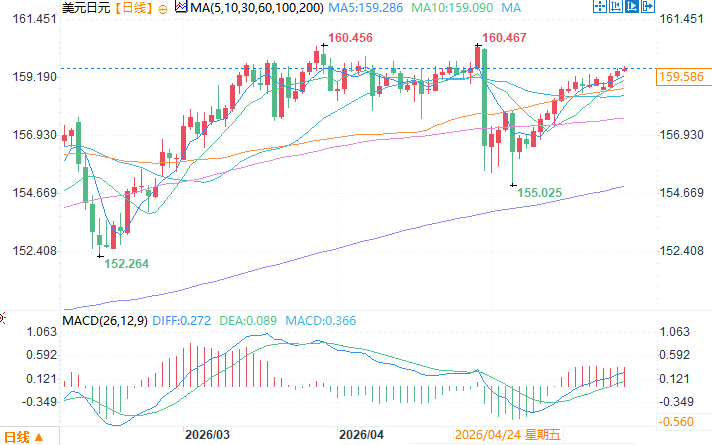
USD/JPY Daily Chart Source: EasyForex
At 13:18 Beijing time on May 28, the USD/JPY exchange rate was 159.55/56.
Affected by the disruption of shipping in the Strait of Hormuz and the renewed escalation of tensions between the US and Iran, the safe-haven appeal of the yen has weakened significantly and it has continued to decline. Coupled with the overall strengthening of the US dollar and rising expectations of a Fed rate hike, the USD/JPY pair had previously risen for three consecutive days, hitting a four-week high in Asian trading on Thursday (May 28).
However, the expectation of potential intervention in the foreign exchange market by the Bank of Japan, as well as the upcoming release of key US economic data, have created significant resistance to further appreciation of the exchange rate, resulting in an intensified battle between bulls and bears in the market.
The exchange rate rose sharply, while the yen continued to weaken under pressure.
The US dollar continued its strong performance against the Japanese yen during Thursday's Asian trading session, extending its gains from the previous three trading days. The yen reached a high of 159.649, a new high in nearly four weeks.
The core driver of the current weakness in the yen stems from the negative external economic impact of the Middle East conflict. As a country heavily reliant on imported energy, Japan's energy supply chain is directly disrupted by the disruption of shipping through the Strait of Hormuz. Growing concerns about a Japanese economic downturn have significantly weakened the yen's support. Simultaneously, the across-the-board strengthening of the US dollar has further propelled the USD/JPY exchange rate, becoming the primary driver of this appreciation.
The situation in the Middle East continues to deteriorate, and negative fundamental factors continue to ferment.
The current Middle East geopolitical crisis continues to disrupt global markets. Since the outbreak of the conflict, Iran has imposed shipping restrictions, coupled with the US military's blockade of Iranian ports. This has led to a sharp decline in the volume of traffic through the Strait of Hormuz, a core global energy shipping route, directly resulting in a tightening of the global energy supply pattern.
For resource-poor Japan, which is highly dependent on energy imports, supply chain disruptions will significantly increase pressure on the domestic economy, and market pessimism continues to weigh on the yen's exchange rate. On Wednesday night Beijing time, the US launched another military strike against Iran, further escalating regional conflict and boosting geopolitical uncertainty, which continues to weigh on yen assets.
A U.S. official stated that the military operation precisely targeted Iranian military facilities that posed a direct threat to U.S. forces and commercial shipping in the Strait of Hormuz. The official added that the U.S. military successfully intercepted and shot down several threatening Iranian drones during the operation. U.S. President Trump stated that he was not satisfied with the current terms of the U.S.-Iran negotiations and would not hastily sign a ceasefire agreement, completely dispelling market expectations for a short-term diplomatic reconciliation and an end to the March geopolitical conflict.
Monetary policy expectations are diverging, and the battle between bulls and bears is gradually intensifying.
Escalating geopolitical risks coupled with inflationary concerns have further solidified the US dollar's dominance as the global reserve currency. Markets widely anticipate that, influenced by persistent inflationary disturbances, the Federal Reserve may initiate an interest rate hike cycle this year. This expectation of monetary policy tightening continues to support the dollar's strength, providing medium- to long-term upward momentum for the USD/JPY exchange rate.
At the same time, market sentiment turned cautious, limiting the unilateral upward movement of the exchange rate. The market widely anticipates that Japanese regulators may intervene in the exchange rate again to stabilize the yen, an expectation that has deterred yen bears from taking any aggressive action.
With key US data releases approaching, the market enters a wait-and-see period.
Global trading funds have largely opted to temporarily withdraw and observe the market, primarily due to the release of several key US macroeconomic data releases at 8:30 PM Beijing time on Thursday, including the preliminary US PCE and GDP reports. As core indicators for the Federal Reserve's monetary policy adjustments, these data will directly impact market expectations for interest rate hikes and determine the subsequent trajectory of the US dollar.
Before the data is released, market trading is cautious, and the short-term gains of the USD/JPY exchange rate may be limited, with the overall trend remaining one of high-level fluctuations.
Summarize
In summary, escalating geopolitical conflicts in the Middle East, the energy supply crisis, and divergent monetary policy expectations between the US and Japan have collectively fueled the rise in the USD/JPY exchange rate, pushing it to a new high. However, potential intervention in the Japanese foreign exchange market and uncertainties surrounding key economic data have limited the upside potential of the exchange rate.
The market is expected to fluctuate at high levels in the short term, and its future trend will depend heavily on the latest developments in US inflation, economic data, and the situation in the Middle East.
USD/JPY Daily Chart Source: EasyForex
At 13:18 Beijing time on May 28, the USD/JPY exchange rate was 159.55/56.
- Risk Warning and Disclaimer
- The market involves risk, and trading may not be suitable for all investors. This article is for reference only and does not constitute personal investment advice, nor does it take into account certain users’ specific investment objectives, financial situation, or other needs. Any investment decisions made based on this information are at your own risk.