













Breaking! Iran attacks US military base; USD/JPY approaches 160 again; tonight's PCE data may determine the outcome?
2026-05-28 14:46:08
On Thursday (May 28) during Asian trading hours, the US dollar rose against the Japanese yen but encountered resistance, briefly hitting a four-week high of 159.65. Driven by the renewed escalation of the US-Iran military conflict, the US dollar index rose as much as 0.3% to 99.54, its highest level since April 8, providing upward momentum for the US dollar against the yen.
However, the yen's decline was limited, outperforming other non-US currencies. The USD/JPY pair is currently trading around 159.50, thanks to Bank of Japan Governor Kazuo Ueda's warnings about a "second-round effect." Meanwhile, rising oil prices are a negative factor for Japan's energy-dependent economy. The market will now focus on the US April PCE data to be released on Thursday.
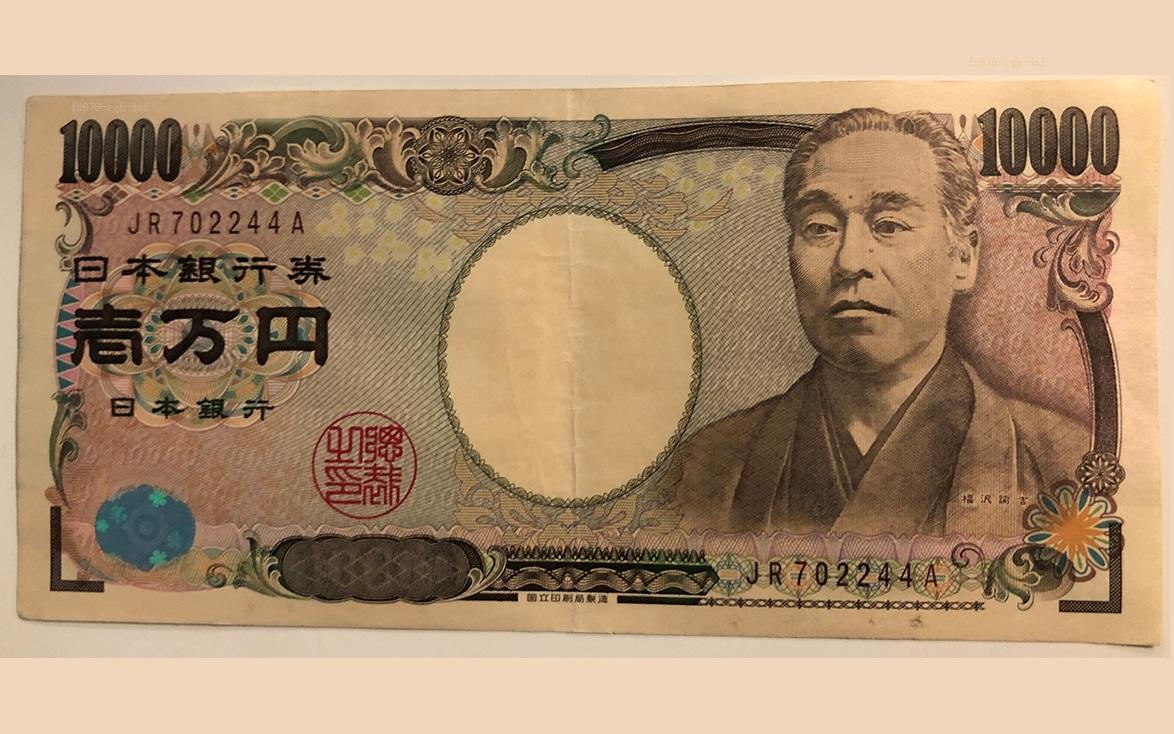
The dollar rose against the yen, primarily due to the dollar's strength amid renewed tensions in the Middle East. During Thursday's Asian session, the dollar reached 159.65 against the yen, a near four-week high. The previous day, the exchange rate had fallen to around 158.80 due to rising expectations of peace talks; however, market sentiment quickly reversed after the Iranian Revolutionary Guard claimed responsibility for an attack on a US military base, escalating the conflict again, and dollar buying surged back in.
The US dollar index held steady above the 99 level, reflecting market pricing in geopolitical risks. The 99 level is a key pivot point since the fourth quarter of 2025 and also the first psychological barrier above the 100-day moving average (98.62). As long as the dollar index remains above 99, it indicates that market concerns about the Middle East situation have not dissipated; a breach of 99 could mean that expectations of peace talks have regained the upper hand. Historically, the dollar has tended to strengthen during Middle East conflicts, and the current escalation of the US-Iran military standoff is driving safe-haven flows into dollar assets.
Iran's Islamic Revolutionary Guard Corps said earlier Thursday that it had launched an attack on a U.S. military base in retaliation for Washington's attack on areas near Bandar Abbas airport. This marks the first time Iran has publicly claimed a direct attack on a U.S. base since the conflict began in late February, signifying an escalation of the military confrontation from a maritime standoff to direct strikes against each other's military facilities. As of now, the U.S. has not issued an official response to this claim.
The Revolutionary Guard also threatened a "more decisive response" should the United States launch another attack. Analysts point out that this "responding to escalation with escalation" confrontation model means that miscalculation by either side could lead to a rapid loss of control of the conflict. For the oil market, if Iran completely blocks the Strait of Hormuz, oil prices could surge again to over $100, further exacerbating global inflationary pressures.
The renewed escalation of conflict in the Middle East has driven up oil prices, a situation that is detrimental to the currencies of economies heavily reliant on oil imports to meet their energy needs, such as Japan.
As one of the world's largest crude oil importers, Japan will see rising oil prices directly increase its import costs, potentially putting further pressure on its trade balance and domestic inflation. While a certain level of inflation has been a long-sought goal for the Bank of Japan, cost-push rather than demand-push inflation will compress corporate profit margins rather than stimulate consumption expansion.
More alarmingly, if oil prices remain above $95, the Bank of Japan may be forced to prematurely exit its negative interest rate policy to curb inflation expectations, which could put pressure on Japan's massive public debt. Therefore, in the current environment of high oil prices and persistent geopolitical risks, the yen is facing a double whammy of rising import costs and a policy dilemma.
Meanwhile, the yen performed relatively strongly against other currencies. Bank of Japan Governor Kazuo Ueda warned in a speech on Wednesday that following the oil price shock, "high inflation expectations and rising wages" could trigger a second wave of effects.
Ueda's remarks indicate that the Bank of Japan is closely monitoring the risks of rising inflation expectations, which provided some support for the yen. However, he did not comment on when the Bank of Japan would raise interest rates this year.
Analysts generally believe that if oil prices remain above $95 and inflation expectations rise further, the Bank of Japan may implement a "defensive rate hike" this fall (around October) to curb the spread of a second wave of effects. Prior to this, every speech by Ueda will be a key variable in the yen's exchange rate.
Looking ahead, investors will focus on the U.S. April Personal Consumption Expenditures (PCE) price index data to be released at 20:30 Beijing time on Thursday.
As the Federal Reserve's preferred inflation gauge, PCE data will provide the market with the latest clues about inflation trends and may influence the next move of the US dollar and the Japanese yen.
The market will now closely watch the US April PCE data to determine the Federal Reserve's future policy path. Until the situation in the Strait of Hormuz becomes clearer, the USD/JPY pair is likely to continue fluctuating within the 159-160 range, and further statements from Kazuo Ueda regarding interest rate hikes will be a key variable in the yen's movement.
Currently, the USD/JPY pair is showing a consolidation and correction pattern within a medium-term upward trend on the daily chart. Short-term bullish momentum is relatively strong, and the support below is solid.
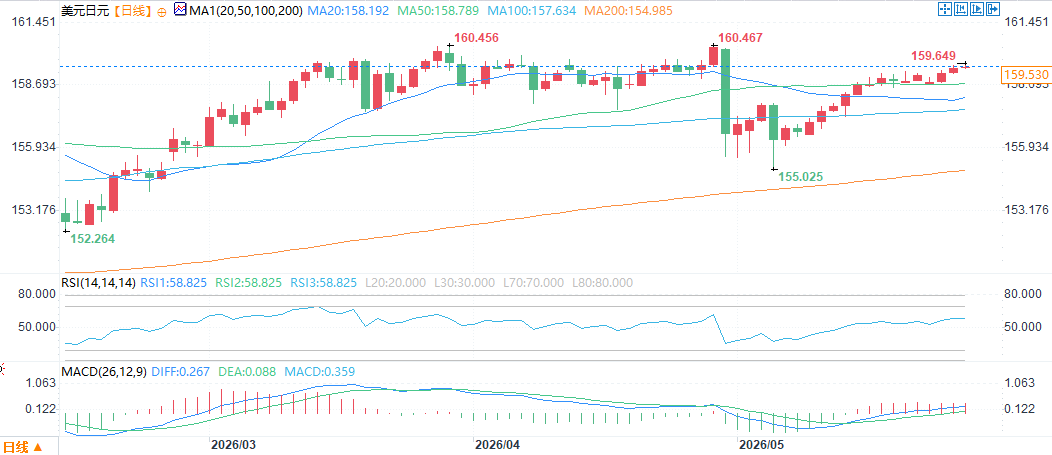
(USD/JPY daily chart, source: FX678)
In terms of moving averages, the current price is around 159.50, above the 20-day, 50-day, 100-day, and 200-day moving averages, all of which are in a bullish alignment, indicating a well-maintained medium-term uptrend. The 20-day moving average (158.19) and the 50-day moving average (158.79) have formed a support zone, with key support below at the previous low of around 155.025; on the upside, it faces strong resistance as it approaches the previous high of 160.45-160.47.
Regarding the RSI indicator, the value is 58.83, which is above the 50 neutral line and has not yet entered the overbought zone, indicating that the current bullish momentum is sufficient and there is still upward momentum in the short term. However, it is close to the previous high, so we need to be wary of the risk of momentum weakening.
Regarding the MACD indicator, the DIFF line (0.267) is running above the DEA line (0.088), and the MACD red bar is 0.359, indicating that the bullish momentum is still being released and has just recovered from the previous pullback, with no obvious divergence or topping signals yet.
The USD/JPY pair has a clear medium-term uptrend, supported by moving averages and bullish technical indicators, and is currently challenging previous highs. A successful break above the previous resistance level around 160.5 would open up further upside potential; if it encounters resistance and falls back, the 20-day moving average around 158.2 is a key support level. Holding this level would likely maintain the slightly bullish trend.
At 14:45 Beijing time on May 28, the USD/JPY exchange rate was 159.49/50.
However, the yen's decline was limited, outperforming other non-US currencies. The USD/JPY pair is currently trading around 159.50, thanks to Bank of Japan Governor Kazuo Ueda's warnings about a "second-round effect." Meanwhile, rising oil prices are a negative factor for Japan's energy-dependent economy. The market will now focus on the US April PCE data to be released on Thursday.
US Dollar Strengthens: Geopolitical Risks Drive Up Dollar Index
The dollar rose against the yen, primarily due to the dollar's strength amid renewed tensions in the Middle East. During Thursday's Asian session, the dollar reached 159.65 against the yen, a near four-week high. The previous day, the exchange rate had fallen to around 158.80 due to rising expectations of peace talks; however, market sentiment quickly reversed after the Iranian Revolutionary Guard claimed responsibility for an attack on a US military base, escalating the conflict again, and dollar buying surged back in.
The US dollar index held steady above the 99 level, reflecting market pricing in geopolitical risks. The 99 level is a key pivot point since the fourth quarter of 2025 and also the first psychological barrier above the 100-day moving average (98.62). As long as the dollar index remains above 99, it indicates that market concerns about the Middle East situation have not dissipated; a breach of 99 could mean that expectations of peace talks have regained the upper hand. Historically, the dollar has tended to strengthen during Middle East conflicts, and the current escalation of the US-Iran military standoff is driving safe-haven flows into dollar assets.
Iran retaliates: Revolutionary Guard attacks US military base
Iran's Islamic Revolutionary Guard Corps said earlier Thursday that it had launched an attack on a U.S. military base in retaliation for Washington's attack on areas near Bandar Abbas airport. This marks the first time Iran has publicly claimed a direct attack on a U.S. base since the conflict began in late February, signifying an escalation of the military confrontation from a maritime standoff to direct strikes against each other's military facilities. As of now, the U.S. has not issued an official response to this claim.
The Revolutionary Guard also threatened a "more decisive response" should the United States launch another attack. Analysts point out that this "responding to escalation with escalation" confrontation model means that miscalculation by either side could lead to a rapid loss of control of the conflict. For the oil market, if Iran completely blocks the Strait of Hormuz, oil prices could surge again to over $100, further exacerbating global inflationary pressures.
Rising oil prices: a negative factor for the Japanese economy
The renewed escalation of conflict in the Middle East has driven up oil prices, a situation that is detrimental to the currencies of economies heavily reliant on oil imports to meet their energy needs, such as Japan.
As one of the world's largest crude oil importers, Japan will see rising oil prices directly increase its import costs, potentially putting further pressure on its trade balance and domestic inflation. While a certain level of inflation has been a long-sought goal for the Bank of Japan, cost-push rather than demand-push inflation will compress corporate profit margins rather than stimulate consumption expansion.
More alarmingly, if oil prices remain above $95, the Bank of Japan may be forced to prematurely exit its negative interest rate policy to curb inflation expectations, which could put pressure on Japan's massive public debt. Therefore, in the current environment of high oil prices and persistent geopolitical risks, the yen is facing a double whammy of rising import costs and a policy dilemma.
Yen Resilience: Kazuo Ueda Warns of "Second-Round Effect"
Meanwhile, the yen performed relatively strongly against other currencies. Bank of Japan Governor Kazuo Ueda warned in a speech on Wednesday that following the oil price shock, "high inflation expectations and rising wages" could trigger a second wave of effects.
Ueda's remarks indicate that the Bank of Japan is closely monitoring the risks of rising inflation expectations, which provided some support for the yen. However, he did not comment on when the Bank of Japan would raise interest rates this year.
Analysts generally believe that if oil prices remain above $95 and inflation expectations rise further, the Bank of Japan may implement a "defensive rate hike" this fall (around October) to curb the spread of a second wave of effects. Prior to this, every speech by Ueda will be a key variable in the yen's exchange rate.
Market Focus: US PCE Data
Looking ahead, investors will focus on the U.S. April Personal Consumption Expenditures (PCE) price index data to be released at 20:30 Beijing time on Thursday.
As the Federal Reserve's preferred inflation gauge, PCE data will provide the market with the latest clues about inflation trends and may influence the next move of the US dollar and the Japanese yen.
The market will now closely watch the US April PCE data to determine the Federal Reserve's future policy path. Until the situation in the Strait of Hormuz becomes clearer, the USD/JPY pair is likely to continue fluctuating within the 159-160 range, and further statements from Kazuo Ueda regarding interest rate hikes will be a key variable in the yen's movement.
USD/JPY Daily Technical Analysis
Currently, the USD/JPY pair is showing a consolidation and correction pattern within a medium-term upward trend on the daily chart. Short-term bullish momentum is relatively strong, and the support below is solid.
(USD/JPY daily chart, source: FX678)
In terms of moving averages, the current price is around 159.50, above the 20-day, 50-day, 100-day, and 200-day moving averages, all of which are in a bullish alignment, indicating a well-maintained medium-term uptrend. The 20-day moving average (158.19) and the 50-day moving average (158.79) have formed a support zone, with key support below at the previous low of around 155.025; on the upside, it faces strong resistance as it approaches the previous high of 160.45-160.47.
Regarding the RSI indicator, the value is 58.83, which is above the 50 neutral line and has not yet entered the overbought zone, indicating that the current bullish momentum is sufficient and there is still upward momentum in the short term. However, it is close to the previous high, so we need to be wary of the risk of momentum weakening.
Regarding the MACD indicator, the DIFF line (0.267) is running above the DEA line (0.088), and the MACD red bar is 0.359, indicating that the bullish momentum is still being released and has just recovered from the previous pullback, with no obvious divergence or topping signals yet.
The USD/JPY pair has a clear medium-term uptrend, supported by moving averages and bullish technical indicators, and is currently challenging previous highs. A successful break above the previous resistance level around 160.5 would open up further upside potential; if it encounters resistance and falls back, the 20-day moving average around 158.2 is a key support level. Holding this level would likely maintain the slightly bullish trend.
At 14:45 Beijing time on May 28, the USD/JPY exchange rate was 159.49/50.
- Risk Warning and Disclaimer
- The market involves risk, and trading may not be suitable for all investors. This article is for reference only and does not constitute personal investment advice, nor does it take into account certain users’ specific investment objectives, financial situation, or other needs. Any investment decisions made based on this information are at your own risk.

