Tokyo's CPI fell below 2% for the third consecutive month, suppressing expectations of an interest rate hike, and the USD/JPY exchange rate approached the 160 mark.
2026-05-29 11:24:35
The USD/JPY pair remained range-bound in Asian trading on Friday, as the latest May Consumer Price Index (CPI) data from Tokyo failed to provide any new directional signals, resulting in a lackluster performance for the yen. The Tokyo inflation data was largely in line with market expectations, further confirming that Japan's inflation momentum remains weak, leading to a continued cooling of market expectations for further near-term interest rate hikes by the Bank of Japan.
Data shows that Tokyo's overall CPI rose 1.6% year-on-year in May, while core CPI (excluding fresh food) rose 1.5% year-on-year, matching the four-year low hit in April; and core CPI, excluding food and energy, remained at 1.9%. All three key inflation indicators are below the Bank of Japan's 2% policy target, indicating that domestic price pressures in Japan have not yet formed a sustained upward trend.
The market had already largely anticipated a slowdown in Tokyo's inflation, so the yen showed almost no significant fluctuation after the data release. Analysts believe that what truly impacted the market was not the data itself, but rather its reaffirmation that the Bank of Japan lacked the conditions for further policy tightening. Previously, the core CPI in April had fallen rapidly from 2.3% to 1.9%, significantly weakening market expectations for a June rate hike by the Bank of Japan, and the May data further reinforced this assessment.
From an inflation structure perspective, Japanese government energy subsidies continue to suppress gasoline and utility prices, while food inflation is gradually cooling. Although some rents have increased since the start of the new fiscal year, and some energy subsidies are being phased out, these factors are currently insufficient to push overall inflation back above 2%. The market generally believes that the Bank of Japan is truly concerned about whether service sector inflation can accelerate again, because only when wages and service prices form a sustained upward cycle will the Bank of Japan have a stronger reason to raise interest rates further.
Despite recent warnings from the Japanese government about potential intervention in the foreign exchange market, the market's reaction to mere verbal intervention has noticeably weakened. A growing number of traders believe that without a genuine shift to a more hawkish policy from the Bank of Japan, intervention alone in the foreign exchange market will be insufficient to sustainably reverse the yen's weakness. Currently, there remains a spread of approximately 300 basis points between the Federal Reserve's 3.50%-3.75% interest rate range and the Bank of Japan's 0.75% policy rate, meaning that carry trades on USD/JPY still offer a significant daily profit advantage.
Carry trades, in essence, involve investors borrowing low-interest-rate yen and then buying high-yield dollar assets. With the US-Japan interest rate differential remaining high for an extended period, a large amount of international capital has continued to flow out of yen assets and into dollar bonds and dollar money market instruments, which is one of the important reasons for the yen's continued weakness.
The market is currently focused on the upcoming Japanese retail sales data, but analysts generally believe that unless there are extremely unexpected developments, it will be difficult to truly change the market's assessment of the Bank of Japan's policy path. This is because the Bank of Japan pays more attention to wage growth and core service sector inflation than to single-month consumption data. Therefore, even strong retail sales figures are insufficient to prompt the market to repric its expectations for a Bank of Japan interest rate hike.
Meanwhile, Japan's Ministry of Finance has intervened in the foreign exchange market twice recently, with market estimates suggesting a cumulative investment of over $60 billion. However, market performance shows that the USD/JPY exchange rate has gradually recovered to around 160 after the intervention, indicating that foreign exchange intervention alone is insufficient to reverse the long-term trend. The market's real concern is not whether to intervene, but rather whether the Bank of Japan has lost the effective policy tools to reverse the yen's depreciation trend.
From a global market perspective, the Federal Reserve's continued high-interest-rate policy continues to support the dollar's performance. The US economy remains resilient overall, and high US Treasury yields are driving global capital flows into dollar assets. Meanwhile, Japan's prolonged low-interest-rate environment and weak economic growth are further diminishing the yen's attractiveness.
From a technical perspective, the USD/JPY pair maintains a clear bullish structure on the daily chart. The exchange rate is currently trading above the 50-day EMA, and the overall upward channel remains intact. The daily MACD indicator is still above the zero line, and the RSI remains around 60, indicating that medium-term bullish momentum still dominates the market. A decisive break above the 160 level could open up further upside potential and reignite market concerns about potential Japanese government intervention.
From a 4-hour chart perspective, while the USD/JPY pair has experienced some short-term consolidation at higher levels, it maintains an overall strong structure. The short-term moving average system remains in a bullish alignment, indicating limited downward pressure. The 158.50 area is currently a key short-term support level; a break below this area could lead to further testing of support near 156. However, until then, the market generally favors buying the dollar on dips.
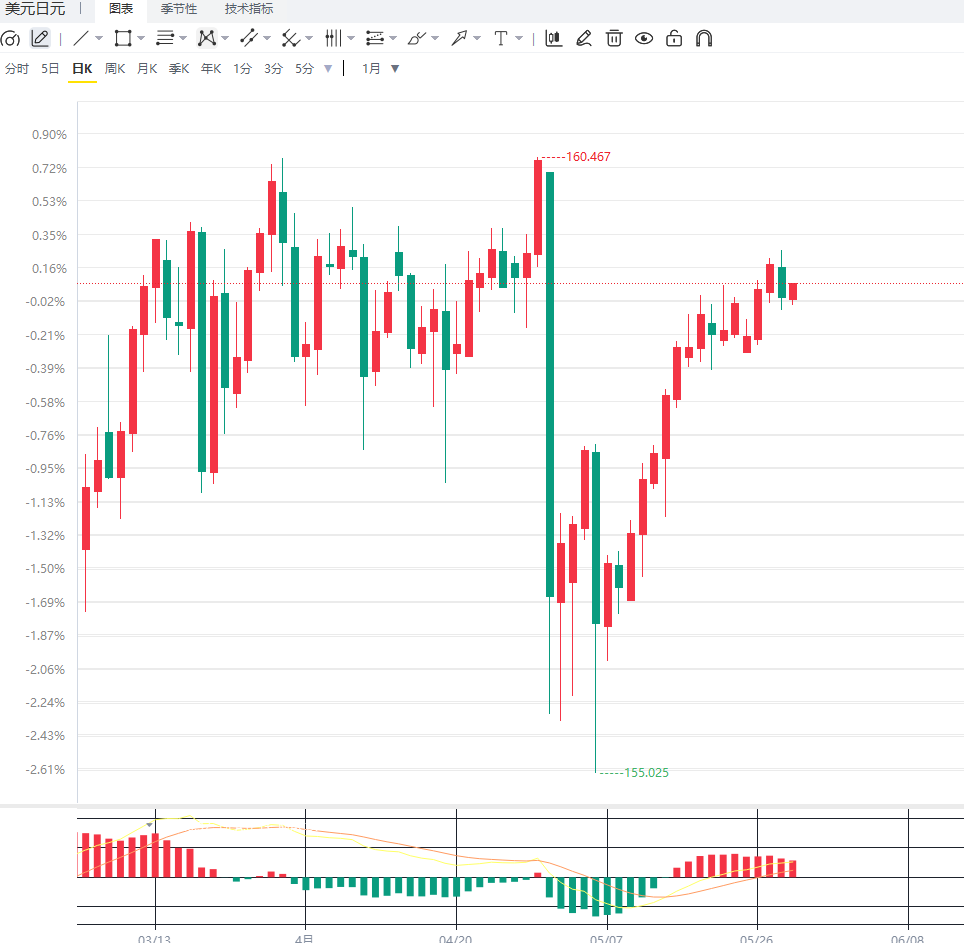
Overall, the yen market is currently in a phase lacking new catalysts. In the short term, persistently low inflation in Japan, the clear advantage of carry trades, and the lack of signals of a policy shift from the Bank of Japan suggest that the USD/JPY exchange rate will likely remain more likely to rise than fall. However, as the exchange rate approaches the key level of 160, the risk of renewed intervention by the Japanese authorities is rapidly increasing.
Editor's Summary : Tokyo's May inflation data reaffirmed insufficient domestic price pressure in Japan, further reducing the likelihood of a further short-term interest rate hike by the Bank of Japan. With the US-Japan interest rate differential remaining high, global carry trade continues to put pressure on the yen, and the USD/JPY exchange rate maintains its overall strength. However, the market is gradually approaching a sensitive area. On the one hand, the Japanese government continues to warn of exchange rate volatility risks; on the other hand, the USD/JPY exchange rate is approaching the 160 level, potentially triggering official intervention again. Going forward, the market will focus on the Bank of Japan's next meeting, the Federal Reserve's interest rate cut path, and Japanese wage growth, as these factors will determine whether a true turning point occurs in the yen's medium- to long-term trend.
Data shows that Tokyo's overall CPI rose 1.6% year-on-year in May, while core CPI (excluding fresh food) rose 1.5% year-on-year, matching the four-year low hit in April; and core CPI, excluding food and energy, remained at 1.9%. All three key inflation indicators are below the Bank of Japan's 2% policy target, indicating that domestic price pressures in Japan have not yet formed a sustained upward trend.
The market had already largely anticipated a slowdown in Tokyo's inflation, so the yen showed almost no significant fluctuation after the data release. Analysts believe that what truly impacted the market was not the data itself, but rather its reaffirmation that the Bank of Japan lacked the conditions for further policy tightening. Previously, the core CPI in April had fallen rapidly from 2.3% to 1.9%, significantly weakening market expectations for a June rate hike by the Bank of Japan, and the May data further reinforced this assessment.
From an inflation structure perspective, Japanese government energy subsidies continue to suppress gasoline and utility prices, while food inflation is gradually cooling. Although some rents have increased since the start of the new fiscal year, and some energy subsidies are being phased out, these factors are currently insufficient to push overall inflation back above 2%. The market generally believes that the Bank of Japan is truly concerned about whether service sector inflation can accelerate again, because only when wages and service prices form a sustained upward cycle will the Bank of Japan have a stronger reason to raise interest rates further.
Despite recent warnings from the Japanese government about potential intervention in the foreign exchange market, the market's reaction to mere verbal intervention has noticeably weakened. A growing number of traders believe that without a genuine shift to a more hawkish policy from the Bank of Japan, intervention alone in the foreign exchange market will be insufficient to sustainably reverse the yen's weakness. Currently, there remains a spread of approximately 300 basis points between the Federal Reserve's 3.50%-3.75% interest rate range and the Bank of Japan's 0.75% policy rate, meaning that carry trades on USD/JPY still offer a significant daily profit advantage.
Carry trades, in essence, involve investors borrowing low-interest-rate yen and then buying high-yield dollar assets. With the US-Japan interest rate differential remaining high for an extended period, a large amount of international capital has continued to flow out of yen assets and into dollar bonds and dollar money market instruments, which is one of the important reasons for the yen's continued weakness.
The market is currently focused on the upcoming Japanese retail sales data, but analysts generally believe that unless there are extremely unexpected developments, it will be difficult to truly change the market's assessment of the Bank of Japan's policy path. This is because the Bank of Japan pays more attention to wage growth and core service sector inflation than to single-month consumption data. Therefore, even strong retail sales figures are insufficient to prompt the market to repric its expectations for a Bank of Japan interest rate hike.
Meanwhile, Japan's Ministry of Finance has intervened in the foreign exchange market twice recently, with market estimates suggesting a cumulative investment of over $60 billion. However, market performance shows that the USD/JPY exchange rate has gradually recovered to around 160 after the intervention, indicating that foreign exchange intervention alone is insufficient to reverse the long-term trend. The market's real concern is not whether to intervene, but rather whether the Bank of Japan has lost the effective policy tools to reverse the yen's depreciation trend.
From a global market perspective, the Federal Reserve's continued high-interest-rate policy continues to support the dollar's performance. The US economy remains resilient overall, and high US Treasury yields are driving global capital flows into dollar assets. Meanwhile, Japan's prolonged low-interest-rate environment and weak economic growth are further diminishing the yen's attractiveness.
From a technical perspective, the USD/JPY pair maintains a clear bullish structure on the daily chart. The exchange rate is currently trading above the 50-day EMA, and the overall upward channel remains intact. The daily MACD indicator is still above the zero line, and the RSI remains around 60, indicating that medium-term bullish momentum still dominates the market. A decisive break above the 160 level could open up further upside potential and reignite market concerns about potential Japanese government intervention.
From a 4-hour chart perspective, while the USD/JPY pair has experienced some short-term consolidation at higher levels, it maintains an overall strong structure. The short-term moving average system remains in a bullish alignment, indicating limited downward pressure. The 158.50 area is currently a key short-term support level; a break below this area could lead to further testing of support near 156. However, until then, the market generally favors buying the dollar on dips.
Overall, the yen market is currently in a phase lacking new catalysts. In the short term, persistently low inflation in Japan, the clear advantage of carry trades, and the lack of signals of a policy shift from the Bank of Japan suggest that the USD/JPY exchange rate will likely remain more likely to rise than fall. However, as the exchange rate approaches the key level of 160, the risk of renewed intervention by the Japanese authorities is rapidly increasing.
Editor's Summary : Tokyo's May inflation data reaffirmed insufficient domestic price pressure in Japan, further reducing the likelihood of a further short-term interest rate hike by the Bank of Japan. With the US-Japan interest rate differential remaining high, global carry trade continues to put pressure on the yen, and the USD/JPY exchange rate maintains its overall strength. However, the market is gradually approaching a sensitive area. On the one hand, the Japanese government continues to warn of exchange rate volatility risks; on the other hand, the USD/JPY exchange rate is approaching the 160 level, potentially triggering official intervention again. Going forward, the market will focus on the Bank of Japan's next meeting, the Federal Reserve's interest rate cut path, and Japanese wage growth, as these factors will determine whether a true turning point occurs in the yen's medium- to long-term trend.
- Risk Warning and Disclaimer
- The market involves risk, and trading may not be suitable for all investors. This article is for reference only and does not constitute personal investment advice, nor does it take into account certain users’ specific investment objectives, financial situation, or other needs. Any investment decisions made based on this information are at your own risk.