With expectations of a tightening of approximately 32 basis points this year already priced in, how much support can the pound still find?
2026-05-29 17:57:11
On Friday, May 29, the British pound traded around 1.341 against the US dollar during the European session, under pressure throughout the day. The daily chart shows that the exchange rate previously retreated from 1.3657 to 1.3302, then rebounded to around 1.341, but remained below the Bollinger Band middle line at 1.3492, only above the lower line at 1.3335.
The main driver influencing the pound against the dollar has shifted from simply comparing the strength of economic data to how the Bank of England will handle energy price shocks and the policy trade-off between its inflation target and economic slowdown. The Middle East conflict has disrupted global energy transport and supply, causing the inflation path to shift upward again, and previously priced-in interest rate cuts have been quickly withdrawn from the market. This has provided some support for the pound based on interest rate expectations, but rising energy input costs, pressure on real incomes, and weakening risk appetite have limited the potential for further appreciation.
Bank of England Governor Andrew Bailey stated on May 29th that the Bank of England's decision to maintain the policy rate at 3.75% at its most recent meeting was a proactive choice made in the face of various possible outcomes. With the market's anticipated rate cut temporarily removed, the policy environment is now "significantly tighter" compared to before the shock. He also pointed out that, given the weak economic activity and the uncertainty surrounding the duration of the shock, temporarily tolerating inflation above the 2% target is justifiable, but this tolerance will decrease should a second wave of effects emerge in wages, business pricing, or inflation expectations.
This statement doesn't simply imply a bias in one direction. For the pound, fading expectations of interest rate cuts will raise short-term interest rate pricing, providing support from an interest rate differential perspective; however, Bailey didn't commit to a rapid rate hike, instead focusing on whether a second-round effect has formed. In other words, the Bank of England is currently more concerned about whether inflation, initially a one-off shock from energy prices, will evolve into more persistent wage and service price pressures.
At its April meeting, the Bank of England voted 8-1 to keep the policy rate at 3.75%, with only one member favoring a 25 basis point increase to 4%. The next interest rate decision will be announced on June 18. The key issue at this meeting is not whether to acknowledge the existence of the energy shock, but whether policymakers believe the shock is sufficient to alter medium-term inflation stickiness.
Latest data reveals the two-way tension facing the pound. The UK Consumer Price Index (CPI) rose 2.8% year-on-year in April, down from 3.3% in March, but still above the Bank of England's 2% target. In his speech, Bailey pointed out that household energy prices contributed an additional 0.8 percentage points to April's inflation rate compared to pre-conflict expectations, and predicted that inflation still faces the risk of further increases this year as utility costs and business costs are passed on.
At the same time, economic activity is insufficient to provide room for continued austerity measures. In the first quarter of 2026, UK real GDP grew by 0.6% quarter-on-quarter, and real GDP per capita also grew by 0.6%, indicating resilience at the beginning of the year; however, retail sales fell by 1.3% month-on-month in April, reversing the 0.6% increase in March, suggesting that cost-of-living pressures and cautious consumption are re-emerging.
Therefore, rising inflation does not inherently equate to a sustained appreciation of the pound. If the market only sees expectations of rising interest rates, the pound may receive temporary support; however, if the erosion of consumption, corporate profits, and real income by the energy shock is also taken into account, the exchange rate is likely to encounter a discount at higher levels. This is also a key reason why the pound/dollar exchange rate has remained around 1.34 even after policy expectations shifted towards tightening.
The current interest rate market has already priced in at least one 25-basis-point hike by the Bank of England this year, with about a one-third probability of a second action, equivalent to approximately 33 basis points. The market has already pre-paid a premium for policy tightening; whether the pound can receive stronger support going forward depends on whether actual data validates this expectation, rather than solely on the central bank's statements.
Logically, energy shocks have two opposing transmission chains on exchange rates. The first is the interest rate chain: increased inflation risks lead to the withdrawal of interest rate cuts, and even increased expectations of rate hikes, providing support for the pound sterling due to interest rate differentials. The second is the growth and risk chain: rising input costs compress real purchasing power, making it more difficult for businesses to pass on costs, putting pressure on the economic outlook, and temporarily strengthening the safe-haven appeal of the dollar, thus limiting the pound sterling's rebound.
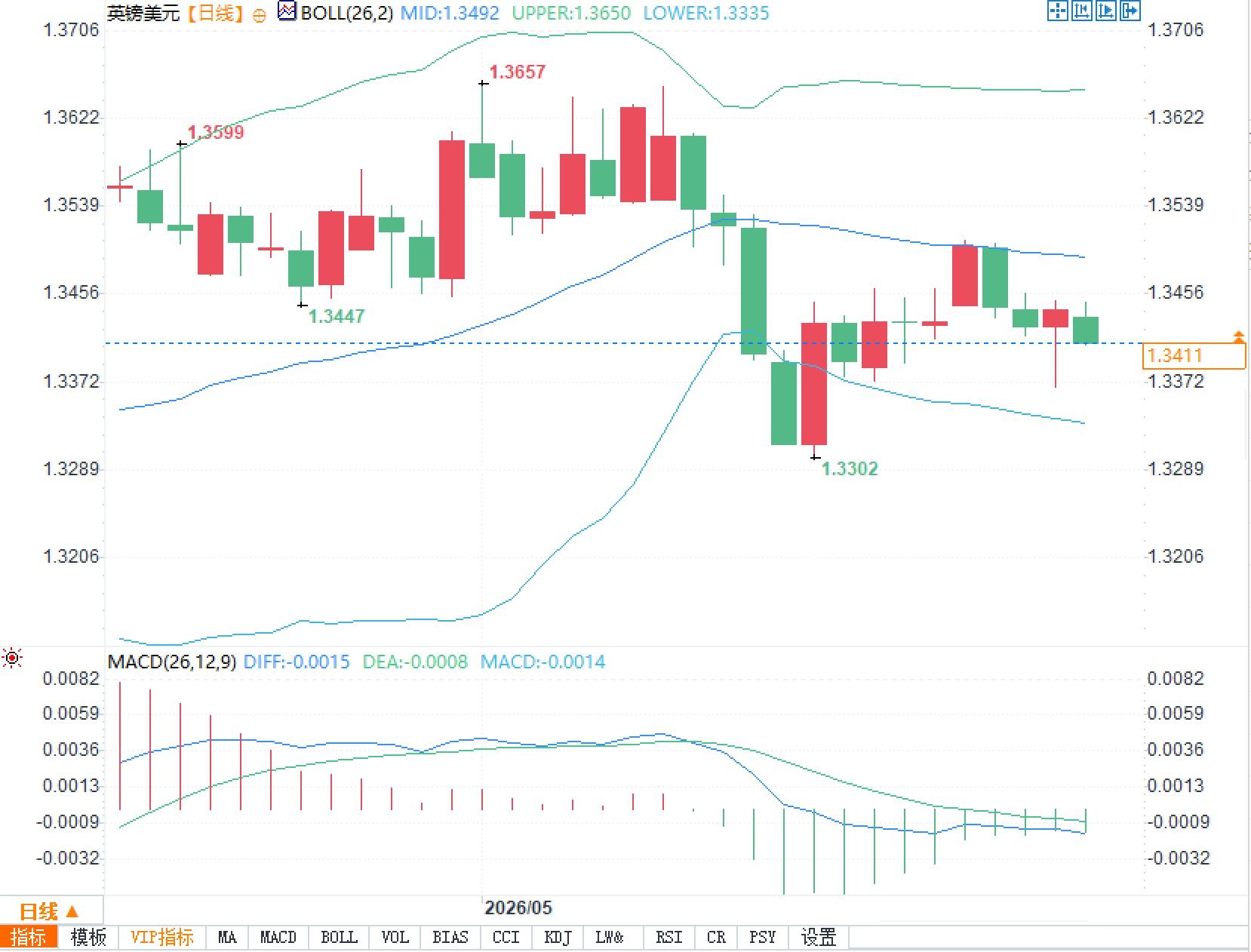
The technical structure also reflects this contradiction. On the daily chart, the exchange rate is below the middle Bollinger Band, and the MACD indicator shows DIFF at -0.0015, DEA at -0.0008, and the histogram at -0.0014, indicating that the recovery after the previous sharp drop has not yet completed the momentum reversal. The current price does not reflect a single interest rate hike logic, but rather the market reassessing three variables: the duration of the energy price shock, the strength of the second round of effects in the UK, and whether the June meeting can confirm the tightening expectation this year.
The main driver influencing the pound against the dollar has shifted from simply comparing the strength of economic data to how the Bank of England will handle energy price shocks and the policy trade-off between its inflation target and economic slowdown. The Middle East conflict has disrupted global energy transport and supply, causing the inflation path to shift upward again, and previously priced-in interest rate cuts have been quickly withdrawn from the market. This has provided some support for the pound based on interest rate expectations, but rising energy input costs, pressure on real incomes, and weakening risk appetite have limited the potential for further appreciation.
Bailey's key message: The cancellation of expectations for interest rate cuts constitutes a tightening, but does not equate to an immediate rate hike.
Bank of England Governor Andrew Bailey stated on May 29th that the Bank of England's decision to maintain the policy rate at 3.75% at its most recent meeting was a proactive choice made in the face of various possible outcomes. With the market's anticipated rate cut temporarily removed, the policy environment is now "significantly tighter" compared to before the shock. He also pointed out that, given the weak economic activity and the uncertainty surrounding the duration of the shock, temporarily tolerating inflation above the 2% target is justifiable, but this tolerance will decrease should a second wave of effects emerge in wages, business pricing, or inflation expectations.
This statement doesn't simply imply a bias in one direction. For the pound, fading expectations of interest rate cuts will raise short-term interest rate pricing, providing support from an interest rate differential perspective; however, Bailey didn't commit to a rapid rate hike, instead focusing on whether a second-round effect has formed. In other words, the Bank of England is currently more concerned about whether inflation, initially a one-off shock from energy prices, will evolve into more persistent wage and service price pressures.
At its April meeting, the Bank of England voted 8-1 to keep the policy rate at 3.75%, with only one member favoring a 25 basis point increase to 4%. The next interest rate decision will be announced on June 18. The key issue at this meeting is not whether to acknowledge the existence of the energy shock, but whether policymakers believe the shock is sufficient to alter medium-term inflation stickiness.
Macroeconomic contradiction: Inflation is higher than the target, but the growth buffer is thinning.
Latest data reveals the two-way tension facing the pound. The UK Consumer Price Index (CPI) rose 2.8% year-on-year in April, down from 3.3% in March, but still above the Bank of England's 2% target. In his speech, Bailey pointed out that household energy prices contributed an additional 0.8 percentage points to April's inflation rate compared to pre-conflict expectations, and predicted that inflation still faces the risk of further increases this year as utility costs and business costs are passed on.
At the same time, economic activity is insufficient to provide room for continued austerity measures. In the first quarter of 2026, UK real GDP grew by 0.6% quarter-on-quarter, and real GDP per capita also grew by 0.6%, indicating resilience at the beginning of the year; however, retail sales fell by 1.3% month-on-month in April, reversing the 0.6% increase in March, suggesting that cost-of-living pressures and cautious consumption are re-emerging.
Therefore, rising inflation does not inherently equate to a sustained appreciation of the pound. If the market only sees expectations of rising interest rates, the pound may receive temporary support; however, if the erosion of consumption, corporate profits, and real income by the energy shock is also taken into account, the exchange rate is likely to encounter a discount at higher levels. This is also a key reason why the pound/dollar exchange rate has remained around 1.34 even after policy expectations shifted towards tightening.
Exchange rate pricing framework: Whether the 32 basis point expectation can be realized depends on the second-round effect.
The current interest rate market has already priced in at least one 25-basis-point hike by the Bank of England this year, with about a one-third probability of a second action, equivalent to approximately 33 basis points. The market has already pre-paid a premium for policy tightening; whether the pound can receive stronger support going forward depends on whether actual data validates this expectation, rather than solely on the central bank's statements.
Logically, energy shocks have two opposing transmission chains on exchange rates. The first is the interest rate chain: increased inflation risks lead to the withdrawal of interest rate cuts, and even increased expectations of rate hikes, providing support for the pound sterling due to interest rate differentials. The second is the growth and risk chain: rising input costs compress real purchasing power, making it more difficult for businesses to pass on costs, putting pressure on the economic outlook, and temporarily strengthening the safe-haven appeal of the dollar, thus limiting the pound sterling's rebound.
The technical structure also reflects this contradiction. On the daily chart, the exchange rate is below the middle Bollinger Band, and the MACD indicator shows DIFF at -0.0015, DEA at -0.0008, and the histogram at -0.0014, indicating that the recovery after the previous sharp drop has not yet completed the momentum reversal. The current price does not reflect a single interest rate hike logic, but rather the market reassessing three variables: the duration of the energy price shock, the strength of the second round of effects in the UK, and whether the June meeting can confirm the tightening expectation this year.
- Risk Warning and Disclaimer
- The market involves risk, and trading may not be suitable for all investors. This article is for reference only and does not constitute personal investment advice, nor does it take into account certain users’ specific investment objectives, financial situation, or other needs. Any investment decisions made based on this information are at your own risk.