The biggest contradiction in the US dollar has been exposed: If hawkish expectations fail to materialize, will 99 become the peak?
2026-05-29 19:57:00
On Friday, May 29th, the US dollar index traded around 99 during the European session, while the 10-year US Treasury yield was approximately 4.448%. Looking at the daily chart, the Bollinger Bands have a middle band at 98.7044, an upper band at 99.6369, and a lower band at 97.7719. The price has recovered from the previous low of around 97.6229, but has not yet effectively opened up upward potential. On the macroeconomic front, Federal Reserve official Schmid recently emphasized that inflation remains the primary concern and has lingered above the target for too long. Market pricing in this year's policy path has shifted from expectations of rate cuts to discussions of a more tightening stance.
The current core of the dollar index's trading is not based on the strength or weakness of individual economic data points, but rather on the market's reassessment of the Federal Reserve's response function. Schmid stated that vigilance should not be relaxed at present, and the focus remains on bringing inflation back to the 2% target. He also cautioned that the recent price increases should not be simply viewed as a short-term disturbance. Although Schmid is not a voting member of the Federal Reserve this year, his remarks echo the cautious statements of several other officials recently, indicating that the focus of policy discussions is shifting from "when to ease" to "whether it is necessary to maintain restrictive conditions for a longer period."
This change is significant for the US dollar index because it provides renewed support for the dollar in terms of interest rate expectations. The market had previously bet on room for rate cuts this year, but the latest data shows that the Federal Reserve is highly likely to maintain its target range of 3.5% to 3.75% at its next meeting. Meanwhile, traders have shifted from expecting rate cuts to assessing the possibility of rate hikes this year. For the foreign exchange market, changes in policy expectations are often more important than the outcome of a single meeting, as they directly affect the dollar's interest rate premium relative to major currencies.
The recent pricing of the US dollar index cannot be separated from the energy and bond markets. Energy price volatility caused by the Middle East conflict has introduced new uncertainty into the inflation path. Schmid noted that the US economy is less exposed to energy shocks than in the past, but rising gasoline prices will still weaken consumer purchasing power. Furthermore, even in the face of higher prices, energy companies have not significantly increased output due to increased capital discipline and higher price uncertainty.
This means the market cannot simply explain the trend using the traditional explanation of "rising energy prices driving up demand for the dollar as a safe haven." A more complete logic is that if energy prices push up inflation expectations, the stickiness of US Treasury yields will increase, thus supporting the dollar's interest rate differential; however, if energy shocks suppress consumption and risk appetite, the dollar may gain temporary defensive demand, while also facing the converse constraint of cooling growth expectations. The current fluctuation of the dollar index around 99 is precisely the result of the interplay between these two forces.
From the daily chart, the US dollar index has completed its recovery from the low near 97.62, with the price regaining the Bollinger Band middle line at 98.7044 and repeatedly testing the 99.09 to 99.55 range. The upper Bollinger Band is located near 99.6369, indicating that there is still room for upward movement in the short term. However, the area around the upper band is also a dense area of previous rebound highs. Without further increases in yields or a further hawkish shift in policy expectations, the index is likely to encounter selling pressure in this area.
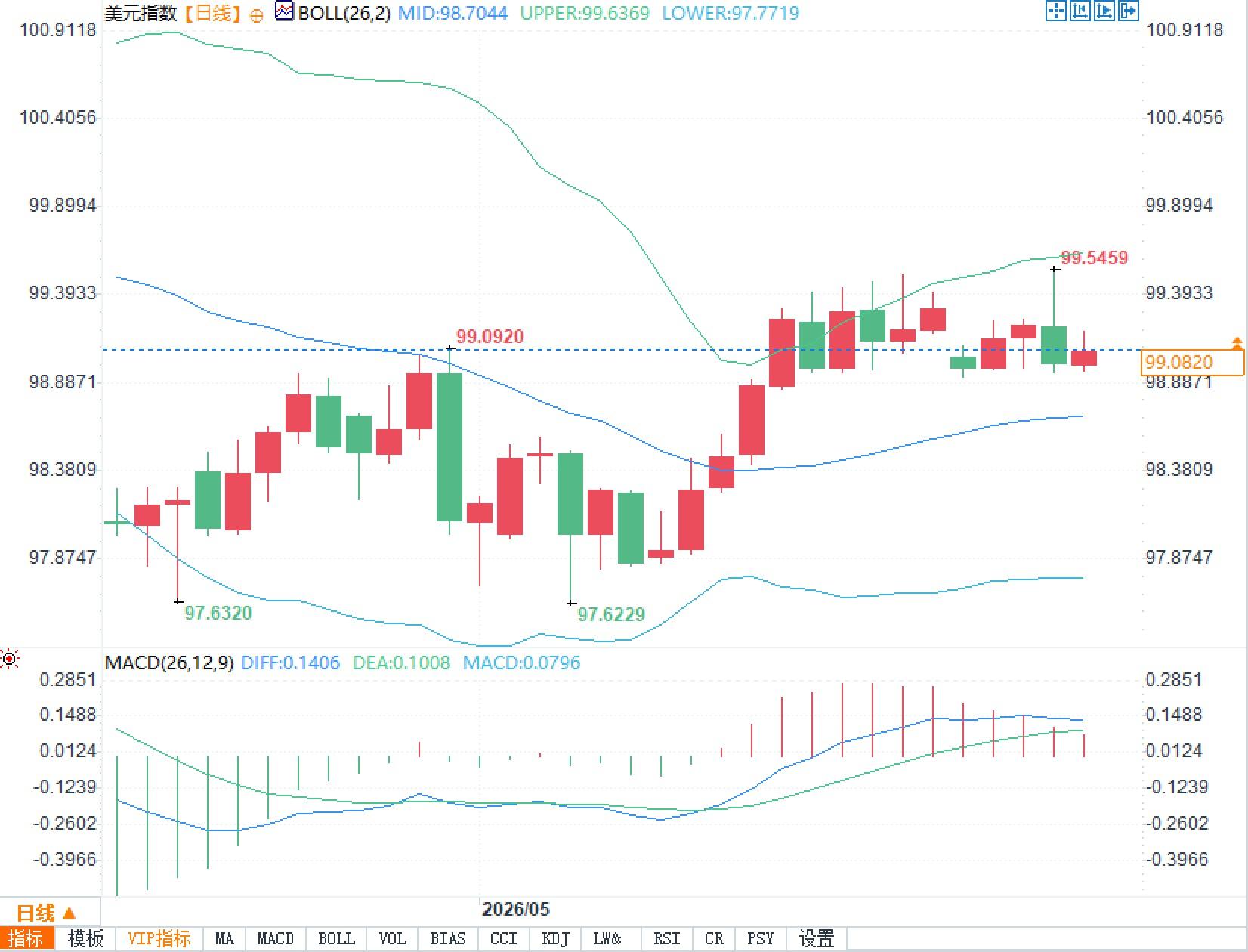
Regarding the MACD, the DIFF is 0.1406, the DEA is 0.1008, and the histogram is 0.0796, indicating that momentum is still in a recovery phase, but the histogram's edge has not shown significant expansion. In other words, the US dollar index is not currently in a high-speed phase of a one-sided trend, but rather in a confirmation period after rebounding from the bottom. Traders are watching whether the 99.55 to 99.63 area can be effectively digested, and whether the middle band around 98.70 can form stable support. If the price continues to trade above the middle band, the market will tend to view the dollar as a currency with "still supported by policy differentials"; if it falls back below the middle band, the reliability of the previous rebound will be weakened.
The biggest contradiction regarding the current US dollar index is not whether inflation is too high, but whether high inflation can translate into stronger expectations of policy action. Schmid's speech increased market sensitivity to inflation risks, but he did not clearly outline a path for interest rate hikes. The market is currently more likely re-pricing a scenario of "maintaining high interest rates for a longer period," rather than directly pricing in a continuous tightening cycle.
Therefore, the key variables for the US dollar index going forward focus on three areas: first, whether inflation data continues to demonstrate sticky price pressures; second, whether the labor market remains balanced, preventing a significant weakening of growth expectations; and third, whether energy prices continue to influence US Treasury yields through inflation expectations. As long as these three areas do not show a significant reversal, the US dollar index will remain resilient on the downside. However, if inflation falls faster than expected, or yields fail to continue rising, the upside potential above 99 will be limited.
The inflation narrative has once again overshadowed the growth narrative.
The current core of the dollar index's trading is not based on the strength or weakness of individual economic data points, but rather on the market's reassessment of the Federal Reserve's response function. Schmid stated that vigilance should not be relaxed at present, and the focus remains on bringing inflation back to the 2% target. He also cautioned that the recent price increases should not be simply viewed as a short-term disturbance. Although Schmid is not a voting member of the Federal Reserve this year, his remarks echo the cautious statements of several other officials recently, indicating that the focus of policy discussions is shifting from "when to ease" to "whether it is necessary to maintain restrictive conditions for a longer period."
This change is significant for the US dollar index because it provides renewed support for the dollar in terms of interest rate expectations. The market had previously bet on room for rate cuts this year, but the latest data shows that the Federal Reserve is highly likely to maintain its target range of 3.5% to 3.75% at its next meeting. Meanwhile, traders have shifted from expecting rate cuts to assessing the possibility of rate hikes this year. For the foreign exchange market, changes in policy expectations are often more important than the outcome of a single meeting, as they directly affect the dollar's interest rate premium relative to major currencies.
Energy prices and yields remain key drivers of dollar pricing.
The recent pricing of the US dollar index cannot be separated from the energy and bond markets. Energy price volatility caused by the Middle East conflict has introduced new uncertainty into the inflation path. Schmid noted that the US economy is less exposed to energy shocks than in the past, but rising gasoline prices will still weaken consumer purchasing power. Furthermore, even in the face of higher prices, energy companies have not significantly increased output due to increased capital discipline and higher price uncertainty.
This means the market cannot simply explain the trend using the traditional explanation of "rising energy prices driving up demand for the dollar as a safe haven." A more complete logic is that if energy prices push up inflation expectations, the stickiness of US Treasury yields will increase, thus supporting the dollar's interest rate differential; however, if energy shocks suppress consumption and risk appetite, the dollar may gain temporary defensive demand, while also facing the converse constraint of cooling growth expectations. The current fluctuation of the dollar index around 99 is precisely the result of the interplay between these two forces.
Technical analysis indicates the rebound has entered a verification zone.
From the daily chart, the US dollar index has completed its recovery from the low near 97.62, with the price regaining the Bollinger Band middle line at 98.7044 and repeatedly testing the 99.09 to 99.55 range. The upper Bollinger Band is located near 99.6369, indicating that there is still room for upward movement in the short term. However, the area around the upper band is also a dense area of previous rebound highs. Without further increases in yields or a further hawkish shift in policy expectations, the index is likely to encounter selling pressure in this area.
Regarding the MACD, the DIFF is 0.1406, the DEA is 0.1008, and the histogram is 0.0796, indicating that momentum is still in a recovery phase, but the histogram's edge has not shown significant expansion. In other words, the US dollar index is not currently in a high-speed phase of a one-sided trend, but rather in a confirmation period after rebounding from the bottom. Traders are watching whether the 99.55 to 99.63 area can be effectively digested, and whether the middle band around 98.70 can form stable support. If the price continues to trade above the middle band, the market will tend to view the dollar as a currency with "still supported by policy differentials"; if it falls back below the middle band, the reliability of the previous rebound will be weakened.
The crux of the US dollar index lies in whether the "hawkish expectations" can continue to materialize.
The biggest contradiction regarding the current US dollar index is not whether inflation is too high, but whether high inflation can translate into stronger expectations of policy action. Schmid's speech increased market sensitivity to inflation risks, but he did not clearly outline a path for interest rate hikes. The market is currently more likely re-pricing a scenario of "maintaining high interest rates for a longer period," rather than directly pricing in a continuous tightening cycle.
Therefore, the key variables for the US dollar index going forward focus on three areas: first, whether inflation data continues to demonstrate sticky price pressures; second, whether the labor market remains balanced, preventing a significant weakening of growth expectations; and third, whether energy prices continue to influence US Treasury yields through inflation expectations. As long as these three areas do not show a significant reversal, the US dollar index will remain resilient on the downside. However, if inflation falls faster than expected, or yields fail to continue rising, the upside potential above 99 will be limited.
- Risk Warning and Disclaimer
- The market involves risk, and trading may not be suitable for all investors. This article is for reference only and does not constitute personal investment advice, nor does it take into account certain users’ specific investment objectives, financial situation, or other needs. Any investment decisions made based on this information are at your own risk.