US Dollar Analysis: Ceasefire Agreement Progress and PCE Revision Unlikely to Change Dollar's Strong Baseline
2026-05-29 20:07:58
On Friday (May 29), during the Asian and European trading sessions, the US dollar index traded in a narrow range between 99.00 and 99.10, continuing the pattern from the overnight close. Yesterday (May 28), the DXY closed near 99.02-99.10, with extremely limited daily fluctuations. Looking back over the past week, the index has generally exhibited a wide-range, high-level consolidation trend, failing to form a clear directional breakout. The cumulative amplitude was controlled at around 0.5%, still about 1% higher than at the beginning of May. Market participants are generally cautiously observing, awaiting substantial confirmation of geopolitical developments and policy clues from the Federal Reserve.
The 60-day ceasefire agreement reached between the US and Iran has temporarily eased immediate concerns about an escalation of the Middle East conflict, and the improved risk sentiment has suppressed the safe-haven appeal of the US dollar. However, the agreement remains unresolved (still awaiting Trump's approval), the timetable for reopening the Strait of Hormuz is unclear, and the hawkish signals from Federal Reserve officials, along with the stabilization of US Treasury yields yesterday, have all contributed to keeping the US dollar anchored within a trading range.
1. Geopolitics: Ceasefire agreement temporarily postponed, market cautiously optimistic.
Latest news indicates that the United States and Iran have reached a provisional agreement to extend the existing ceasefire for 60 days, but the agreement still needs formal approval from US President Trump to take effect. The market's reaction to this news has been one of restrained optimism: oil prices have fallen moderately, the direct risk of escalation in the Middle East has clearly cooled, risk assets have generally received support, and the safe-haven premium for the US dollar has narrowed accordingly.
However, the key constraint preventing further market sentiment gains lies in the lack of any substantial commitment to the Strait of Hormuz. This vital waterway is directly related to global oil supply security. If the ceasefire remains only a temporary agreement without addressing the core issue of reopening the strait, the downward pressure on the dollar is unlikely to develop into a sustained trend. ING analysts Francesco Pesole and Chris Turner also clearly pointed out that for the dollar to experience a further significant decline, "the Strait of Hormuz still needs to be truly reopened." Until then, any rebound or decline could be quickly reversed. This logic forms the core narrative of the dollar's movements this week—every news headline related to the Iranian situation directly drives short-term fluctuations in the foreign exchange market.
2. Federal Reserve officials have made a series of statements, with an overall hawkish tone.
Over the past two days, several Federal Reserve officials with voting rights and influence have spoken out. Overall, the hawkish camp has clearly gained the upper hand, which has provided solid policy support for the US dollar.
Lisa Cook (May 27, Stanford University Forum)
Cook's remarks were the most hawkish among officials in this round of statements. Speaking at an AI forum hosted by the Stanford University Economic Policy Institute, she explicitly stated that inflation is currently "clearly heading in the wrong direction," driven by factors including the lagged effects of tariffs, oil prices pushed up by the Iran war, and construction worker wages and chip demand driven by the AI data center investment boom. While she indicated a current preference for maintaining interest rates, she immediately followed up with a clear threat of a rate hike: "After five years of above-target inflation, I am particularly wary of the risks that inflation is rooted in price and wage setting behavior. I am prepared to raise interest rates should the expected cooling of inflation fail to materialize." This statement signifies that Cook, previously considered dovish, has substantially shifted to a more hawkish stance.
Vice Chairman Philip Jefferson (May 27, Bank of Japan meeting in Tokyo)
Speaking at the Bank of Japan's annual International Monetary and Economic Research Conference, Jefferson listed the Middle East energy shock as the top of his three key global developments. He pointed out that rising oil prices pose a downside risk to global growth and also bring upside risks to inflation, explicitly stating that inflation risks "remain skewed to the upside." However, he also anticipated that inflation might decline within the year as tariffs and the energy shock subside, and expressed concern about downside risks in the labor market. His overall stance was "hawkish with a dovish bias"—he did not directly threaten to raise interest rates, but explicitly refused to presuppose a timetable for the next rate cut under the current circumstances, emphasizing that he would make judgments based on data at each meeting.
Neel Kashkari, President of the Federal Reserve Bank of Minneapolis (May 27-28, Tokyo)
During his attendance at the Bank of Japan meeting, Kashkari delivered two highly consistent hawkish speeches. He stated bluntly that persistently high inflation after five years of exceeding the target is his "primary concern"; the labor market is in "good shape," providing the Federal Reserve with room to focus all its efforts on inflation. He cited energy and fertilizer prices as the main drivers of current price pressures, tracing the cumulative effects of a series of global shocks, from the COVID-19 pandemic to tariffs, the Russia-Ukraine conflict, and the Iran conflict. He warned that if inflation expectations become unanchored, the Federal Reserve will have to adopt a "more aggressive" policy response.
The combined effect of the three statements
Judging from the statements of the three, the disagreement lies in Jefferson's reservations about whether inflation is "temporary," while Cook and Kashkari have both issued substantial warnings about the sustainability of inflation. The minutes of the Fed's late April meeting (released May 20) already recorded that "the vast majority of participants noted an increasing risk of inflation returning to the 2% target," and the 8-4 vote within the FOMC (Harmark, Kashkari, and Logan opposed retaining dovish language) represents the largest split since 1992. This series of signals has led CME FedWatch to show a probability of a rate hike before the end of 2026 of approximately 40%, while market bets on a rate cut before the end of the year have almost disappeared.
3. Yesterday's US economic data: Overall weak, but did not shake policy expectations.
Multiple US data releases on May 28th point in the same direction—economic momentum is slowing at the margin.
Core PCE (April): Up 0.2% month-over-month, below market expectations of 0.3%; year-over-year reading met expectations. This is a rare "soft" inflation data point, but because the absolute level still exceeds the Fed's 2% target, and officials are more focused on the sustainability of inflation than on single-month data, market bets on interest rate cuts have not increased significantly as a result.
The first quarter GDP was revised downward to an annualized growth rate of 1.6%, lower than the initial estimate. This further confirms the basic judgment that the economy had a weak start to the year, with both manufacturing and trade data being dragged down to some extent.
April new home sales: A sharp decline of 6.2% to 622,000 units, significantly lower than market expectations, continuing the ongoing adjustment in the housing market. The suppressive effect of high interest rates on interest rate-sensitive sectors remains clearly visible.
Taken together, the three data points suggest that marginal pressures on consumption and investment are accumulating, which deviates somewhat from the expectation of a "soft landing." However, the interest rate futures market reacted quite restrainedly to this data—given the unchanged hawkish tone of Federal Reserve officials and the unresolved inflation risks, investors generally prefer to wait for the next more indicative data, such as the CPI, before adjusting their judgment on the Fed's interest rate hike/cutting path.
4. US Treasury Market: Yields stabilized in the short term, providing support for the US dollar.
Understanding the dynamics of the bond market is an essential part of understanding the current trend of the US dollar.
Looking at the overall trend in May, the 10-year US Treasury yield rose sharply from a relatively low level in early to mid-May, reaching a high of 4.46%-4.47% (close to the high level since June last year). This rise in yields was driven by a combination of factors, including the Iran war, persistent inflation, and a hawkish stance from the Federal Reserve. Subsequently, news of a geopolitical ceasefire emerged, and yields began to slightly retreat from their highs. The 3.74 basis point decline on the 28th was more likely due to short-term profit-taking than a directional reversal.
The 4.44% 10-year yield remains relatively high on a historical basis, reflecting the market's true pricing in expectations of persistently high interest rates. This provides substantial bottom support for the DXY from the perspective of funding costs and the attractiveness of dollar assets, limiting the downside potential of the dollar. If energy prices stabilize due to the ceasefire agreement, yields may decline slightly further, but the downside potential is very limited until a clear inflection point in inflation is observed.
The yield on 10-year US Treasury bonds has fallen rapidly from its recent high of 4.682%, currently hovering around a key support level of 4.433%. The RSI indicator has dropped to 3.96, entering oversold territory, indicating a significant weakening of downward momentum. Coupled with the partial correction of previously over-traded expectations of "high interest rates lasting longer," there is a possibility of a technical bottoming out and rebound in the short term, potentially correcting towards the 4.50%-4.55% range, which could boost the US dollar.
ING analysts rancesco Pesole and Chris Turner, among others, made the following key assessment today: While the extension of the Iranian ceasefire agreement will improve market sentiment, a further significant decline in the US dollar requires the Strait of Hormuz to truly reopen—the ceasefire agreement alone is insufficient to open up downside potential for the dollar. They also noted that if today's German CPI data is as high as expected, it could potentially put pressure on the euro, indirectly supporting the dollar. Furthermore, they pointed out that the Fed's hawkish stance, combined with inflation data, has led the market to currently price in a potential 15 basis point rise in interest rates before the end of the year, despite recent declines in energy prices.
Other major institutions share a similar consensus: in the short term, the DXY index is highly dependent on geopolitical news. If a ceasefire agreement is ultimately implemented and the Taiwan Strait reopens, the index may test lower levels; if the situation remains deadlocked or new uncertainties arise, the index is expected to rebound to 99.50 or even higher. The Federal Reserve's hawkish stance is widely regarded as a crucial policy defense for the US dollar.
The DXY is currently fluctuating around the 99.00 psychological level, which is also a key battleground for the divergence between bulls and bears. The short-term 5-day and 10-day moving averages (MA5 and MA10) are slightly intertwined without a clear directional tilt, indicating a temporary balance between bullish and bearish forces. However, in the medium to long term, the MA50 and MA100 maintain a gentle downward sloping pressure, meaning that a reversal in the medium-term trend has not yet been established. The RSI indicator is in the neutral zone (approximately 47-52), neither overbought nor oversold. The Bollinger Bands are narrow, suggesting that short-term trading will mainly be range-bound, requiring a clear catalyst to trigger a breakout.
Key price level
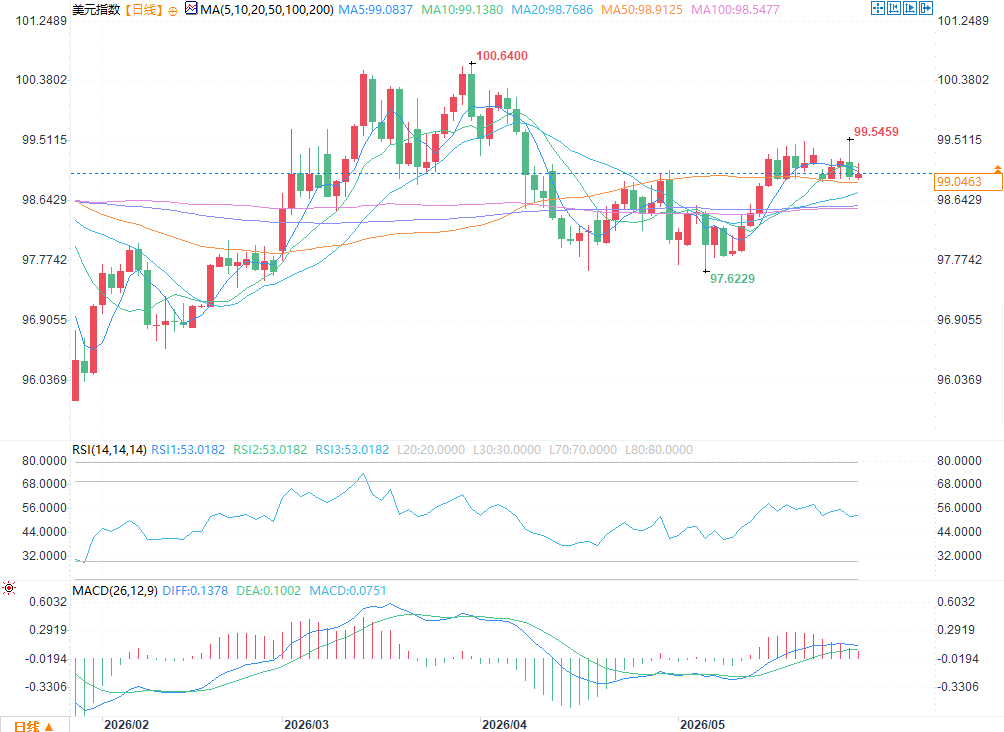
(US Dollar Index Daily Chart Source: FX678)
Support levels below: 98.90-99.00 is the most critical support area in the near term. If this area is effectively broken (with two consecutive days of closing prices below 99.00), it may trigger more stop-loss orders and accelerate the decline to around 98.50. Further down, 98.00-98.20 is a key medium-term support level.
Resistance levels: The 99.50-100.00 range is the main resistance zone in the near term, especially around the psychological level of 99.50, where a large number of short positions are holding onto unrealized profits and long positions are taking profits. Only a break above this level could open up further upward potential for a rebound.
The current DXY technical outlook is neutral to stable, making a range-bound trading strategy of buying low and selling high suitable. The initiation of a trend-driven market depends on one of the following conditions being met: either the reopening of the Strait of Hormuz is confirmed, driving a significant improvement in risk sentiment and causing the dollar to break below 99.00; or ceasefire negotiations break down or the Federal Reserve issues a clearer signal of interest rate hikes, pushing the dollar above 99.50. Until then, directional bets are generally not very cost-effective.
Germany's May CPI data (expected around 15:00-16:00): If the data exceeds expectations, it will strengthen the narrative of European inflation resilience, but it may also simultaneously suppress expectations of a rate cut by the ECB/EUR/USD, creating a complex impact on the EUR/USD exchange rate. A detailed assessment of the data is necessary.
US April advanced trade balance data and wholesale/retail inventories (around 20:30): The former reflects the trend of the trade deficit, while the latter is a leading revision signal for the second-quarter GDP data. If the inventory data is high, it may imply a signal of weakening consumer demand.
Fed Officials' Speeches (Scattered Throughout the Day): Several officials, including Kashkari, Schmid, Daly, and Bowman, will be speaking today. Based on the tone of the past two days' speeches, pay close attention to their latest statements on the sustainability of inflation and the threshold for interest rate hikes. Any unexpectedly hawkish remarks could drive a dollar rebound, and vice versa.
Overall, today's macroeconomic calendar is relatively light, with market focus remaining on three variables: whether Trump will make a public statement on the ceasefire agreement, the latest developments in the Strait of Hormuz, and the details of the wording in speeches by several Federal Reserve officials today.
Q1: Why didn't the US dollar fall sharply after the US-Iran ceasefire agreement was extended?
The positive impact of the ceasefire announcement has been partially realized, but two key constraints remain: first, the agreement still requires formal approval from Trump, making its implementation uncertain; second, the prospects for reopening the Strait of Hormuz are unclear, which is the core indicator that the risks to oil prices and energy supply have truly been eliminated. Meanwhile, a series of hawkish statements from Federal Reserve officials provided a strong policy counterweight to the dollar, ensuring a moderate and controllable decline rather than a one-sided trend.
Q2: What positions do Cook, Jefferson, and Kashkari represent respectively?
All three are hawkish, but to varying degrees. Cook's shift has been the most significant this time—she explicitly stated that "inflation is heading in the wrong direction" and is prepared to raise interest rates, representing a substantial leap in stance for the outside world. Kashkari has consistently been a hawk, and his wording this time continues his hawkish style. Jefferson, on the other hand, is relatively cautious. While acknowledging the upside risks to inflation, he also expressed reservations about the downside risks to the labor market, making him the closest to being "neutral to hawkish" among the three.
Q3: With several US economic indicators showing weakness, why has the market barely reacted to expectations of an interest rate cut?
Lower-than-expected core PCE, downward revision of GDP, and weakening new home sales all point to a marginal economic slowdown. However, investors believe that a single data point is insufficient to change the Federal Reserve's policy framework—currently, the Fed is more focused on evidence of a sustained decline in inflation than on a single month's core PCE. With officials clearly stating the need for more data to confirm this, the market is choosing to wait for more indicative data such as the CPI before adjusting its bets on the interest rate cut path.
Q4: How should we understand the impact of the 10-year US Treasury yield on the US dollar?
Yesterday, the 10-year yield fell by approximately 3.74 basis points to 4.443%, which technically represents a short-term pullback, but the absolute level remains high—reflecting the market's solid pricing in of a prolonged period of high interest rates. Higher yields mean that the relative attractiveness of dollar assets remains, and also imply continued capital inflows, structurally limiting the downside potential of the dollar. If yields subsequently fall further due to geopolitical easing and break below the 4.30% level, the support level for the dollar will need to be reassessed.
Q5: In the current environment, how should ordinary investors operate?
Short-term recommendations suggest maintaining a light position or remaining on the sidelines, avoiding betting on a one-sided market trend before the direction is clear. Given the current oscillating pattern, consider a light short position around 99.00-99.10, with levels above 99.50 considered strong resistance for selling on rallies. If geopolitical tensions escalate suddenly, 98.80-99.00 can be used as a stop-loss reference. Simultaneously, closely monitor three key variables today: Trump's public statements on a ceasefire, the latest developments in the Strait of Hormuz, and the wording details in speeches by several Federal Reserve officials.
The 60-day ceasefire agreement reached between the US and Iran has temporarily eased immediate concerns about an escalation of the Middle East conflict, and the improved risk sentiment has suppressed the safe-haven appeal of the US dollar. However, the agreement remains unresolved (still awaiting Trump's approval), the timetable for reopening the Strait of Hormuz is unclear, and the hawkish signals from Federal Reserve officials, along with the stabilization of US Treasury yields yesterday, have all contributed to keeping the US dollar anchored within a trading range.
Fundamental Analysis
1. Geopolitics: Ceasefire agreement temporarily postponed, market cautiously optimistic.
Latest news indicates that the United States and Iran have reached a provisional agreement to extend the existing ceasefire for 60 days, but the agreement still needs formal approval from US President Trump to take effect. The market's reaction to this news has been one of restrained optimism: oil prices have fallen moderately, the direct risk of escalation in the Middle East has clearly cooled, risk assets have generally received support, and the safe-haven premium for the US dollar has narrowed accordingly.
However, the key constraint preventing further market sentiment gains lies in the lack of any substantial commitment to the Strait of Hormuz. This vital waterway is directly related to global oil supply security. If the ceasefire remains only a temporary agreement without addressing the core issue of reopening the strait, the downward pressure on the dollar is unlikely to develop into a sustained trend. ING analysts Francesco Pesole and Chris Turner also clearly pointed out that for the dollar to experience a further significant decline, "the Strait of Hormuz still needs to be truly reopened." Until then, any rebound or decline could be quickly reversed. This logic forms the core narrative of the dollar's movements this week—every news headline related to the Iranian situation directly drives short-term fluctuations in the foreign exchange market.
2. Federal Reserve officials have made a series of statements, with an overall hawkish tone.
Over the past two days, several Federal Reserve officials with voting rights and influence have spoken out. Overall, the hawkish camp has clearly gained the upper hand, which has provided solid policy support for the US dollar.
Lisa Cook (May 27, Stanford University Forum)
Cook's remarks were the most hawkish among officials in this round of statements. Speaking at an AI forum hosted by the Stanford University Economic Policy Institute, she explicitly stated that inflation is currently "clearly heading in the wrong direction," driven by factors including the lagged effects of tariffs, oil prices pushed up by the Iran war, and construction worker wages and chip demand driven by the AI data center investment boom. While she indicated a current preference for maintaining interest rates, she immediately followed up with a clear threat of a rate hike: "After five years of above-target inflation, I am particularly wary of the risks that inflation is rooted in price and wage setting behavior. I am prepared to raise interest rates should the expected cooling of inflation fail to materialize." This statement signifies that Cook, previously considered dovish, has substantially shifted to a more hawkish stance.
Vice Chairman Philip Jefferson (May 27, Bank of Japan meeting in Tokyo)
Speaking at the Bank of Japan's annual International Monetary and Economic Research Conference, Jefferson listed the Middle East energy shock as the top of his three key global developments. He pointed out that rising oil prices pose a downside risk to global growth and also bring upside risks to inflation, explicitly stating that inflation risks "remain skewed to the upside." However, he also anticipated that inflation might decline within the year as tariffs and the energy shock subside, and expressed concern about downside risks in the labor market. His overall stance was "hawkish with a dovish bias"—he did not directly threaten to raise interest rates, but explicitly refused to presuppose a timetable for the next rate cut under the current circumstances, emphasizing that he would make judgments based on data at each meeting.
Neel Kashkari, President of the Federal Reserve Bank of Minneapolis (May 27-28, Tokyo)
During his attendance at the Bank of Japan meeting, Kashkari delivered two highly consistent hawkish speeches. He stated bluntly that persistently high inflation after five years of exceeding the target is his "primary concern"; the labor market is in "good shape," providing the Federal Reserve with room to focus all its efforts on inflation. He cited energy and fertilizer prices as the main drivers of current price pressures, tracing the cumulative effects of a series of global shocks, from the COVID-19 pandemic to tariffs, the Russia-Ukraine conflict, and the Iran conflict. He warned that if inflation expectations become unanchored, the Federal Reserve will have to adopt a "more aggressive" policy response.
The combined effect of the three statements
Judging from the statements of the three, the disagreement lies in Jefferson's reservations about whether inflation is "temporary," while Cook and Kashkari have both issued substantial warnings about the sustainability of inflation. The minutes of the Fed's late April meeting (released May 20) already recorded that "the vast majority of participants noted an increasing risk of inflation returning to the 2% target," and the 8-4 vote within the FOMC (Harmark, Kashkari, and Logan opposed retaining dovish language) represents the largest split since 1992. This series of signals has led CME FedWatch to show a probability of a rate hike before the end of 2026 of approximately 40%, while market bets on a rate cut before the end of the year have almost disappeared.
3. Yesterday's US economic data: Overall weak, but did not shake policy expectations.
Multiple US data releases on May 28th point in the same direction—economic momentum is slowing at the margin.
Core PCE (April): Up 0.2% month-over-month, below market expectations of 0.3%; year-over-year reading met expectations. This is a rare "soft" inflation data point, but because the absolute level still exceeds the Fed's 2% target, and officials are more focused on the sustainability of inflation than on single-month data, market bets on interest rate cuts have not increased significantly as a result.
The first quarter GDP was revised downward to an annualized growth rate of 1.6%, lower than the initial estimate. This further confirms the basic judgment that the economy had a weak start to the year, with both manufacturing and trade data being dragged down to some extent.
April new home sales: A sharp decline of 6.2% to 622,000 units, significantly lower than market expectations, continuing the ongoing adjustment in the housing market. The suppressive effect of high interest rates on interest rate-sensitive sectors remains clearly visible.
Taken together, the three data points suggest that marginal pressures on consumption and investment are accumulating, which deviates somewhat from the expectation of a "soft landing." However, the interest rate futures market reacted quite restrainedly to this data—given the unchanged hawkish tone of Federal Reserve officials and the unresolved inflation risks, investors generally prefer to wait for the next more indicative data, such as the CPI, before adjusting their judgment on the Fed's interest rate hike/cutting path.
4. US Treasury Market: Yields stabilized in the short term, providing support for the US dollar.
Understanding the dynamics of the bond market is an essential part of understanding the current trend of the US dollar.
Looking at the overall trend in May, the 10-year US Treasury yield rose sharply from a relatively low level in early to mid-May, reaching a high of 4.46%-4.47% (close to the high level since June last year). This rise in yields was driven by a combination of factors, including the Iran war, persistent inflation, and a hawkish stance from the Federal Reserve. Subsequently, news of a geopolitical ceasefire emerged, and yields began to slightly retreat from their highs. The 3.74 basis point decline on the 28th was more likely due to short-term profit-taking than a directional reversal.
The 4.44% 10-year yield remains relatively high on a historical basis, reflecting the market's true pricing in expectations of persistently high interest rates. This provides substantial bottom support for the DXY from the perspective of funding costs and the attractiveness of dollar assets, limiting the downside potential of the dollar. If energy prices stabilize due to the ceasefire agreement, yields may decline slightly further, but the downside potential is very limited until a clear inflection point in inflation is observed.
The yield on 10-year US Treasury bonds has fallen rapidly from its recent high of 4.682%, currently hovering around a key support level of 4.433%. The RSI indicator has dropped to 3.96, entering oversold territory, indicating a significant weakening of downward momentum. Coupled with the partial correction of previously over-traded expectations of "high interest rates lasting longer," there is a possibility of a technical bottoming out and rebound in the short term, potentially correcting towards the 4.50%-4.55% range, which could boost the US dollar.
mainstream view
ING analysts rancesco Pesole and Chris Turner, among others, made the following key assessment today: While the extension of the Iranian ceasefire agreement will improve market sentiment, a further significant decline in the US dollar requires the Strait of Hormuz to truly reopen—the ceasefire agreement alone is insufficient to open up downside potential for the dollar. They also noted that if today's German CPI data is as high as expected, it could potentially put pressure on the euro, indirectly supporting the dollar. Furthermore, they pointed out that the Fed's hawkish stance, combined with inflation data, has led the market to currently price in a potential 15 basis point rise in interest rates before the end of the year, despite recent declines in energy prices.
Other major institutions share a similar consensus: in the short term, the DXY index is highly dependent on geopolitical news. If a ceasefire agreement is ultimately implemented and the Taiwan Strait reopens, the index may test lower levels; if the situation remains deadlocked or new uncertainties arise, the index is expected to rebound to 99.50 or even higher. The Federal Reserve's hawkish stance is widely regarded as a crucial policy defense for the US dollar.
Technical Analysis
The DXY is currently fluctuating around the 99.00 psychological level, which is also a key battleground for the divergence between bulls and bears. The short-term 5-day and 10-day moving averages (MA5 and MA10) are slightly intertwined without a clear directional tilt, indicating a temporary balance between bullish and bearish forces. However, in the medium to long term, the MA50 and MA100 maintain a gentle downward sloping pressure, meaning that a reversal in the medium-term trend has not yet been established. The RSI indicator is in the neutral zone (approximately 47-52), neither overbought nor oversold. The Bollinger Bands are narrow, suggesting that short-term trading will mainly be range-bound, requiring a clear catalyst to trigger a breakout.
Key price level
(US Dollar Index Daily Chart Source: FX678)
Support levels below: 98.90-99.00 is the most critical support area in the near term. If this area is effectively broken (with two consecutive days of closing prices below 99.00), it may trigger more stop-loss orders and accelerate the decline to around 98.50. Further down, 98.00-98.20 is a key medium-term support level.
Resistance levels: The 99.50-100.00 range is the main resistance zone in the near term, especially around the psychological level of 99.50, where a large number of short positions are holding onto unrealized profits and long positions are taking profits. Only a break above this level could open up further upward potential for a rebound.
The current DXY technical outlook is neutral to stable, making a range-bound trading strategy of buying low and selling high suitable. The initiation of a trend-driven market depends on one of the following conditions being met: either the reopening of the Strait of Hormuz is confirmed, driving a significant improvement in risk sentiment and causing the dollar to break below 99.00; or ceasefire negotiations break down or the Federal Reserve issues a clearer signal of interest rate hikes, pushing the dollar above 99.50. Until then, directional bets are generally not very cost-effective.
Today's financial calendar (Beijing time)
Germany's May CPI data (expected around 15:00-16:00): If the data exceeds expectations, it will strengthen the narrative of European inflation resilience, but it may also simultaneously suppress expectations of a rate cut by the ECB/EUR/USD, creating a complex impact on the EUR/USD exchange rate. A detailed assessment of the data is necessary.
US April advanced trade balance data and wholesale/retail inventories (around 20:30): The former reflects the trend of the trade deficit, while the latter is a leading revision signal for the second-quarter GDP data. If the inventory data is high, it may imply a signal of weakening consumer demand.
Fed Officials' Speeches (Scattered Throughout the Day): Several officials, including Kashkari, Schmid, Daly, and Bowman, will be speaking today. Based on the tone of the past two days' speeches, pay close attention to their latest statements on the sustainability of inflation and the threshold for interest rate hikes. Any unexpectedly hawkish remarks could drive a dollar rebound, and vice versa.
Overall, today's macroeconomic calendar is relatively light, with market focus remaining on three variables: whether Trump will make a public statement on the ceasefire agreement, the latest developments in the Strait of Hormuz, and the details of the wording in speeches by several Federal Reserve officials today.
Frequently Asked Questions
Q1: Why didn't the US dollar fall sharply after the US-Iran ceasefire agreement was extended?
The positive impact of the ceasefire announcement has been partially realized, but two key constraints remain: first, the agreement still requires formal approval from Trump, making its implementation uncertain; second, the prospects for reopening the Strait of Hormuz are unclear, which is the core indicator that the risks to oil prices and energy supply have truly been eliminated. Meanwhile, a series of hawkish statements from Federal Reserve officials provided a strong policy counterweight to the dollar, ensuring a moderate and controllable decline rather than a one-sided trend.
Q2: What positions do Cook, Jefferson, and Kashkari represent respectively?
All three are hawkish, but to varying degrees. Cook's shift has been the most significant this time—she explicitly stated that "inflation is heading in the wrong direction" and is prepared to raise interest rates, representing a substantial leap in stance for the outside world. Kashkari has consistently been a hawk, and his wording this time continues his hawkish style. Jefferson, on the other hand, is relatively cautious. While acknowledging the upside risks to inflation, he also expressed reservations about the downside risks to the labor market, making him the closest to being "neutral to hawkish" among the three.
Q3: With several US economic indicators showing weakness, why has the market barely reacted to expectations of an interest rate cut?
Lower-than-expected core PCE, downward revision of GDP, and weakening new home sales all point to a marginal economic slowdown. However, investors believe that a single data point is insufficient to change the Federal Reserve's policy framework—currently, the Fed is more focused on evidence of a sustained decline in inflation than on a single month's core PCE. With officials clearly stating the need for more data to confirm this, the market is choosing to wait for more indicative data such as the CPI before adjusting its bets on the interest rate cut path.
Q4: How should we understand the impact of the 10-year US Treasury yield on the US dollar?
Yesterday, the 10-year yield fell by approximately 3.74 basis points to 4.443%, which technically represents a short-term pullback, but the absolute level remains high—reflecting the market's solid pricing in of a prolonged period of high interest rates. Higher yields mean that the relative attractiveness of dollar assets remains, and also imply continued capital inflows, structurally limiting the downside potential of the dollar. If yields subsequently fall further due to geopolitical easing and break below the 4.30% level, the support level for the dollar will need to be reassessed.
Q5: In the current environment, how should ordinary investors operate?
Short-term recommendations suggest maintaining a light position or remaining on the sidelines, avoiding betting on a one-sided market trend before the direction is clear. Given the current oscillating pattern, consider a light short position around 99.00-99.10, with levels above 99.50 considered strong resistance for selling on rallies. If geopolitical tensions escalate suddenly, 98.80-99.00 can be used as a stop-loss reference. Simultaneously, closely monitor three key variables today: Trump's public statements on a ceasefire, the latest developments in the Strait of Hormuz, and the wording details in speeches by several Federal Reserve officials.
- Risk Warning and Disclaimer
- The market involves risk, and trading may not be suitable for all investors. This article is for reference only and does not constitute personal investment advice, nor does it take into account certain users’ specific investment objectives, financial situation, or other needs. Any investment decisions made based on this information are at your own risk.