The pricing logic for crude oil has long transcended a single missile conflict, signifying the collapse of the old order.
2026-07-14 01:54:10
The oil market is being repriced not by a missile strike, but by the collapse of the existing control framework. West Texas Intermediate (WTI) crude is nearing $75, up nearly 5% on the day; Brent crude is approaching $80. This is triggered by Trump's announcement that the US will reinstate a shipping blockade against Iran, imposing a 20% tariff on every shipment allowed to pass through the Strait of Hormuz. Just a week ago, based on expectations of a three-week easing of tensions, oil prices fell back to around $67, pre-war levels; now, almost all the price reductions from the easing have been wiped out.  This passage fee, previously declared illegitimate by both sides, was explicitly prohibited by the Memorandum of Understanding (MOU) signed in mid-June, which forcibly banned Tehran from charging merchant ships passage fees in the Strait of Hormuz. Washington spent weeks upholding this clause as a fundamental principle. Oman submitted a position paper to the International Maritime Organization (IMO), a UN maritime agency, emphasizing that international straits should not be charged passage fees; just days earlier, the IMO Secretary General also stated that there was no legal basis for charging vessels in the Strait of Hormuz. This set of legal arguments was originally intended to refute Iran's fee-charging plan; however, on Monday, the US adopted this logic and began imposing the tax itself. The core flaw in this passage policy lies in the fact that who collects the fees does not change the legal issue, a point deliberately avoided in the US announcement. The law of the sea does not concern itself with which navy establishes the passage fee station. Therefore, the market is betting not only on the 20% tax itself, but also on the deeper logic that neither side in the conflict is willing to abide by the rules to restore normal shipping. The Strait of Hormuz has thus transformed from a "war risk issue with a deadline" into a struggle for interests with no end in sight. The market has already implicitly borne the high costs of passage . In shipping, hidden passage fees have long existed. Shipping market estimates suggest that chartering a tanker loading cargo from inside the strait to Asia costs approximately twice as much as departing from outside the strait. In addition, shipowners must pay extra for war risk insurance. Currently, traffic volume in the strait is only one-third of normal; on Monday morning, Iranian forces fired warning shots at two vessels attempting to pass. The military strikes that day also affected Khuzestan province, Iran's core oil-producing province. The risks are twofold: on the one hand, crude oil passage through the strait is obstructed; on the other hand, oil production in the producing regions is impacted. Conflicting signals from Iran itself have further exacerbated market concerns: the Straits Authority claims insufficient navigation conditions when the situation is unstable, but Iranian diplomats have claimed the existence of safe passage routes. Shipping companies, after considering both statements, rationally conclude that only the risk pricing factored into insurance premiums is reliable. The US Strategic Petroleum Reserve itself is already facing a crisis. As of the week ending July 3, the US Strategic Petroleum Reserve stood at 319.5 million barrels, a new low since April 1983. The US had previously pledged to release 172 million barrels from its reserves, in conjunction with the International Energy Agency's release of 400 million barrels of crude oil. Since then, the US has been continuously depleting its reserves at a rate of nearly 6 million barrels per week. Currently, storage facilities hold less than half of their total capacity. At the G7 summit, Trump admitted that without the easing agreement in June, the US Strategic Reserve would have been depleted in about four more weeks. Commercial inventories are also failing to provide a buffer. Total US crude oil inventories (including strategic reserves) have fallen to 734 million barrels, the lowest since 1984; commercial inventories have declined for ten consecutive weeks; Cushing crude oil hub inventories are below 20 million barrels, a level that would almost hinder crude oil delivery to refineries; and with the summer travel peak approaching, refinery utilization rates are above 96%. The US plan to replenish its reserves by 200 million barrels over the next year has created potential new crude oil demand beyond the market. Oil prices will face two key tests this week . On Tuesday at 12:30 GMT, the June CPI data will be released. The market generally expects the US CPI to fall by 0.1% month-on-month and slow to 3.8% year-on-year. Monday's surge in oil prices has not yet been reflected in the June inflation data, but it will significantly push up inflation figures for July and August. At 2:00 PM on the same day, the Federal Reserve Chairman will testify before Congress. The current surge in oil prices is creating a new round of inflationary risks. On Wednesday, official US inventory data will be released: whether the continued decline in reserves and the tenth consecutive month of decline in commercial inventories will continue into July. Given the restricted flow of goods across the Taiwan Strait, a significant further decline in inventories would solidify the tight supply-demand situation; only an unexpected increase in inventories could suppress the upward momentum of oil prices in the absence of peace news. Key Price Levels and Future Trends Resistance Level:
 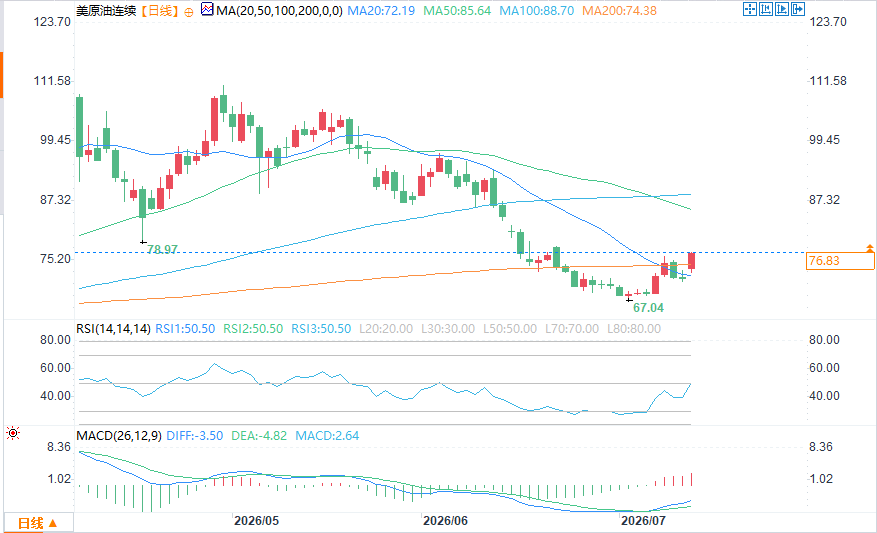 (WTI Crude Oil Daily Chart Source: EasyForex) The 200-day moving average at $77.25 is the first important level, followed by the 50-day moving average at $80.21. Since the sharp drop in oil prices from $107.35 in May, both moving averages are currently maintaining a downward trend. Support Level: The intraday low of $72.53 is a key short-term support level. Holding this level is crucial for oil prices to remain above $70; a break below this level would target the pre-war low of $67.09, which is likely to be tested when the situation truly eases. Market Outlook: Bullish The daily stochastic oscillator has turned upwards from the 35 range; Straits Times clearance is only one-third of normal; reserves previously used to mitigate oil price spikes have fallen to a 43-year low. A pullback to around $72.53 presents a buying opportunity; only a daily close below this level would risk breaching the $70 psychological level again.
This passage fee, previously declared illegitimate by both sides, was explicitly prohibited by the Memorandum of Understanding (MOU) signed in mid-June, which forcibly banned Tehran from charging merchant ships passage fees in the Strait of Hormuz. Washington spent weeks upholding this clause as a fundamental principle. Oman submitted a position paper to the International Maritime Organization (IMO), a UN maritime agency, emphasizing that international straits should not be charged passage fees; just days earlier, the IMO Secretary General also stated that there was no legal basis for charging vessels in the Strait of Hormuz. This set of legal arguments was originally intended to refute Iran's fee-charging plan; however, on Monday, the US adopted this logic and began imposing the tax itself. The core flaw in this passage policy lies in the fact that who collects the fees does not change the legal issue, a point deliberately avoided in the US announcement. The law of the sea does not concern itself with which navy establishes the passage fee station. Therefore, the market is betting not only on the 20% tax itself, but also on the deeper logic that neither side in the conflict is willing to abide by the rules to restore normal shipping. The Strait of Hormuz has thus transformed from a "war risk issue with a deadline" into a struggle for interests with no end in sight. The market has already implicitly borne the high costs of passage . In shipping, hidden passage fees have long existed. Shipping market estimates suggest that chartering a tanker loading cargo from inside the strait to Asia costs approximately twice as much as departing from outside the strait. In addition, shipowners must pay extra for war risk insurance. Currently, traffic volume in the strait is only one-third of normal; on Monday morning, Iranian forces fired warning shots at two vessels attempting to pass. The military strikes that day also affected Khuzestan province, Iran's core oil-producing province. The risks are twofold: on the one hand, crude oil passage through the strait is obstructed; on the other hand, oil production in the producing regions is impacted. Conflicting signals from Iran itself have further exacerbated market concerns: the Straits Authority claims insufficient navigation conditions when the situation is unstable, but Iranian diplomats have claimed the existence of safe passage routes. Shipping companies, after considering both statements, rationally conclude that only the risk pricing factored into insurance premiums is reliable. The US Strategic Petroleum Reserve itself is already facing a crisis. As of the week ending July 3, the US Strategic Petroleum Reserve stood at 319.5 million barrels, a new low since April 1983. The US had previously pledged to release 172 million barrels from its reserves, in conjunction with the International Energy Agency's release of 400 million barrels of crude oil. Since then, the US has been continuously depleting its reserves at a rate of nearly 6 million barrels per week. Currently, storage facilities hold less than half of their total capacity. At the G7 summit, Trump admitted that without the easing agreement in June, the US Strategic Reserve would have been depleted in about four more weeks. Commercial inventories are also failing to provide a buffer. Total US crude oil inventories (including strategic reserves) have fallen to 734 million barrels, the lowest since 1984; commercial inventories have declined for ten consecutive weeks; Cushing crude oil hub inventories are below 20 million barrels, a level that would almost hinder crude oil delivery to refineries; and with the summer travel peak approaching, refinery utilization rates are above 96%. The US plan to replenish its reserves by 200 million barrels over the next year has created potential new crude oil demand beyond the market. Oil prices will face two key tests this week . On Tuesday at 12:30 GMT, the June CPI data will be released. The market generally expects the US CPI to fall by 0.1% month-on-month and slow to 3.8% year-on-year. Monday's surge in oil prices has not yet been reflected in the June inflation data, but it will significantly push up inflation figures for July and August. At 2:00 PM on the same day, the Federal Reserve Chairman will testify before Congress. The current surge in oil prices is creating a new round of inflationary risks. On Wednesday, official US inventory data will be released: whether the continued decline in reserves and the tenth consecutive month of decline in commercial inventories will continue into July. Given the restricted flow of goods across the Taiwan Strait, a significant further decline in inventories would solidify the tight supply-demand situation; only an unexpected increase in inventories could suppress the upward momentum of oil prices in the absence of peace news. Key Price Levels and Future Trends Resistance Level: (WTI Crude Oil Daily Chart Source: EasyForex) The 200-day moving average at $77.25 is the first important level, followed by the 50-day moving average at $80.21. Since the sharp drop in oil prices from $107.35 in May, both moving averages are currently maintaining a downward trend. Support Level: The intraday low of $72.53 is a key short-term support level. Holding this level is crucial for oil prices to remain above $70; a break below this level would target the pre-war low of $67.09, which is likely to be tested when the situation truly eases. Market Outlook: Bullish The daily stochastic oscillator has turned upwards from the 35 range; Straits Times clearance is only one-third of normal; reserves previously used to mitigate oil price spikes have fallen to a 43-year low. A pullback to around $72.53 presents a buying opportunity; only a daily close below this level would risk breaching the $70 psychological level again.
- Risk Warning and Disclaimer
- The market involves risk, and trading may not be suitable for all investors. This article is for reference only and does not constitute personal investment advice, nor does it take into account certain users’ specific investment objectives, financial situation, or other needs. Any investment decisions made based on this information are at your own risk.