Goldman Sachs warns of escalating demand weakness and lowers its fourth-quarter oil price forecast.
2026-06-01 15:52:18
The international crude oil market has recently fluctuated between geopolitical risks and demand concerns. As the situation between the US and Iran continues to escalate, and supply risks in the Middle East persist, oil prices have received some support. However, a recent research report from Goldman Sachs indicates that signs of weakening demand are increasing, which could become a significant source of pressure on oil prices in the future.

In a report released on May 31, Goldman Sachs’ head of commodities research, Daan Struve and his team pointed out that the latest oil sales data from Western Europe were weaker than expected, indicating that global energy consumption demand may be slowing further.
According to the report, Western European oil sales data for April indicates that Goldman Sachs' previous forecasts for global oil demand remained overly optimistic. The research team believes that their already relatively conservative demand forecast still faces a downside risk of approximately 2 million barrels per day.
This change has a significant impact on future oil price expectations. Goldman Sachs stated that if demand remains weak, its previous forecast of an average Brent crude oil price of $90 per barrel in the fourth quarter may face downward pressure of approximately $10. Currently, the market is in a phase of intense competition between supply and demand factors. On the one hand, the situation in the Middle East remains complex, particularly regarding the significant uncertainty surrounding supply recovery following the US-Iran conflict.
The Strait of Hormuz, one of the world's most important energy transport routes, handles approximately 20% of global seaborne crude oil shipments. Any risk of supply disruptions in the region could quickly drive up international oil prices. On the other hand, signs of slowing global economic growth are weakening demand for crude oil. European manufacturing activity remains sluggish, consumer spending growth is weak, and high energy prices themselves are suppressing the recovery of end-user demand.
Goldman Sachs analysts point out that the most significant characteristic of the current market is the simultaneous existence of supply and demand risks, both of which are highly uncertain. Goldman Sachs analysts stated, "We believe that Middle East supply losses could persist for a longer period, posing a significant upside price risk, but weak demand also presents a significant downside price risk. Actual end-user oil demand may decline more than expected due to rising prices."
From a market perspective, if supply disruptions in the Middle East last longer than expected, international crude oil inventories could decline rapidly, thereby driving up oil prices. However, if high oil prices persist for too long, they could further dampen consumer demand, creating a negative feedback loop.
This situation suggests that future oil price volatility may further increase. The market needs to pay attention not only to geopolitical developments but also to closely monitor changes in global economic activity and energy consumption.
Meanwhile, the maintenance of high interest rates by major central banks around the world is also putting pressure on energy demand. High financing costs and slowing economic growth are jointly affecting corporate investment and household consumption, thus indirectly impacting oil demand.
From an investor's perspective, the crude oil market has entered a new phase where supply shocks and demand adjustments are occurring simultaneously. Traditional methods that solely rely on supply risk to predict oil price trends are facing challenges.
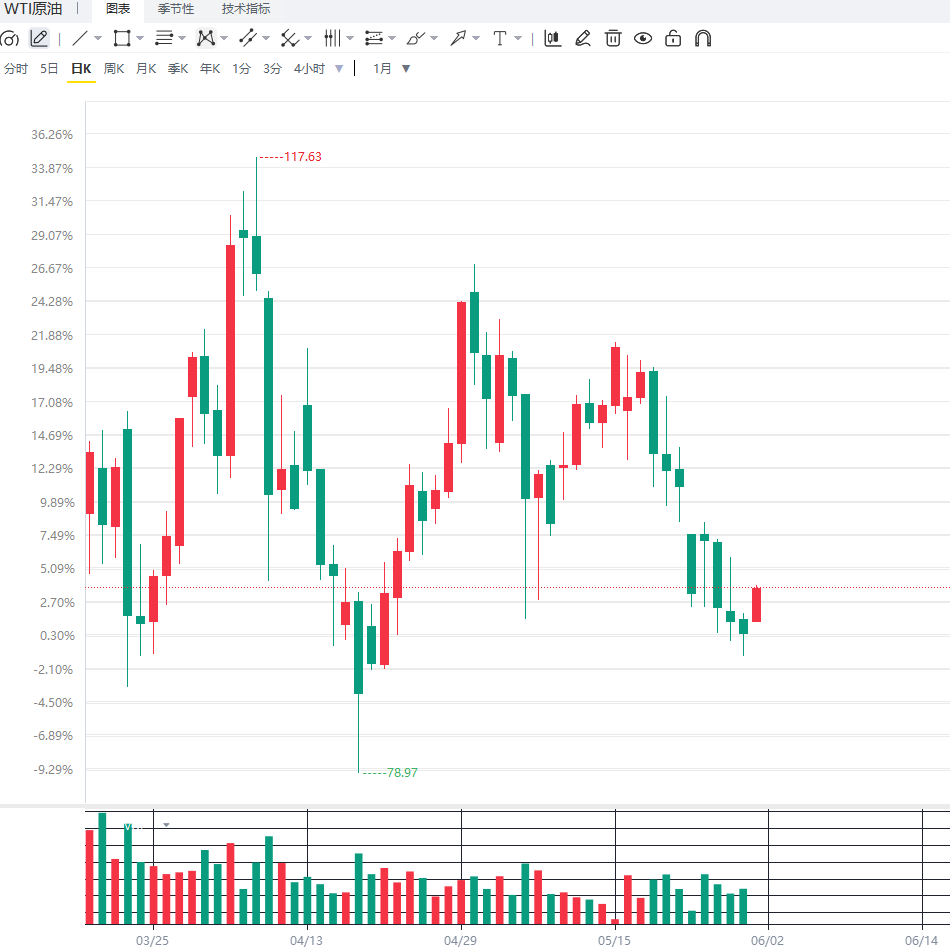
From the daily chart, international oil prices have recently rebounded from previous lows, but remain within a wide trading range. WTI crude oil is currently trading near $90, with the market testing a key resistance area. The $92 area constitutes a significant short-term resistance level, while the $86 area forms a core support zone. A break above $92 could lead to further gains towards $95 or even $98; a break below $86 could open up new downside potential. The RSI indicator is around 55, indicating some recovery in market momentum but no strong trend yet. The MACD indicator maintains a golden cross structure, but the expansion of the red bars is slowing, reflecting that upward momentum still needs further confirmation.
Editor's Summary : Goldman Sachs' latest report reveals the core contradiction facing the current crude oil market: the simultaneous existence of supply risks and weak demand. The Middle East situation continues to provide risk premium support for the market, but weakening European demand data indicates that global consumption growth is facing pressure. From the core market logic, the future direction of oil prices will depend more on the comparison between the rate of demand decline and the scale of supply losses. If the slowdown in demand exceeds the impact of supply contraction, oil prices may face downward pressure; conversely, if supply disruptions continue to expand, oil prices still have room for further increases. For investors, the market is currently entering a high-volatility phase, making it significantly more difficult to judge unilateral trends. News from both the supply and demand sides could become important factors triggering sharp price fluctuations. Going forward, it is crucial to focus on global economic data, developments in the Middle East situation, changes in crude oil inventories, and demand performance in major consuming regions. These factors will jointly determine whether international oil prices can maintain high levels in the fourth quarter and verify whether Goldman Sachs' $90 forecast needs further adjustment.
In a report released on May 31, Goldman Sachs’ head of commodities research, Daan Struve and his team pointed out that the latest oil sales data from Western Europe were weaker than expected, indicating that global energy consumption demand may be slowing further.
According to the report, Western European oil sales data for April indicates that Goldman Sachs' previous forecasts for global oil demand remained overly optimistic. The research team believes that their already relatively conservative demand forecast still faces a downside risk of approximately 2 million barrels per day.
This change has a significant impact on future oil price expectations. Goldman Sachs stated that if demand remains weak, its previous forecast of an average Brent crude oil price of $90 per barrel in the fourth quarter may face downward pressure of approximately $10. Currently, the market is in a phase of intense competition between supply and demand factors. On the one hand, the situation in the Middle East remains complex, particularly regarding the significant uncertainty surrounding supply recovery following the US-Iran conflict.
The Strait of Hormuz, one of the world's most important energy transport routes, handles approximately 20% of global seaborne crude oil shipments. Any risk of supply disruptions in the region could quickly drive up international oil prices. On the other hand, signs of slowing global economic growth are weakening demand for crude oil. European manufacturing activity remains sluggish, consumer spending growth is weak, and high energy prices themselves are suppressing the recovery of end-user demand.
Goldman Sachs analysts point out that the most significant characteristic of the current market is the simultaneous existence of supply and demand risks, both of which are highly uncertain. Goldman Sachs analysts stated, "We believe that Middle East supply losses could persist for a longer period, posing a significant upside price risk, but weak demand also presents a significant downside price risk. Actual end-user oil demand may decline more than expected due to rising prices."
From a market perspective, if supply disruptions in the Middle East last longer than expected, international crude oil inventories could decline rapidly, thereby driving up oil prices. However, if high oil prices persist for too long, they could further dampen consumer demand, creating a negative feedback loop.
This situation suggests that future oil price volatility may further increase. The market needs to pay attention not only to geopolitical developments but also to closely monitor changes in global economic activity and energy consumption.
Meanwhile, the maintenance of high interest rates by major central banks around the world is also putting pressure on energy demand. High financing costs and slowing economic growth are jointly affecting corporate investment and household consumption, thus indirectly impacting oil demand.
From an investor's perspective, the crude oil market has entered a new phase where supply shocks and demand adjustments are occurring simultaneously. Traditional methods that solely rely on supply risk to predict oil price trends are facing challenges.
From the daily chart, international oil prices have recently rebounded from previous lows, but remain within a wide trading range. WTI crude oil is currently trading near $90, with the market testing a key resistance area. The $92 area constitutes a significant short-term resistance level, while the $86 area forms a core support zone. A break above $92 could lead to further gains towards $95 or even $98; a break below $86 could open up new downside potential. The RSI indicator is around 55, indicating some recovery in market momentum but no strong trend yet. The MACD indicator maintains a golden cross structure, but the expansion of the red bars is slowing, reflecting that upward momentum still needs further confirmation.
Editor's Summary : Goldman Sachs' latest report reveals the core contradiction facing the current crude oil market: the simultaneous existence of supply risks and weak demand. The Middle East situation continues to provide risk premium support for the market, but weakening European demand data indicates that global consumption growth is facing pressure. From the core market logic, the future direction of oil prices will depend more on the comparison between the rate of demand decline and the scale of supply losses. If the slowdown in demand exceeds the impact of supply contraction, oil prices may face downward pressure; conversely, if supply disruptions continue to expand, oil prices still have room for further increases. For investors, the market is currently entering a high-volatility phase, making it significantly more difficult to judge unilateral trends. News from both the supply and demand sides could become important factors triggering sharp price fluctuations. Going forward, it is crucial to focus on global economic data, developments in the Middle East situation, changes in crude oil inventories, and demand performance in major consuming regions. These factors will jointly determine whether international oil prices can maintain high levels in the fourth quarter and verify whether Goldman Sachs' $90 forecast needs further adjustment.
- Risk Warning and Disclaimer
- The market involves risk, and trading may not be suitable for all investors. This article is for reference only and does not constitute personal investment advice, nor does it take into account certain users’ specific investment objectives, financial situation, or other needs. Any investment decisions made based on this information are at your own risk.