Gold Trading Alert: Two Major Negative Factors Cause Gold Prices to Plunge Nearly 2% at One Point; Can Trump "Turn the Tide"?
2026-06-02 07:51:42
On Monday (June 1st), spot gold prices fluctuated downwards, plunging nearly 2% at one point to a daily low of $4447.71 per ounce. This decline was driven by multiple factors. Firstly, the latest US ISM Manufacturing Purchasing Managers' Index for May was very strong, boosting the US dollar and putting direct pressure on dollar-denominated gold. Secondly, geopolitical tensions in the Middle East escalated again over the weekend: Israel intensified its military offensive in Lebanon, the US claimed to have struck Iranian military targets, and Tehran responded with an attack on a US military base. These escalating conflicts significantly increased market concerns about geopolitical risks, pushing international oil prices up by more than 8%, reaching a near one-week high. The surge in oil prices further exacerbated market concerns about the inflation outlook and reinforced investors' expectations that the Federal Reserve might continue to raise interest rates; these factors combined to suppress gold prices.
However, gold prices rebounded somewhat in the final trading session, ultimately closing near $4,485 per ounce. This was mainly due to comments made by US President Trump, who stated that Hezbollah and Israel had agreed not to attack each other. This statement warmed market expectations for peace in the Middle East, thus prompting gold prices to recover some lost ground. Looking ahead, investors will need to closely monitor the latest developments in the Middle East and a series of upcoming US economic data releases.
On Tuesday (June 2) in early Asian trading, spot gold traded in a narrow range, currently around $4,482 per ounce.

Data released by the Institute for Supply Management (ISM) shows that the ISM Manufacturing Index rose further to 54.0 in May from 52.7 in April. This marks the fifth consecutive month that the index has been in expansion territory and represents the highest reading since May 2022, clearly indicating that U.S. manufacturing activity is continuing to improve.
Looking at the sub-indices, the new orders index climbed from 54.1 to 56.8, indicating that downstream demand remains robust; while the employment index remains in contraction territory, recording 48.6, suggesting that employment in the manufacturing sector has not yet fully recovered.
Meanwhile, U.S. construction spending data for April also showed strong performance, rising 0.4% month-over-month to a seasonally adjusted annualized total of $2.172 trillion. Private residential construction spending rose 0.8%, while public construction spending increased by 0.4%.
These strong economic data further pressured metal prices, including gold. Continued improvement in factory activity and expansion in the construction sector indicate that the fundamentals of the US economy remain resilient, while uncertainty surrounding input costs remains closely linked to oil prices, tariff policies, and geopolitical risks in the Middle East.
Tensions between the US and Iran did not ease as the market had expected over the past weekend. The two sides failed to reach an agreement on reopening the Strait of Hormuz and instead launched military strikes against each other. Reports indicate that Iran suspended negotiations with the US following Israel's attack on Lebanon. Although President Trump later stated that discussions were continuing, market anxieties have escalated sharply.
As a result, US crude oil prices surged by as much as 8%, reaching $94.78 per barrel, the highest level in nearly a week. In terms of the direct impact on gold, the soaring oil prices had a negative ripple effect: higher energy prices exacerbated inflation expectations, which in turn pushed up US Treasury yields and supported a stronger dollar, all of which put downward pressure on gold.
While geopolitical conflict risks still marginally support defensive asset allocations for investors, the dominant factors at present are rising oil prices, stronger yields, and a stronger US dollar. In other financial markets, the clearest transmission chain includes rising oil prices, pressure on fuel-sensitive stocks, strength in the energy sector, and renewed volatility in shipping-related sectors.
According to the US, the US military struck Iranian military targets over the weekend. In response, Iran's Islamic Revolutionary Guard Corps announced on Monday that it had retaliated by striking a US military base. This series of exchanges is the latest confrontation between the two sides in the ongoing negotiations aimed at ending the three-month-long war.
The U.S. Central Command issued a statement on the social media platform X, stating that the strikes against targets off the Iranian coast in the Gulf were in response to "aggressive actions by Iran, including the downing of a U.S. MQ-1 drone operating over international waters." The statement further detailed that U.S. aircraft responded swiftly, destroying Iranian air defense systems, a ground control station, and two one-off attack drones that posed a clear threat to passing vessels.
The U.S. Central Command added that it will continue to protect U.S. assets and interests during the current ceasefire.
In response, Iran's Islamic Revolutionary Guard Corps said on Monday that it had struck an airbase used by the United States to attack southern Iran. Kuwait's national news agency, KUNA, reported that nationwide alerts were raised on Monday, and air defense systems successfully intercepted missiles and drones. It should be noted that a large U.S. military base is located in Kuwait.
Influenced by the aforementioned geopolitical situation and economic data, the US dollar index rose as much as 0.454% to a high of 99.38 on Monday; while gold prices fell nearly 2% to a low of $4,447.71.
However, market sentiment shifted towards the end of Monday's New York trading session. US President Trump posted on the social media platform Truth Social that Hezbollah and Israel had agreed to a truce. Following this news, both oil prices and the US dollar gave back some of their gains, but still closed up 5% and 0.26% respectively – US crude oil ultimately closed at $92.47 per barrel, and the dollar index closed at 99.19. Meanwhile, gold prices rebounded slightly to around $4485 per ounce, narrowing the day's losses to 1.2%.
In his post, Trump detailed that he had a productive call with Israeli Prime Minister Netanyahu, and that the U.S. would not send troops to Beirut, the Lebanese capital, with all troops en route to provide assistance withdrawn. He also stated that through a high-level envoy, he had successfully communicated with Hezbollah, reaching a comprehensive ceasefire agreement: Israel would not attack Hezbollah, and Hezbollah would cease attacks on Israel.
Subsequently, Hezbollah MP Hassan Fadrallah stated that his party supports a comprehensive ceasefire across the entire territory of Lebanon, and emphasized that achieving a comprehensive ceasefire is a prerequisite for the withdrawal of Israeli troops from all Lebanese territory.
However, Israeli Defense Minister Katz stated that Trump was employing the principle of reciprocity established by Israel, which stipulates that Israel will launch airstrikes against Beirut whenever there is a fire attack targeting Israeli settlements—he believes this is the core meaning of Trump's related statements.
Esmail Qaani, commander of the Quds Force of Iran's Islamic Revolutionary Guard Corps, stated firmly that Israel's aggression in Lebanon and the Gaza Strip was carried out with the undisguised support and protection of the United States. He argued that these actions would only further strengthen the "axis of resistance" and increase its support for these two fronts, while also prompting other fronts to begin operations.
Israeli National Security Minister Ben-Gwer publicly called on Prime Minister Netanyahu to reject the ceasefire agreement in Lebanon brokered by the United States, advocating for continued strikes against Hezbollah to effectively restore security and stability in northern Israel.
The Speaker of the Lebanese Parliament stated that Lebanon is determined to achieve a ceasefire nationwide, especially in the southern region. He added that if an agreement to end the conflict is reached between Iran and the United States, it will include a cessation of attacks on all fronts, with the Lebanese front being a key focus. He also stated that Lebanon will never forget the positive and constructive attitude that Iran has adopted during this sensitive period.
### (V) Trump expects the US and Iran to reach a memorandum of understanding within a week
According to an ABC News report on June 1st, US President Trump expressed optimism in a telephone interview. He stated that negotiations between the US and Iran were progressing "looked good, very good," and that while there had been some "minor hiccups," they had been quickly resolved. Trump anticipated that the two sides would reach a memorandum of understanding within the next week to extend the current ceasefire and push for the reopening of the Strait of Hormuz. However, he also noted that he had not yet approved the memorandum, and several details still needed to be finalized. Investors therefore need to continue to closely monitor further developments in the Middle East.
Last week's US inflation data indicated that price pressures remain stubbornly high, with rising energy costs playing a significant role. Higher oil prices, linked to Middle East tensions, are increasingly impacting broader inflation indicators. Traditionally, gold typically benefits from periods of uncertainty and inflation concerns. However, the current situation is unique in that persistently high inflation also reduces the likelihood of future interest rate cuts by the Federal Reserve. As markets continue to anticipate a prolonged period of restrictive monetary policy, higher bond yields and interest rates increase the opportunity cost of holding non-yielding assets like gold. As a result, the gold market is caught between two competing forces: on the one hand, geopolitical uncertainty continues to provide safe-haven support for gold prices; on the other hand, expectations of higher interest rates constitute a significant headwind.
This week, market focus will be on Friday's US non-farm payrolls report, likely the most influential economic data of the week. Investors will not only pay attention to the total number of jobs added, but also closely monitor sub-data such as wage growth and the unemployment rate for clues about the potential strength of the labor market. A stronger-than-expected non-farm payrolls report could further push up US Treasury yields and provide additional support for the dollar, thus putting downward pressure on gold prices. Conversely, weak data could reignite speculation about future policy easing and provide new upward momentum for gold. Against the backdrop of intertwined inflation concerns, geopolitical risks, and monetary policy expectations, the upcoming data will play a crucial role in determining whether gold can successfully stabilize after its recent pullback.
From a technical chart perspective, gold is currently exhibiting a hesitant stance. The area around $4,400 per ounce is the most crucial support level to watch. This area roughly coincides with the rising 200-day moving average of gold prices, a technical indicator that has provided effective support during past pullbacks. For most of the past two years, gold prices have comfortably traded above this long-term trendline, making recent tests of this support level particularly significant.
Historical precedent suggests we need to remain cautious: the last time gold prices clearly broke below the 200-day moving average was at the end of 2023, triggering a significant short-term decline before the bulls regained control. Since then, each test of the same indicator has produced a strong rebound, helping to maintain the overall bullish trend.
For now, the recent rebound suggests buyers remain prepared to defend this area. However, a clear break below $4,400 per ounce could significantly shift market sentiment and expose deeper support levels – first around $4,200, followed by the psychologically significant $4,000 level. On the upside, initial resistance is currently around $4,500, with a break above that level targeting the $4,640-$4,650 area, followed by the $4,570-$4,575 zone. A successful break above this area could refocus market attention on the $4,650 level.
In summary, the current gold market appears to be caught between two powerful narratives. On the one hand, ongoing geopolitical uncertainty in the Middle East continues to support demand for safe-haven assets; on the other hand, persistent inflationary pressures and the resulting high interest rate expectations limit the potential for sustained gold price increases. Until either of these themes establishes a clear dominant position, volatile price swings and range-bound trading are likely to remain the primary characteristics of the gold market, with an overall bias towards a slight downward trend. Investors need to closely monitor both the latest developments in the geopolitical situation and the release of US economic data (especially the non-farm payroll report) to make prudent judgments in this complex and volatile market environment.
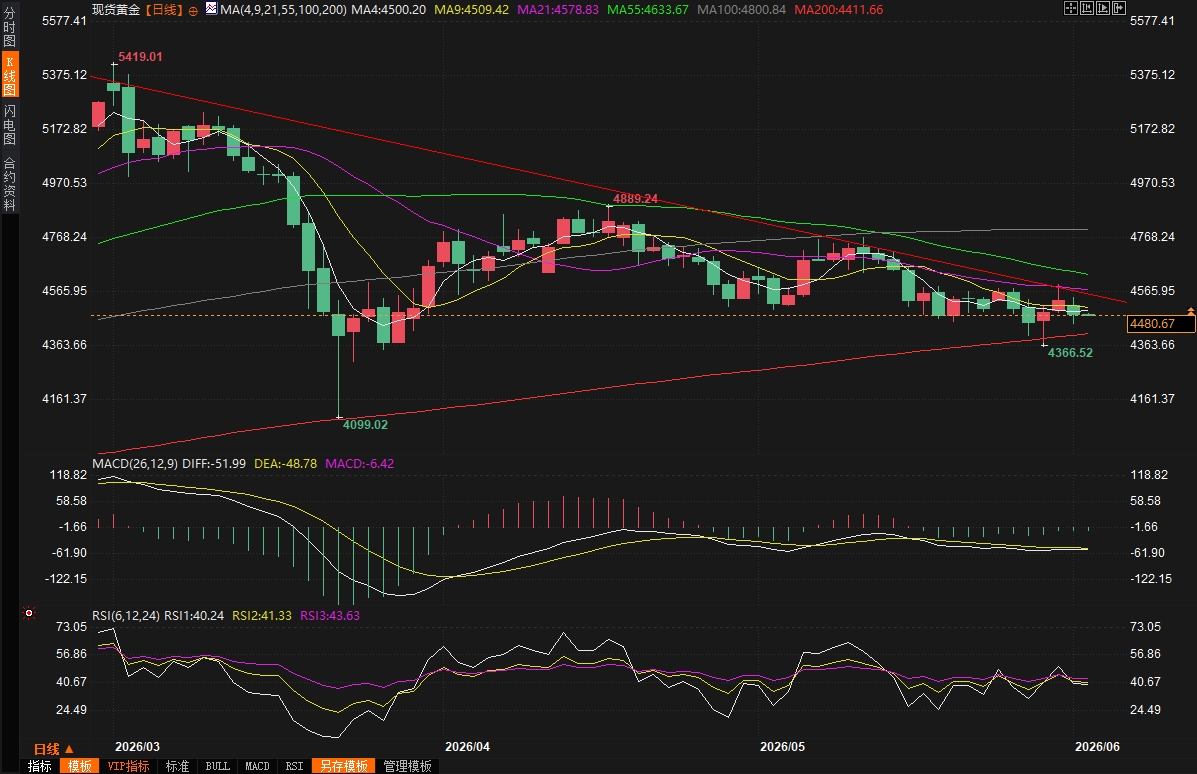
(Spot gold daily chart, source: FX678)
At 07:50 Beijing time, spot gold was trading at $4481.03 per ounce.
However, gold prices rebounded somewhat in the final trading session, ultimately closing near $4,485 per ounce. This was mainly due to comments made by US President Trump, who stated that Hezbollah and Israel had agreed not to attack each other. This statement warmed market expectations for peace in the Middle East, thus prompting gold prices to recover some lost ground. Looking ahead, investors will need to closely monitor the latest developments in the Middle East and a series of upcoming US economic data releases.
On Tuesday (June 2) in early Asian trading, spot gold traded in a narrow range, currently around $4,482 per ounce.
(i) Better-than-expected economic data and a stronger dollar put downward pressure on gold prices.
Data released by the Institute for Supply Management (ISM) shows that the ISM Manufacturing Index rose further to 54.0 in May from 52.7 in April. This marks the fifth consecutive month that the index has been in expansion territory and represents the highest reading since May 2022, clearly indicating that U.S. manufacturing activity is continuing to improve.
Looking at the sub-indices, the new orders index climbed from 54.1 to 56.8, indicating that downstream demand remains robust; while the employment index remains in contraction territory, recording 48.6, suggesting that employment in the manufacturing sector has not yet fully recovered.
Meanwhile, U.S. construction spending data for April also showed strong performance, rising 0.4% month-over-month to a seasonally adjusted annualized total of $2.172 trillion. Private residential construction spending rose 0.8%, while public construction spending increased by 0.4%.
These strong economic data further pressured metal prices, including gold. Continued improvement in factory activity and expansion in the construction sector indicate that the fundamentals of the US economy remain resilient, while uncertainty surrounding input costs remains closely linked to oil prices, tariff policies, and geopolitical risks in the Middle East.
(ii) A sudden escalation of geopolitical risks and a surge in oil prices indirectly put pressure on gold.
Tensions between the US and Iran did not ease as the market had expected over the past weekend. The two sides failed to reach an agreement on reopening the Strait of Hormuz and instead launched military strikes against each other. Reports indicate that Iran suspended negotiations with the US following Israel's attack on Lebanon. Although President Trump later stated that discussions were continuing, market anxieties have escalated sharply.
As a result, US crude oil prices surged by as much as 8%, reaching $94.78 per barrel, the highest level in nearly a week. In terms of the direct impact on gold, the soaring oil prices had a negative ripple effect: higher energy prices exacerbated inflation expectations, which in turn pushed up US Treasury yields and supported a stronger dollar, all of which put downward pressure on gold.
While geopolitical conflict risks still marginally support defensive asset allocations for investors, the dominant factors at present are rising oil prices, stronger yields, and a stronger US dollar. In other financial markets, the clearest transmission chain includes rising oil prices, pressure on fuel-sensitive stocks, strength in the energy sector, and renewed volatility in shipping-related sectors.
(III) Mutual attacks between the US and Iran escalate the military standoff.
According to the US, the US military struck Iranian military targets over the weekend. In response, Iran's Islamic Revolutionary Guard Corps announced on Monday that it had retaliated by striking a US military base. This series of exchanges is the latest confrontation between the two sides in the ongoing negotiations aimed at ending the three-month-long war.
The U.S. Central Command issued a statement on the social media platform X, stating that the strikes against targets off the Iranian coast in the Gulf were in response to "aggressive actions by Iran, including the downing of a U.S. MQ-1 drone operating over international waters." The statement further detailed that U.S. aircraft responded swiftly, destroying Iranian air defense systems, a ground control station, and two one-off attack drones that posed a clear threat to passing vessels.
The U.S. Central Command added that it will continue to protect U.S. assets and interests during the current ceasefire.
In response, Iran's Islamic Revolutionary Guard Corps said on Monday that it had struck an airbase used by the United States to attack southern Iran. Kuwait's national news agency, KUNA, reported that nationwide alerts were raised on Monday, and air defense systems successfully intercepted missiles and drones. It should be noted that a large U.S. military base is located in Kuwait.
Influenced by the aforementioned geopolitical situation and economic data, the US dollar index rose as much as 0.454% to a high of 99.38 on Monday; while gold prices fell nearly 2% to a low of $4,447.71.
(iv) Trump releases conciliatory signals, ceasefire expectations boost gold prices at the close.
However, market sentiment shifted towards the end of Monday's New York trading session. US President Trump posted on the social media platform Truth Social that Hezbollah and Israel had agreed to a truce. Following this news, both oil prices and the US dollar gave back some of their gains, but still closed up 5% and 0.26% respectively – US crude oil ultimately closed at $92.47 per barrel, and the dollar index closed at 99.19. Meanwhile, gold prices rebounded slightly to around $4485 per ounce, narrowing the day's losses to 1.2%.
In his post, Trump detailed that he had a productive call with Israeli Prime Minister Netanyahu, and that the U.S. would not send troops to Beirut, the Lebanese capital, with all troops en route to provide assistance withdrawn. He also stated that through a high-level envoy, he had successfully communicated with Hezbollah, reaching a comprehensive ceasefire agreement: Israel would not attack Hezbollah, and Hezbollah would cease attacks on Israel.
Subsequently, Hezbollah MP Hassan Fadrallah stated that his party supports a comprehensive ceasefire across the entire territory of Lebanon, and emphasized that achieving a comprehensive ceasefire is a prerequisite for the withdrawal of Israeli troops from all Lebanese territory.
However, Israeli Defense Minister Katz stated that Trump was employing the principle of reciprocity established by Israel, which stipulates that Israel will launch airstrikes against Beirut whenever there is a fire attack targeting Israeli settlements—he believes this is the core meaning of Trump's related statements.
Esmail Qaani, commander of the Quds Force of Iran's Islamic Revolutionary Guard Corps, stated firmly that Israel's aggression in Lebanon and the Gaza Strip was carried out with the undisguised support and protection of the United States. He argued that these actions would only further strengthen the "axis of resistance" and increase its support for these two fronts, while also prompting other fronts to begin operations.
Israeli National Security Minister Ben-Gwer publicly called on Prime Minister Netanyahu to reject the ceasefire agreement in Lebanon brokered by the United States, advocating for continued strikes against Hezbollah to effectively restore security and stability in northern Israel.
The Speaker of the Lebanese Parliament stated that Lebanon is determined to achieve a ceasefire nationwide, especially in the southern region. He added that if an agreement to end the conflict is reached between Iran and the United States, it will include a cessation of attacks on all fronts, with the Lebanese front being a key focus. He also stated that Lebanon will never forget the positive and constructive attitude that Iran has adopted during this sensitive period.
### (V) Trump expects the US and Iran to reach a memorandum of understanding within a week
According to an ABC News report on June 1st, US President Trump expressed optimism in a telephone interview. He stated that negotiations between the US and Iran were progressing "looked good, very good," and that while there had been some "minor hiccups," they had been quickly resolved. Trump anticipated that the two sides would reach a memorandum of understanding within the next week to extend the current ceasefire and push for the reopening of the Strait of Hormuz. However, he also noted that he had not yet approved the memorandum, and several details still needed to be finalized. Investors therefore need to continue to closely monitor further developments in the Middle East.
(vi) Economic data becomes the focus; the non-farm payroll report may determine the short-term direction.
Last week's US inflation data indicated that price pressures remain stubbornly high, with rising energy costs playing a significant role. Higher oil prices, linked to Middle East tensions, are increasingly impacting broader inflation indicators. Traditionally, gold typically benefits from periods of uncertainty and inflation concerns. However, the current situation is unique in that persistently high inflation also reduces the likelihood of future interest rate cuts by the Federal Reserve. As markets continue to anticipate a prolonged period of restrictive monetary policy, higher bond yields and interest rates increase the opportunity cost of holding non-yielding assets like gold. As a result, the gold market is caught between two competing forces: on the one hand, geopolitical uncertainty continues to provide safe-haven support for gold prices; on the other hand, expectations of higher interest rates constitute a significant headwind.
This week, market focus will be on Friday's US non-farm payrolls report, likely the most influential economic data of the week. Investors will not only pay attention to the total number of jobs added, but also closely monitor sub-data such as wage growth and the unemployment rate for clues about the potential strength of the labor market. A stronger-than-expected non-farm payrolls report could further push up US Treasury yields and provide additional support for the dollar, thus putting downward pressure on gold prices. Conversely, weak data could reignite speculation about future policy easing and provide new upward momentum for gold. Against the backdrop of intertwined inflation concerns, geopolitical risks, and monetary policy expectations, the upcoming data will play a crucial role in determining whether gold can successfully stabilize after its recent pullback.
(VII) Gold Technical Forecast: $4,400 Support Level Becomes a Watershed Between Bullish and Bearish Trends
From a technical chart perspective, gold is currently exhibiting a hesitant stance. The area around $4,400 per ounce is the most crucial support level to watch. This area roughly coincides with the rising 200-day moving average of gold prices, a technical indicator that has provided effective support during past pullbacks. For most of the past two years, gold prices have comfortably traded above this long-term trendline, making recent tests of this support level particularly significant.
Historical precedent suggests we need to remain cautious: the last time gold prices clearly broke below the 200-day moving average was at the end of 2023, triggering a significant short-term decline before the bulls regained control. Since then, each test of the same indicator has produced a strong rebound, helping to maintain the overall bullish trend.
For now, the recent rebound suggests buyers remain prepared to defend this area. However, a clear break below $4,400 per ounce could significantly shift market sentiment and expose deeper support levels – first around $4,200, followed by the psychologically significant $4,000 level. On the upside, initial resistance is currently around $4,500, with a break above that level targeting the $4,640-$4,650 area, followed by the $4,570-$4,575 zone. A successful break above this area could refocus market attention on the $4,650 level.
Summary: The tug-of-war between bulls and bears continues, and violent fluctuations may become the norm.
In summary, the current gold market appears to be caught between two powerful narratives. On the one hand, ongoing geopolitical uncertainty in the Middle East continues to support demand for safe-haven assets; on the other hand, persistent inflationary pressures and the resulting high interest rate expectations limit the potential for sustained gold price increases. Until either of these themes establishes a clear dominant position, volatile price swings and range-bound trading are likely to remain the primary characteristics of the gold market, with an overall bias towards a slight downward trend. Investors need to closely monitor both the latest developments in the geopolitical situation and the release of US economic data (especially the non-farm payroll report) to make prudent judgments in this complex and volatile market environment.
(Spot gold daily chart, source: FX678)
At 07:50 Beijing time, spot gold was trading at $4481.03 per ounce.
- Risk Warning and Disclaimer
- The market involves risk, and trading may not be suitable for all investors. This article is for reference only and does not constitute personal investment advice, nor does it take into account certain users’ specific investment objectives, financial situation, or other needs. Any investment decisions made based on this information are at your own risk.