Japanese bond yields surged to levels not seen since 1997, so why did the yen fall instead of rise?
2026-06-02 19:53:54
Currently, the USD/JPY pair is just a step away from the traditional Japanese intervention level of 160, and yen shorts should still be aware of the risks.
Japanese government bond yields across all maturities have risen sharply, with the 10-year yield reaching a high of 2.590%, the highest since 1997, and the 20-year yield touching 3.495%. Multiple internal and external factors have pushed up long-term interest rates, but instead of helping the yen appreciate, they have accelerated its depreciation.
Internally, the expansionary fiscal policy of the Sanae Takaichi government has led to an increase in the supply of newly issued government bonds, and the market is worried about the sustainability of debt (Japan's public debt has exceeded 260% of GDP). Investors are demanding a higher risk premium, and the concern about the unsustainability of debt is putting downward pressure on the yen.
From an external perspective, the interest rate differential between the US and Japan remained at 200-250 basis points, with global funds selling Japanese bonds and buying US bonds. This, coupled with the overall rise in global bond yields, created a significant external pull.
In addition, the Bank of Japan's debt reduction process, which began in 2024, reduced official demand for bonds, which put pressure on Japanese bonds. Meanwhile, the upward shift in the inflation center has completely changed the pricing logic of long-term interest rates, further amplifying the upward pressure on yields.
Against this backdrop, the debate over the Bank of Japan's debt reduction continues to intensify, with the latest institutional survey minutes showing significant differences in market opinions on the pace of reduction.
Dovish views held a slight advantage, with most institutions believing there was no need to further reduce debt and advocating for maintaining the monthly bond purchase scale of 2.1 trillion yen to ensure liquidity supply during the economic expansion period.
Some institutions favor a gradual reduction, proposing a cut of 100 billion yen per quarter, gradually decreasing to 1.7 trillion yen per month;
Hawks, on the other hand, believe that the bond-buying tool has fulfilled its policy mission and suggest that monthly bond purchases be reduced to 1.3 trillion yen or even eliminated in the medium to long term.
According to the current plan, the Bank of Japan plans to reduce its monthly bond purchases by 200 billion yen per quarter, down to 2.1 trillion yen in the first quarter of 2027. However, the upcoming monetary policy meeting will revise the details after fiscal year 2026, and the market generally expects the pace of bond reduction to be significantly slower than previously anticipated.
For the Bank of Japan, current decision-making is under triple pressure: on the one hand, in order to restore market-based pricing in the bond market and reduce the central bank's monopolistic holdings of Japanese government bonds (holding ratio exceeding 50%), continued bond reduction is imperative;
On the other hand, aggressive debt reduction may lead to a further surge in yields, pushing up the government's interest costs (for every 1 percentage point increase in the benchmark interest rate, the annual interest burden will increase to the trillion-yen level), tightening the credit environment and triggering risks in the bond market. The previous insufficient subscription and abnormal yield fluctuations in ultra-long-term government bonds have already sounded the alarm.
This dilemma makes it highly likely that the central bank will adopt a gradual strategy, flexibly balancing interest rate hikes, bond purchases, and foreign exchange market intervention.
In the currency market, the Japanese yen is facing multiple pressures and challenges.
The USD/JPY exchange rate is gradually approaching the important psychological level of 160, and the net short positions of the yen held by asset management institutions and hedge funds have hit a new high since July 2024.
Japanese authorities have cumulatively used 11.7 trillion yen (approximately US$74 billion) of foreign exchange reserves to intervene in the foreign exchange market, exceeding market expectations. Finance Minister Satsuki Katayama has clearly stated that Japan will deal with sharp fluctuations and malicious speculation, and the market is bracing for a new round of battle between bulls and bears.
From a fundamental perspective, the core of the pressure on the yen lies in the interest rate differential between the US and Japan and the policy divergence: the probability of the Federal Reserve raising interest rates in 2026 is still 50%, and although it has not closed the door to interest rate cuts, short-term interest rates remain high;
The Bank of Japan's cautious approach to reducing its bond holdings and its delayed interest rate hikes have further solidified the space for carry trades, creating a vicious cycle of "Japanese bond sell-offs - yen depreciation".
Although theoretically rising Japanese bond yields should help narrow interest rate differentials and support the yen, the market is more concerned about economic and fiscal deterioration, and in reality, the yen has continued to be under pressure.
This is actually quite interesting. On the one hand, the government has a strong desire to intervene in the depreciation of the yen. On the other hand, as a major exporting country, Japan believes that depreciation will enhance the competitiveness of its export companies.
Meanwhile, I suspect that the Bank of Japan does not want to raise interest rates, because even though Bessant said it several times, the Bank of Japan still did not choose to raise interest rates.
Kazuo Ueda will be giving a speech tomorrow. We can see if his remarks confirm our speculations, provide reasons for not raising interest rates, and support the argument that the yen will not continue to depreciate.
Looking ahead, the Bank of Japan's interest rate path is highly correlated with the yen's exchange rate. If persistently high inflation forces the central bank to accelerate interest rate hikes and debt reduction, the US-Japan interest rate differential may narrow in the short term, giving the yen a rebound momentum, but it will have to bear the risks of economic pain and bond market volatility.
If the government maintains an easing policy to stabilize the bond market and the economy, the pressure on the yen to depreciate may continue, and the intervention and negotiation at the 160 level will be a key point to watch.
As we analyzed before, the appreciation of the yen caused by central bank intervention will eventually be depreciated back to the market. Currently, the USD/JPY pair has stabilized above the middle line of the upward channel, just a step away from the 160 point mark. Technically, it is still expected to continue to rebound. This is a contest between the market and central bank intervention.
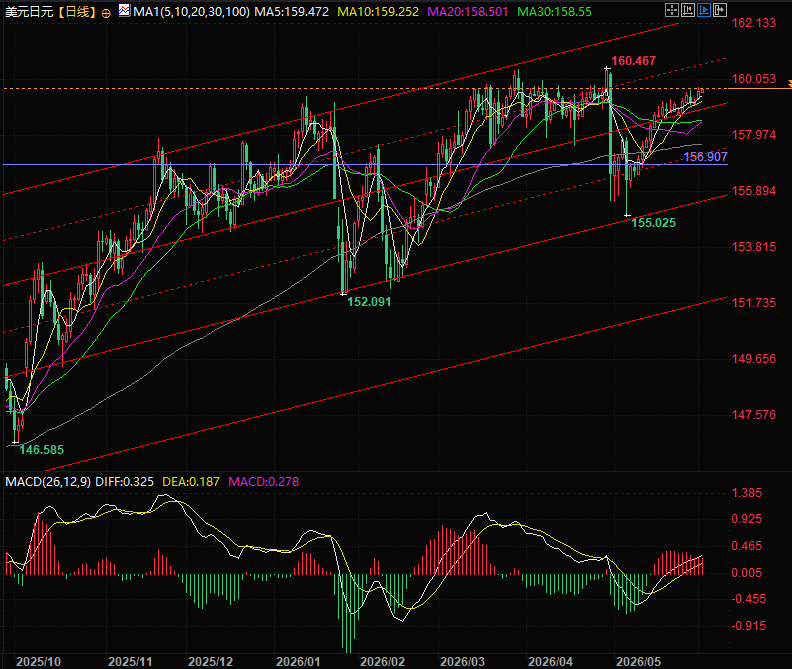
(USD/JPY daily chart, source: FX678)
At 19:49 Beijing time, the USD/JPY exchange rate is currently at 159.72.
Japanese government bond yields across all maturities have risen sharply, with the 10-year yield reaching a high of 2.590%, the highest since 1997, and the 20-year yield touching 3.495%. Multiple internal and external factors have pushed up long-term interest rates, but instead of helping the yen appreciate, they have accelerated its depreciation.
Internally, the expansionary fiscal policy of the Sanae Takaichi government has led to an increase in the supply of newly issued government bonds, and the market is worried about the sustainability of debt (Japan's public debt has exceeded 260% of GDP). Investors are demanding a higher risk premium, and the concern about the unsustainability of debt is putting downward pressure on the yen.
From an external perspective, the interest rate differential between the US and Japan remained at 200-250 basis points, with global funds selling Japanese bonds and buying US bonds. This, coupled with the overall rise in global bond yields, created a significant external pull.
In addition, the Bank of Japan's debt reduction process, which began in 2024, reduced official demand for bonds, which put pressure on Japanese bonds. Meanwhile, the upward shift in the inflation center has completely changed the pricing logic of long-term interest rates, further amplifying the upward pressure on yields.
Debt contraction game: Market divergence is significant, with doves slightly ahead.
Against this backdrop, the debate over the Bank of Japan's debt reduction continues to intensify, with the latest institutional survey minutes showing significant differences in market opinions on the pace of reduction.
Dovish views held a slight advantage, with most institutions believing there was no need to further reduce debt and advocating for maintaining the monthly bond purchase scale of 2.1 trillion yen to ensure liquidity supply during the economic expansion period.
Some institutions favor a gradual reduction, proposing a cut of 100 billion yen per quarter, gradually decreasing to 1.7 trillion yen per month;
Hawks, on the other hand, believe that the bond-buying tool has fulfilled its policy mission and suggest that monthly bond purchases be reduced to 1.3 trillion yen or even eliminated in the medium to long term.
According to the current plan, the Bank of Japan plans to reduce its monthly bond purchases by 200 billion yen per quarter, down to 2.1 trillion yen in the first quarter of 2027. However, the upcoming monetary policy meeting will revise the details after fiscal year 2026, and the market generally expects the pace of bond reduction to be significantly slower than previously anticipated.
Central Bank Dilemma: Gradual Choices Under Triple Pressures
For the Bank of Japan, current decision-making is under triple pressure: on the one hand, in order to restore market-based pricing in the bond market and reduce the central bank's monopolistic holdings of Japanese government bonds (holding ratio exceeding 50%), continued bond reduction is imperative;
On the other hand, aggressive debt reduction may lead to a further surge in yields, pushing up the government's interest costs (for every 1 percentage point increase in the benchmark interest rate, the annual interest burden will increase to the trillion-yen level), tightening the credit environment and triggering risks in the bond market. The previous insufficient subscription and abnormal yield fluctuations in ultra-long-term government bonds have already sounded the alarm.
This dilemma makes it highly likely that the central bank will adopt a gradual strategy, flexibly balancing interest rate hikes, bond purchases, and foreign exchange market intervention.
Currency Game: Yen Under Pressure Approaches Key Level, Intervention Expectations Rise
In the currency market, the Japanese yen is facing multiple pressures and challenges.
The USD/JPY exchange rate is gradually approaching the important psychological level of 160, and the net short positions of the yen held by asset management institutions and hedge funds have hit a new high since July 2024.
Japanese authorities have cumulatively used 11.7 trillion yen (approximately US$74 billion) of foreign exchange reserves to intervene in the foreign exchange market, exceeding market expectations. Finance Minister Satsuki Katayama has clearly stated that Japan will deal with sharp fluctuations and malicious speculation, and the market is bracing for a new round of battle between bulls and bears.
From a fundamental perspective, the core of the pressure on the yen lies in the interest rate differential between the US and Japan and the policy divergence: the probability of the Federal Reserve raising interest rates in 2026 is still 50%, and although it has not closed the door to interest rate cuts, short-term interest rates remain high;
The Bank of Japan's cautious approach to reducing its bond holdings and its delayed interest rate hikes have further solidified the space for carry trades, creating a vicious cycle of "Japanese bond sell-offs - yen depreciation".
Although theoretically rising Japanese bond yields should help narrow interest rate differentials and support the yen, the market is more concerned about economic and fiscal deterioration, and in reality, the yen has continued to be under pressure.
Summary and Technical Analysis:
This is actually quite interesting. On the one hand, the government has a strong desire to intervene in the depreciation of the yen. On the other hand, as a major exporting country, Japan believes that depreciation will enhance the competitiveness of its export companies.
Meanwhile, I suspect that the Bank of Japan does not want to raise interest rates, because even though Bessant said it several times, the Bank of Japan still did not choose to raise interest rates.
Kazuo Ueda will be giving a speech tomorrow. We can see if his remarks confirm our speculations, provide reasons for not raising interest rates, and support the argument that the yen will not continue to depreciate.
Looking ahead, the Bank of Japan's interest rate path is highly correlated with the yen's exchange rate. If persistently high inflation forces the central bank to accelerate interest rate hikes and debt reduction, the US-Japan interest rate differential may narrow in the short term, giving the yen a rebound momentum, but it will have to bear the risks of economic pain and bond market volatility.
If the government maintains an easing policy to stabilize the bond market and the economy, the pressure on the yen to depreciate may continue, and the intervention and negotiation at the 160 level will be a key point to watch.
As we analyzed before, the appreciation of the yen caused by central bank intervention will eventually be depreciated back to the market. Currently, the USD/JPY pair has stabilized above the middle line of the upward channel, just a step away from the 160 point mark. Technically, it is still expected to continue to rebound. This is a contest between the market and central bank intervention.
(USD/JPY daily chart, source: FX678)
At 19:49 Beijing time, the USD/JPY exchange rate is currently at 159.72.
- Risk Warning and Disclaimer
- The market involves risk, and trading may not be suitable for all investors. This article is for reference only and does not constitute personal investment advice, nor does it take into account certain users’ specific investment objectives, financial situation, or other needs. Any investment decisions made based on this information are at your own risk.