













Gold prices are constrained by the 50-day and 200-day moving averages; funds are expected to return to gold after the Iranian conflict de-escalates.
2026-06-03 02:10:36
International gold prices fell in May due to geopolitical conflicts with Iran: geopolitical conflicts pushed up US Treasury yields and the US dollar index, while market expectations for interest rate cuts cooled in tandem; however, the four fundamental factors of huge debt risks, the de-dollarization process, inflation stickiness, and continued gold purchases by central banks around the world remain important supports for gold prices, with only some countries selling gold in the short term due to energy expenditure pressures.

Gold prices fell for the third consecutive month in May. He pointed out, "Even with the recent pullback in gold prices, the year-to-date increase for gold in 2026 is still 5%, with a cumulative increase of 36% over the past year and a staggering 91% over the past two years."
The continued tension in the Strait of Hormuz, coupled with persistently high prices for crude oil, natural gas, and refined oil products, has become a negative factor suppressing gold prices.
Rising energy prices failed to trigger traditional safe-haven buying; instead, they exacerbated inflation concerns, raised US Treasury yields, and boosted the dollar, leading to a downward revision of market expectations for a Federal Reserve rate cut. This confluence of factors significantly weighed on non-interest-bearing assets like gold.
This round of gold price adjustments coincided with global stock markets hitting record highs; at the same time, some central banks had to reduce their gold reserves to stabilize their currencies and offset high energy expenditures.
Saxo Bank's Hansen stated, "This recent decline in gold prices once again exposes a key logic that ordinary investors often overlook: although gold is generally regarded as an inflation hedge, the causes of inflation directly determine the performance of gold prices."
Historical patterns show that during economic downturns or periods of financial crisis, rising inflation coupled with declining real yields and a weakening dollar often leads to strong gold prices. However, the current situation is quite different: supply-side driven energy inflation is simultaneously pushing up prices and supporting yields and the dollar. Under this combination, even with rising inflation, gold prices are likely to face short-term downward pressure.
Currently, funds in the precious metals market are closely watching the Federal Reserve's interest rate direction. Rising US Treasury yields and a decreased probability of interest rate cuts are directly dragging down gold's performance.
Hansen stated, "However, the negative impact of interest rates is unlikely to dominate gold price trends in the long term. Once the geopolitical situation in the Middle East eases and the energy price surge gradually subsides, funds will return to the core medium- to long-term logic that has supported the gold bull market over the past few years."
The central bank's continued diversified gold purchases are the core support.
The short-term reduction in gold holdings by some countries is mostly a tactical portfolio adjustment, not a long-term strategic shift; the global trend of diversification of foreign exchange reserves has not changed, especially since the proportion of gold reserves held by central banks in emerging markets is far lower than that of developed economies, leaving ample room for them to increase their holdings.
The Russia-Ukraine conflict and the US-Iran standoff have further solidified the strategic value of gold for various countries. Constrained by the risks of unilateral sanctions, the need for diversification of foreign exchange reserves, fiscal pressures, and concerns about long-term currency depreciation, many central banks are continuing to reduce their reliance on traditional reserve assets such as the US dollar. Global central banks are expected to maintain net gold purchases in the coming year.
China's physical and investment demand supports gold prices.
Domestic investment demand fluctuates with market sentiment, but residents' investment strategies are gradually shifting from real estate and fixed-income wealth management products to gold, resulting in stable long-term demand for physical gold purchases. The People's Bank of China increased its gold reserves for the sixth consecutive month in April, driving up gold imports via Hong Kong to 58.6 tons month-on-month and more than double year-on-year.
The global high debt environment benefits gold's value preservation properties.
With the fiscal deficits and government debt of major economies continuing to expand, coupled with the huge capital expenditures brought about by the transformation to new energy, the implementation of artificial intelligence, energy self-sufficiency, and climate governance, the demand for commodities and the long-term inflation center are more likely to rise than fall, and the demand for hedging continues to benefit physical assets such as gold.
Technical Analysis
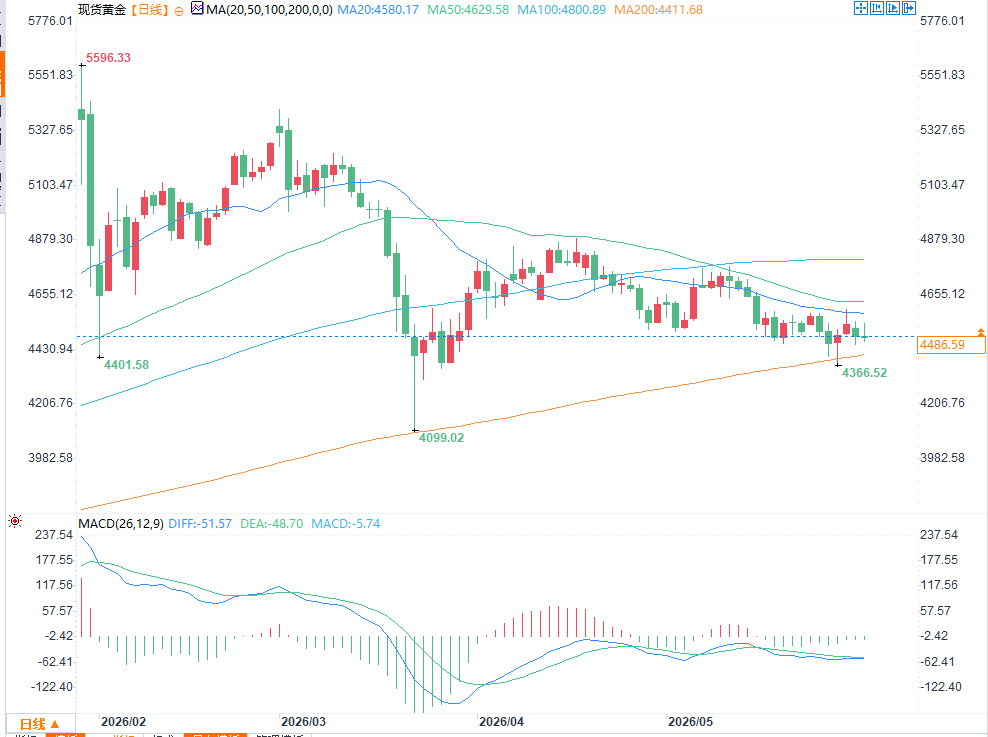
(Spot gold daily chart source: FX678)
From a technical perspective, gold prices have repeatedly found support near the 200-day moving average (currently around $4,400/ounce). During this pullback, the price tested this moving average twice, attracting bargain hunters each time. While short-term gold prices may still experience some downward volatility, long-term funds are continuously entering the market at lower levels, indicating strong support.
At present, most investors choose to wait and see before increasing their gold holdings; however, as the market is no longer swayed by intraday oil price fluctuations and sudden geopolitical news, funds will once again focus on the medium- to long-term positive logic of gold.
The long-term outlook for gold is bullish. If the diversification of global foreign exchange reserves, fiscal expansion, and the trend of de-dollarization continue to accelerate, the upside potential for gold prices will further expand.
Gold prices fell for the third consecutive month in May. He pointed out, "Even with the recent pullback in gold prices, the year-to-date increase for gold in 2026 is still 5%, with a cumulative increase of 36% over the past year and a staggering 91% over the past two years."
The continued tension in the Strait of Hormuz, coupled with persistently high prices for crude oil, natural gas, and refined oil products, has become a negative factor suppressing gold prices.
Rising energy prices failed to trigger traditional safe-haven buying; instead, they exacerbated inflation concerns, raised US Treasury yields, and boosted the dollar, leading to a downward revision of market expectations for a Federal Reserve rate cut. This confluence of factors significantly weighed on non-interest-bearing assets like gold.
This round of gold price adjustments coincided with global stock markets hitting record highs; at the same time, some central banks had to reduce their gold reserves to stabilize their currencies and offset high energy expenditures.
Saxo Bank's Hansen stated, "This recent decline in gold prices once again exposes a key logic that ordinary investors often overlook: although gold is generally regarded as an inflation hedge, the causes of inflation directly determine the performance of gold prices."
Historical patterns show that during economic downturns or periods of financial crisis, rising inflation coupled with declining real yields and a weakening dollar often leads to strong gold prices. However, the current situation is quite different: supply-side driven energy inflation is simultaneously pushing up prices and supporting yields and the dollar. Under this combination, even with rising inflation, gold prices are likely to face short-term downward pressure.
Currently, funds in the precious metals market are closely watching the Federal Reserve's interest rate direction. Rising US Treasury yields and a decreased probability of interest rate cuts are directly dragging down gold's performance.
Hansen stated, "However, the negative impact of interest rates is unlikely to dominate gold price trends in the long term. Once the geopolitical situation in the Middle East eases and the energy price surge gradually subsides, funds will return to the core medium- to long-term logic that has supported the gold bull market over the past few years."
The central bank's continued diversified gold purchases are the core support.
The short-term reduction in gold holdings by some countries is mostly a tactical portfolio adjustment, not a long-term strategic shift; the global trend of diversification of foreign exchange reserves has not changed, especially since the proportion of gold reserves held by central banks in emerging markets is far lower than that of developed economies, leaving ample room for them to increase their holdings.
The Russia-Ukraine conflict and the US-Iran standoff have further solidified the strategic value of gold for various countries. Constrained by the risks of unilateral sanctions, the need for diversification of foreign exchange reserves, fiscal pressures, and concerns about long-term currency depreciation, many central banks are continuing to reduce their reliance on traditional reserve assets such as the US dollar. Global central banks are expected to maintain net gold purchases in the coming year.
China's physical and investment demand supports gold prices.
Domestic investment demand fluctuates with market sentiment, but residents' investment strategies are gradually shifting from real estate and fixed-income wealth management products to gold, resulting in stable long-term demand for physical gold purchases. The People's Bank of China increased its gold reserves for the sixth consecutive month in April, driving up gold imports via Hong Kong to 58.6 tons month-on-month and more than double year-on-year.
The global high debt environment benefits gold's value preservation properties.
With the fiscal deficits and government debt of major economies continuing to expand, coupled with the huge capital expenditures brought about by the transformation to new energy, the implementation of artificial intelligence, energy self-sufficiency, and climate governance, the demand for commodities and the long-term inflation center are more likely to rise than fall, and the demand for hedging continues to benefit physical assets such as gold.
Technical Analysis
(Spot gold daily chart source: FX678)
From a technical perspective, gold prices have repeatedly found support near the 200-day moving average (currently around $4,400/ounce). During this pullback, the price tested this moving average twice, attracting bargain hunters each time. While short-term gold prices may still experience some downward volatility, long-term funds are continuously entering the market at lower levels, indicating strong support.
At present, most investors choose to wait and see before increasing their gold holdings; however, as the market is no longer swayed by intraday oil price fluctuations and sudden geopolitical news, funds will once again focus on the medium- to long-term positive logic of gold.
The long-term outlook for gold is bullish. If the diversification of global foreign exchange reserves, fiscal expansion, and the trend of de-dollarization continue to accelerate, the upside potential for gold prices will further expand.
- Risk Warning and Disclaimer
- The market involves risk, and trading may not be suitable for all investors. This article is for reference only and does not constitute personal investment advice, nor does it take into account certain users’ specific investment objectives, financial situation, or other needs. Any investment decisions made based on this information are at your own risk.

