A sharp drop in inventories coupled with a stalemate in the war has pushed oil prices toward $100.
2026-06-04 01:05:41
The EIA weekly inventory data released on Wednesday became the strongest catalyst for the market that day. For the week ending May 29, U.S. commercial crude oil inventories plummeted by 8 million barrels to 433.7 million barrels, far exceeding analysts' expectations of a 4 million barrel drop and rewriting the record for the largest weekly decline this year.
This outcome was driven by a simultaneous surge in both exports and refinery demand. Weekly oil exports reached 5.9 million barrels per day, the second-highest level on record, leading to a weekly decrease of 6.7 million barrels in Gulf Coast storage areas. Meanwhile, refinery utilization rates rose to 94.7%, indicating that downstream demand is operating at high intensity. Inventories at Cushing, Oklahoma—the WTI futures pricing hub—also shrank further by 583,000 barrels to 22.4 million barrels.
Of particular concern is the continued depletion of the Strategic Petroleum Reserve (SPR). The SPR decreased by another 8 million barrels this week, reaching its lowest point since January 2024. This oil is part of the 172 million barrels of emergency reserves released by the US government in response to soaring oil prices. Matt Smith, head of commodities research at Kpler, precisely breaks this down: although a significant portion of the crude oil released by the SPR flowed into commercial inventories, commercial inventories still saw a net decrease of 8 million barrels—meaning that the actual shrinkage in total crude oil inventories reached as high as 16 million barrels. Since the start of the joint US-Israeli operation against Iraq on February 28, US crude oil inventories have cumulatively decreased by approximately 63.9 million barrels. These four months of figures outline the complete picture of a structural tightening of wartime supply.
"SPR crude oil continued to decline from inventories, decreasing by another 8 million barrels last week. Despite a significant transfer of crude oil to commercial inventories, commercial inventories still decreased by 8 million barrels—meaning total crude oil inventories decreased by 16 million barrels."
Geopolitics
The conflict in Iran is the fundamental narrative behind this round of crude oil price movements. The conflict has lasted for four months, and there have been no signs of substantive negotiations between the US and Iran. Major buyers in Asia and Europe continue to seek alternative supply channels to replace the blocked oil flows from the Middle East. This is the direct reason why US exports have remained at historically high levels, and also the underlying logic behind this week's unexpected inventory decline. Brent crude oil has historically been more sensitive to the situation in Iran than WTI, and the persistent price difference between the two is itself a pricing reflection of a geopolitical premium. As long as the negotiating table remains empty, this premium will be difficult to dissipate.
Technical Analysis
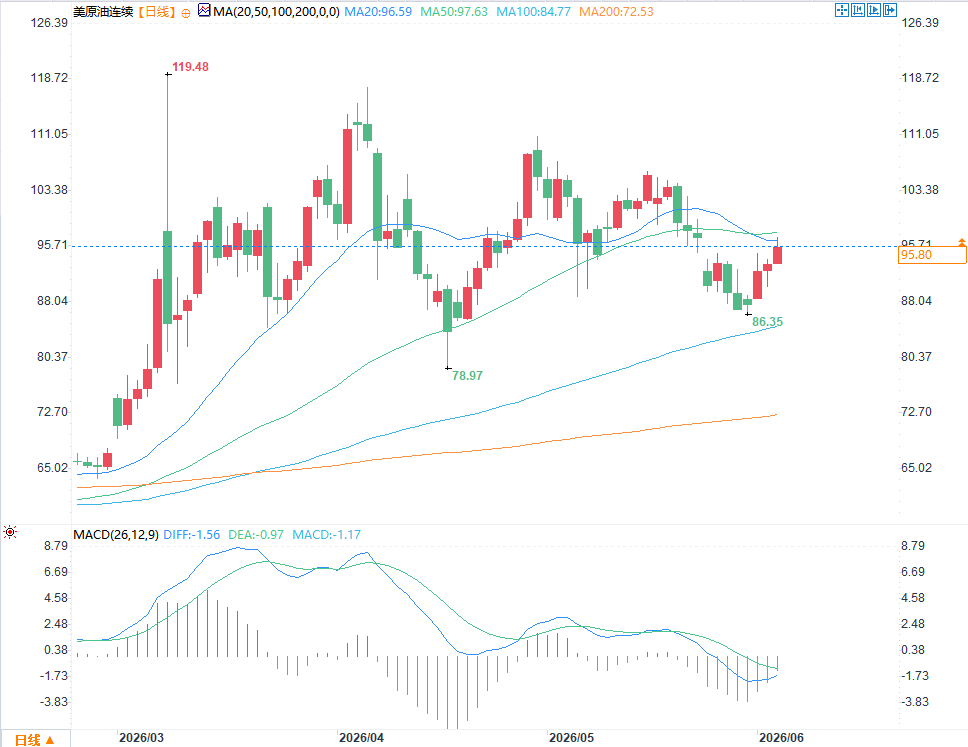
(WTI crude oil daily chart source: FX678)
From a price structure perspective, Brent crude is testing the 50-day moving average, and the $100 level holds strong psychological significance for both bulls and bears—it's a crucial defensive position for bears and a key target for bulls. A successful break above this level would target $104; while there is some resistance in this area, it doesn't constitute a "ceiling" signaling the end of the trend. For WTI, $90 is a proven strong support level, and short-term pullbacks should be seen as buying opportunities rather than a trend reversal signal.
The current operational logic is quite clear: with the combined effects of geopolitical premiums and tightening supply, shorting crude oil at any level offers no advantage in terms of odds. Waiting for a pullback to buy is the most cost-effective strategy at this stage.
Short-term disturbances on the demand side
Of course, not all data points to optimism. Following the Memorial Day long weekend, refined product inventories unexpectedly accumulated: gasoline inventories increased by 3.4 million barrels, a significant deviation from analysts' expectations of a 500,000-barrel decrease; distillate fuel inventories also increased by 1.5 million barrels, compared to an expected decrease of 300,000 barrels. UBS analyst Giovanni Stanovo attributed this to a temporary pullback in implied demand after the holiday and predicted that this effect would naturally dissipate in the coming weeks, at which point refined product demand should return to an upward trajectory. Total product supply (a proxy for demand) decreased by 610,000 barrels per day to 20.33 million barrels per day, a marginal variable that needs continued monitoring.
The temporary fluctuations in refined oil prices are insufficient to shake the overall bullish trend in crude oil. Structural tightening on the supply side and persistent geopolitical premiums remain the core drivers propelling prices towards $100.
As of 01:00 Beijing time, Brent crude oil was trading at $97.70 per barrel, up $1.94; WTI crude oil was trading at $95.74 per barrel, up $1.98.
This outcome was driven by a simultaneous surge in both exports and refinery demand. Weekly oil exports reached 5.9 million barrels per day, the second-highest level on record, leading to a weekly decrease of 6.7 million barrels in Gulf Coast storage areas. Meanwhile, refinery utilization rates rose to 94.7%, indicating that downstream demand is operating at high intensity. Inventories at Cushing, Oklahoma—the WTI futures pricing hub—also shrank further by 583,000 barrels to 22.4 million barrels.
Of particular concern is the continued depletion of the Strategic Petroleum Reserve (SPR). The SPR decreased by another 8 million barrels this week, reaching its lowest point since January 2024. This oil is part of the 172 million barrels of emergency reserves released by the US government in response to soaring oil prices. Matt Smith, head of commodities research at Kpler, precisely breaks this down: although a significant portion of the crude oil released by the SPR flowed into commercial inventories, commercial inventories still saw a net decrease of 8 million barrels—meaning that the actual shrinkage in total crude oil inventories reached as high as 16 million barrels. Since the start of the joint US-Israeli operation against Iraq on February 28, US crude oil inventories have cumulatively decreased by approximately 63.9 million barrels. These four months of figures outline the complete picture of a structural tightening of wartime supply.
"SPR crude oil continued to decline from inventories, decreasing by another 8 million barrels last week. Despite a significant transfer of crude oil to commercial inventories, commercial inventories still decreased by 8 million barrels—meaning total crude oil inventories decreased by 16 million barrels."
Geopolitics
The conflict in Iran is the fundamental narrative behind this round of crude oil price movements. The conflict has lasted for four months, and there have been no signs of substantive negotiations between the US and Iran. Major buyers in Asia and Europe continue to seek alternative supply channels to replace the blocked oil flows from the Middle East. This is the direct reason why US exports have remained at historically high levels, and also the underlying logic behind this week's unexpected inventory decline. Brent crude oil has historically been more sensitive to the situation in Iran than WTI, and the persistent price difference between the two is itself a pricing reflection of a geopolitical premium. As long as the negotiating table remains empty, this premium will be difficult to dissipate.
Technical Analysis
(WTI crude oil daily chart source: FX678)
From a price structure perspective, Brent crude is testing the 50-day moving average, and the $100 level holds strong psychological significance for both bulls and bears—it's a crucial defensive position for bears and a key target for bulls. A successful break above this level would target $104; while there is some resistance in this area, it doesn't constitute a "ceiling" signaling the end of the trend. For WTI, $90 is a proven strong support level, and short-term pullbacks should be seen as buying opportunities rather than a trend reversal signal.
The current operational logic is quite clear: with the combined effects of geopolitical premiums and tightening supply, shorting crude oil at any level offers no advantage in terms of odds. Waiting for a pullback to buy is the most cost-effective strategy at this stage.
Short-term disturbances on the demand side
Of course, not all data points to optimism. Following the Memorial Day long weekend, refined product inventories unexpectedly accumulated: gasoline inventories increased by 3.4 million barrels, a significant deviation from analysts' expectations of a 500,000-barrel decrease; distillate fuel inventories also increased by 1.5 million barrels, compared to an expected decrease of 300,000 barrels. UBS analyst Giovanni Stanovo attributed this to a temporary pullback in implied demand after the holiday and predicted that this effect would naturally dissipate in the coming weeks, at which point refined product demand should return to an upward trajectory. Total product supply (a proxy for demand) decreased by 610,000 barrels per day to 20.33 million barrels per day, a marginal variable that needs continued monitoring.
The temporary fluctuations in refined oil prices are insufficient to shake the overall bullish trend in crude oil. Structural tightening on the supply side and persistent geopolitical premiums remain the core drivers propelling prices towards $100.
As of 01:00 Beijing time, Brent crude oil was trading at $97.70 per barrel, up $1.94; WTI crude oil was trading at $95.74 per barrel, up $1.98.
- Risk Warning and Disclaimer
- The market involves risk, and trading may not be suitable for all investors. This article is for reference only and does not constitute personal investment advice, nor does it take into account certain users’ specific investment objectives, financial situation, or other needs. Any investment decisions made based on this information are at your own risk.