The rebound failed to reverse the downward trend, and silver still faces triple negative pressure.
2026-06-04 13:53:12
Silver prices rebounded by more than 1% during Asian trading hours on Thursday (June 4) before retreating slightly to trade around $73.30. Silver had fallen sharply in the previous trading day.
However, the overall outlook remains bearish, mainly due to market concerns that the US blockade of Iranian seaports may be prolonged, while hawkish expectations from the Federal Reserve are also putting pressure on non-interest-bearing assets.
US President Trump said on Wednesday that the US naval blockade against Iran could continue until Labor Day (September 7), but he also expressed confidence that this scenario was "unlikely to happen."
If the US and Iran fail to reach a permanent settlement, the continued blockade will mean long-term restrictions on energy transport through the Strait of Hormuz, further driving up global energy prices.
For economies heavily reliant on oil imports, this will bring the dual pressures of deteriorating terms of trade and imported inflation; for precious metals such as silver, the continued rise in energy prices will reinforce expectations that the Federal Reserve will maintain high interest rates, while suppressing industrial demand.
Trump's statement that it was "unlikely" eased market concerns to some extent, but as long as there is no substantial progress in negotiations, the risk of a prolonged lockdown cannot be completely ruled out.
Since the outbreak of the Middle East wars, silver prices have consistently underperformed. Rising oil prices have increased global inflationary pressures, forcing traders to significantly adjust their bets on Federal Reserve policy—before the wars, the market widely expected two rate cuts, but now not only are rate cuts completely ruled out, but the possibility of further rate hikes this year is even being priced in.
This reversal of expectations is the core reason for silver's continued underperformance. Theoretically, a Fed rate hike is a clear negative for non-interest-bearing assets like silver: higher interest rates increase the opportunity cost of holding silver, leading investors to shift towards higher-yielding dollar assets. As long as geopolitical tensions remain high, oil prices remain high, and the Fed maintains a hawkish stance, silver's upside potential will continue to be constrained.
In the US, Wednesday's ADP employment data for May exceeded expectations, setting a positive tone for Friday's non-farm payroll data. The data showed that the US private sector added 122,000 jobs, higher than the expected 117,000 and the previous month's 105,000, indicating that the labor market remains resilient.
If Friday's non-farm payroll data is also strong, it could further reinforce market expectations that the Federal Reserve will maintain its tightening stance.
For silver, strong employment data implies two transmission paths: first, the Federal Reserve has more reason to maintain high interest rates or even raise them further, which is bearish for silver; second, the US dollar may strengthen, further suppressing silver prices. Conversely, if the non-farm payroll data falls short of expectations, it may temporarily alleviate the downward pressure on silver.
TD Securities predicts that silver prices will rise further from $78.50 per ounce in the third quarter of 2026 to $84.50 per ounce in the second quarter of next year. The core logic is that the rapid development of artificial intelligence, data centers, electric vehicles, solar panels, and power grid upgrades is driving continued growth in silver demand, while global silver mine supply growth is limited, resulting in a supply gap for several consecutive years. With investment and industrial demand expanding simultaneously, the silver market is gradually entering a phase of structural shortage.
UBS has significantly lowered its silver price forecasts, reducing its end-June target from $100 to $85, its September target from $95 to $85, its December target from $85 to $80, and its March 2027 target from $85 to $75. This adjustment is primarily based on: cooling investment demand (ETF holdings have plummeted by nearly 70 million ounces this year), weakened photovoltaic demand due to high prices, suppressed demand for silver jewelry due to high prices, and a recovery in mine supply (estimated to be close to 850 million ounces). UBS expects the silver supply deficit to narrow significantly from its previous estimate of 300 million ounces to 60-70 million ounces by 2026.
Spot silver prices initially surged to 121.49 before retreating, then rebounded from the March low of 60.96. Currently, the price is trading below the 50-day moving average (MA50) at 76.11, but has stabilized above the 200-day moving average (MA200) at 67.41, representing a medium- to long-term support level. In the short term, it faces resistance from the 50-day moving average and is consolidating within a range of 73-89.34. A break above 76.12 could test the previous high of 89.34, while a pullback below 73 would target the 200-day moving average support.
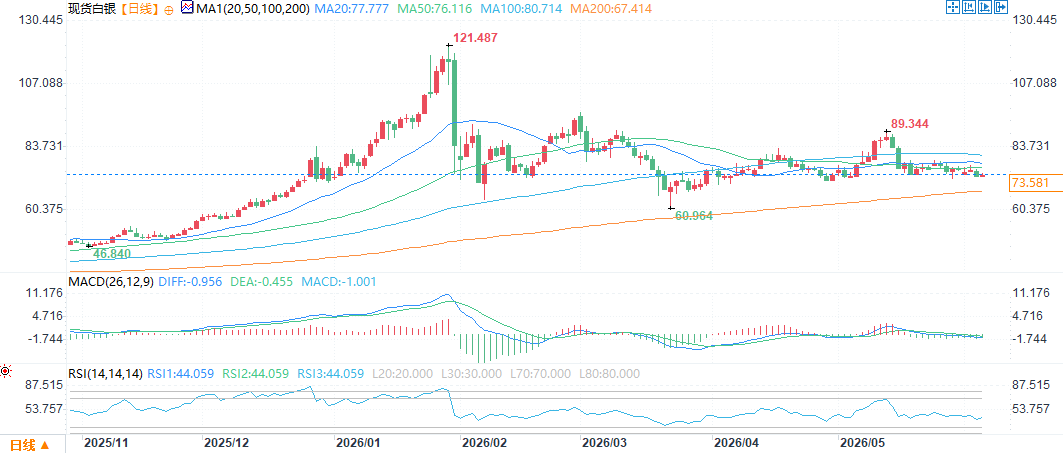
(Spot silver daily chart, source: EasyForex)
The MACD lines are below the zero line, and the green bars are increasing slightly, indicating that the short-term bears have a slight advantage but there is no signal of a deep weakening. The RSI indicator is at 44 in the neutral range and has not entered the overbought or oversold range. The market continues to consolidate within the range, and the overall trend is still biased towards bottoming out, relying on the 200-day moving average.
Silver prices have seen a technical rebound after a continuous decline, but the overall outlook remains fragile. Concerns about a potentially prolonged US naval blockade of Iran, inflationary pressures stemming from the Middle East wars, and rising expectations of a hawkish stance from the Federal Reserve constitute a triple negative factor for silver.
At 13:52 Beijing time on June 4, spot silver was trading at $73.20 per ounce.
However, the overall outlook remains bearish, mainly due to market concerns that the US blockade of Iranian seaports may be prolonged, while hawkish expectations from the Federal Reserve are also putting pressure on non-interest-bearing assets.
Concerns about a US naval blockade are weighing on silver's prospects.
US President Trump said on Wednesday that the US naval blockade against Iran could continue until Labor Day (September 7), but he also expressed confidence that this scenario was "unlikely to happen."
If the US and Iran fail to reach a permanent settlement, the continued blockade will mean long-term restrictions on energy transport through the Strait of Hormuz, further driving up global energy prices.
For economies heavily reliant on oil imports, this will bring the dual pressures of deteriorating terms of trade and imported inflation; for precious metals such as silver, the continued rise in energy prices will reinforce expectations that the Federal Reserve will maintain high interest rates, while suppressing industrial demand.
Trump's statement that it was "unlikely" eased market concerns to some extent, but as long as there is no substantial progress in negotiations, the risk of a prolonged lockdown cannot be completely ruled out.
Silver has been under continuous pressure since the Middle East wars.
Since the outbreak of the Middle East wars, silver prices have consistently underperformed. Rising oil prices have increased global inflationary pressures, forcing traders to significantly adjust their bets on Federal Reserve policy—before the wars, the market widely expected two rate cuts, but now not only are rate cuts completely ruled out, but the possibility of further rate hikes this year is even being priced in.
This reversal of expectations is the core reason for silver's continued underperformance. Theoretically, a Fed rate hike is a clear negative for non-interest-bearing assets like silver: higher interest rates increase the opportunity cost of holding silver, leading investors to shift towards higher-yielding dollar assets. As long as geopolitical tensions remain high, oil prices remain high, and the Fed maintains a hawkish stance, silver's upside potential will continue to be constrained.
US employment data provides guidance for the market.
In the US, Wednesday's ADP employment data for May exceeded expectations, setting a positive tone for Friday's non-farm payroll data. The data showed that the US private sector added 122,000 jobs, higher than the expected 117,000 and the previous month's 105,000, indicating that the labor market remains resilient.
If Friday's non-farm payroll data is also strong, it could further reinforce market expectations that the Federal Reserve will maintain its tightening stance.
For silver, strong employment data implies two transmission paths: first, the Federal Reserve has more reason to maintain high interest rates or even raise them further, which is bearish for silver; second, the US dollar may strengthen, further suppressing silver prices. Conversely, if the non-farm payroll data falls short of expectations, it may temporarily alleviate the downward pressure on silver.
Institutional Views
TD Securities predicts that silver prices will rise further from $78.50 per ounce in the third quarter of 2026 to $84.50 per ounce in the second quarter of next year. The core logic is that the rapid development of artificial intelligence, data centers, electric vehicles, solar panels, and power grid upgrades is driving continued growth in silver demand, while global silver mine supply growth is limited, resulting in a supply gap for several consecutive years. With investment and industrial demand expanding simultaneously, the silver market is gradually entering a phase of structural shortage.
UBS has significantly lowered its silver price forecasts, reducing its end-June target from $100 to $85, its September target from $95 to $85, its December target from $85 to $80, and its March 2027 target from $85 to $75. This adjustment is primarily based on: cooling investment demand (ETF holdings have plummeted by nearly 70 million ounces this year), weakened photovoltaic demand due to high prices, suppressed demand for silver jewelry due to high prices, and a recovery in mine supply (estimated to be close to 850 million ounces). UBS expects the silver supply deficit to narrow significantly from its previous estimate of 300 million ounces to 60-70 million ounces by 2026.
Technical Analysis
Spot silver prices initially surged to 121.49 before retreating, then rebounded from the March low of 60.96. Currently, the price is trading below the 50-day moving average (MA50) at 76.11, but has stabilized above the 200-day moving average (MA200) at 67.41, representing a medium- to long-term support level. In the short term, it faces resistance from the 50-day moving average and is consolidating within a range of 73-89.34. A break above 76.12 could test the previous high of 89.34, while a pullback below 73 would target the 200-day moving average support.
(Spot silver daily chart, source: EasyForex)
The MACD lines are below the zero line, and the green bars are increasing slightly, indicating that the short-term bears have a slight advantage but there is no signal of a deep weakening. The RSI indicator is at 44 in the neutral range and has not entered the overbought or oversold range. The market continues to consolidate within the range, and the overall trend is still biased towards bottoming out, relying on the 200-day moving average.
Silver prices have seen a technical rebound after a continuous decline, but the overall outlook remains fragile. Concerns about a potentially prolonged US naval blockade of Iran, inflationary pressures stemming from the Middle East wars, and rising expectations of a hawkish stance from the Federal Reserve constitute a triple negative factor for silver.
At 13:52 Beijing time on June 4, spot silver was trading at $73.20 per ounce.
- Risk Warning and Disclaimer
- The market involves risk, and trading may not be suitable for all investors. This article is for reference only and does not constitute personal investment advice, nor does it take into account certain users’ specific investment objectives, financial situation, or other needs. Any investment decisions made based on this information are at your own risk.