The US dollar index remains volatile at high levels, awaiting a breakout.
2026-06-04 14:35:24
The US dollar index (DXY) consolidated around 99.50 during Asian trading on Thursday. After rising for three consecutive trading days, the dollar bulls temporarily slowed their advance, as improved market risk sentiment led to some safe-haven outflows from dollar assets. However, from an overall fundamental perspective, the dollar remains supported by interest rate expectations and economic fundamentals.

The core factor driving recent dollar volatility remains the evolving situation in the Middle East. With Lebanon and Israel reaching a new ceasefire agreement under US mediation, market concerns about a further escalation of the regional conflict have eased. The two sides not only agreed to extend the ceasefire but also plan to establish several pilot security zones, with the Lebanese army taking full responsibility for security affairs in these areas.
This development lowered market expectations for a full-blown regional conflict, boosting global risk appetite. Reduced safe-haven demand caused the dollar index to retreat from recent highs, while gold, risk assets, and some high-risk currencies received support.
However, markets have not completely shaken off concerns about Middle East risks. Tensions between the United States and Iran persist. US President Trump recently stated that the US might reconsider the current ceasefire if Iran causes casualties among US military personnel. Meanwhile, uncertainty surrounding shipping in the Strait of Hormuz remains.
Market concerns persist that further delays in the reopening of the Strait of Hormuz will continue to strain the global energy supply chain. The Strait of Hormuz handles approximately 20% of global seaborne crude oil transport, and its stability directly impacts the operation of the international energy market. As a result, international oil prices have remained high recently. Rising energy prices are further fueling global inflationary pressures and altering market perceptions of major central bank monetary policies.
For the US dollar, the most important supporting factor at present comes from changes in expectations regarding Federal Reserve policy. Recent US economic data has consistently exceeded market expectations, indicating that the US economy remains resilient. Data shows that both the May ADP private sector employment figure and the JOLTS job openings data were better than market expectations, reflecting continued robust growth in the labor market. The strong performance of the job market means that consumer demand remains supported, while also reducing the risk of a short-term economic recession.
As employment data continues to improve, the market is beginning to reassess the future path of interest rates. Investors generally believe that, given renewed inflationary pressures, the Federal Reserve may need to maintain high interest rates for a longer period to ensure price pressures are effectively controlled. Market estimates suggest that traders now expect a 42% probability of further policy tightening by the Fed before the end of the year. This expectation is significantly higher than previous levels and is pushing US Treasury yields to remain high.
The US dollar has thus gained new fundamental support. Although safe-haven demand has weakened somewhat, the yield advantage brought by the high-interest-rate environment continues to attract international capital inflows into dollar assets. The market is now turning its attention to the upcoming US non-farm payroll report. As an important indicator of the health of the US economy, the non-farm payroll data will directly affect the market's judgment on the future direction of monetary policy.
If job growth continues to be strong, market expectations for the duration of the high-interest-rate environment may intensify further, thereby driving the dollar higher again. Conversely, if employment data slows significantly, it could weaken the dollar's recent gains. Overall, the dollar market is currently in a phase of balancing improved risk sentiment and rising interest rate expectations. In the short term, declining safe-haven demand is limiting the dollar's gains, but in the medium to long term, the resilience of the US economy and expectations for Federal Reserve policy remain important supports.
From a daily chart perspective, the US dollar index maintains an overall upward-biased pattern. Prices have regained footing near the 20-day and 50-day moving averages, and the bullish structure is gradually recovering. The MACD indicator is above the zero line, with the red histogram expanding, indicating strengthening upward momentum. The RSI indicator is around 58, reflecting a positive market sentiment but not yet entering overbought territory. Key support levels to watch are 98.80 and 98.20, while resistance levels are 100.20 and 101.00.
From a 4-hour chart perspective, the US dollar index has entered a consolidation phase around 99.50. The MACD indicator is running at a high level, but momentum is starting to slow, indicating a short-term need for consolidation. The RSI remains in the 55-60 range, suggesting the market is still biased towards bullishness. If it breaks through the 100.20 resistance, it may further challenge the 101.00 area; if it falls below the 98.80 support, it may pull back to around 98.20 to find support.
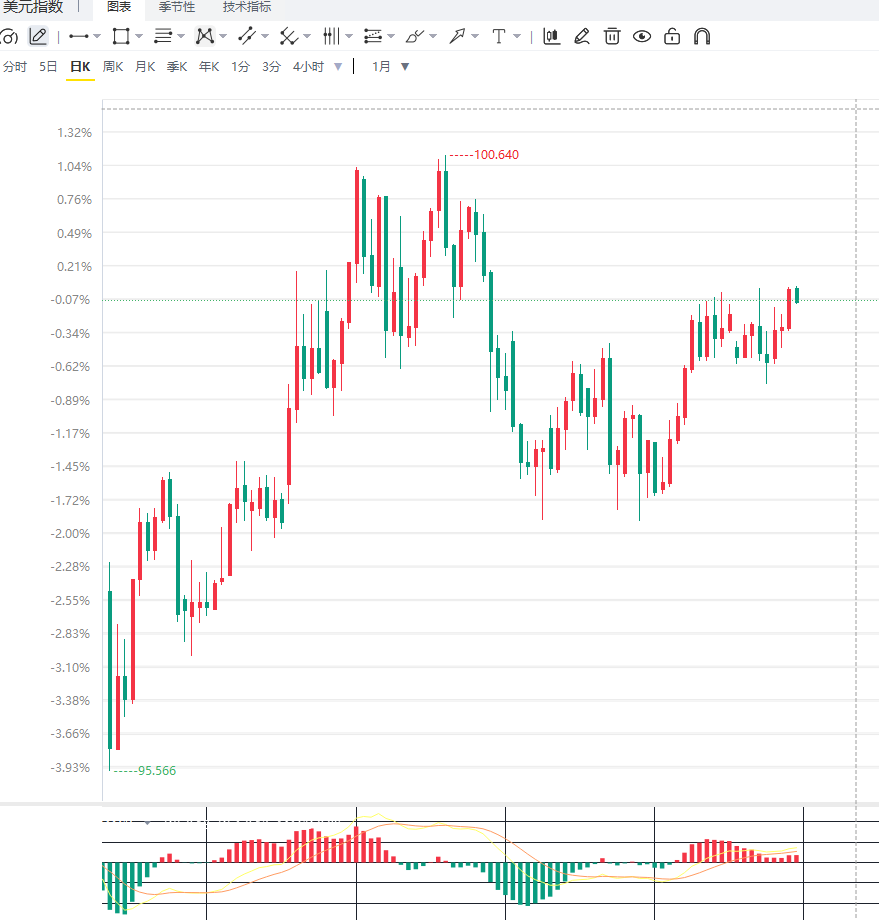
Editor's Summary : The recent performance of the US dollar index fully reflects the market's repricing of the global risk environment and monetary policy outlook. The ceasefire agreement between Lebanon and Israel alleviated some safe-haven demand, causing a technical pullback in the dollar. However, continued strong US economic data and inflationary risks from rising energy prices are driving the market to re-induce the possibility of further tightening by the Federal Reserve.
The core factor driving recent dollar volatility remains the evolving situation in the Middle East. With Lebanon and Israel reaching a new ceasefire agreement under US mediation, market concerns about a further escalation of the regional conflict have eased. The two sides not only agreed to extend the ceasefire but also plan to establish several pilot security zones, with the Lebanese army taking full responsibility for security affairs in these areas.
This development lowered market expectations for a full-blown regional conflict, boosting global risk appetite. Reduced safe-haven demand caused the dollar index to retreat from recent highs, while gold, risk assets, and some high-risk currencies received support.
However, markets have not completely shaken off concerns about Middle East risks. Tensions between the United States and Iran persist. US President Trump recently stated that the US might reconsider the current ceasefire if Iran causes casualties among US military personnel. Meanwhile, uncertainty surrounding shipping in the Strait of Hormuz remains.
Market concerns persist that further delays in the reopening of the Strait of Hormuz will continue to strain the global energy supply chain. The Strait of Hormuz handles approximately 20% of global seaborne crude oil transport, and its stability directly impacts the operation of the international energy market. As a result, international oil prices have remained high recently. Rising energy prices are further fueling global inflationary pressures and altering market perceptions of major central bank monetary policies.
For the US dollar, the most important supporting factor at present comes from changes in expectations regarding Federal Reserve policy. Recent US economic data has consistently exceeded market expectations, indicating that the US economy remains resilient. Data shows that both the May ADP private sector employment figure and the JOLTS job openings data were better than market expectations, reflecting continued robust growth in the labor market. The strong performance of the job market means that consumer demand remains supported, while also reducing the risk of a short-term economic recession.
As employment data continues to improve, the market is beginning to reassess the future path of interest rates. Investors generally believe that, given renewed inflationary pressures, the Federal Reserve may need to maintain high interest rates for a longer period to ensure price pressures are effectively controlled. Market estimates suggest that traders now expect a 42% probability of further policy tightening by the Fed before the end of the year. This expectation is significantly higher than previous levels and is pushing US Treasury yields to remain high.
The US dollar has thus gained new fundamental support. Although safe-haven demand has weakened somewhat, the yield advantage brought by the high-interest-rate environment continues to attract international capital inflows into dollar assets. The market is now turning its attention to the upcoming US non-farm payroll report. As an important indicator of the health of the US economy, the non-farm payroll data will directly affect the market's judgment on the future direction of monetary policy.
If job growth continues to be strong, market expectations for the duration of the high-interest-rate environment may intensify further, thereby driving the dollar higher again. Conversely, if employment data slows significantly, it could weaken the dollar's recent gains. Overall, the dollar market is currently in a phase of balancing improved risk sentiment and rising interest rate expectations. In the short term, declining safe-haven demand is limiting the dollar's gains, but in the medium to long term, the resilience of the US economy and expectations for Federal Reserve policy remain important supports.
From a daily chart perspective, the US dollar index maintains an overall upward-biased pattern. Prices have regained footing near the 20-day and 50-day moving averages, and the bullish structure is gradually recovering. The MACD indicator is above the zero line, with the red histogram expanding, indicating strengthening upward momentum. The RSI indicator is around 58, reflecting a positive market sentiment but not yet entering overbought territory. Key support levels to watch are 98.80 and 98.20, while resistance levels are 100.20 and 101.00.
From a 4-hour chart perspective, the US dollar index has entered a consolidation phase around 99.50. The MACD indicator is running at a high level, but momentum is starting to slow, indicating a short-term need for consolidation. The RSI remains in the 55-60 range, suggesting the market is still biased towards bullishness. If it breaks through the 100.20 resistance, it may further challenge the 101.00 area; if it falls below the 98.80 support, it may pull back to around 98.20 to find support.
Editor's Summary : The recent performance of the US dollar index fully reflects the market's repricing of the global risk environment and monetary policy outlook. The ceasefire agreement between Lebanon and Israel alleviated some safe-haven demand, causing a technical pullback in the dollar. However, continued strong US economic data and inflationary risks from rising energy prices are driving the market to re-induce the possibility of further tightening by the Federal Reserve.
- Risk Warning and Disclaimer
- The market involves risk, and trading may not be suitable for all investors. This article is for reference only and does not constitute personal investment advice, nor does it take into account certain users’ specific investment objectives, financial situation, or other needs. Any investment decisions made based on this information are at your own risk.