Was the euro's rebound just a feint? Three major questions remain unanswered: energy, central banks, and non-farm payrolls.
2026-06-04 14:35:47
On Thursday (June 4) during the Asian session, the euro rose slightly against the US dollar to around 1.1610, but its overall outlook remains uncertain.
The euro faces multiple pressures, including rising energy prices due to the Middle East crisis and uncertainty surrounding the possibility of the European Central Bank discussing interest rate hikes at its policy meeting next week.
Meanwhile, the market is also awaiting the release of the US non-farm payroll data for May on Friday.
The euro is currently facing broad pressure from multiple directions, casting a shadow over its short-term outlook.
The Middle East crisis has driven up global energy prices. As an economy heavily reliant on oil imports, the Eurozone has experienced a deterioration in its terms of trade, with rising import costs while export revenues have not kept pace. In contrast, the United States, as a net energy exporter, has been less affected, further strengthening the relative strength of the dollar and diminishing the appeal of the euro.
In May, the Eurozone's overall Harmonized Index of Consumer Prices (HICP) rose 3.2% year-on-year, while the core HICP rose 2.5% year-on-year, both higher than previous levels and above the European Central Bank's 2% inflation target. The stubbornness of core inflation indicates that underlying price pressures remain.
However, investors remain significantly divided on whether the European Central Bank will raise interest rates next week, as weakening economic growth momentum forces the central bank to proceed cautiously when tightening policy.
Given persistent inflationary pressures, the European Central Bank is highly likely to hold in-depth discussions on tightening policy at its meeting next week and may release hawkish signals—such as raising inflation forecasts, lowering growth forecasts, or explicitly hinting at the possibility of future interest rate hikes.
This will provide some support for the euro. If the ECB provides clear guidance on interest rate hikes, the euro is expected to rebound against the dollar and test key resistance areas.
However, hawkish signals are unlikely to fully offset the pressure from high energy prices and concerns about economic growth in the short term—persistently high oil prices are diminishing the euro's appeal, while interest rate hikes could further dampen weak economic activity. Therefore, even if the euro receives a brief boost, the rebound will be limited.
The dollar index edged back to around 99.45 on Thursday, but remained near its eight-and-a-half-week high of 99.55. Amid the difficult negotiations between the US and Iran – Iran stating there was "no substantial progress" while Trump indicated an agreement could be reached "this weekend" – market concerns about the Middle East situation persisted, and safe-haven demand for the dollar remained.
Looking ahead, investors are focused on the US May non-farm payroll data to be released on Friday. The better-than-expected ADP data previously set a positive tone for this month's non-farm payroll report.
Strong non-farm payroll data would reinforce expectations that the Federal Reserve will maintain high interest rates or even raise rates this year, potentially pushing the dollar index above 99.55. However, weaker-than-expected data could trigger a short-term pullback in the dollar. Before the data release, the dollar index is likely to remain range-bound between 99.30 and 99.55.
BNP Paribas projects that Eurozone GDP growth will slow to 1.0% in 2026 from 1.5% in 2025, but economic activity will be able to withstand energy shocks thanks to investments in defense, artificial intelligence, and electrification. Inflation is expected to rebound to 3.0% in 2026 and rise to 3.3% in 2027. The European Central Bank is expected to raise interest rates twice in 2026 by 25 basis points (the first in June), pushing deposit rates to 2.5%. BNP Paribas forecasts the euro to reach 1.21 against the US dollar in the fourth quarter of 2026 and 1.25 in the fourth quarter of 2027, primarily based on the continued trend of diversification of the US dollar globally, which will drive its depreciation.
HSBC believes the euro/dollar exchange rate lacks a clear unilateral trend in the short term. Until the Middle East deadlock is clearly resolved, the dollar is likely to remain range-bound. While interest rate differentials (the Fed's hawkish stance and the partial pricing in of ECB rate hikes) will support the dollar, they are insufficient to trigger a sustained rise. Regarding the euro, HSBC points out that the market has already priced in approximately 60 basis points of ECB rate hikes this year, but with increasing signs of weakening activity in the Eurozone, the ECB is unlikely to adopt a more hawkish path than the market expects. Therefore, the euro's potential for independent appreciation is limited, and the risks are skewed to the downside.
UBS believes the euro will likely remain range-bound against the dollar, with limited upside potential. The core reason lies in the continued divergence in central bank policies: the Federal Reserve is relatively hawkish (emphasizing "higher interest rates for longer"), while the European Central Bank faces a more fragile eurozone recovery. Furthermore, the ongoing conflict in Ukraine continues to impact European energy security and industrial competitiveness, and concerns about China's growth further increase uncertainty about the eurozone's outlook. UBS recommends a strategy that emphasizes risk management within the current range and avoids chasing the euro higher.
The euro/dollar pair is exhibiting a wide-range fluctuation on the daily chart, currently trading at 1.1610 below the 20-day and 50-day moving averages. The previous high of 1.2081 and the next high of 1.1848 have gradually moved down, with resistance at 1.1848 and key support near the recent low of 1.1410.
The MACD lines are running slightly below the zero line with a small amount of green bars, indicating a slight short-term bearish advantage. The RSI is in the neutral range of 43.23, with no obvious overbought or oversold conditions. The short-term market is expected to remain range-bound without a clear directional trend, awaiting a breakout of the key upper and lower ranges to determine the trend.
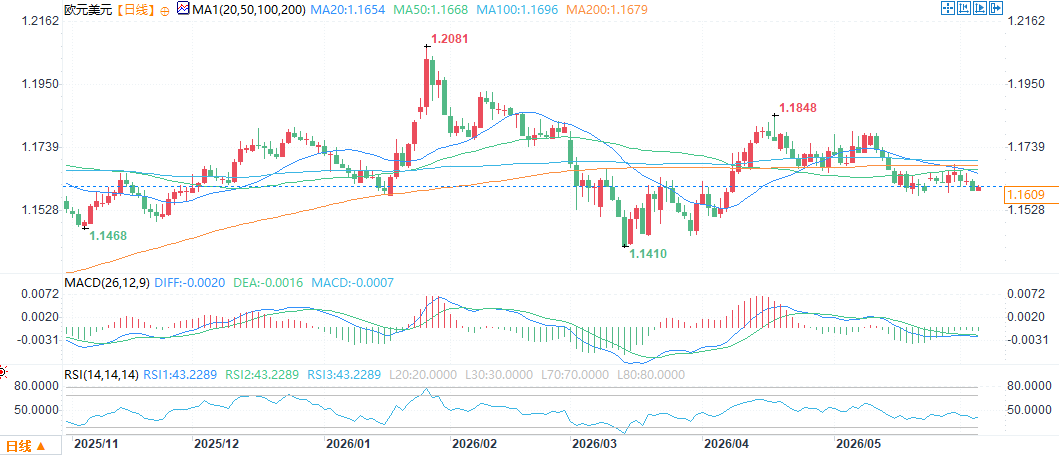
(Euro/USD daily chart, source: FX678)
At 14:35 Beijing time on June 4, the euro was trading at 1.1612/13 against the US dollar.
The euro faces multiple pressures, including rising energy prices due to the Middle East crisis and uncertainty surrounding the possibility of the European Central Bank discussing interest rate hikes at its policy meeting next week.
Meanwhile, the market is also awaiting the release of the US non-farm payroll data for May on Friday.
Euro under pressure: Energy prices and monetary policy uncertainty
The euro is currently facing broad pressure from multiple directions, casting a shadow over its short-term outlook.
The Middle East crisis has driven up global energy prices. As an economy heavily reliant on oil imports, the Eurozone has experienced a deterioration in its terms of trade, with rising import costs while export revenues have not kept pace. In contrast, the United States, as a net energy exporter, has been less affected, further strengthening the relative strength of the dollar and diminishing the appeal of the euro.
In May, the Eurozone's overall Harmonized Index of Consumer Prices (HICP) rose 3.2% year-on-year, while the core HICP rose 2.5% year-on-year, both higher than previous levels and above the European Central Bank's 2% inflation target. The stubbornness of core inflation indicates that underlying price pressures remain.
However, investors remain significantly divided on whether the European Central Bank will raise interest rates next week, as weakening economic growth momentum forces the central bank to proceed cautiously when tightening policy.
Policy Outlook: ECB May Release Hawkish Signals
Given persistent inflationary pressures, the European Central Bank is highly likely to hold in-depth discussions on tightening policy at its meeting next week and may release hawkish signals—such as raising inflation forecasts, lowering growth forecasts, or explicitly hinting at the possibility of future interest rate hikes.
This will provide some support for the euro. If the ECB provides clear guidance on interest rate hikes, the euro is expected to rebound against the dollar and test key resistance areas.
However, hawkish signals are unlikely to fully offset the pressure from high energy prices and concerns about economic growth in the short term—persistently high oil prices are diminishing the euro's appeal, while interest rate hikes could further dampen weak economic activity. Therefore, even if the euro receives a brief boost, the rebound will be limited.
The US dollar remained strong as markets awaited non-farm payroll data.
The dollar index edged back to around 99.45 on Thursday, but remained near its eight-and-a-half-week high of 99.55. Amid the difficult negotiations between the US and Iran – Iran stating there was "no substantial progress" while Trump indicated an agreement could be reached "this weekend" – market concerns about the Middle East situation persisted, and safe-haven demand for the dollar remained.
Looking ahead, investors are focused on the US May non-farm payroll data to be released on Friday. The better-than-expected ADP data previously set a positive tone for this month's non-farm payroll report.
Strong non-farm payroll data would reinforce expectations that the Federal Reserve will maintain high interest rates or even raise rates this year, potentially pushing the dollar index above 99.55. However, weaker-than-expected data could trigger a short-term pullback in the dollar. Before the data release, the dollar index is likely to remain range-bound between 99.30 and 99.55.
Institutional Views
BNP Paribas projects that Eurozone GDP growth will slow to 1.0% in 2026 from 1.5% in 2025, but economic activity will be able to withstand energy shocks thanks to investments in defense, artificial intelligence, and electrification. Inflation is expected to rebound to 3.0% in 2026 and rise to 3.3% in 2027. The European Central Bank is expected to raise interest rates twice in 2026 by 25 basis points (the first in June), pushing deposit rates to 2.5%. BNP Paribas forecasts the euro to reach 1.21 against the US dollar in the fourth quarter of 2026 and 1.25 in the fourth quarter of 2027, primarily based on the continued trend of diversification of the US dollar globally, which will drive its depreciation.
HSBC believes the euro/dollar exchange rate lacks a clear unilateral trend in the short term. Until the Middle East deadlock is clearly resolved, the dollar is likely to remain range-bound. While interest rate differentials (the Fed's hawkish stance and the partial pricing in of ECB rate hikes) will support the dollar, they are insufficient to trigger a sustained rise. Regarding the euro, HSBC points out that the market has already priced in approximately 60 basis points of ECB rate hikes this year, but with increasing signs of weakening activity in the Eurozone, the ECB is unlikely to adopt a more hawkish path than the market expects. Therefore, the euro's potential for independent appreciation is limited, and the risks are skewed to the downside.
UBS believes the euro will likely remain range-bound against the dollar, with limited upside potential. The core reason lies in the continued divergence in central bank policies: the Federal Reserve is relatively hawkish (emphasizing "higher interest rates for longer"), while the European Central Bank faces a more fragile eurozone recovery. Furthermore, the ongoing conflict in Ukraine continues to impact European energy security and industrial competitiveness, and concerns about China's growth further increase uncertainty about the eurozone's outlook. UBS recommends a strategy that emphasizes risk management within the current range and avoids chasing the euro higher.
Technical Analysis
The euro/dollar pair is exhibiting a wide-range fluctuation on the daily chart, currently trading at 1.1610 below the 20-day and 50-day moving averages. The previous high of 1.2081 and the next high of 1.1848 have gradually moved down, with resistance at 1.1848 and key support near the recent low of 1.1410.
The MACD lines are running slightly below the zero line with a small amount of green bars, indicating a slight short-term bearish advantage. The RSI is in the neutral range of 43.23, with no obvious overbought or oversold conditions. The short-term market is expected to remain range-bound without a clear directional trend, awaiting a breakout of the key upper and lower ranges to determine the trend.
(Euro/USD daily chart, source: FX678)
At 14:35 Beijing time on June 4, the euro was trading at 1.1612/13 against the US dollar.
- Risk Warning and Disclaimer
- The market involves risk, and trading may not be suitable for all investors. This article is for reference only and does not constitute personal investment advice, nor does it take into account certain users’ specific investment objectives, financial situation, or other needs. Any investment decisions made based on this information are at your own risk.