Gold prices rebounded by more than 1%, is gold rallying again as geopolitical risks ease?
2026-06-05 02:28:24
Gold rebounded on Thursday (June 4th) supported by net central bank buying and holding above the 200-day moving average (around $4422), but partially retraced its gains after the opening and is currently in a consolidation phase following the technical rebound. Spot gold is fluctuating around $4450-$4500, while the narrowing decline in the US dollar index is putting some downward pressure on gold prices.

Geopolitical easing in stages
The US-brokered ceasefire agreement between Israel and Lebanon provided a short-term boost to the market, which believed it could drive broader progress in US-Iran negotiations (Iran had previously insisted that any agreement must end hostilities in Lebanon). Safe-haven demand eased, leading to a technical rebound in gold prices. However, Hezbollah's rejection of key terms of the agreement (demanding a complete Israeli withdrawal and a full ceasefire) indicates significant fragility and that Middle East risks have not been completely eliminated, making it difficult for gold prices to gain sustained upward momentum.
Central bank net purchases provide long-term support
Data from the World Gold Council (WGC) shows that global central banks resumed net purchases of 17 tons of gold in April (after net selling in March). This trend continues the strategy of diversifying reserves in recent years, providing a solid downside buffer for gold prices even in an environment of recovering risk appetite.
Federal Reserve officials' statements and policy expectations
Recent speeches by officials show some divergence, but the overall consensus reinforces the "long-term maintenance of high interest rates" scenario, further reducing expectations for rate cuts this year: Cleveland Fed President Beth Hammack (June 2nd) adopted a hawkish stance, expressing concern that inflation is "too high and is rising" (not just in energy, but also in sectors like healthcare and electricity), believing that current policy constraints may be insufficient, and that if the trend continues, "action may be needed soon." Some officials (such as Jeff Schmid) emphasized that inflation driven by factors like tariffs cannot be simply "seen through," otherwise it would damage the Fed's credibility; Mary Daly and others are relatively more concerned about its temporary impact.
The core of the disagreement among officials lies in whether the current inflation (contributed by energy and tariffs) is temporary or embedded in the economy. With hawkish voices dominating, the probability of holding rates steady at the June meeting is close to 100%, with subsequent significant rate cuts expected to be priced in. Higher interest rates and real yields continue to put pressure on non-interest-bearing gold.
Outlook for the impact of tomorrow's non-farm payroll report
The May non-farm payroll data will be released tomorrow (June 5th). Market consensus expects approximately 85,000 new jobs (previous value 115,000), with the unemployment rate remaining at 4.3%, and average hourly earnings rising 0.3% month-on-month and slowing to around 3.4% year-on-year. Recent ADP private sector employment data showed an increase of 122,000, indicating continued resilience in the labor market. If the data is stronger than expected (significantly above 100,000), it will reinforce the view of a robust labor market and persistent inflationary pressures, further increasing expectations of "interest rates remaining high," which would be bearish for gold.
If the data is weaker than expected (significantly lower than expected or the unemployment rate rises), it may alleviate concerns about tightening, boost expectations of interest rate cuts, and provide short-term support for gold.
Given the Federal Reserve's current cautious stance on inflation, even a weak non-farm payrolls report is unlikely to immediately and significantly reverse policy expectations; the impact is more likely to manifest as short-term fluctuations.
Technical Analysis
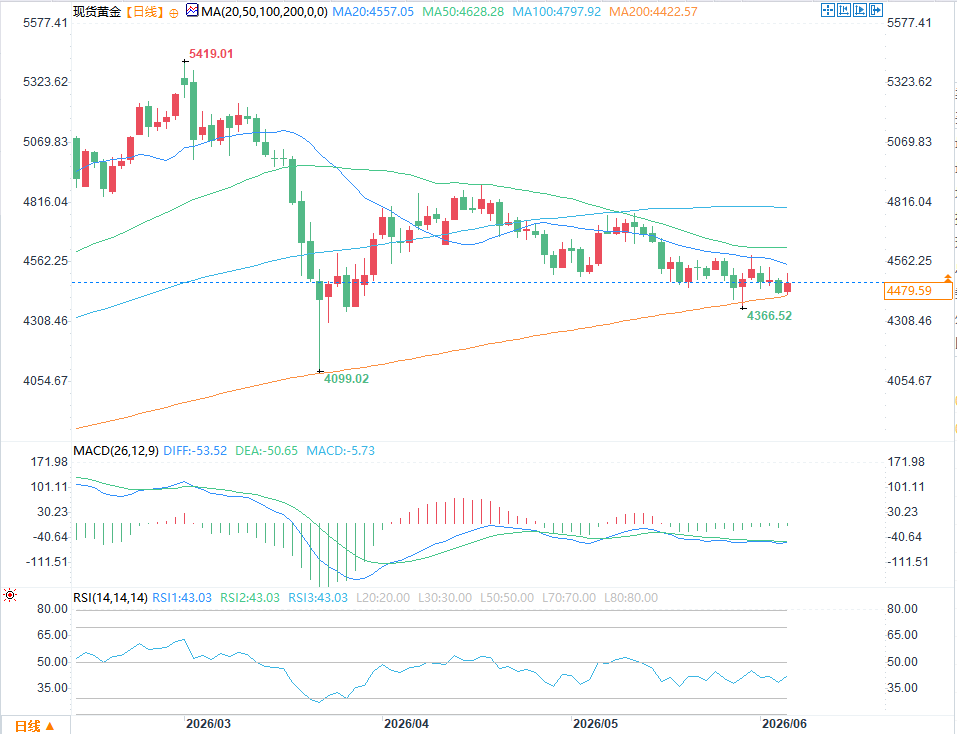
(Spot gold daily chart source: FX678)
Spot gold held above the key long-term support level of the 200-day moving average, but remains well below the 100-day moving average (around $4798), indicating a neutral to slightly bearish overall trend. The RSI is around 45 (moderate buying momentum), and the MACD is slightly negative. Short-term resistance is seen at $4600, with further upward movement requiring a break above the 100-day moving average; support lies at $4427 and lower around the $4100 area.
Summarize
Gold's technical rebound today was mainly driven by a temporary easing of geopolitical tensions and continued central bank buying, with yesterday's weakening dollar also providing supplementary support. However, hawkish statements from the Federal Reserve, discussions on tariff-related inflation, and a stabilizing dollar collectively limited upside potential. Tomorrow's non-farm payroll data will be a key catalyst, and gold prices are expected to continue fluctuating within the $4400-$4600 range in the short term.
In the long term, central bank demand remains the core positive factor for gold, but a significant decline in inflation and a renewed rise in expectations of interest rate cuts are needed to open a more sustainable upward channel. It is recommended to pay attention to tomorrow's non-farm payroll results, subsequent developments in the Middle East situation, and further signals from the Federal Reserve, and to manage positions prudently.
Geopolitical easing in stages
The US-brokered ceasefire agreement between Israel and Lebanon provided a short-term boost to the market, which believed it could drive broader progress in US-Iran negotiations (Iran had previously insisted that any agreement must end hostilities in Lebanon). Safe-haven demand eased, leading to a technical rebound in gold prices. However, Hezbollah's rejection of key terms of the agreement (demanding a complete Israeli withdrawal and a full ceasefire) indicates significant fragility and that Middle East risks have not been completely eliminated, making it difficult for gold prices to gain sustained upward momentum.
Central bank net purchases provide long-term support
Data from the World Gold Council (WGC) shows that global central banks resumed net purchases of 17 tons of gold in April (after net selling in March). This trend continues the strategy of diversifying reserves in recent years, providing a solid downside buffer for gold prices even in an environment of recovering risk appetite.
Federal Reserve officials' statements and policy expectations
Recent speeches by officials show some divergence, but the overall consensus reinforces the "long-term maintenance of high interest rates" scenario, further reducing expectations for rate cuts this year: Cleveland Fed President Beth Hammack (June 2nd) adopted a hawkish stance, expressing concern that inflation is "too high and is rising" (not just in energy, but also in sectors like healthcare and electricity), believing that current policy constraints may be insufficient, and that if the trend continues, "action may be needed soon." Some officials (such as Jeff Schmid) emphasized that inflation driven by factors like tariffs cannot be simply "seen through," otherwise it would damage the Fed's credibility; Mary Daly and others are relatively more concerned about its temporary impact.
The core of the disagreement among officials lies in whether the current inflation (contributed by energy and tariffs) is temporary or embedded in the economy. With hawkish voices dominating, the probability of holding rates steady at the June meeting is close to 100%, with subsequent significant rate cuts expected to be priced in. Higher interest rates and real yields continue to put pressure on non-interest-bearing gold.
Outlook for the impact of tomorrow's non-farm payroll report
The May non-farm payroll data will be released tomorrow (June 5th). Market consensus expects approximately 85,000 new jobs (previous value 115,000), with the unemployment rate remaining at 4.3%, and average hourly earnings rising 0.3% month-on-month and slowing to around 3.4% year-on-year. Recent ADP private sector employment data showed an increase of 122,000, indicating continued resilience in the labor market. If the data is stronger than expected (significantly above 100,000), it will reinforce the view of a robust labor market and persistent inflationary pressures, further increasing expectations of "interest rates remaining high," which would be bearish for gold.
If the data is weaker than expected (significantly lower than expected or the unemployment rate rises), it may alleviate concerns about tightening, boost expectations of interest rate cuts, and provide short-term support for gold.
Given the Federal Reserve's current cautious stance on inflation, even a weak non-farm payrolls report is unlikely to immediately and significantly reverse policy expectations; the impact is more likely to manifest as short-term fluctuations.
Technical Analysis
(Spot gold daily chart source: FX678)
Spot gold held above the key long-term support level of the 200-day moving average, but remains well below the 100-day moving average (around $4798), indicating a neutral to slightly bearish overall trend. The RSI is around 45 (moderate buying momentum), and the MACD is slightly negative. Short-term resistance is seen at $4600, with further upward movement requiring a break above the 100-day moving average; support lies at $4427 and lower around the $4100 area.
Summarize
Gold's technical rebound today was mainly driven by a temporary easing of geopolitical tensions and continued central bank buying, with yesterday's weakening dollar also providing supplementary support. However, hawkish statements from the Federal Reserve, discussions on tariff-related inflation, and a stabilizing dollar collectively limited upside potential. Tomorrow's non-farm payroll data will be a key catalyst, and gold prices are expected to continue fluctuating within the $4400-$4600 range in the short term.
In the long term, central bank demand remains the core positive factor for gold, but a significant decline in inflation and a renewed rise in expectations of interest rate cuts are needed to open a more sustainable upward channel. It is recommended to pay attention to tomorrow's non-farm payroll results, subsequent developments in the Middle East situation, and further signals from the Federal Reserve, and to manage positions prudently.
- Risk Warning and Disclaimer
- The market involves risk, and trading may not be suitable for all investors. This article is for reference only and does not constitute personal investment advice, nor does it take into account certain users’ specific investment objectives, financial situation, or other needs. Any investment decisions made based on this information are at your own risk.