The US dollar awaits non-farm payrolls above 99.40: Can the employment data break the deadlock?
2026-06-05 09:04:53
The U.S. nonfarm payrolls report for May will be released on Friday (June 5).
Some prominent figures on Wall Street believe that the labor market, which was already showing signs of weakness at this time last year, may face the risk of a "catch-up" decline in data, with overall employment under downward pressure.
The market has already priced in this risk – the US dollar index is currently fluctuating narrowly, hovering around 99.45, and bulls are clearly becoming more cautious ahead of the non-farm payrolls report.
Earlier this week, the U.S. Bureau of Labor Statistics released JOLTS data showing that job openings unexpectedly rose to 7.6 million in April from 7.4 million, far exceeding market expectations. This indicates that corporate hiring demand remains resilient, particularly in sectors such as healthcare and professional services. However, the number of people voluntarily leaving their jobs fell to its lowest level since August 2020. The voluntary turnover rate is considered a key indicator of worker confidence, and its sharp decline suggests a significant decrease in workers' confidence in finding new employment, with more people choosing to hold onto their jobs rather than risk changing careers.
This combination of "high job vacancies and low voluntary resignations" outlines a rigid pattern of "low hiring and low layoffs" in the labor market. Companies are still hiring, but workers are more cautious due to uncertainty, leading to decreased market liquidity and reduced job matching efficiency.
In addition, the number of initial jobless claims last week also recorded its largest increase since early February.
An analysis by Oxford Economics points out that the current decline in both turnover and layoff rates indicates that "neither employers nor employees are in a hurry to take action." Geopolitical risks and rising energy costs have further dampened workers' confidence in changing jobs, and the labor market is trapped in a stagnant pattern of "low hiring, low layoffs."
Edgen macro analyst James Okafor noted that the April job openings data "far exceeded expectations," a magnitude that "eliminates one of the key arguments supporting a recent rate cut." He believes the Fed will view this as "confirmation that labor demand remains too strong to justify further policy easing."
Bank of America expects nonfarm payrolls to increase by about 95,000 in May, believing that the education and healthcare sectors will remain the main drivers, while hiring may see some industry-wide expansion—manufacturing, trade, and transportation may see improvement, and the construction industry will also benefit from demand for data center construction.
Goldman Sachs projects only 60,000 new jobs to be created. Its analyst team points out that its tracked "big data job growth indicator" slowed in May, a judgment based on a comprehensive assessment of high-frequency labor market data.
James Knightley, chief international economist at ING, believes that ADP data showing the labor market is "continuously and steadily creating jobs" gives the Federal Reserve little reason to consider cutting interest rates in the short term. Combined with the data showing a surge in JOLTS job openings to 7.6 million, the Fed can continue to focus on inflation.
From a policy perspective, barring any surprises in the May non-farm payroll data, the Federal Reserve has virtually no reason to adjust interest rates at its June meeting—and the market currently expects no change at that time either. In fact, a pause in rate hikes has become the baseline scenario for the year; and with inflation remaining stubbornly high, the market is increasingly pricing in the possibility of a rate hike in early 2027.
New York Fed President Williams, a key figure in the FOMC, recently stated that monetary policy is "in the right place," with no need for raising or lowering interest rates at present, and no clear direction for future interest rate movements.
Bank of America believes that if the unemployment rate remains at 4.3% or lower, the Federal Reserve will be more inclined to hold off on monetary policy in the short term, given the rising risk of inflation.
George Catrambone, head of fixed income for the Americas at DWS, pointed out that the rise in bond yields since the Middle East conflict has tightened financial conditions to the equivalent of a 75 basis point interest rate hike, and the market itself has partially done the tightening work for the Federal Reserve.
WisdomTree strategists believe that although the market has priced in a rate hike, the Fed is "still a long way from raising rates," and the more likely outcome of the June meeting is that the policy statement will shift from an accommodative bias to a "balanced" outlook.
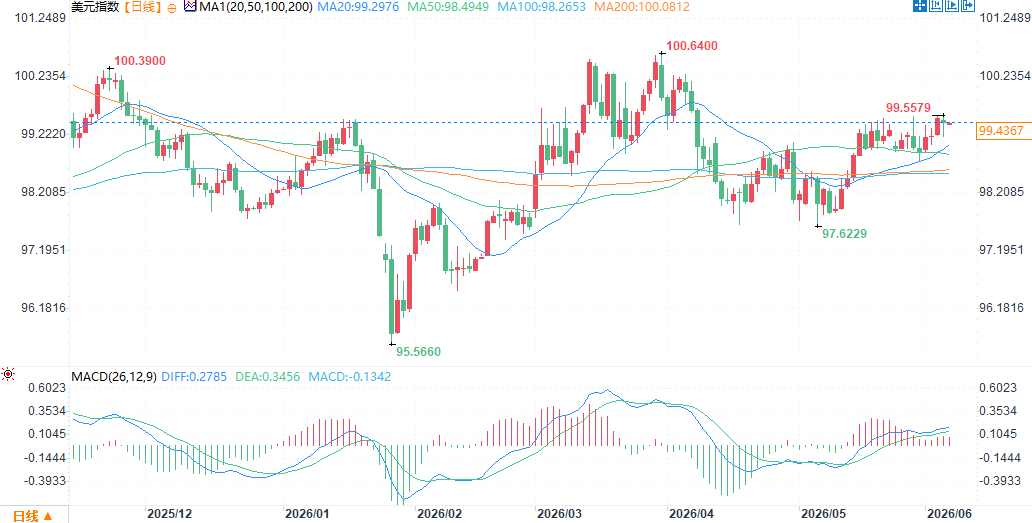
(US Dollar Index Daily Chart, Source: FX678)
At 9:04 AM Beijing time on June 5, the US dollar index was at 99.43.
Some prominent figures on Wall Street believe that the labor market, which was already showing signs of weakness at this time last year, may face the risk of a "catch-up" decline in data, with overall employment under downward pressure.
The market has already priced in this risk – the US dollar index is currently fluctuating narrowly, hovering around 99.45, and bulls are clearly becoming more cautious ahead of the non-farm payrolls report.
Leading indicators: layoffs increase, job vacancies unexpectedly surge.
Earlier this week, the U.S. Bureau of Labor Statistics released JOLTS data showing that job openings unexpectedly rose to 7.6 million in April from 7.4 million, far exceeding market expectations. This indicates that corporate hiring demand remains resilient, particularly in sectors such as healthcare and professional services. However, the number of people voluntarily leaving their jobs fell to its lowest level since August 2020. The voluntary turnover rate is considered a key indicator of worker confidence, and its sharp decline suggests a significant decrease in workers' confidence in finding new employment, with more people choosing to hold onto their jobs rather than risk changing careers.
This combination of "high job vacancies and low voluntary resignations" outlines a rigid pattern of "low hiring and low layoffs" in the labor market. Companies are still hiring, but workers are more cautious due to uncertainty, leading to decreased market liquidity and reduced job matching efficiency.
In addition, the number of initial jobless claims last week also recorded its largest increase since early February.
An analysis by Oxford Economics points out that the current decline in both turnover and layoff rates indicates that "neither employers nor employees are in a hurry to take action." Geopolitical risks and rising energy costs have further dampened workers' confidence in changing jobs, and the labor market is trapped in a stagnant pattern of "low hiring, low layoffs."
Edgen macro analyst James Okafor noted that the April job openings data "far exceeded expectations," a magnitude that "eliminates one of the key arguments supporting a recent rate cut." He believes the Fed will view this as "confirmation that labor demand remains too strong to justify further policy easing."
Institutional forecasts
Bank of America expects nonfarm payrolls to increase by about 95,000 in May, believing that the education and healthcare sectors will remain the main drivers, while hiring may see some industry-wide expansion—manufacturing, trade, and transportation may see improvement, and the construction industry will also benefit from demand for data center construction.
Goldman Sachs projects only 60,000 new jobs to be created. Its analyst team points out that its tracked "big data job growth indicator" slowed in May, a judgment based on a comprehensive assessment of high-frequency labor market data.
James Knightley, chief international economist at ING, believes that ADP data showing the labor market is "continuously and steadily creating jobs" gives the Federal Reserve little reason to consider cutting interest rates in the short term. Combined with the data showing a surge in JOLTS job openings to 7.6 million, the Fed can continue to focus on inflation.
Policy Implications: The Federal Reserve is highly likely to hold rates steady.
From a policy perspective, barring any surprises in the May non-farm payroll data, the Federal Reserve has virtually no reason to adjust interest rates at its June meeting—and the market currently expects no change at that time either. In fact, a pause in rate hikes has become the baseline scenario for the year; and with inflation remaining stubbornly high, the market is increasingly pricing in the possibility of a rate hike in early 2027.
New York Fed President Williams, a key figure in the FOMC, recently stated that monetary policy is "in the right place," with no need for raising or lowering interest rates at present, and no clear direction for future interest rate movements.
Bank of America believes that if the unemployment rate remains at 4.3% or lower, the Federal Reserve will be more inclined to hold off on monetary policy in the short term, given the rising risk of inflation.
George Catrambone, head of fixed income for the Americas at DWS, pointed out that the rise in bond yields since the Middle East conflict has tightened financial conditions to the equivalent of a 75 basis point interest rate hike, and the market itself has partially done the tightening work for the Federal Reserve.
WisdomTree strategists believe that although the market has priced in a rate hike, the Fed is "still a long way from raising rates," and the more likely outcome of the June meeting is that the policy statement will shift from an accommodative bias to a "balanced" outlook.
(US Dollar Index Daily Chart, Source: FX678)
At 9:04 AM Beijing time on June 5, the US dollar index was at 99.43.
- Risk Warning and Disclaimer
- The market involves risk, and trading may not be suitable for all investors. This article is for reference only and does not constitute personal investment advice, nor does it take into account certain users’ specific investment objectives, financial situation, or other needs. Any investment decisions made based on this information are at your own risk.