The war is not over, and interest rate hikes are on the horizon! The euro is dancing on the edge of stagflation. How long can it hold the 1.16 level?
2026-06-05 10:25:14
The euro initially rose from a low of 1.1594 to 1.1644 against the dollar on Thursday (June 4) due to a rise in US initial jobless claims. However, risks of a slowdown in the Eurozone economy limited further gains, and optimistic market expectations for US non-farm payroll data led to a pullback to around 1.1610 by the end of the session. As of Friday (June 5) in Asian trading, the euro is still hovering around 1.1610.
The conflict in the Middle East continues. Although US President Trump brokered a ceasefire agreement between Israel and Lebanon, the agreement is extremely fragile—the Israeli army has launched attacks in southern Lebanon and has publicly stated that it will not withdraw from Lebanon; Hezbollah, backed by Iran, has explicitly rejected the ceasefire proposal.
Meanwhile, negotiations between the US and Iran have also reached a stalemate. Iran insists on unfreezing funds, while the US demands that Iran take substantive action first on the nuclear issue and the right of passage through the Strait of Hormuz. The core differences are unlikely to be bridged in the short term.
Against this backdrop, geopolitical factors remain the dominant market variable, while macroeconomic data has temporarily taken a backseat. Traders are focusing more on the progress of US-Iran negotiations and the situation on the Israel-Lebanon border.
U.S. initial jobless claims data showed a moderate slowdown in the job market: for the week ending May 30, initial claims totaled 225,000, higher than the expected 213,000. Meanwhile, Challenger job cuts rose 16% in May, from 83,837 to 97,000.
Nevertheless, Kansas City Fed President Schmid stated that "inflation remains too high" and called it the biggest risk facing the U.S. economy.
He pointed out that the question is "whether the Fed should remain patient on interest rates or take action." This hawkish statement provided some support for the dollar.
Dallas Fed President Logan delivered a clear hawkish signal in her speech on June 4. She pointed out that monetary policy "has not dampened economic growth," and that inflation does not appear to be falling back toward the 2% target, but rather remaining around 2.5%.
She believes current interest rates are "either neutral or even accommodative," and that the Federal Reserve "needs at least a slightly restrictive policy stance to accomplish its anti-inflation mission." Therefore, she is "growing concerned that interest rates may need to be raised later this year" to fully restore price stability and balance the Fed's dual mandate.
The situation in the Eurozone is quite different, with most economic data pointing downwards.
The Citi Eurozone Economic Surprise Index fell to -45.2 as of June 3, indicating that economic indicators continue to fall short of expectations and the EU economy remains weak. GDP growth in the first quarter of 2026 is projected to be only 0.1% quarter-on-quarter, lower than 0.2% in the fourth quarter of 2025 and 0.3% in the third quarter, showing signs of a continued economic slowdown against the backdrop of rising energy prices (the Iran war has caused the overall HICP to rise to 3.2% year-on-year).
European Central Bank Governing Council member Winsch stated that even if the US and Iran reach a peace agreement before next week's meeting, it is unlikely to dispel the logic of a June rate hike. He favors a 25 basis point rate hike, and expects that if the conflict continues, a consensus on a rate hike is easily reached; even if a ceasefire agreement is reached, although the necessity for a rate hike may weaken, the central bank will most likely still choose to raise rates. Winsch warned against excessively delaying anti-inflation policies, as this would damage the central bank's credibility and push up long-term inflation expectations.
European Central Bank (ECB) Executive Board member Schnabel stated that the ECB may have passed an "irreversible tipping point," with energy infrastructure already damaged and high energy prices permeating the broader economy; even if the war ended today, an interest rate hike would be necessary. Lithuanian Central Bank Governor Szymkus explicitly stated that a June rate hike is inevitable, and officials such as Stornaras and Nagel also believe it is necessary to take action to limit a second wave of effects.
The market is betting on a 98% probability of a 25 basis point rate hike by the European Central Bank in June. Affected by the Middle East conflict, the Eurozone's overall inflation rate reached 3.2% in May, far exceeding the 2% target. Overall, there is a broad consensus within the ECB regarding a June rate hike, and the hawkish stance is providing a floor for the euro. However, for an already weak economy, the impending tightening will undoubtedly be a new test.
The market expects nonfarm payrolls to slow to 85,000 in May from 115,000 in April (median forecast), which would be the lowest growth rate this year, except for the negative growth in February.
The slowdown in employment is due to both the fading of seasonal benefits from the unusually warm weather and a decline in hiring intentions following increased uncertainty about the economic outlook. The unemployment rate is expected to remain unchanged at 4.3%, still at a historically low level, indicating that the labor market has not yet experienced a substantial deterioration. Average hourly earnings are projected to rebound from 0.2% to 0.4% month-on-month, one of the most closely watched variables by the market—a stronger-than-expected rebound in wage growth could further reinforce the Federal Reserve's vigilance regarding inflation, and even if the job growth figures are weak, it may be difficult to shake its hawkish stance.
In Europe, Q1 GDP is projected to grow by 0.1% quarter-on-quarter and 0.8% year-on-year, unchanged from the previous quarter. This growth rate reflects that the Eurozone economy has entered a state of "slight growth"—slowing to 0.1% for two consecutive quarters after a growth rate of 0.3% in Q3 2025. High energy prices continue to erode household purchasing power and corporate profitability, the manufacturing PMI remains in contraction territory, and the expansion momentum of the service sector has also weakened significantly.
Meanwhile, several European Central Bank officials have explicitly supported a June rate hike, suggesting the Eurozone may face a stagflation dilemma: "economic slowdown continues, but rate hikes are imminent." The market will closely watch for any unexpected downward revisions to GDP data, which could influence the ECB's subsequent pace of rate hikes.
The euro/dollar pair is maintaining a range-bound trading pattern on the daily chart, currently trading around 1.1610, and is under pressure below the 20-day and 50-day moving averages. The key resistance level is the previous high of 1.1848, while the support level is at 1.1500. After falling from the high, the price has entered a narrow consolidation range near the middle Bollinger Band.
The MACD lines are running below the zero axis and slightly turning green, indicating a slight short-term advantage for the bears. The indicators are not extremely overbought or oversold, and the RSI is in the neutral range. The market is expected to fluctuate weakly in the short term. A rebound is possible only if the price can hold above the short-term moving average of 1.1645. A break below 1.1600 would lead to further testing of the support level.
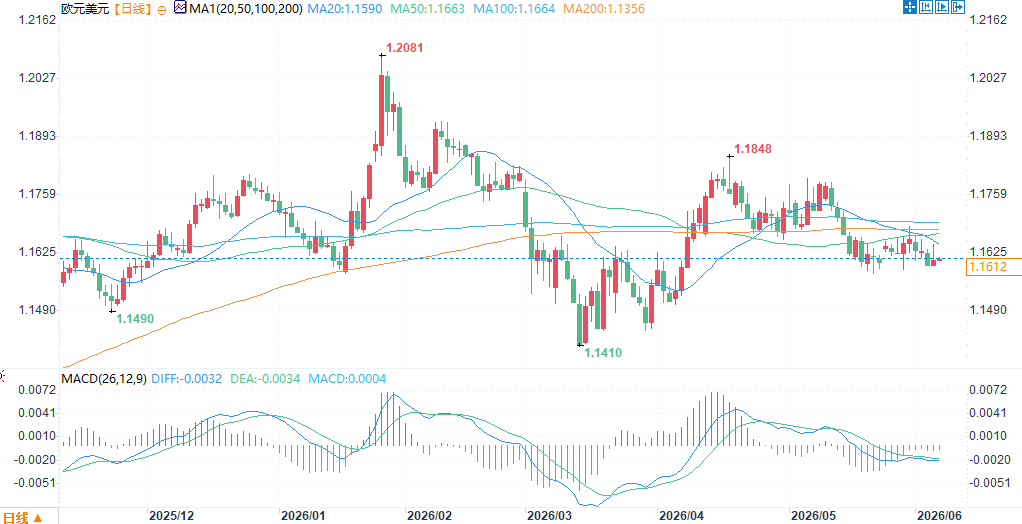
(EUR/USD daily chart, source: FX678)
At 10:25 Beijing time on June 5, the euro was trading at 1.1615/16 against the US dollar.
Geopolitics dominates market sentiment
The conflict in the Middle East continues. Although US President Trump brokered a ceasefire agreement between Israel and Lebanon, the agreement is extremely fragile—the Israeli army has launched attacks in southern Lebanon and has publicly stated that it will not withdraw from Lebanon; Hezbollah, backed by Iran, has explicitly rejected the ceasefire proposal.
Meanwhile, negotiations between the US and Iran have also reached a stalemate. Iran insists on unfreezing funds, while the US demands that Iran take substantive action first on the nuclear issue and the right of passage through the Strait of Hormuz. The core differences are unlikely to be bridged in the short term.
Against this backdrop, geopolitical factors remain the dominant market variable, while macroeconomic data has temporarily taken a backseat. Traders are focusing more on the progress of US-Iran negotiations and the situation on the Israel-Lebanon border.
Schmid and Logan sound the alarm about interest rate hikes.
U.S. initial jobless claims data showed a moderate slowdown in the job market: for the week ending May 30, initial claims totaled 225,000, higher than the expected 213,000. Meanwhile, Challenger job cuts rose 16% in May, from 83,837 to 97,000.
Nevertheless, Kansas City Fed President Schmid stated that "inflation remains too high" and called it the biggest risk facing the U.S. economy.
He pointed out that the question is "whether the Fed should remain patient on interest rates or take action." This hawkish statement provided some support for the dollar.
Dallas Fed President Logan delivered a clear hawkish signal in her speech on June 4. She pointed out that monetary policy "has not dampened economic growth," and that inflation does not appear to be falling back toward the 2% target, but rather remaining around 2.5%.
She believes current interest rates are "either neutral or even accommodative," and that the Federal Reserve "needs at least a slightly restrictive policy stance to accomplish its anti-inflation mission." Therefore, she is "growing concerned that interest rates may need to be raised later this year" to fully restore price stability and balance the Fed's dual mandate.
Eurozone: Stagflation Risks Coexist with Hawkish Central Banks
The situation in the Eurozone is quite different, with most economic data pointing downwards.
The Citi Eurozone Economic Surprise Index fell to -45.2 as of June 3, indicating that economic indicators continue to fall short of expectations and the EU economy remains weak. GDP growth in the first quarter of 2026 is projected to be only 0.1% quarter-on-quarter, lower than 0.2% in the fourth quarter of 2025 and 0.3% in the third quarter, showing signs of a continued economic slowdown against the backdrop of rising energy prices (the Iran war has caused the overall HICP to rise to 3.2% year-on-year).
European Central Bank Governing Council member Winsch stated that even if the US and Iran reach a peace agreement before next week's meeting, it is unlikely to dispel the logic of a June rate hike. He favors a 25 basis point rate hike, and expects that if the conflict continues, a consensus on a rate hike is easily reached; even if a ceasefire agreement is reached, although the necessity for a rate hike may weaken, the central bank will most likely still choose to raise rates. Winsch warned against excessively delaying anti-inflation policies, as this would damage the central bank's credibility and push up long-term inflation expectations.
European Central Bank (ECB) Executive Board member Schnabel stated that the ECB may have passed an "irreversible tipping point," with energy infrastructure already damaged and high energy prices permeating the broader economy; even if the war ended today, an interest rate hike would be necessary. Lithuanian Central Bank Governor Szymkus explicitly stated that a June rate hike is inevitable, and officials such as Stornaras and Nagel also believe it is necessary to take action to limit a second wave of effects.
The market is betting on a 98% probability of a 25 basis point rate hike by the European Central Bank in June. Affected by the Middle East conflict, the Eurozone's overall inflation rate reached 3.2% in May, far exceeding the 2% target. Overall, there is a broad consensus within the ECB regarding a June rate hike, and the hawkish stance is providing a floor for the euro. However, for an already weak economy, the impending tightening will undoubtedly be a new test.
Market Outlook: Non-Farm Payroll Data to be Key
The market expects nonfarm payrolls to slow to 85,000 in May from 115,000 in April (median forecast), which would be the lowest growth rate this year, except for the negative growth in February.
The slowdown in employment is due to both the fading of seasonal benefits from the unusually warm weather and a decline in hiring intentions following increased uncertainty about the economic outlook. The unemployment rate is expected to remain unchanged at 4.3%, still at a historically low level, indicating that the labor market has not yet experienced a substantial deterioration. Average hourly earnings are projected to rebound from 0.2% to 0.4% month-on-month, one of the most closely watched variables by the market—a stronger-than-expected rebound in wage growth could further reinforce the Federal Reserve's vigilance regarding inflation, and even if the job growth figures are weak, it may be difficult to shake its hawkish stance.
In Europe, Q1 GDP is projected to grow by 0.1% quarter-on-quarter and 0.8% year-on-year, unchanged from the previous quarter. This growth rate reflects that the Eurozone economy has entered a state of "slight growth"—slowing to 0.1% for two consecutive quarters after a growth rate of 0.3% in Q3 2025. High energy prices continue to erode household purchasing power and corporate profitability, the manufacturing PMI remains in contraction territory, and the expansion momentum of the service sector has also weakened significantly.
Meanwhile, several European Central Bank officials have explicitly supported a June rate hike, suggesting the Eurozone may face a stagflation dilemma: "economic slowdown continues, but rate hikes are imminent." The market will closely watch for any unexpected downward revisions to GDP data, which could influence the ECB's subsequent pace of rate hikes.
Technical Analysis
The euro/dollar pair is maintaining a range-bound trading pattern on the daily chart, currently trading around 1.1610, and is under pressure below the 20-day and 50-day moving averages. The key resistance level is the previous high of 1.1848, while the support level is at 1.1500. After falling from the high, the price has entered a narrow consolidation range near the middle Bollinger Band.
The MACD lines are running below the zero axis and slightly turning green, indicating a slight short-term advantage for the bears. The indicators are not extremely overbought or oversold, and the RSI is in the neutral range. The market is expected to fluctuate weakly in the short term. A rebound is possible only if the price can hold above the short-term moving average of 1.1645. A break below 1.1600 would lead to further testing of the support level.
(EUR/USD daily chart, source: FX678)
At 10:25 Beijing time on June 5, the euro was trading at 1.1615/16 against the US dollar.
- Risk Warning and Disclaimer
- The market involves risk, and trading may not be suitable for all investors. This article is for reference only and does not constitute personal investment advice, nor does it take into account certain users’ specific investment objectives, financial situation, or other needs. Any investment decisions made based on this information are at your own risk.