Non-farm payrolls and CPI data are coming in quick succession: the US dollar faces a directional decision.
2026-06-05 16:47:04
On Friday (June 5) during the European session, the US dollar index fluctuated lower and is currently trading around 99.30, on track for its second consecutive day of decline.
Ahead of the non-farm payroll data release, market sentiment turned cautious, and the US dollar continued its downward trend from the previous day.
The U.S. non-farm payroll data for May will be released tonight, and this will be the most important labor market update before the new Federal Reserve Chairman, Warsh, chairs his first policy meeting later this month.
Recent labor market data presents a mixed but generally stable picture of the job market—ADP reported 122,000 new jobs, exceeding expectations, and JOLTS job openings unexpectedly jumped to 7.6 million, but initial jobless claims rose slightly and the voluntary turnover rate fell to its lowest level since the pandemic.

If May's non-farm payrolls increase significantly falls short of the expected 85,000, or if the unemployment rate unexpectedly rises, it could weaken market expectations for interest rates. Currently, federal funds futures market pricing indicates a roughly 50% probability that the Federal Reserve will need to raise interest rates this year to combat inflation—a probability that has risen sharply from a month ago, but significant uncertainty remains. A weak non-farm payroll report could prompt the market to reassess the necessity of a rate hike, lowering the probability from 50%, potentially putting downward pressure on the dollar.
Conversely, if the non-farm payroll data exceeds expectations (e.g., more than 120,000 new jobs) or wage growth unexpectedly rises, it will further strengthen market expectations that the Federal Reserve will maintain its tightening stance, and the probability of a rate hike may rise further from 50%. The US dollar is expected to break through the key resistance level of 99.50 and test the 100.15/42 area.
It's important to emphasize that the non-farm payroll data is only the first piece of the puzzle. The May CPI report, to be released next week, is equally crucial—April's CPI rose to 3.8% year-on-year, well above the Fed's 2% target. Traders will use this data to assess whether new Fed Chairman Warsh is willing to ease policy amid escalating inflation concerns. If the CPI continues to rise, even with a weak non-farm payroll report, the Fed may be forced to maintain a hawkish stance; if the CPI shows signs of decline, it could provide Warsh with some policy flexibility.
Warsh had previously been optimistic about the deflationary potential of AI, believing it could create conditions for interest rate cuts. However, current data is challenging this optimistic outlook—high energy prices, a resilient labor market, and the AI investment boom actually boosting demand in the short term. He faces a dilemma: sticking to the AI deflationary logic and remaining on hold could risk runaway inflation; aligning with the data's shift towards a hawkish stance could go against Trump's desire for interest rate cuts. The market will closely watch any statements he makes after the release of the non-farm payroll and CPI data.
OCBC strategists stated that the US dollar is expected to exhibit a "firm but range-bound" pattern. Resilient US economic growth and persistent inflation are supporting the dollar, which has gradually strengthened over the past few weeks. If the US and Iran reach an agreement to reopen the Strait of Hormuz, falling oil prices will negatively impact the dollar, but the relative strength of the US economy should limit its downside. Currently, there are no strong reasons to be bearish on the dollar; the baseline scenario anticipates a gradual recovery in Middle Eastern oil flows in the second half of the year.
A senior market analyst at FOREX.com pointed out that the US dollar index has been blocked below the key resistance area of 99.50 for the third consecutive week, indicating a lack of confidence in the Federal Reserve's policy path. Currently, the market is pricing in a roughly 50% probability that the Fed will not raise interest rates this year, and this divergence in expectations has resulted in a lack of clear direction for the dollar. The upcoming non-farm payroll data will be a key catalyst—if the job market remains resilient, it may strengthen inflation concerns and reduce expectations of further easing; if the data weakens, it may prompt the market to reassess the policy outlook. A break above 99.50 for the dollar requires confirmation that the Fed's expectations have shifted back towards tightening.
The US dollar index has rebounded from its previous low of 97.62 and is currently hovering below its previous high of 99.56, near the 20-day moving average. The current price is firmly supported by the 100-day and 200-day moving averages, and the medium-term upward trend is clear, with the moving average system forming a multi-layered support zone below.
The MACD indicator is running above the zero axis, with the DIFF remaining above the DEA. The red bars are slightly converging, but the bullish structure remains intact, and bullish momentum still exists. The key short-term resistance is 99.56. A break above this level will open up upward space. When the price retraces, the moving averages will provide support. Overall, the short-term trend is one of slightly bullish fluctuation.
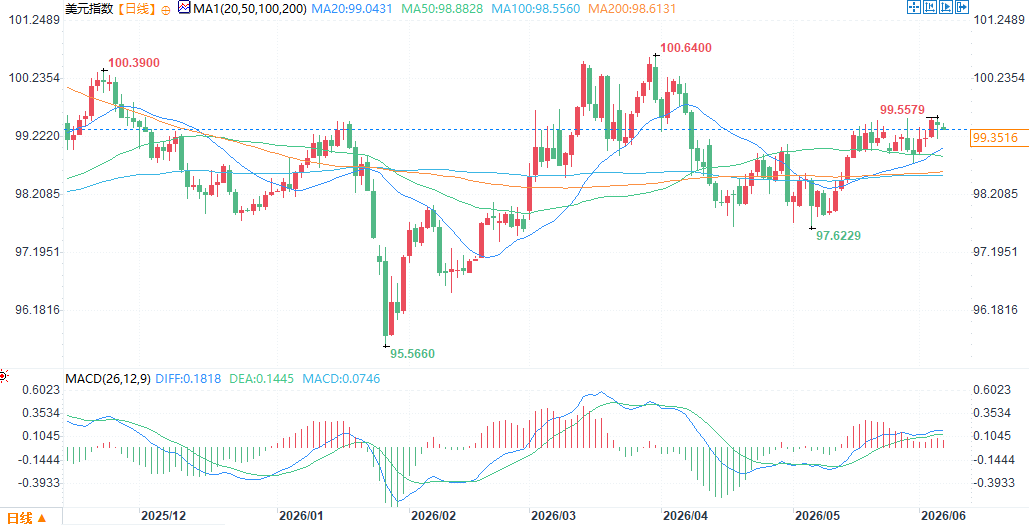
(US Dollar Index Daily Chart, Source: FX678)
At 16:33 Beijing time on June 5, the US dollar index was at 99.24.
Ahead of the non-farm payroll data release, market sentiment turned cautious, and the US dollar continued its downward trend from the previous day.
The U.S. non-farm payroll data for May will be released tonight, and this will be the most important labor market update before the new Federal Reserve Chairman, Warsh, chairs his first policy meeting later this month.
Recent labor market data presents a mixed but generally stable picture of the job market—ADP reported 122,000 new jobs, exceeding expectations, and JOLTS job openings unexpectedly jumped to 7.6 million, but initial jobless claims rose slightly and the voluntary turnover rate fell to its lowest level since the pandemic.
Non-farm payroll scenario projection: Weak data would lower the probability of an interest rate hike, while strong data would indicate an imminent breakout for the US dollar.
If May's non-farm payrolls increase significantly falls short of the expected 85,000, or if the unemployment rate unexpectedly rises, it could weaken market expectations for interest rates. Currently, federal funds futures market pricing indicates a roughly 50% probability that the Federal Reserve will need to raise interest rates this year to combat inflation—a probability that has risen sharply from a month ago, but significant uncertainty remains. A weak non-farm payroll report could prompt the market to reassess the necessity of a rate hike, lowering the probability from 50%, potentially putting downward pressure on the dollar.
Conversely, if the non-farm payroll data exceeds expectations (e.g., more than 120,000 new jobs) or wage growth unexpectedly rises, it will further strengthen market expectations that the Federal Reserve will maintain its tightening stance, and the probability of a rate hike may rise further from 50%. The US dollar is expected to break through the key resistance level of 99.50 and test the 100.15/42 area.
Next week's CPI is also crucial.
It's important to emphasize that the non-farm payroll data is only the first piece of the puzzle. The May CPI report, to be released next week, is equally crucial—April's CPI rose to 3.8% year-on-year, well above the Fed's 2% target. Traders will use this data to assess whether new Fed Chairman Warsh is willing to ease policy amid escalating inflation concerns. If the CPI continues to rise, even with a weak non-farm payroll report, the Fed may be forced to maintain a hawkish stance; if the CPI shows signs of decline, it could provide Warsh with some policy flexibility.
Warsh had previously been optimistic about the deflationary potential of AI, believing it could create conditions for interest rate cuts. However, current data is challenging this optimistic outlook—high energy prices, a resilient labor market, and the AI investment boom actually boosting demand in the short term. He faces a dilemma: sticking to the AI deflationary logic and remaining on hold could risk runaway inflation; aligning with the data's shift towards a hawkish stance could go against Trump's desire for interest rate cuts. The market will closely watch any statements he makes after the release of the non-farm payroll and CPI data.
Institutional Views
OCBC strategists stated that the US dollar is expected to exhibit a "firm but range-bound" pattern. Resilient US economic growth and persistent inflation are supporting the dollar, which has gradually strengthened over the past few weeks. If the US and Iran reach an agreement to reopen the Strait of Hormuz, falling oil prices will negatively impact the dollar, but the relative strength of the US economy should limit its downside. Currently, there are no strong reasons to be bearish on the dollar; the baseline scenario anticipates a gradual recovery in Middle Eastern oil flows in the second half of the year.
A senior market analyst at FOREX.com pointed out that the US dollar index has been blocked below the key resistance area of 99.50 for the third consecutive week, indicating a lack of confidence in the Federal Reserve's policy path. Currently, the market is pricing in a roughly 50% probability that the Fed will not raise interest rates this year, and this divergence in expectations has resulted in a lack of clear direction for the dollar. The upcoming non-farm payroll data will be a key catalyst—if the job market remains resilient, it may strengthen inflation concerns and reduce expectations of further easing; if the data weakens, it may prompt the market to reassess the policy outlook. A break above 99.50 for the dollar requires confirmation that the Fed's expectations have shifted back towards tightening.
Technical Analysis
The US dollar index has rebounded from its previous low of 97.62 and is currently hovering below its previous high of 99.56, near the 20-day moving average. The current price is firmly supported by the 100-day and 200-day moving averages, and the medium-term upward trend is clear, with the moving average system forming a multi-layered support zone below.
The MACD indicator is running above the zero axis, with the DIFF remaining above the DEA. The red bars are slightly converging, but the bullish structure remains intact, and bullish momentum still exists. The key short-term resistance is 99.56. A break above this level will open up upward space. When the price retraces, the moving averages will provide support. Overall, the short-term trend is one of slightly bullish fluctuation.
(US Dollar Index Daily Chart, Source: FX678)
At 16:33 Beijing time on June 5, the US dollar index was at 99.24.
- Risk Warning and Disclaimer
- The market involves risk, and trading may not be suitable for all investors. This article is for reference only and does not constitute personal investment advice, nor does it take into account certain users’ specific investment objectives, financial situation, or other needs. Any investment decisions made based on this information are at your own risk.