With foreign exchange reserves falling to a record low and Japan's room for intervention narrowing, can the yen still hold the 160 red line?
2026-06-05 16:48:01
On Friday (June 5), during the European session, the USD/JPY pair saw a slight pullback, currently trading around 159.90. The pair had previously touched the 160 yen level.
Japanese Finance Minister Katsunobu Kato said on Friday that Japan is ready to respond to the foreign exchange market and reserves the right to take "decisive action" to deal with excessive volatility, as the yen hovers near the key level of 160 yen to the dollar.
These remarks come as investors are closely watching official signals for any indication that Japan may be preparing to intervene again to rescue the weak yen.
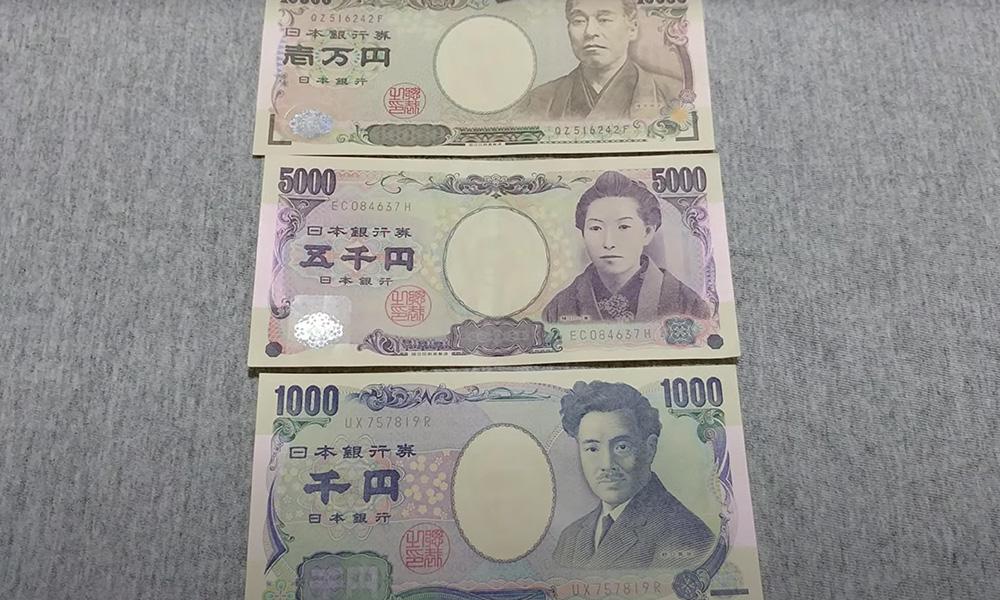
Japanese Finance Minister Katsunobu Kato stated in parliament that Japan will respond appropriately to the foreign exchange market if necessary. He pointed out that since the outbreak of the Middle East war in February, speculative activity has accounted for a large portion of the highly volatile market. Kato revealed that Japan and the United States are maintaining close contact regarding market trends, and according to the joint statement signed last year, Japan has the right to take decisive action against excessive volatility. This statement came against the backdrop of the yen approaching the key 160 level again, which the market interpreted as a warning of potential intervention.
Japanese Prime Minister Sanae Takaichi stated at the same meeting that the best way to maintain the yen's value is not through temporary intervention, but by investing in growth sectors to enhance Japan's global competitiveness. She called for increased investment in high-tech, green energy, and digital transformation. Analysts believe that short-term intervention and long-term reforms complement each other—intervention buys time for reform, while reform provides an exit strategy for intervention; together, they constitute Japan's dual strategy for dealing with a weak yen.
Japanese Finance Minister Satsuki Katayama stated that the authorities are prepared to take appropriate measures in the foreign exchange market at any time and reserve the right to take "decisive action" against excessive exchange rate fluctuations.
The sharp decline in foreign exchange reserves highlights the cost of intervention.
Data released on Friday showed that Japan's foreign exchange reserves suffered a historic drop, falling $77.1 billion from the previous month to $1.306 trillion, a decline of 5.6%, marking the largest monthly decline since the resumption of large-scale intervention. This indicates that the limitations of continued large-scale intervention are becoming apparent after the record $73 billion yen purchase operation.
Structurally, foreign securities were the main factor in the decline, decreasing by $75.6 billion to $931.7 billion that month. Analysts believe that U.S. Treasury bonds appeared to be sold to fund market intervention, and Tokyo has signaled its willingness to finance through the sale of U.S. Treasury bonds. Finance Ministry officials declined to confirm this, noting that rising yields also dragged down reserve values.
Analysts point out that volatility in global bond markets may reduce the US's tolerance for large-scale Japanese yen purchases (if involving substantial sales of US Treasury bonds), thereby shrinking Tokyo's room for maneuver. As the costs of intervention become increasingly apparent, Japan's future policy options for dealing with yen depreciation will face greater constraints.
According to one analyst, US Treasury bonds appear to have been sold to fund market intervention, with Tokyo signaling its willingness to finance such operations through the sale of US Treasury bonds. He pointed out that the sharp reduction in foreign exchange reserves of securities coincided closely with the timing of the intervention; Japanese authorities conducted a record $73 billion intervention during the Golden Week holiday, with the reduction of US Treasury bonds being the most direct source of dollar funding.
A Ministry of Finance official declined to confirm whether U.S. bonds were sold as part of the intervention, noting that the recent rise in U.S. Treasury yields had also reduced the market value of bond holdings, thus dragging down foreign exchange reserves. In other words, the decline in reserves was partly due to valuation devaluation, not entirely due to active intervention. The Ministry of Finance's ambiguous statement both preserved flexibility for future operations and avoided potential diplomatic friction from directly confirming the details of the intervention.
Patrick Zweifel, chief economist at Pictet Asset Management, said Japan would defend the yen by selling US Treasury bonds, calling it a "natural trend." He cited two main reasons: the central bank's own balance sheet management needs and the need to diversify geopolitical risks.
Weber's analysis points out that the sharp rise in Japanese long-term government bond yields is mainly attributed to the increase in "inflation risk premium" and "sovereign risk premium." The Bank of Japan's lack of credibility in combating inflation has led to solidified inflation expectations, trapping the yen in a "vicious cycle"—the central bank's lack of credibility leads to rising inflation expectations, which in turn causes the yen to depreciate, exacerbating import inflation and further increasing inflation expectations.
Regarding the effectiveness of intervention, Weber emphasized that intervention can only smooth out fluctuations, not reverse trends. "Ultimately, a change in economic fundamentals is needed to reverse the trend." He predicted that for the yen to escape its predicament, one of three things is needed: the Bank of Japan demonstrating a stronger determination to combat inflation and raising interest rates significantly, inflation unexpectedly plummeting, or fiscal policy shifting towards tightening.
Analysts say that turmoil in global bond markets could reduce Washington's tolerance for another large-scale yen purchase, if it involves a significant sale of U.S. Treasury bonds, thus shrinking Tokyo's room for maneuver.
Yuji Saito, executive advisor at SBI FX Trade, suggested a potential mechanism to alleviate these constraints. He stated that Japan could utilize the Federal Reserve's foreign and international monetary authorities repurchase facility to increase dollar liquidity without directly selling U.S. Treasury bonds. This facility, launched in March 2020 to stabilize markets during the pandemic, can now serve a dual purpose: both easing funding pressures and sending a warning signal to the market. Saito stated, "The key is to stabilize the bond market while simultaneously sending a warning signal to the foreign exchange market."
The USD/JPY pair is currently in a medium- to long-term upward channel on the daily chart, with the current price approaching the important resistance level of 160. After retracing to a low of 155, it has been steadily rising, with the 200-day moving average providing long-term upward support. Short- and medium-term moving averages are also turning upward in tandem, indicating a solid bullish trend and multiple layers of support from the moving averages.
The MACD is running above the zero line, the DIFF is above the DEA, and the red bars are maintained, indicating strong bullish momentum. In the short term, it is under pressure at the historical high of 160.47. A breakthrough would open up upward space, while pullbacks would find support at the 20/50-day moving averages. The short-term trend is expected to be slightly bullish with some fluctuations.
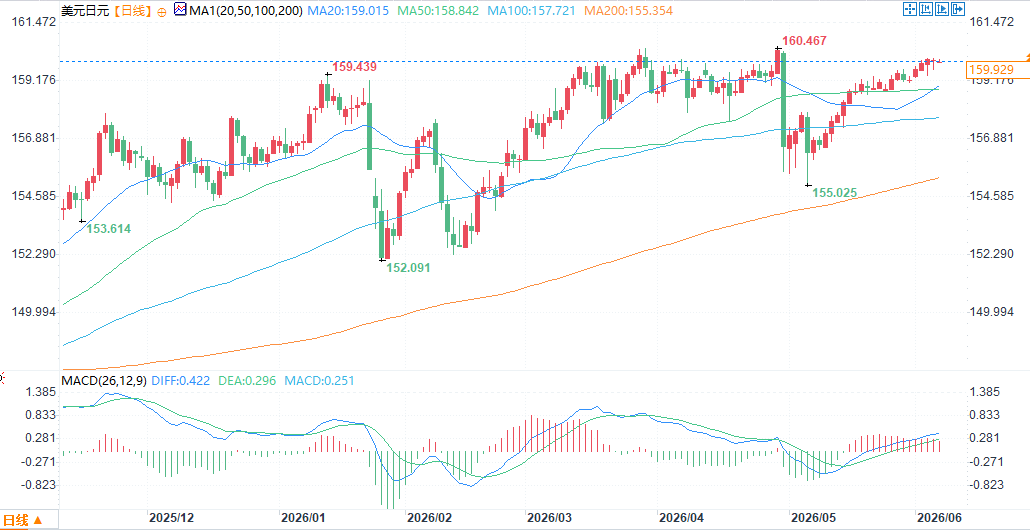
(USD/JPY daily chart, source: FX678)
At 16:19 Beijing time on June 5, the USD/JPY exchange rate was 159.92/93.
Japanese Finance Minister Katsunobu Kato said on Friday that Japan is ready to respond to the foreign exchange market and reserves the right to take "decisive action" to deal with excessive volatility, as the yen hovers near the key level of 160 yen to the dollar.
These remarks come as investors are closely watching official signals for any indication that Japan may be preparing to intervene again to rescue the weak yen.
Intervention warnings and market background
Japanese Finance Minister Katsunobu Kato stated in parliament that Japan will respond appropriately to the foreign exchange market if necessary. He pointed out that since the outbreak of the Middle East war in February, speculative activity has accounted for a large portion of the highly volatile market. Kato revealed that Japan and the United States are maintaining close contact regarding market trends, and according to the joint statement signed last year, Japan has the right to take decisive action against excessive volatility. This statement came against the backdrop of the yen approaching the key 160 level again, which the market interpreted as a warning of potential intervention.
Japanese Prime Minister Sanae Takaichi stated at the same meeting that the best way to maintain the yen's value is not through temporary intervention, but by investing in growth sectors to enhance Japan's global competitiveness. She called for increased investment in high-tech, green energy, and digital transformation. Analysts believe that short-term intervention and long-term reforms complement each other—intervention buys time for reform, while reform provides an exit strategy for intervention; together, they constitute Japan's dual strategy for dealing with a weak yen.
Japanese Finance Minister Satsuki Katayama stated that the authorities are prepared to take appropriate measures in the foreign exchange market at any time and reserve the right to take "decisive action" against excessive exchange rate fluctuations.
The sharp decline in foreign exchange reserves highlights the cost of intervention.
Data released on Friday showed that Japan's foreign exchange reserves suffered a historic drop, falling $77.1 billion from the previous month to $1.306 trillion, a decline of 5.6%, marking the largest monthly decline since the resumption of large-scale intervention. This indicates that the limitations of continued large-scale intervention are becoming apparent after the record $73 billion yen purchase operation.
Structurally, foreign securities were the main factor in the decline, decreasing by $75.6 billion to $931.7 billion that month. Analysts believe that U.S. Treasury bonds appeared to be sold to fund market intervention, and Tokyo has signaled its willingness to finance through the sale of U.S. Treasury bonds. Finance Ministry officials declined to confirm this, noting that rising yields also dragged down reserve values.
Analysts point out that volatility in global bond markets may reduce the US's tolerance for large-scale Japanese yen purchases (if involving substantial sales of US Treasury bonds), thereby shrinking Tokyo's room for maneuver. As the costs of intervention become increasingly apparent, Japan's future policy options for dealing with yen depreciation will face greater constraints.
Analyst opinion: US Treasuries were sold off to finance intervention.
According to one analyst, US Treasury bonds appear to have been sold to fund market intervention, with Tokyo signaling its willingness to finance such operations through the sale of US Treasury bonds. He pointed out that the sharp reduction in foreign exchange reserves of securities coincided closely with the timing of the intervention; Japanese authorities conducted a record $73 billion intervention during the Golden Week holiday, with the reduction of US Treasury bonds being the most direct source of dollar funding.
A Ministry of Finance official declined to confirm whether U.S. bonds were sold as part of the intervention, noting that the recent rise in U.S. Treasury yields had also reduced the market value of bond holdings, thus dragging down foreign exchange reserves. In other words, the decline in reserves was partly due to valuation devaluation, not entirely due to active intervention. The Ministry of Finance's ambiguous statement both preserved flexibility for future operations and avoided potential diplomatic friction from directly confirming the details of the intervention.
Patrick Zweifel, chief economist at Pictet Asset Management, said Japan would defend the yen by selling US Treasury bonds, calling it a "natural trend." He cited two main reasons: the central bank's own balance sheet management needs and the need to diversify geopolitical risks.
Weber's analysis points out that the sharp rise in Japanese long-term government bond yields is mainly attributed to the increase in "inflation risk premium" and "sovereign risk premium." The Bank of Japan's lack of credibility in combating inflation has led to solidified inflation expectations, trapping the yen in a "vicious cycle"—the central bank's lack of credibility leads to rising inflation expectations, which in turn causes the yen to depreciate, exacerbating import inflation and further increasing inflation expectations.
Regarding the effectiveness of intervention, Weber emphasized that intervention can only smooth out fluctuations, not reverse trends. "Ultimately, a change in economic fundamentals is needed to reverse the trend." He predicted that for the yen to escape its predicament, one of three things is needed: the Bank of Japan demonstrating a stronger determination to combat inflation and raising interest rates significantly, inflation unexpectedly plummeting, or fiscal policy shifting towards tightening.
Potential constraints: Volatility in the US Treasury market may limit Japan's room for maneuver.
Analysts say that turmoil in global bond markets could reduce Washington's tolerance for another large-scale yen purchase, if it involves a significant sale of U.S. Treasury bonds, thus shrinking Tokyo's room for maneuver.
Yuji Saito, executive advisor at SBI FX Trade, suggested a potential mechanism to alleviate these constraints. He stated that Japan could utilize the Federal Reserve's foreign and international monetary authorities repurchase facility to increase dollar liquidity without directly selling U.S. Treasury bonds. This facility, launched in March 2020 to stabilize markets during the pandemic, can now serve a dual purpose: both easing funding pressures and sending a warning signal to the market. Saito stated, "The key is to stabilize the bond market while simultaneously sending a warning signal to the foreign exchange market."
Technical Analysis
The USD/JPY pair is currently in a medium- to long-term upward channel on the daily chart, with the current price approaching the important resistance level of 160. After retracing to a low of 155, it has been steadily rising, with the 200-day moving average providing long-term upward support. Short- and medium-term moving averages are also turning upward in tandem, indicating a solid bullish trend and multiple layers of support from the moving averages.
The MACD is running above the zero line, the DIFF is above the DEA, and the red bars are maintained, indicating strong bullish momentum. In the short term, it is under pressure at the historical high of 160.47. A breakthrough would open up upward space, while pullbacks would find support at the 20/50-day moving averages. The short-term trend is expected to be slightly bullish with some fluctuations.
(USD/JPY daily chart, source: FX678)
At 16:19 Beijing time on June 5, the USD/JPY exchange rate was 159.92/93.
- Risk Warning and Disclaimer
- The market involves risk, and trading may not be suitable for all investors. This article is for reference only and does not constitute personal investment advice, nor does it take into account certain users’ specific investment objectives, financial situation, or other needs. Any investment decisions made based on this information are at your own risk.