Iran's surprise attack on Israel caused oil prices to surge by as much as 3%! Analysts say that increasing production is meaningless unless the Strait of Hormuz reopens.
2026-06-08 08:41:40
On Monday (June 8) during Asian trading hours, international oil prices jumped more than 3% at one point, with WTI crude oil rising to $93.90 per barrel, approaching the $94 mark. Prices subsequently retreated somewhat, and WTI crude oil is currently trading above $92.50 per barrel.
Iran launched multiple missiles into Israel on Sunday, threatening the already fragile US-Iran ceasefire agreement and further dimming the prospects for peace negotiations.
Despite the ongoing conflict in the Middle East, which has prevented several OPEC+ members from increasing production, the organization approved its fourth increase in crude oil production targets in four months on Sunday (June 7). Since the end of February, the disruption of oil shipping routes through the Strait of Hormuz due to the war has caused the worst supply crisis in global history, with major OPEC+ members such as Saudi Arabia unable to fully meet customer demand. The UAE's withdrawal from OPEC after nearly 60 years of membership has further exacerbated the predicament facing OPEC+.
The seven core members of OPEC+ (comprising OPEC and allies such as Russia) increased their production quotas by nearly 600,000 barrels per day between April and June, attempting to send a stabilizing signal to the market through monthly increases. However, this policy adjustment on paper has not translated into an actual increase in supply. According to official data released by OPEC, the group's overall actual output has actually plummeted, dragged down by a sharp reduction in the export capacity of major Gulf member countries.
Specifically, in February of this year, OPEC+ daily production remained at a high level of 42.77 million barrels. At that time, although tensions between the United States and Iran were beginning to emerge, shipping through the Strait of Hormuz was not completely disrupted, and crude oil exports from major oil-producing countries remained largely normal. However, by April, with the continued escalation of the military conflict, the Strait of Hormuz, the world's most critical oil transport route, was effectively cut off, preventing Gulf countries such as Saudi Arabia and Kuwait from smoothly shipping their crude oil. Even those countries that still had production capacity could not convert it into effective export supply.
Against this backdrop, OPEC+'s actual daily output in April fell to 33.19 million barrels, a sharp decrease of 9.58 million barrels from February, representing a drop of over 22%. This huge gap not only completely offset the theoretical increase brought about by the quota increase, but also exposed a serious disconnect between current production policy and geopolitical realities. Analysts point out that as long as the Straits blockade continues, any written commitment to increase production will be unlikely to change the actual situation of tight supply.
In a formal statement released on Sunday, OPEC said its seven core members had agreed to raise its crude oil production target by 188,000 barrels per day starting in July, the same increase as in June. This marks the fourth consecutive month that OPEC+ has raised its production quotas, demonstrating its intention to alleviate market supply shortages through continued production increases.
It's worth noting that the upward revision in July was smaller than in the previous two months. Data shows that the monthly increase in May and April was 206,000 barrels per day, while the increase in June and July was revised down to 188,000 barrels per day. OPEC explained that this adjustment mainly took into account the UAE's withdrawal from the organization. Since May 1st, the UAE has no longer participated in OPEC+ production quota allocation, so the remaining member countries need to rebalance their respective production increases, resulting in a slight reduction in the monthly increase.
At the national level, a spokesperson for the Iraqi Ministry of Oil told the country's official news agency that, according to the latest agreement, Iraq's crude oil production quota will increase by 26,000 barrels per day starting in July. As the second-largest oil producer within OPEC after Saudi Arabia, Iraq's slight increase in production is seen as a positive response to the current supply crisis in the global market. Analysts point out that although the increase is limited, this move will help partially offset the supply gap caused by the obstruction of exports from Gulf countries; however, the actual effect still depends on whether the navigation conditions in the Strait of Hormuz can be improved.
Saxo Bank commodities analyst Ole Hansen told AFP that any announced production increases or adjustments to production targets by OPEC+ will have very limited practical value, as OPEC is currently almost powerless. He believes the core issue in the market is not supply willingness or quota figures, but rather the inability of major Gulf oil-producing countries like Saudi Arabia and Kuwait to transport crude oil through the Strait of Hormuz, a crucial waterway closed due to the US-Iran conflict. Therefore, no matter how much OPEC+ raises production quotas monthly, this "paper oil" cannot actually reach global buyers.
Hansen further pointed out that the overproduction compensation mechanism previously established by OPEC+—which required overproduction members to make up for quota overruns through additional production cuts—has now become virtually ineffective due to widespread supply disruptions. With several core member countries forced to drastically reduce exports due to force majeure (Strait blockade, export facility shutdowns), the mechanism lacks both an operational basis and the ability to have any marginal impact on actual supply. Hansen's comments reveal a crucial reality: until the Strait of Hormuz reopens, any policy tools from OPEC+ will be unlikely to change the underlying supply shortage.
This production increase by seven countries is a crucial part of the gradual withdrawal from the 1.65 million barrels per day production cut agreement reached in 2023. It's worth noting that the UAE was still a member of the agreement at the time, participating in the initial allocation of production cut quotas. According to the original roadmap, OPEC+ planned to smoothly exit all production cuts by the end of 2025 through small monthly increases. However, with the UAE's formal withdrawal from OPEC on May 1st, the original production allocation pattern was disrupted, forcing the remaining member countries to readjust their replenishment schedules.
Based on calculations using the latest agreement terms, starting in July, and considering the UAE's withdrawal and subsequent cessation of quota allocation, the seven core member countries will need to replenish approximately 567,000 barrels per day of their remaining production cuts to the market. This figure is derived from the original total production cut of 1.65 million barrels per day for 2023, minus the portion gradually replenished in previous months, and excluding the UAE's share.
Based on the current production increase path, if OPEC+ continues to increase production by approximately 188,000 barrels per day in August and September, the remaining 567,000 barrels per day of production cuts will be fully replenished by the end of September. This means that by this fall at the latest, the seven core OPEC+ members will have completely withdrawn from the production cuts implemented since 2023, theoretically restoring production levels to pre-cut levels. However, analysts point out that whether actual supply can recover simultaneously still depends on the navigation conditions of the Strait of Hormuz and the export compliance capabilities of each member country.
US crude oil futures are currently in a weak consolidation phase after a period of high-level fluctuations. A double top formed at $119.48 and $117.63, with prices falling back to around $92. Key support is at $86.35, and resistance is at $92.70. The medium-term moving average system shows that the long-term bullish trend remains intact, but the short-term 20-day moving average (MA20) has turned downwards, and prices have broken below this moving average.
In terms of technical indicators, the MACD has formed a death cross below the zero line, and the green bars are still releasing bearish momentum; the RSI is in the neutral to weak range of 46.88, with no obvious oversold signal, indicating insufficient short-term rebound momentum.
In summary, oil prices are likely to be weak in the short term. If they cannot hold above $92.70, they will likely test the support level at $86.35. If they break through the resistance level with significant volume, they may rebound to test the MA50 resistance. Overall, we need to be wary of fundamental factors causing disruption, and the technical outlook is currently dominated by a weak and volatile trend.
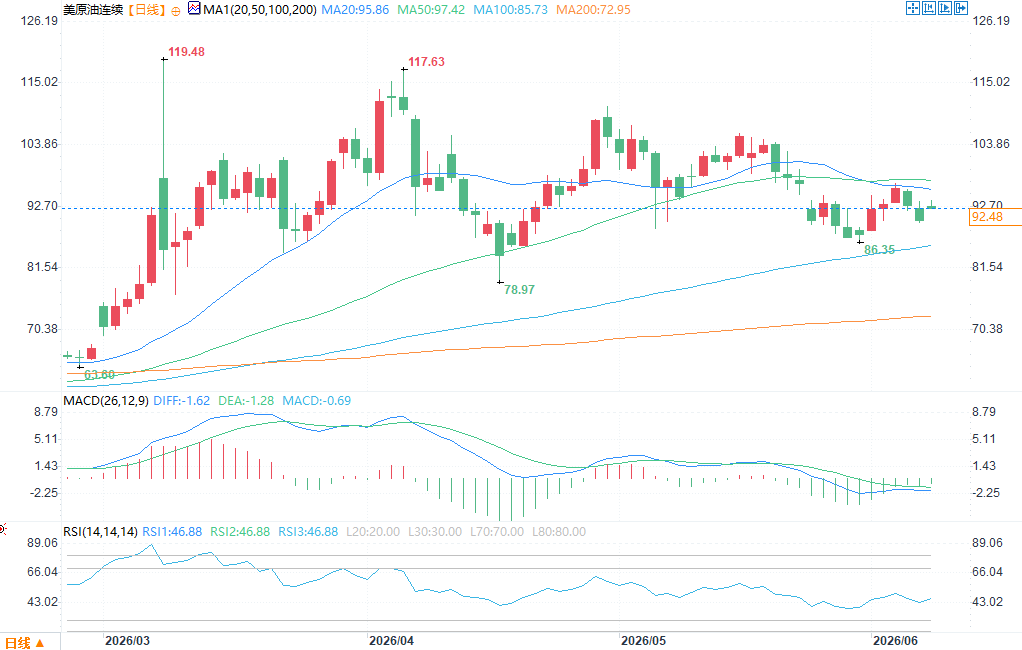
(US crude oil futures daily chart, source: FX678)
At 8:34 AM Beijing time on June 8, US crude oil futures were trading at $92.57 per barrel.
Iran launched multiple missiles into Israel on Sunday, threatening the already fragile US-Iran ceasefire agreement and further dimming the prospects for peace negotiations.
Despite the ongoing conflict in the Middle East, which has prevented several OPEC+ members from increasing production, the organization approved its fourth increase in crude oil production targets in four months on Sunday (June 7). Since the end of February, the disruption of oil shipping routes through the Strait of Hormuz due to the war has caused the worst supply crisis in global history, with major OPEC+ members such as Saudi Arabia unable to fully meet customer demand. The UAE's withdrawal from OPEC after nearly 60 years of membership has further exacerbated the predicament facing OPEC+.
Background to increased production: The dual impact of war and withdrawal
The seven core members of OPEC+ (comprising OPEC and allies such as Russia) increased their production quotas by nearly 600,000 barrels per day between April and June, attempting to send a stabilizing signal to the market through monthly increases. However, this policy adjustment on paper has not translated into an actual increase in supply. According to official data released by OPEC, the group's overall actual output has actually plummeted, dragged down by a sharp reduction in the export capacity of major Gulf member countries.
Specifically, in February of this year, OPEC+ daily production remained at a high level of 42.77 million barrels. At that time, although tensions between the United States and Iran were beginning to emerge, shipping through the Strait of Hormuz was not completely disrupted, and crude oil exports from major oil-producing countries remained largely normal. However, by April, with the continued escalation of the military conflict, the Strait of Hormuz, the world's most critical oil transport route, was effectively cut off, preventing Gulf countries such as Saudi Arabia and Kuwait from smoothly shipping their crude oil. Even those countries that still had production capacity could not convert it into effective export supply.
Against this backdrop, OPEC+'s actual daily output in April fell to 33.19 million barrels, a sharp decrease of 9.58 million barrels from February, representing a drop of over 22%. This huge gap not only completely offset the theoretical increase brought about by the quota increase, but also exposed a serious disconnect between current production policy and geopolitical realities. Analysts point out that as long as the Straits blockade continues, any written commitment to increase production will be unlikely to change the actual situation of tight supply.
Latest decision: An additional 188,000 barrels per day will be added in July.
In a formal statement released on Sunday, OPEC said its seven core members had agreed to raise its crude oil production target by 188,000 barrels per day starting in July, the same increase as in June. This marks the fourth consecutive month that OPEC+ has raised its production quotas, demonstrating its intention to alleviate market supply shortages through continued production increases.
It's worth noting that the upward revision in July was smaller than in the previous two months. Data shows that the monthly increase in May and April was 206,000 barrels per day, while the increase in June and July was revised down to 188,000 barrels per day. OPEC explained that this adjustment mainly took into account the UAE's withdrawal from the organization. Since May 1st, the UAE has no longer participated in OPEC+ production quota allocation, so the remaining member countries need to rebalance their respective production increases, resulting in a slight reduction in the monthly increase.
At the national level, a spokesperson for the Iraqi Ministry of Oil told the country's official news agency that, according to the latest agreement, Iraq's crude oil production quota will increase by 26,000 barrels per day starting in July. As the second-largest oil producer within OPEC after Saudi Arabia, Iraq's slight increase in production is seen as a positive response to the current supply crisis in the global market. Analysts point out that although the increase is limited, this move will help partially offset the supply gap caused by the obstruction of exports from Gulf countries; however, the actual effect still depends on whether the navigation conditions in the Strait of Hormuz can be improved.
Market reaction: Analysts believe that increasing production has limited significance.
Saxo Bank commodities analyst Ole Hansen told AFP that any announced production increases or adjustments to production targets by OPEC+ will have very limited practical value, as OPEC is currently almost powerless. He believes the core issue in the market is not supply willingness or quota figures, but rather the inability of major Gulf oil-producing countries like Saudi Arabia and Kuwait to transport crude oil through the Strait of Hormuz, a crucial waterway closed due to the US-Iran conflict. Therefore, no matter how much OPEC+ raises production quotas monthly, this "paper oil" cannot actually reach global buyers.
Hansen further pointed out that the overproduction compensation mechanism previously established by OPEC+—which required overproduction members to make up for quota overruns through additional production cuts—has now become virtually ineffective due to widespread supply disruptions. With several core member countries forced to drastically reduce exports due to force majeure (Strait blockade, export facility shutdowns), the mechanism lacks both an operational basis and the ability to have any marginal impact on actual supply. Hansen's comments reveal a crucial reality: until the Strait of Hormuz reopens, any policy tools from OPEC+ will be unlikely to change the underlying supply shortage.
Gradual recovery: The 2023 production cut plan will soon be fully phased out.
This production increase by seven countries is a crucial part of the gradual withdrawal from the 1.65 million barrels per day production cut agreement reached in 2023. It's worth noting that the UAE was still a member of the agreement at the time, participating in the initial allocation of production cut quotas. According to the original roadmap, OPEC+ planned to smoothly exit all production cuts by the end of 2025 through small monthly increases. However, with the UAE's formal withdrawal from OPEC on May 1st, the original production allocation pattern was disrupted, forcing the remaining member countries to readjust their replenishment schedules.
Based on calculations using the latest agreement terms, starting in July, and considering the UAE's withdrawal and subsequent cessation of quota allocation, the seven core member countries will need to replenish approximately 567,000 barrels per day of their remaining production cuts to the market. This figure is derived from the original total production cut of 1.65 million barrels per day for 2023, minus the portion gradually replenished in previous months, and excluding the UAE's share.
Based on the current production increase path, if OPEC+ continues to increase production by approximately 188,000 barrels per day in August and September, the remaining 567,000 barrels per day of production cuts will be fully replenished by the end of September. This means that by this fall at the latest, the seven core OPEC+ members will have completely withdrawn from the production cuts implemented since 2023, theoretically restoring production levels to pre-cut levels. However, analysts point out that whether actual supply can recover simultaneously still depends on the navigation conditions of the Strait of Hormuz and the export compliance capabilities of each member country.
Technical Analysis
US crude oil futures are currently in a weak consolidation phase after a period of high-level fluctuations. A double top formed at $119.48 and $117.63, with prices falling back to around $92. Key support is at $86.35, and resistance is at $92.70. The medium-term moving average system shows that the long-term bullish trend remains intact, but the short-term 20-day moving average (MA20) has turned downwards, and prices have broken below this moving average.
In terms of technical indicators, the MACD has formed a death cross below the zero line, and the green bars are still releasing bearish momentum; the RSI is in the neutral to weak range of 46.88, with no obvious oversold signal, indicating insufficient short-term rebound momentum.
In summary, oil prices are likely to be weak in the short term. If they cannot hold above $92.70, they will likely test the support level at $86.35. If they break through the resistance level with significant volume, they may rebound to test the MA50 resistance. Overall, we need to be wary of fundamental factors causing disruption, and the technical outlook is currently dominated by a weak and volatile trend.
(US crude oil futures daily chart, source: FX678)
At 8:34 AM Beijing time on June 8, US crude oil futures were trading at $92.57 per barrel.
- Risk Warning and Disclaimer
- The market involves risk, and trading may not be suitable for all investors. This article is for reference only and does not constitute personal investment advice, nor does it take into account certain users’ specific investment objectives, financial situation, or other needs. Any investment decisions made based on this information are at your own risk.