The ceasefire agreement is now defunct! Gold has fallen below the $4,300 mark; will this week's US CPI be its lifeline?
2026-06-08 13:47:01
On Monday (June 8) during Asian trading hours, spot gold prices quickly plunged after hitting $4,353 per ounce at the open, currently falling below $4,300. As of 13:40, it had reached its lowest level since March 22, at $4,268.42 per ounce. Market risk aversion and concerns about the situation in the Middle East intertwined, leading to sharp fluctuations in precious metal prices.
Despite the escalating tensions in the Middle East initially boosting safe-haven demand, stronger-than-expected US non-farm payroll data has shifted the Federal Reserve's interest rate expectations, leaving gold under continued selling pressure. Market focus is now shifting to next week's inflation data.
Tensions in the Middle East escalated sharply again early Monday morning local time. Israel launched airstrikes against military targets in western and central Iran in response to a previous Iranian missile attack. According to Iranian state media, loud explosions were heard in the capital Tehran, the northwestern city of Tabriz, and the central city of Isfahan. The explosions in Isfahan province, home to important Iranian nuclear facilities and military bases, have raised deep international concerns that the conflict could spread further to these facilities.
The Israeli airstrikes came just hours after Iran launched multiple missile attacks into Israel. Iran stated that the retaliatory action was a response to an earlier Israeli attack on the southern outskirts of Beirut, the Lebanese capital. The Israeli strike on Beirut's southern outskirts resulted in at least two deaths and more than ten injuries, further escalating the cross-border confrontation between Hezbollah and Israel.
As Israel and Iran become entangled in a cycle of "attacks and retaliations," the already precarious US-Iran ceasefire agreement faces the risk of complete collapse. The ongoing conflict since late February has disrupted shipping in the Strait of Hormuz, and this latest action by both sides directly targeting each other's territory marks a new and more dangerous phase in the Middle East situation.
Following the release of the non-farm payroll data, the market significantly repriced its expectations for Federal Reserve interest rates. Previously, the mainstream market expectation was that the Fed would maintain interest rates unchanged or even cut them this year, but the much stronger-than-expected 172,000 new non-farm jobs in May completely changed this assessment. Federal funds futures now indicate that the market expects a nearly 73% probability of at least a 25 basis point rate hike by the end of the year, compared to only around 45% a week ago. This dramatic shift reflects how a strong labor market is reshaping investors' perceptions of the monetary policy path.
Market focus has now shifted to this week's May CPI report. April's CPI unexpectedly rose 3.8% year-on-year, exceeding market expectations. Driven by the recent surge in energy prices, the market anticipates May inflation will accelerate further to 4.2%. If inflation data remains robust, it could further reinforce the recent hawkish shift in market pricing, even pushing the probability of an interest rate hike towards 80% or higher. Conversely, if inflation unexpectedly slows, it could partially offset the interest rate hike expectations brought about by the non-farm payroll data, providing breathing room for non-yielding assets such as gold.
Since the inflation side of the Federal Reserve's dual mandate is likely to determine the next policy move by new Chairman Kevin Warsh, gold will remain vulnerable as long as energy prices remain high. The continued closure of the Strait of Hormuz has pushed crude oil prices above $90, and rising energy costs are being passed on to end-consumer prices through gasoline, electricity, and transportation costs. Unless there is a substantial easing of tensions in the Middle East, energy prices are unlikely to fall significantly, meaning inflationary pressures will persist. Against this backdrop, the Federal Reserve is likely to be forced to maintain a hawkish stance, and gold, as a non-interest-bearing asset, will face continued holding cost pressures under the expectation of rising interest rates, making its short-term outlook unfavorable.
JPMorgan Chase remains bullish on the medium-term outlook for gold, despite short-term weak demand leading to a downward revision of its 2026 average price forecast. In May, the bank lowered its 2026 average gold price forecast from $5,708/oz to $5,243/oz, primarily due to a temporary slump in both financial trading demand and physical gold allocation demand, which dragged down gold prices in the first half of the year. However, JPMorgan Chase explicitly maintains its year-end upside target, predicting that gold prices could climb to $6,000/oz by the end of 2026. The bank's analysts believe that the current downturn is temporary, and as macroeconomic uncertainties such as energy and inflation gradually dissipate, demand for gold will rebound.
Entering the second half of 2026, institutional investors' trading and allocation needs, along with the normalized gold purchases by global central banks, are expected to rebound simultaneously, providing a dual impetus for rising gold prices. JPMorgan Chase also predicts that the average gold price will rise further to $6,263 per ounce in 2027, believing that the current upward cycle in gold prices has not ended. Natasha Kaneva, head of commodities research at the bank, further pointed out that if the Strait of Hormuz reopens to traffic in June, the Federal Reserve is more likely to remain on hold, leading to a decline in real interest rates and a rise in gold prices, prompting central banks to resume gold purchases. She predicts that gold prices could reach $6,000 per ounce by the end of the year and rise to $6,300 per ounce by the end of 2027.
Goldman Sachs remains firmly bullish. In its latest research report, the bank maintained its bullish target of $5,400/ounce for gold by the end of 2026, clearly stating its structurally bullish outlook on the medium- to long-term trend of gold prices, while only taking a tactical cautious approach to short-term fluctuations.
Goldman Sachs' core bullish logic focuses on the inelastic demand for gold from global central banks. Data shows that global central bank gold purchases are expected to continue to rebound in 2026, with average monthly purchases potentially reaching 60 tons, a significant increase from previous averages. Goldman Sachs analysts stated that persistent global geopolitical uncertainty, the urgent need for central banks to diversify their asset allocation, and the steady progress of de-dollarization all contribute to the continued strengthening of gold's status as a core reserve asset. Long-term demand for gold continues to provide solid support for gold prices. Furthermore, the US is expected to cut interest rates twice more this year, further solidifying the medium-term outlook for gold.
Spot gold is currently in a medium-term downtrend channel on the daily chart. After falling from the March high of 5419.01 and undergoing two rounds of correction, it has now broken below 4300, indicating a clearly weak overall trend. The moving average system is in a typical bearish alignment, with the price having broken below the MA20, MA50, and MA100, and currently trading below the MA200 (approximately 4431.77). This moving average, along with the previous consolidation range, forms a strong short-term resistance zone, with resistance levels around 4516, 4623, and 4889.
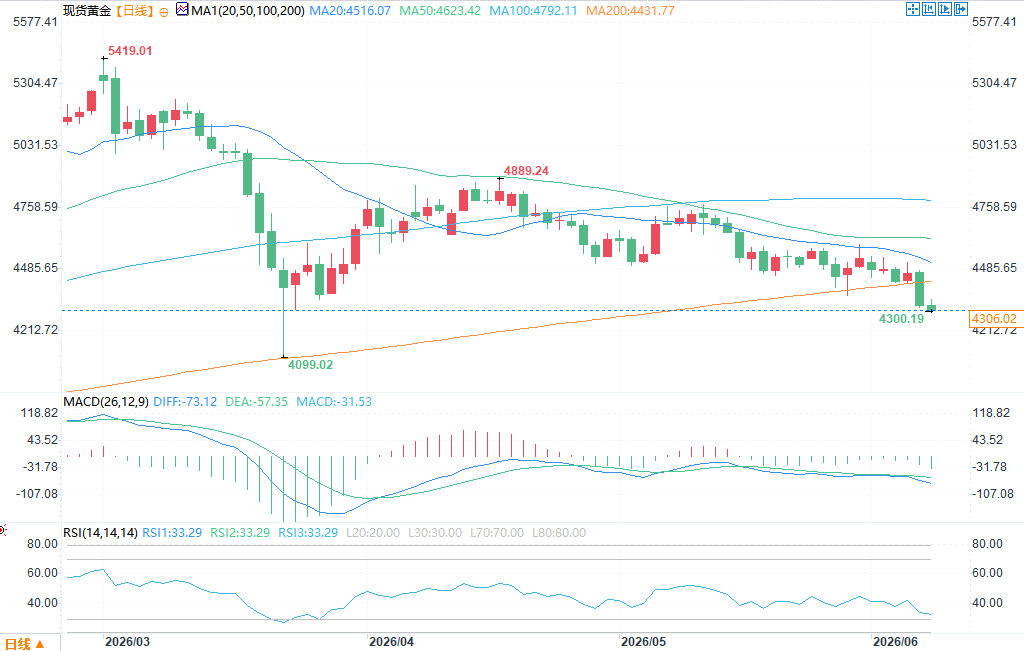
(Spot gold daily chart, source: FX678)
In terms of technical indicators, the MACD shows that the bearish momentum is still being released, with the DIFF line continuing to run below the DEA line and the green bars expanding, indicating that the downtrend has not yet shown a clear exhaustion signal; the RSI value is 33.29, which is close to the oversold threshold of 30, indicating that the short-term oversold condition is obvious and there is a possibility of a technical rebound, but a trend reversal signal has not yet been formed.
In summary, gold is currently in a state of "bearish dominance + short-term oversold." The price has now fallen below 4300, opening up further downside potential. A trend reversal still requires confirmation from signals such as a MACD golden cross and an RSI breakout above 50. Investors are advised to maintain flexible trading strategies before next week's CPI data release and pay attention to the weekly closing price for further guidance.
At 13:44 Beijing time on June 8, spot gold was trading at $4288.92 per ounce.
Despite the escalating tensions in the Middle East initially boosting safe-haven demand, stronger-than-expected US non-farm payroll data has shifted the Federal Reserve's interest rate expectations, leaving gold under continued selling pressure. Market focus is now shifting to next week's inflation data.
The ceasefire agreement is on the verge of collapse.
Tensions in the Middle East escalated sharply again early Monday morning local time. Israel launched airstrikes against military targets in western and central Iran in response to a previous Iranian missile attack. According to Iranian state media, loud explosions were heard in the capital Tehran, the northwestern city of Tabriz, and the central city of Isfahan. The explosions in Isfahan province, home to important Iranian nuclear facilities and military bases, have raised deep international concerns that the conflict could spread further to these facilities.
The Israeli airstrikes came just hours after Iran launched multiple missile attacks into Israel. Iran stated that the retaliatory action was a response to an earlier Israeli attack on the southern outskirts of Beirut, the Lebanese capital. The Israeli strike on Beirut's southern outskirts resulted in at least two deaths and more than ten injuries, further escalating the cross-border confrontation between Hezbollah and Israel.
As Israel and Iran become entangled in a cycle of "attacks and retaliations," the already precarious US-Iran ceasefire agreement faces the risk of complete collapse. The ongoing conflict since late February has disrupted shipping in the Strait of Hormuz, and this latest action by both sides directly targeting each other's territory marks a new and more dangerous phase in the Middle East situation.
Fundamental drivers: Interest rate expectations shift, CPI data becomes key.
Following the release of the non-farm payroll data, the market significantly repriced its expectations for Federal Reserve interest rates. Previously, the mainstream market expectation was that the Fed would maintain interest rates unchanged or even cut them this year, but the much stronger-than-expected 172,000 new non-farm jobs in May completely changed this assessment. Federal funds futures now indicate that the market expects a nearly 73% probability of at least a 25 basis point rate hike by the end of the year, compared to only around 45% a week ago. This dramatic shift reflects how a strong labor market is reshaping investors' perceptions of the monetary policy path.
Market focus has now shifted to this week's May CPI report. April's CPI unexpectedly rose 3.8% year-on-year, exceeding market expectations. Driven by the recent surge in energy prices, the market anticipates May inflation will accelerate further to 4.2%. If inflation data remains robust, it could further reinforce the recent hawkish shift in market pricing, even pushing the probability of an interest rate hike towards 80% or higher. Conversely, if inflation unexpectedly slows, it could partially offset the interest rate hike expectations brought about by the non-farm payroll data, providing breathing room for non-yielding assets such as gold.
Since the inflation side of the Federal Reserve's dual mandate is likely to determine the next policy move by new Chairman Kevin Warsh, gold will remain vulnerable as long as energy prices remain high. The continued closure of the Strait of Hormuz has pushed crude oil prices above $90, and rising energy costs are being passed on to end-consumer prices through gasoline, electricity, and transportation costs. Unless there is a substantial easing of tensions in the Middle East, energy prices are unlikely to fall significantly, meaning inflationary pressures will persist. Against this backdrop, the Federal Reserve is likely to be forced to maintain a hawkish stance, and gold, as a non-interest-bearing asset, will face continued holding cost pressures under the expectation of rising interest rates, making its short-term outlook unfavorable.
Institutional Views
JPMorgan Chase remains bullish on the medium-term outlook for gold, despite short-term weak demand leading to a downward revision of its 2026 average price forecast. In May, the bank lowered its 2026 average gold price forecast from $5,708/oz to $5,243/oz, primarily due to a temporary slump in both financial trading demand and physical gold allocation demand, which dragged down gold prices in the first half of the year. However, JPMorgan Chase explicitly maintains its year-end upside target, predicting that gold prices could climb to $6,000/oz by the end of 2026. The bank's analysts believe that the current downturn is temporary, and as macroeconomic uncertainties such as energy and inflation gradually dissipate, demand for gold will rebound.
Entering the second half of 2026, institutional investors' trading and allocation needs, along with the normalized gold purchases by global central banks, are expected to rebound simultaneously, providing a dual impetus for rising gold prices. JPMorgan Chase also predicts that the average gold price will rise further to $6,263 per ounce in 2027, believing that the current upward cycle in gold prices has not ended. Natasha Kaneva, head of commodities research at the bank, further pointed out that if the Strait of Hormuz reopens to traffic in June, the Federal Reserve is more likely to remain on hold, leading to a decline in real interest rates and a rise in gold prices, prompting central banks to resume gold purchases. She predicts that gold prices could reach $6,000 per ounce by the end of the year and rise to $6,300 per ounce by the end of 2027.
Goldman Sachs remains firmly bullish. In its latest research report, the bank maintained its bullish target of $5,400/ounce for gold by the end of 2026, clearly stating its structurally bullish outlook on the medium- to long-term trend of gold prices, while only taking a tactical cautious approach to short-term fluctuations.
Goldman Sachs' core bullish logic focuses on the inelastic demand for gold from global central banks. Data shows that global central bank gold purchases are expected to continue to rebound in 2026, with average monthly purchases potentially reaching 60 tons, a significant increase from previous averages. Goldman Sachs analysts stated that persistent global geopolitical uncertainty, the urgent need for central banks to diversify their asset allocation, and the steady progress of de-dollarization all contribute to the continued strengthening of gold's status as a core reserve asset. Long-term demand for gold continues to provide solid support for gold prices. Furthermore, the US is expected to cut interest rates twice more this year, further solidifying the medium-term outlook for gold.
Technical Analysis
Spot gold is currently in a medium-term downtrend channel on the daily chart. After falling from the March high of 5419.01 and undergoing two rounds of correction, it has now broken below 4300, indicating a clearly weak overall trend. The moving average system is in a typical bearish alignment, with the price having broken below the MA20, MA50, and MA100, and currently trading below the MA200 (approximately 4431.77). This moving average, along with the previous consolidation range, forms a strong short-term resistance zone, with resistance levels around 4516, 4623, and 4889.
(Spot gold daily chart, source: FX678)
In terms of technical indicators, the MACD shows that the bearish momentum is still being released, with the DIFF line continuing to run below the DEA line and the green bars expanding, indicating that the downtrend has not yet shown a clear exhaustion signal; the RSI value is 33.29, which is close to the oversold threshold of 30, indicating that the short-term oversold condition is obvious and there is a possibility of a technical rebound, but a trend reversal signal has not yet been formed.
In summary, gold is currently in a state of "bearish dominance + short-term oversold." The price has now fallen below 4300, opening up further downside potential. A trend reversal still requires confirmation from signals such as a MACD golden cross and an RSI breakout above 50. Investors are advised to maintain flexible trading strategies before next week's CPI data release and pay attention to the weekly closing price for further guidance.
At 13:44 Beijing time on June 8, spot gold was trading at $4288.92 per ounce.
- Risk Warning and Disclaimer
- The market involves risk, and trading may not be suitable for all investors. This article is for reference only and does not constitute personal investment advice, nor does it take into account certain users’ specific investment objectives, financial situation, or other needs. Any investment decisions made based on this information are at your own risk.