A much larger-than-expected drop in German factory orders weighed on the euro, causing it to fall sharply against the dollar.
2026-06-08 14:49:57
Data released in early European trading on Monday showed that German manufacturing demand was significantly weaker than market expectations, raising concerns about the prospects for the Eurozone's economic recovery. Data from the Federal Statistical Office of Germany showed that German factory orders fell 3.8% month-on-month in April, ending a previous period of improvement and significantly worse than the market expectation of a 1.2% decline. In contrast, March's data, after revision, showed a 4.5% increase, indicating that German manufacturing has slowed again after a brief period of improvement.

Year-on-year data shows that German factory orders rose 1.6% in April, lower than the revised 4.5% increase in the previous month, further reflecting a significant slowdown in the pace of expansion in manufacturing demand. Following the data release, the euro briefly fell slightly, continuing to trade near its monthly lows against the US dollar, hovering around 1.1520.
As the largest economy in the Eurozone, Germany has long been regarded as an important engine of European industrial growth, and its manufacturing performance is often seen by the market as an important indicator of the health of the Eurozone economy.
Factory order data primarily reflects the demand situation of enterprises' future production activities, including key indicators such as new orders, backlogs, and inventory changes. Generally, order growth suggests potential expansion in future production activity, while a decline in orders may indicate a weakening of the manufacturing sector. This data significantly missed expectations, indicating a decrease in the number of new orders received by German companies, suggesting that the global demand environment remains under pressure.
Market analysts believe that German manufacturing still faces multiple challenges. First, the slowdown in global economic growth is constraining European export demand. Second, relatively high corporate financing costs are impacting manufacturing investment. Furthermore, fluctuations in energy costs and uncertainties in international supply chains continue to affect business confidence. For the euro, weak German economic data may influence market expectations regarding the future policy path of the European Central Bank.
The European Central Bank (ECB) has recently maintained a relatively hawkish stance, and the market widely expects the ECB to continue focusing on inflationary pressures in the near future. However, if German and Eurozone economic data continue to weaken, the market may raise expectations again for a more dovish policy stance from the ECB. This means that interest rates may face downward pressure in the future, thereby weakening the attractiveness of euro-denominated assets. Meanwhile, recent strong US employment data has further strengthened the dollar's advantage.
Data shows that U.S. nonfarm payrolls increased by 172,000 in May, far exceeding market expectations of 85,000, while the unemployment rate remained at 4.3%. The strong job market performance has increased market expectations that the Federal Reserve will maintain its high-interest-rate policy. Against the backdrop of diverging monetary policy expectations between Europe and the U.S., the U.S. dollar index has remained strong, putting continued pressure on the euro.
From a capital flow perspective, the market currently favors allocating to higher-yielding dollar assets, while uncertainty surrounding the Eurozone's economic growth prospects limits the euro's upside potential. Furthermore, ongoing tensions in the Middle East are also driving safe-haven flows towards the dollar. This increased demand for safe-haven assets further enhances the dollar's attractiveness, resulting in a generally weaker euro-dollar exchange rate.
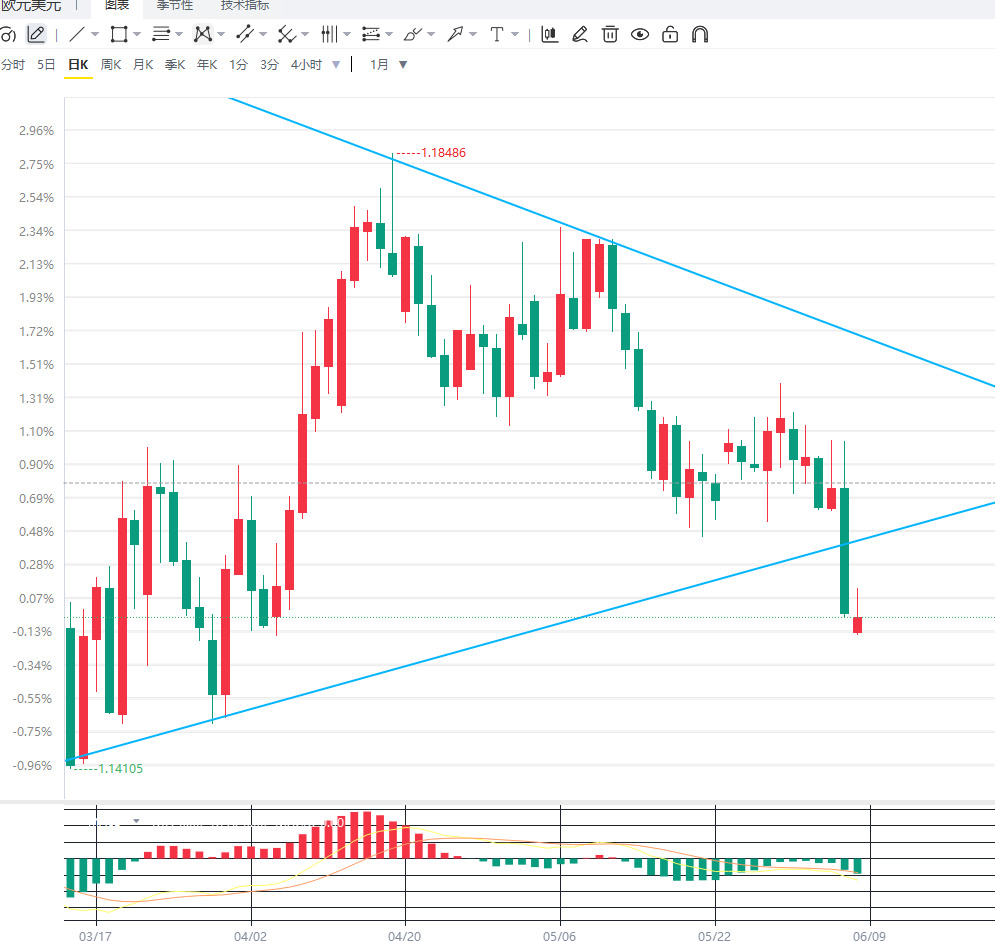
From a technical perspective, the EUR/USD daily chart maintains a consolidation and pullback structure. The exchange rate is currently trading around 1.1520, having fallen to near a one-month low. The 5-day and 10-day moving averages have formed a death cross, indicating that short-term bears are in control. The MACD indicator is near the zero line and continues to decline, with the green bars gradually widening, suggesting increasing downward momentum. The RSI indicator has fallen back to around 45, indicating that the exchange rate still has room for further correction.
From a key position perspective, the important support levels to watch are the 1.1480 and 1.1400 area. A break below these levels could lead to further testing of the support around 1.1320. Resistance is located in the 1.1600 and 1.1680 area. Only a sustained move above 1.1600 would allow the euro to resume its rebound.
From a 4-hour chart perspective, the exchange rate remains within a downward channel. Short-term moving averages are in a bearish alignment, and the MACD indicator is below the zero line, indicating a continued weak short-term trend. However, the RSI is approaching oversold territory, suggesting a potential technical rebound in the short term, but the overall upside is expected to be limited.
Editor's Summary : German factory orders data for April significantly missed expectations, further reflecting the slowdown in the recovery of German manufacturing. As the core of the Eurozone economy, the slowdown in German industrial demand has exacerbated market concerns about the prospects for European economic growth and increased speculation about future policy adjustments by the European Central Bank. Meanwhile, strong US economic data and a resurgence in safe-haven demand for the US dollar have further suppressed the euro's performance. In the short term, the euro/dollar exchange rate still faces some downward pressure. Going forward, the market will focus on subsequent German economic data, Eurozone inflation performance, and policy signals from the European Central Bank to determine whether the euro can escape its current weakness.
Year-on-year data shows that German factory orders rose 1.6% in April, lower than the revised 4.5% increase in the previous month, further reflecting a significant slowdown in the pace of expansion in manufacturing demand. Following the data release, the euro briefly fell slightly, continuing to trade near its monthly lows against the US dollar, hovering around 1.1520.
As the largest economy in the Eurozone, Germany has long been regarded as an important engine of European industrial growth, and its manufacturing performance is often seen by the market as an important indicator of the health of the Eurozone economy.
Factory order data primarily reflects the demand situation of enterprises' future production activities, including key indicators such as new orders, backlogs, and inventory changes. Generally, order growth suggests potential expansion in future production activity, while a decline in orders may indicate a weakening of the manufacturing sector. This data significantly missed expectations, indicating a decrease in the number of new orders received by German companies, suggesting that the global demand environment remains under pressure.
Market analysts believe that German manufacturing still faces multiple challenges. First, the slowdown in global economic growth is constraining European export demand. Second, relatively high corporate financing costs are impacting manufacturing investment. Furthermore, fluctuations in energy costs and uncertainties in international supply chains continue to affect business confidence. For the euro, weak German economic data may influence market expectations regarding the future policy path of the European Central Bank.
The European Central Bank (ECB) has recently maintained a relatively hawkish stance, and the market widely expects the ECB to continue focusing on inflationary pressures in the near future. However, if German and Eurozone economic data continue to weaken, the market may raise expectations again for a more dovish policy stance from the ECB. This means that interest rates may face downward pressure in the future, thereby weakening the attractiveness of euro-denominated assets. Meanwhile, recent strong US employment data has further strengthened the dollar's advantage.
Data shows that U.S. nonfarm payrolls increased by 172,000 in May, far exceeding market expectations of 85,000, while the unemployment rate remained at 4.3%. The strong job market performance has increased market expectations that the Federal Reserve will maintain its high-interest-rate policy. Against the backdrop of diverging monetary policy expectations between Europe and the U.S., the U.S. dollar index has remained strong, putting continued pressure on the euro.
From a capital flow perspective, the market currently favors allocating to higher-yielding dollar assets, while uncertainty surrounding the Eurozone's economic growth prospects limits the euro's upside potential. Furthermore, ongoing tensions in the Middle East are also driving safe-haven flows towards the dollar. This increased demand for safe-haven assets further enhances the dollar's attractiveness, resulting in a generally weaker euro-dollar exchange rate.
From a technical perspective, the EUR/USD daily chart maintains a consolidation and pullback structure. The exchange rate is currently trading around 1.1520, having fallen to near a one-month low. The 5-day and 10-day moving averages have formed a death cross, indicating that short-term bears are in control. The MACD indicator is near the zero line and continues to decline, with the green bars gradually widening, suggesting increasing downward momentum. The RSI indicator has fallen back to around 45, indicating that the exchange rate still has room for further correction.
From a key position perspective, the important support levels to watch are the 1.1480 and 1.1400 area. A break below these levels could lead to further testing of the support around 1.1320. Resistance is located in the 1.1600 and 1.1680 area. Only a sustained move above 1.1600 would allow the euro to resume its rebound.
From a 4-hour chart perspective, the exchange rate remains within a downward channel. Short-term moving averages are in a bearish alignment, and the MACD indicator is below the zero line, indicating a continued weak short-term trend. However, the RSI is approaching oversold territory, suggesting a potential technical rebound in the short term, but the overall upside is expected to be limited.
Editor's Summary : German factory orders data for April significantly missed expectations, further reflecting the slowdown in the recovery of German manufacturing. As the core of the Eurozone economy, the slowdown in German industrial demand has exacerbated market concerns about the prospects for European economic growth and increased speculation about future policy adjustments by the European Central Bank. Meanwhile, strong US economic data and a resurgence in safe-haven demand for the US dollar have further suppressed the euro's performance. In the short term, the euro/dollar exchange rate still faces some downward pressure. Going forward, the market will focus on subsequent German economic data, Eurozone inflation performance, and policy signals from the European Central Bank to determine whether the euro can escape its current weakness.
- Risk Warning and Disclaimer
- The market involves risk, and trading may not be suitable for all investors. This article is for reference only and does not constitute personal investment advice, nor does it take into account certain users’ specific investment objectives, financial situation, or other needs. Any investment decisions made based on this information are at your own risk.